Tag Archives: oil refinery explosions

“The Wellsville File”
Sinclair Oil: 1930s-1990s

In mid-July 1938, a spectacular fire and series of explosions at the Sinclair Oil refinery in Wellsville, New York killed three people and injured at least 75 others. The incident began on a Sunday afternoon, July 17th, and was officially extinguished two days later on Tuesday evening, July 19th, 1938. But over those three days, havoc ensued, as hundreds of firefighters came to battle the inferno. Dozens of storage tanks filled with various volatile mixtures burned and exploded throughout the fire, twisting and destroying refining equipment, resulting in millions of dollars in property damage, three deaths, and many injured.

One of the main explosions of a large tank – or a series of them – is captured during the July 1938 Sinclair Oil refinery fire at Wellsville, New York – a fire that burned for 3 days, killed 3 people & injured at least 75 others.

The fire had begun in the basement of one of the refinery’s processing plants, where a failure of a motor or pump touched off a blaze which later spread to small tanks and barrels of naphtha, which in turn began burning and exploding, spreading the fire throughout the complex. Electric power was soon lost at the refinery as well, and with that, the failure of pumping power to the steam pipe system which was then used for fire suppression. The fire at the Sinclair oil refinery, which had attracted spectators from around the area, was out of control for the next 24 hours or more.

The refinery disaster made national news, with stories by the Associated Press appearing throughout the country, some with photos, and some running on the front page, as shown below at left in The Lowell Sun of Massachusetts.
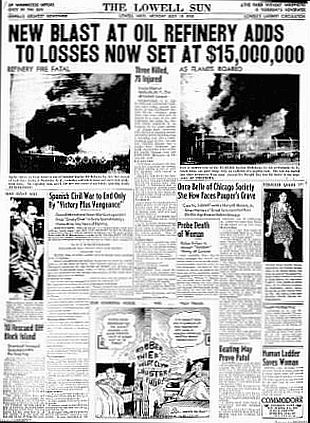
The Lowell Sun newspaper of Lowell, MA, ran a front page story on the Wellsville refinery fire: “New Blast At Oil Refinery Adds To Losses Now Set At $15,000,000.”
NYTimes story on the Sinclair Refinery blaze focuses on exploding giant storage tank that went airborne. More on that later below.

More detail on the Wellsville refinery disaster follows below. But first, some background on the region and the Sinclair Oil Company.


First Oil Boom

Welllsville, in SW New York on PA line, close to oil’s first discovery at Titusville in 1859.
The town of Wellsville is located in southwestern New York state, just north of the Pennsylvania line. Oil fever had come to the Wellsville area in the mid-to-late 1800s, as this town was located just north of the Pennsylvania oil region where the early oil industry was born with Edward Drake’s famous discovery of oil in 1859 at Titusville, Pennsylvania.

In addition to Wellsville, another nearby New York town, named “Petrolia,”was also part of the early oil boom, as oil was also discovered there, somewhat later, in 1879. The name “Petrolia” has also been used to define the larger New York / Pennsylvania oil region at that time. A recent book on the topic – Petrolia: The Landscape of America’s First Oil Boom, by Brian Black – recounts some of the history of the NY-PA region that became America’s largest oil producer between 1859 and 1873. That book also describes the region’s “descent into environmental hell,” as the boom played out during those years.

In any case, by 1901, an oil refinery had been built in Wellsville to process both local and Pennsylvania crude oil, and it operated then as the Wellsville Refining Co. for nearly 20 years By 1919, however, a larger oil company, Sinclair Refining Co., purchased the Wellsville refinery and would operate it there for the next several decades, into the 1950s.

A late 1920s-early-1930s postcard, with a painted rendering of the Wellsville refinery, shows the Sinclair operation in its rural setting of Allegany County in southwestern New York. The town of Wellsville itself was about a mile or so away.
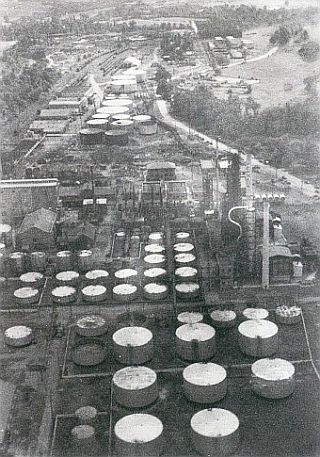


This mid-1930s aerial photo shows the layout of the Sinclair refinery at  Wellsville, with storage tanks, etc,.
This mid-1930s aerial photo shows the layout of the Sinclair refinery at Wellsville, with storage tanks, etc,.


Sinclair Oil

By the 1930s, under the ownership of Sinclair Oil, the Wellsville refinery was expanded and improved. The refinery grounds, plus ancillary areas, including a landfill for wastes, would grow to encompass about 100 total acres.

As shown in the photo at left, there would also be a number of storage tanks at the complex. A rail yard can also be faintly seen in the top left of the photo. The refinery site was also bordered in part by the Genessee River.

In any case, by the 1930s, the Wellsville refinery had become one of Sinclair’s largest refineries.

Sinclair Oil itself, had begun in 1901, as a Kansas pharmacist named, Harry Ford Sinclair, became engaged in trading oil leases, That work took him to the newly opened Oklahoma oil fields. By 1913 he would own more than sixty oil companies, most of which were then in Oklahoma. He later moved his business headquarters to New York City.

In 1916, he formed the Sinclair Oil and Refining Corporation, the same year he bought the Cudahy Refining Company of Chicago which itself owned several pipelines and refineries. So, by the time Sinclair bought the Wellsville refinery in 1919, Sinclair Oil was a well-known company.

A 1920s Sinclair Oils image.
By then, the automobile was coming on the scene. Ford Motor Co’s production of the Model-T, for example, had surpassed 1 million in 1921 and 1922. And by the end of the decade, over 15 million Model-Ts had been produced. Sinclair, had already been servicing this growing auto market, and by 1922, had opened the first modern service station in Chicago, offering oil changes and maintenance in addition to gasoline. In 1926, the company introduced a high-octane premium gasoline, demonstrating its early capabilities in fuel technology.

Sinclair, however, and its founder, Harry Sinclair, were not without scandal. In 1922, Sinclair was found to have received favorable treatment for a public land oil lease for is Mammoth Oil subsidiary at Teapot Dome, Wyoming (no competitive bidding) by Interior Secretary Albert Fall – in what became known as the “Teapot Dome” scandal. The scandal, which also involved another company on another lease, included illicit payments to Secretary Fall by Sinclair and another oil executive. The whole affair became a major scandal, with Congressional and Supreme Court drama through 1929, ending in Sinclair’s case, with a conviction for contempt of Congress and a six-month prison sentence for Mr. Sinclair, after which he resumed his business career.

Sinclair the company, meanwhile, through the Depression, continued acquiring oil companies. In 1932, Prairie Oil and Gas of the southern U.S., and Rio Grande Oil of California were added to Sinclair’s growing empire. By 1933 the company was the eighth largest oil company in America boasting the following assets: 14,000 miles of pipelines; 6,446 railroad tank cars; 100,000 tons of ocean tankers; nine deep-water terminals; 2,170 bulk plants; 8,100 service stations (company-owned or held under long-term lease); 21,000 other retail outlets, and 20,000 employees.

Sinclair’s famous green dinosaur mascot became wildly successful.
The Sinclair pitch: “Dinosaur-era” PA oil.

By 1930, Sinclair had also begun its retail advertising and national marketing strategy featuring what would become its famous green dinosaur. This campaign had a connection to Wellsville-refined Pennsylvania oil – described by Sinclair as “Pennsylvania-grade crudes” – those “laid down during the Mesozoic Era, when dinosaurs roamed the earth.” Sinclair’s campaign would feature a dozen different dinosaurs, and became a great success.
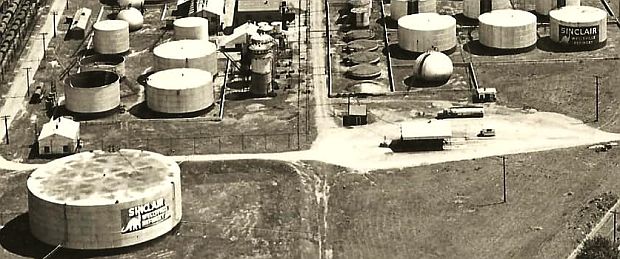
Photo from one end of the Sinclair oil refinery at Wellsville, NY showing two storage tanks there – one far left and another smaller tank far right –  painted with the company’s dinosaur logo, likely from the 1930s.
Photo from one end of the Sinclair oil refinery at Wellsville, NY showing two storage tanks there – one far left and another smaller tank far right – painted with the company’s dinosaur logo, likely from the 1930s.

And by 1932, one of the big dinosaur images – then known as the brontosaurus – became so popular that Sinclair registered its as a company trademark, soon to be seen throughout company literature, advertising, refinery storage tanks, and more. A gigantic Sinclair dinosaur-themed exhibit graced the 1933-1934 Chicago World’s Fair. That exhibit drew more than 24,000 people daily. In 1935, Sinclair issued a dinosaur stamp album and released accompanying dinosaur stamps weekly at its service stations. The first printing of albums sold out within 48 hours after a single network-radio broadcast of the offer. The dinosaur connection would prove to be a brilliant marketing ploy that would stay with the company for decades to this day.


…Back At The Fire

In July 1938, meanwhile, back at the Wellsville refinery fire, volunteer firefighters from surrounding towns, and across the state line from Pennsylvania, had come to fight the blaze. Before it was over, more than 200 volunteer firefighters from 20 towns would be involved in fighting the fire. One report filed by the Associated Press during the fire fight on July 18, 1938 noted that exploding tanks at the refinery were hampering the efforts of the firefighters. “Frequent rumbling explosions threatened new hours of terror tonight as the flame-swept $15,000,000 Sinclair Oil Refinery…,” said the AP story. Firefighters were especially on edge, given some 300 storage tanks of various sizes, containing various fluids, found throughout the refinery. Many of these were on fire. More than a dozen had already exploded in the early hours of the blaze.
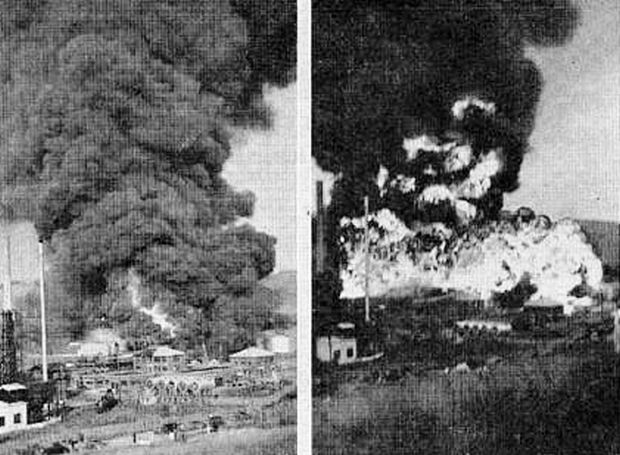
These two photos capture the fire and some explosions (2nd photo) at the Sinclair Oil Refinery at Wellsville, New York, July 1938.

“Anxious firemen, weary but still determined to quench the inferno worked near hot, bulging tanks with little heed for their own safety,” said the AP news report. “…Now and then,” the report continued, “the plates in a tank would begin to shift and swell perceptibly. An alarm would go out. Firemen would run pell-mell to safer quarters. Sometimes the tanks held. Several times they blew up with terrific force. About 16 tanks had exploded by a late hour today….”
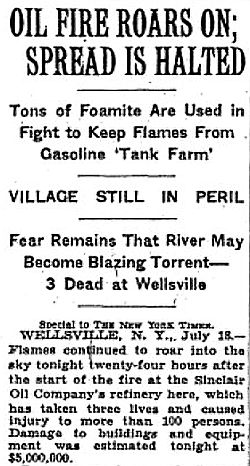
Part of a New York Times story, July 19, 1938.
One giant 50,000-barrel tank of highly inflammable naphtha caught fire, but a crew of 100 tired firemen, endangering their own lives, moved close enough to snuff out the fire with chemicals.

Other dangers at the site emerged as fires once put out, blazed up anew, as occurred in the ruins of the dewaxing plant and power house, then flaring very close to a naphtha plant, filled with high explosive chemicals.

With the continuing danger of exploding tanks, emergency calls wet out to Western New York and Pennsylvania for special fire-fighting equipment and chemicals. And later, special American LaFrance chemical fire trucks and more chemicals arrived via the Erie railroad. Still, Wellsville Fire Chief, Hollin Johnston estimated damage – including business, stock, and equipment losses — would amount to about $5,000,000.

At one point during the battle, firemen hastily constructed an earthen dam in the refinery to stop the advance of flaming liquids, as there was a fear of these flaming rivulets not only spreading within the refinery, but of masses of floating, flaming oil reaching the Genesee River and traveling downstream into Wellsville. Fortunately, the earthen dam held.

However, the most dramatic and lethal incident of the 1938 Sinclair refinery blaze at Wellsville was the giant storage tank that went airborne after catching fire.


Big Flying Tank

About two hours into the blaze, one of the refinery’s big tanks – one with a mixture of 2,500 barrels of lube oil and naphtha – started to burn. According to reports at the scene, “as this tank burned it made a low rumbling sound, then some hissing, as it was wrenched from its ground moorings as though it were a toy.” The huge 10-ton tank, filled with it fluids, was then explosively propelled into the sky and across the Genesee River, a distance of more than 500 feet – flying in the air in “a great fiery arc, dripping liquid flame” as it went.

Life magazine photo of “flying giant oil tank” from 1938 Sinclair Refinery explosion, with tank shown just before impact. Close inspection near the bottom of this photo will reveal very tiny figures on the hillside – spectators who had come there to see the fire that day, now running for their lives. Photo, W. H. Kresge.

The giant flaming tank landed on the opposite river bank, where a crowd of spectators had assembled to watch the blaze, believing they were at a safe distance. Upon landing, the flaming tank instantly killed three spectators, burning others. The hurtling, flaming tank was captured in two photos by a Life magazine photographer, one in mid-flight and another just before landing (see above).…The big tank flew across the river in “a great fiery arc, dripping liquid flame” as it went, landing near a crowd of spectators and killing 3…

The editors at Life magazine named the amazing photo of the flying storage tank fireball their “picture of the week,” and described how it was photographed as follows:

…Photographer W. H. Kresge stood on a hill in Wellsville, N.Y., on July 18 {1936], taking pictures of a million-dollar fire in the Sinclair Refining Co.’s plant. Between him and the refinery flowed the Geneses River. Spectators had gathered on the near bank. Suddenly from the plant came an earth-shaking explosion. Into the air rose a ten-ton steel tank, carrying 2,000 barrels of naphtha. The people started running. In the cloud of flame the tank cleared a low building, rocketed 1,000 ft, across the river and dropped among the crowd. Photographer Kresge caught it just before it landed. Killed were three people in the crowd, which you can see as little figures running for their lives.”

Back at the refinery blaze, hundreds of firemen continued to battle the inferno through Sunday night, with periodic tank explosions refreshing the blaze. There were about 300 storage tanks of various sizes at the refinery, each containing explosive liquids.

Early Monday morning, about 4 a.m, now in the second day of the blaze, one tank exploded and landed atop another tank. Firefighters redoubled their efforts again. By Tuesday morning, on the third day of the battle, the steam suppression system had been restored and the fire was then beginning to be brought under control. Minor explosions and flare ups continued, but the fire was mostly out by 6 pm that evening.
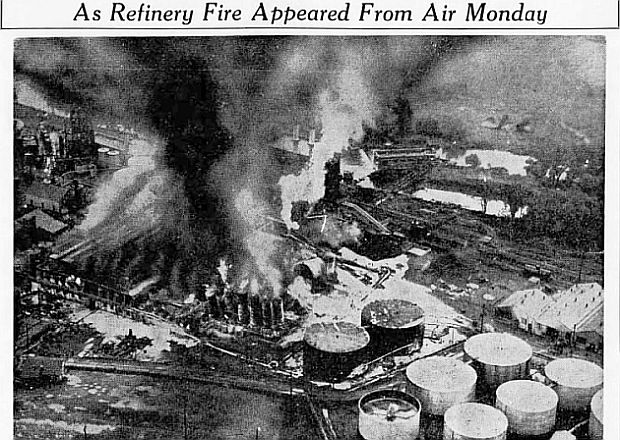
Front-page Associated Press aerial photo of Wellsville refinery fire still burning on Monday, July 18, 1938, as published by The Potter Enterprise (Coudersport, PA). Thursday, Jul 21, 1938 with headline, “As Refinery Fire Appeared From Air Monday.”

In the end, there was much destruction at the refinery, including 14 chilling towers, a dewaxing plant and a dozen big storage tanks – including the one that had been propelled across the Genessee River. Electric lines that ran near the refinery had also been knocked out for a time, leaving a number of small communities in the area, without power, including: Wellsville, Whitesville, Andover, Hallsport, Stannards, Lower Riverside, and West Wellsville.

In the cleanup afterwards, the tank that had blown across the river had embedded part of its gear works into the ground, and even tractors could not move the tank shell. Originally the 2,500-barrel-capacity tank had been 25 feet tall and 25 feet in diameter, weighing tons. The immovable tank shell on the river bank was then cut into halves with an acetylene torch and pulled apart by a bulldozer. It was then that the third body of one of the spectators was found, pressed into the earth.
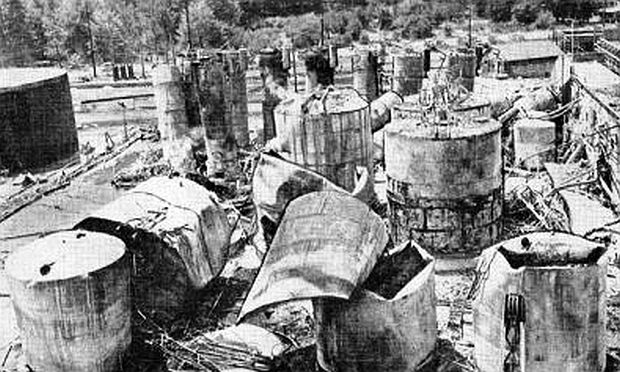
Photograph of the aftermath of the July 1938 fire at the Sinclair oil refinery at Wellsville, NY showing a collection of various refinery tanks scarred and damaged from the blaze, some crumpled and ripped apart.

While the 1938 fire was a significant event causing major damage and loss of life, the available information surveyed so far at this writing does not indicate whether an investigation was held into the Sinclair accident, or if any corrective actions, safety recommendations, penalties, and/or law-suits/reparations resulted given the personal injuries and loss of life that had occurred.

Following the 1938 fire, the Wellsville refinery was rebuilt by Sinclair and reportedly “played a significant role during World War II” and would continue to operate for the next 20 years. However, as regional oil supplies dwindled in later years, the refinery struggled economically.
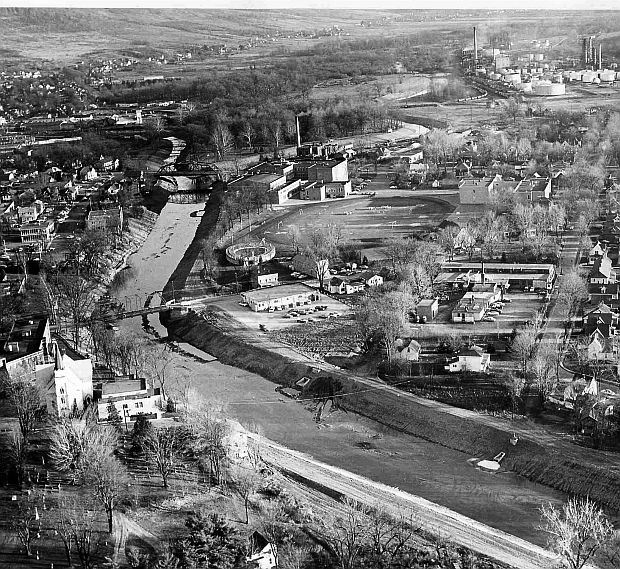
This 1950s aerial photo shows the town of Wellsville, NY and the Genesee River in the foreground, and also in the distance, upper right, the Sinclair Oil Refinery, then still operating.

In February 1958, a second significant fire took out a vital cracking unit, dealing a final blow to the refinery. That fire also drew spectators from the area, and occurred during a snow storm. The in-house Sinclair Refinery fire crew battled the blaze and eventually put it out. The refinery thereafter was shut down, and by April 1958, was formally closed by Sinclair. At the time, it was Sinclair’s smallest refinery, then processing 3,500 barrels of Pennsylvania crude per day.

In 1969, Sinclair Refining merged with the Atlantic-Richfield Company (ARCO), and ARCO thereafter became a “responsible party” for some subsequent clean up at the Wellsville refinery site (more on this below). In April 2000, BP Amoco (now BP) acquired ARCO for $26.8 billion, then becoming responsible for the site thereafter. Today, parts of the site have been repurposed, as a branch campus of Alfred State College now occupies some of the site.

BP placed this explanatory historic marker on the former site of the Sinclair Oil Refinery at Wellsville, NY,  in the early 2000s, some years after much of the site clean-up had occurred there, as described below.
BP placed this explanatory historic marker on the former site of the Sinclair Oil Refinery at Wellsville, NY, in the early 2000s, some years after much of the site clean-up had occurred there, as described below.


Toxic Aftermath

Wastes & Pollution

During the operating history of the Wellsville refinery – over nearly 60 years – the grounds and surrounding environment there, including the town of Wellsville, took a measure of abuse.

EPA found that tetraethyl lead sludge generated in the refining process was temporarily buried in pits within the refinery area.EPA would later investigate and report on its findings at the 100-acre site, revealing quite a compendium of toxic wastes at the site and its adjacent ten-acre landfill. During Sinclair’s refinery operations at Wellsville, and before,EPA found that tetraethyl lead sludge generated in the refining process was temporarily buried in pits within the refinery area. The sludge was then oxidized or burned, causing the creation of lead oxide. The burned sludges were eventually reburied within an adjacent landfill located along the southernmost portion of the site. Other wastes generated during the course of the refinery operations included tank sludges from a solvent plant, sludges from an oil separator, acids, pesticides, waste oil and heavy metals. While these wastes were primarily disposed of at the landfill, manufacturing and waste handling operations at the time also led to contamination of refinery surface soils, subsurface soils, and groundwater.

Although the dump had been closed since 1958, and the refinery shut down in 1963, waste sludges and spilled petroleum had been seeping into groundwater at the refinery site and also into the Genesee River from the landfill. The river was used as a source of drinking water by the town of Wellsville, located 1.25 miles from the site. The Genesee also had changed course somewhat over the years, and had begun eating into the landfill area. Polluted groundwater in the refinery area indicated three distinct and underground plumes in the shallow aquifer.Effects upon fish, waterfowl, and mammals were determined by the US Fish and Wildlife Service to have been significant into the early 1980s, if not beyond.

Volatile and semi-volatile organic compounds and metals were identified in the refinery area. Sampling and analysis indicated the presence of arsenic and lead in surface soils at action levels, and at much lower levels in subsurface soils. Polluted groundwater in the refinery area indicated three distinct and underground plumes in the shallow aquifer – “northern,” “central” and “southern.” These plumes included levels of benzene, toluene, ethylbenzene, xylene, nitrobenzene, naphthalene, arsenic, chromium and lead above action levels selected for the site.

At the refinery’s 10-acre landfill site over the years, a number of wastes were deposited, including: cloth filters used for straining oil; sludges from an oil/water separator; tank sludges from the solvent plant; “off-specification” products; oil-soaked soils and sludges (deposited daily); burnt Fullers Earth (used for filtering); tank sludges (deposited weekly); acid spills; cinders and ash from the coal-fired boiler plant; tetraethyl lead; pesticides; waste oil; and heavy metals.

A 1981 site inspection revealed that debris from the eroding landfill area has washed into and contaminated the Genesee River, and EPA later detected “oily material” entering the water intake of the town’s water treatment plant. In 1983, ARCO – EPA later detected “oily material” entering the water intake of the town’s [Wellsville’s] water treatment plant. which had earlier acquired Sinclair, thereby becoming the site’s responsible party – removed about 10 drums of waste material from the Genesee River that had entered the river from flooding of the landfill.

Reports from the community and site inspections conducted by the New York State Department of Environ-mental Conservation (DEC) indicated that the site warranted inclusion on the National Priorities List (NPL) of toxic sites, also known as Superfund. In 1983 the refinery site was declared a Superfund site by EPA. Atlantic Richfield (ARCO), which had acquired Sinclair in 1969?, was then designated the “potential responsible party” for the refinery pollution.

In 1985, EPA authorized an initial remedial measure at the site, consisting of the relocation of the surface water intake for the Village of Wellsville’s public water supply. The intake was moved to a location some distance upstream from the site in order to eliminate the possibility of landfill wastes contaminating the Village’s drinking water supply.In 1983 the Sinclair refinery site was declared a Superfund site by EPA and placed on the National Priorities List (NPL) of toxic sites. The relocation of the new water intake was completed in the Spring of 1988. According to one report, ARCO paid $3.3 million for Wellsville to relocate its water supply

In the early 1990s, EPA accepted a proposed $15.5 million ARCO plan to focus on the clean-up of the refinery site. By 1994, the surface soils at the main refinery site were excavated and replaced and revegetation followed. Ongoing at the time as well was pumping and treatment of contaminated site groundwater, plus monitoring of surface water, groundwater, and soil gas to track potential contaminant migration from subsurface soils. There was also separate work on the landfill portion of the site. In 1992, a partial rechannelization of the Genesee River was completed to protect the landfill from erosion and flooding. At this time, drum removal, excavation, consolidation, and backfilling of the landfill area was also completed. By 1994, the capping and fencing of the landfill was finished.

Since 1997, the EPA has conducted and publicly reported “five-year-reviews” on the Wellsville site cleanup and status to ensure that implemented remedies protect public health and the environment and that they continue function as intended. While the remediation work at the site was essentially completed in 2010, the EPA and DEC continue periodic sampling and maintenance at the site. One of the most recent “five year reviews” was issued in 2017.


The Fossil Legacy

The “Wellsville file” offers one case study of a portion of the fossil fuel industry’s performance and impact over a 100-year period – from oil boom through toxic clean-up. In the U.S. alone, there are hundreds, if not thousands, of other cases of fossil-fuel-related performance history – history that tells of the industry’s reckless and often wasteful discovery phase, through its considerable, and yes, decades-long beneficial economic contributions (jobs, growth, wealth, invention, etc), as well as the worker risks, community dangers, and environmental impacts that came during those same periods of prosperity.

Whether abandoned oil and gas wells, pipeline leaks, refinery fires and pollution, tank farm contamination, gas station leaks, tanker truck accidents, offshore pollution, shipping spills, etc, the fossil fuel legacy of social and environmental costs – not even considering climate change – offers a considerable ledger of damages. To this day, the industry’s “routine” and operational impacts continue. And while some of these “externalities,” as economists call them, have been contained through regulation and improved technology, the net result has not been a clean or inherently safe fossil fuels industry. As a consequence, societies across the globe continue to absorb these costs, with ongoing risks to workers, the environment, and public health and safety. The alternative, of course, is the need to adopt clean and safe energy sources – a prospect that appears only possible if pushed by unyielding public demand.

For additional stories at this website on the performance history of the oil and petrochemical industries, see the “Oil & Petrochemical History” topics page with a dozen or more story choices.

Thanks for visiting – and if you like what you find here, please make a donation to help support the research, writing, and continued publication of this website. Thank you. – Jack Doyle

Please Support
this Website

Donate Now

Thank You

____________________________________

Date Posted: July 27, 2024
Last Update: July 27, 2024

Comments to:+ jackdoyle47@gmail.com
Twitter: https://twitter.com/PopHistoryDig
BlueSky: jackdoyle.bsky.social

Article Citation:
Jack Doyle, “The Wellsville File, Sinclair Oil:
1930s-1990s,”PopHistoryDig.com, July 27, 2024.

____________________________________


Oil-Related History at Amazon.com
 

Brian Black’s book, “Petrolia: The Landscape of America's First Oil Boom,” Johns Hopkins Univ. Press, June 2000, Click for Amazon.
Upton Sinclair’s classic 1927 novel, “Oil!” includes Teapot Dome scandal & became basis for 2007 film, “There Will Be Blood.” Click for Amazon.
Ron Chernow’s 2004 best-seller, “Titan: The Life of John D. Rockefeller,” 832 pp, Vintage Paperback. Click for Amazon.


Sources, Links & Additional Information
Abridged version of Ida Tarbell’s classic profile of J.D. Rockefeller’s Standard Oil Co., “The History of the Standard Oil Company,” 272 pp.  Click for Amazon.
Abridged version of Ida Tarbell’s classic profile of J.D. Rockefeller’s Standard Oil Co., “The History of the Standard Oil Company,” 272 pp. Click for Amazon.
John T. Arnold & Craig E. Colten (ed), “A Thousand Ways Denied: The Environmental Legacy of Oil in Louisiana ,” 2020,  LSU Press, 282 pp. Click for Amazon.
John T. Arnold & Craig E. Colten (ed), “A Thousand Ways Denied: The Environmental Legacy of Oil in Louisiana ,” 2020, LSU Press, 282 pp. Click for Amazon.
2017 book: “One Minute After Sunrise: The Story of the Standard Oil Refinery Fire of 1955,” 246 pp. Click for copy.
2008 book: “Failure to Learn: The BP Texas City Disaster,” 200pp. Click for copy.
“Early Days of Oil: A Pictorial History of the Beginnings of the Industry in Pennsylvania,” by Paul H. Giddens, 1st edition, 1948, Princeton University Press. Click for book.

“Costly Fire Sweeps Great Oil Refinery; Four Men Are Killed and Scores Injured as Storage Tanks Explode And Shower Flames,” Madera Tribune, Number 65, 18 July 1938, p. 1.

“Exploding Oil Tank Leaps River, Kills 4; Falls Into Crowd Watching Fire at Sinclair Wellsville Plant,” New York Times, July 18, 1938, p. 1.

Wellsville, New York, Volunteer Fire Co., “Sinclair Refinery Fire Booklet,” July 17, 18, 19, 1938.”

Associated Press, “New Blast Spreads Havoc in Oil Fire,” San Pedro News Pilot (CA), Volume 11, Number 113, 18 July 1938.

Wellsville, N.Y., July 18 (Associated Press), “Exploding Tanks Hamper Firemen,” The Arizona Republican (Phoenix, Arizona), Tuesday, July 19, 1938.

“Oil Fire Roars On; Spread Is Halted. Tons of Foamite Are Used in Fight to Keep Flames from Gasoline ‘Tank Farm’. Village Still in Peril; Fear Remains That River May Become Blazing Torrent; 3 Dead at Wellsville; Full Doom Seemed Certain,” New York Times, July 19, 1938, p. 38.

Associated Press, aerial photo of Wellsville refinery fire still burning on Monday, July 18, 1938, as published by The Potter Enterprise (Coudersport, PA). Thursday, Jul 21, 1938 with headline, “As Refinery Fire Appeared From Air Monday.”

“Tank at Refinery Fire Drops Death on Three, Sinclair Refining, Wellsville, New York,” Life, August 1, 1938.

“Sinclair Refinery, Wellsville NY” (commentary with postcard, Tichenor Bros. Inc, circa 1927-1938), OpenValley.org, Ken Cooper, contributor.

“Sinclair Oil and Refining Corporation,” The Encyclopedia of Oklahoma History and Culture, OKhistory.org.

“1938 Sinclair Fire Wellsville NY, by Allen Corwin and the Wellsville NY Historical Society,” YouTube.com, Posted by Thelma Rogers G&H Society, (short film [5:18 minutes] of the 1938 Sinclair Fire as photographed by Volunteer Firefighter Allen Corwin and donated to the Thelma Rogers Genealogical and Historical Society by his grandson, Allen Corwin Jr.), January 12, 2015.

“Sinclair Cracking Still Is Struck by Fire Due to Failure of Line; Crew of Five Escapes Without Injury; Big Crowd is Drawn to Scene,” Wellsville Daily Reporter, February 10, 1958, p. 4.

“Sinclair to Close Refinery,” New York Times, April 11, 1958, p. 32.

Phil Shabecoff, “45 Toxic Waste Sites Listed as Health Risks,” New York Times, July 24, 1982, p. 8.

US Fish and Wildlife Service, “Pre-assessment Screen and Determination for the Sinclair Refinery Superfund Site in Allegany County, New York,” May 2015.

Superfund Site: Sinclair Refinery Wellsville, NY, Site Documents & Data, EPA.gov.

U.S. Environmental Protection Agency, Hazardous Waste Sites: Descriptions on Current National Priorities List, October 1984, HW 8.5, Washington, D.C., December 1984.

SMC Martin Inc., Valley Forge, PA, “Feasibility Study for Sinclair Landfill Site, Wellsville, New York (Draft), Volume 2 of 2: Appendices, Prepared For: New York State Department of Environmental Conservation, 1985, 204 pp.

U.S. Environmental Protection Agency, “More Work On Sinclair Oil Superfund Site In Allegheny County, New York To Start At End Of Month,” EPA News, October 19, 1990.

“EPA Proposes $15.5 Million Clean-Up Remedy For Superfund Site In Wellsville,” EPA News, October 1, 1991.

“Sinclair Refinery; S. Brooklyn Ave,” Toxic Sites.us.

Local History, “Toppling Sinclair Stack Marks the End of an Era; Industry That Once Employed Hundreds and Kept the Great Depression at Bay Is Now Only a Memory,” Patriot and Free Press (Cuba, NY), November 3-9, 1993 (New York State Digital Library – Fulton History).

“Sinclair Fire 1938 – Paddock Collection,” Allegany County Historical Society, Allegany History.org.

U.S. Environmental Protection Agency (EPA), Region 2, New York, NY, “Five-Year Review Report Sinclair Refinery Site, Wellsville, New York,” September 39, 1997.

U.S. EPA, Region 2, New York, NY, “Five-Year Review Report, Sinclair Refinery Site, Village and Town of Wellsville, Allegany County, New York,” September 2007

U.S. EPA, Region 2, New York, NY, “Fourth Five-year Review Report for Sinclair Refinery Superfund Site, Allegany County, New York,” September 12, 2012, 44pp. (PDF).

U.S. EPA, Community Update EPA Completes Work At The Sinclair Refinery Site in Wellsville, NY,” DEC.NY.gov, December 2012.

Ilena Peng and Jessie Blaeser, “New York’s Once-Booming Oil Industry and the Risky Wells it Left Behind,” CityandStateNY.com, May 9, 2022.

Kathryn Ross, VP, Thelma Rogers Genealogical and Historical Society, “Wellsville’s Dinosaur, How the Sinclair Refinery Impacted the World” (re: historical program open to the public), Wellsville Sun, April 3, 2023.

Allen Kerkeslager, “Triple Divide Trail System Strategic Plan,” Genesee River Wilds Project, GeneseeRiverWilds.org, Belmont, NY, 2011.

Bureau of Labor Statistics, U.S. Department of Labor, “Wage Chronology: 1941- 77 Atlantic Richfield and the Oil Workers (Former Sinclair Oil Facilities),” 1976, Bulletin 1915, 46 pp.

Alison Laurence, “Afterlives of Extinction: The Politics of Display in the Modem United States,” Submitted to the Program in Science, Technology, and Society on June 14, 2019 in Partial Fulfillment of the Requirements for the Degree of Doctor of Philosophy in History, Anthropology, and Science, Technology and Society, Massachusetts Institute of Tech-nology, September 2019, 293 pp.


________________________________


Oil/Petrochem Books at Amazon.com
 

Stephen McGinty’s 2008 book, “Fire in the Night: The Piper Alpha Disaster,” Macmillan, Click for Amazon.
Steve Coll’s book, “Private Empire: ExxonMobil and American Power,” Penguin Books. 2013. Click for copy.
Christopher Leonard’s 2019 book, “Kochland: The Secret History of Koch Industries...” Click for copy.


“125 Significant Incidents”
U.S. Refineries, 2012

On August 6th, 2012, a major explosion and fire occurred at the Chevron oil refinery in Richmond, California. It was one of 124 other “significant” U.S. oil refinery incidents that occurred that year, according to the U.S. Chemical Safety and Hazard Investigation Board, commonly known as the Chemical Safety Board, or CSB. In the Chevron case, a pipe in one of the refinery’s crude oil processing units had ruptured and released flammable hydrocarbon fluids, some of which formed a large vapor cloud. That cloud, surrounding 19 Chevron employees then at the scene, soon found an ignition source causing a massive explosion. Amazingly, all 19 employees escaped, narrowly avoiding serious injury or death. However, the ignition of the vapor cloud, and the subsequent burning of the hydrocarbon fluid, resulted in a major refinery fire (photo below). A large plume of particulates and vapor from the incident traveled off site and through the Richmond community. Approximately 15,000 people from the surrounding area sought medical treatment due to the release.

Photo of the raging inferno at the Chevron oil refinery in Richmond, California, August 2012. Note group of firefighters at bottom of photo for scale comparison. Photo from CSB’s subsequent 2014 report.

An investigation of the Chevron refinery incident by the CSB, found that the ruptured pipeline had failed due to corrosion, and that Chevron, over a ten-year period, had failed to effectively apply safer design principles and upgrade the piping in its crude oil processing unit. The CSB also prepared an animated video, available on line, detailing and explaining the incident.

The CSB is an independent U.S. federal agency charged with investigating industrial chemical accidents. Headquartered in Washington, D.C., the agency’s board members are appointed by the president and confirmed by the U. S. Senate. The CSB conducts investigations of accidents in the oil and petrochemical sectors and reports to the public about those incidents, offering analysis of the causes, making recommendations for corrective action and regulatory improvements. Since its creation in 1998, the CSB has consistently turned out reports known for their thoroughness and high quality. In recent years, the agency has also produced excellent video material that cover the details and causes of the accidents it investigates. See their website, CSB.gov, for more information.


2012 Incidents List

The CSB report on the Chevron refinery explosion & fire included the “125 significant incidents” list. Click for PDF.
Included in the CSB’s May 2014 report on the Chevron accident, the cover of which is shown at left, was the CSB’s continuing concern about the high frequency of incidents at U.S. oil refineries – i.e., fires, explosions, chemical releases, worker injuries, etc.,. As an example of this concern, the CSB saw fit to call out the industry on the worrisome trend by publicly listing in their 2014 report, the 125 “significant oil refinery incidents” that had occurred during the 2012 calendar year. The incidents were listed by refinery and location in a separate “Appendix A.” Noted the CSB on this listing:

“These incidents were reported to the Department of Energy and/or the National Response Center and examined by the CSB’s Incident Screening Department. The CSB believes that incidents that result in disruptions to the national energy supply, serious injuries, or receive high media attention are all significant.”

What follows below is the same CSB listing of U.S. oil refinery incidents, large and small, that occurred in calendar year 2012. This listing, however, is offered here in a somewhat different format, although including the short CSB notations used for each incident. This listing is offered separately simply to help give the issue of oil and petrochemical dangers broader public exposure, and to help educate the public about the history and frequency of these incidents, their locations, and their continuing occurrence.

The photos, graphics and other illustrations that appear in the right-hand column of the listing below are provided by the PopHistoryDig.com, primarily as visual aides. They are not necessarily those of the listed 2012 incidents, though some are, as their captions will explain. Others are from earlier and/or later incidents that have occurred at or near some of the same refineries cited; and others are simply generic industry photos used for illustration purposes, along with other related books, reports, maps and/or other graphics. The visuals are included here as additional information that may be of value for public education purposes.

_________________________________________


U.S. Refinery Incidents, 2012
CSB List w/CSB Annotations & Additional Information


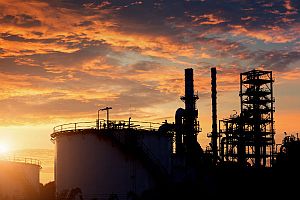
Generic photo of storage tank/oil refinery scene.
2005 file photo of oil refinery and tank farms at Wood River/Roxana, Illinois. Photo, St. Louis Post-Dispatch.
Previous incident - Feb 18, 2008 – explosion & fire at Alon Refinery, Big Spring, TX. EPA photo.
2013 photo - Tesoro tank farm, Utah.
Later incident; April 26, 2018, at Husky Energy refinery,  Superior, WI.   Bob King | Duluth News Tribune.
Later incident; April 26, 2018, at Husky Energy refinery, Superior, WI. Bob King | Duluth News Tribune.
Feb 17, 2012. Firefighters battle blaze at BP’s Cherry Point, WA refinery. AP/Bellingham Herald, P. Dwyer.
Feb 23, 2012. Tank failure (center) at PBF Energy refinery, Paulsboro, NJ. Photo, Sky Truth.
March 2018. Massive flare at ExxonMobil refinery, Chalmette, LA. Flares are used for refinery safety, but also pollute.
August 2007. Earlier  fire at Chevron’s Pascagoula, MS. refinery. Photo, Christy Pritchett, Press-Register.
August 2007. Earlier fire at Chevron’s Pascagoula, MS. refinery. Photo, Christy Pritchett, Press-Register.
2012. “East Bay Times” map shows ConocoPhillips refinery at Rodeo, CA & 4 others in San Francisco area.
Andrew Higgins 2008 book on the earlier 2005 BP Texas City refinery explosion that killed 15 workers and injured another 180. Click for copy at Amazon.com.
Portion of the grounds at Sinclair Oil refinery in Sinclair, Wyoming, where workers were burned/injured in successive fires, 4 injured on May 8 and 2 on May 28, 2012.
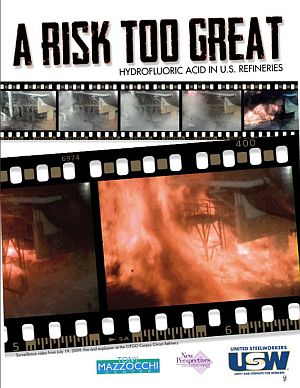
2013 United Steelworkers' report, “A Risk Too Great: Hydro-fluoric Acid in U.S. Refineries,” cover w/ film strips of  2009 incident at Citgo’s Corpus Christi, TX refinery. Click for PDF.
2013 United Steelworkers' report, “A Risk Too Great: Hydro-fluoric Acid in U.S. Refineries,” cover w/ film strips of 2009 incident at Citgo’s Corpus Christi, TX refinery. Click for PDF.
February 2019. PBF Energy’s Delaware City, DE refinery during a later fire at the complex.
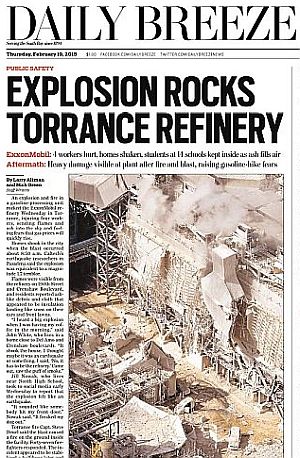
ExxonMobil had a June 2012 fire at its Torrance, CA refinery, plus prior & later incidents, including this 2015 explosion that led to ExxonMobil selling the refinery.
CSB report on earlier 2007 LPG fire at the Valero Refinery in McKee, TX, injuring 4, causing a refinery evacuation & extended shutdown. Click for copy.
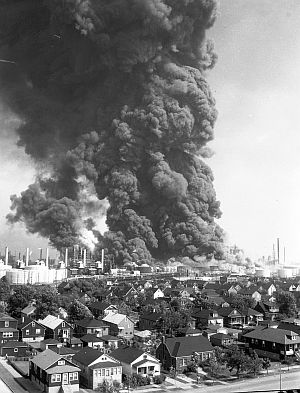
1955. Oil refinery at Whiting, IN, near Chicago, has a long history of incidents, here showing proximity of residential area near refinery during Aug 1955 explosion & fire that burned for 8 days. Click for separate story.
August 2012. Map showing Holly Oil Refinery area at Woods Cross, UT (green) and impacted area (red) of oil spray released from storage tank.
2019. Later WXYZ-TV 6 news report of oil vapor leak from Marathon oil refinery in Detroit, MI.
File photo. Aerial view of the Placid Refinery at Port Allen, LA, on the west bank of the Mississippi River, where a hydrogen fluoride releases occurred, Oct 1, 2012.
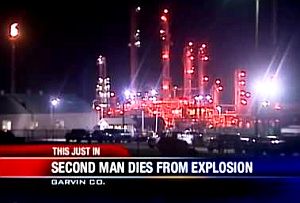
Sept 2012. TV news reporting on second death of worker at CVR Energy refinery at Wynnewood, Oklahoma.
Chicago Tribune file photo of a portion of ExxonMobil refinery at Joliet, IL – where on Oct 19, 2012, oil and gasoline spewed into the air and neighboring area for a half hour or more, shutting down one highway.
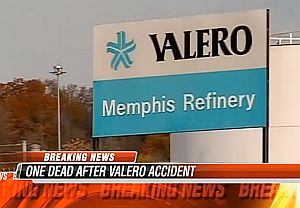
Dec 2012. Local TV news screenshot of early reporting on worker death at Valero Refinery, Memphis, TN.
2014. Large storage tank at ExxonMobil refinery with painted message: “ExxonMobil and Baton Rouge - Growing Together, Working Together.” Click for Exxon-Mobil story. Photo, Monique Verdin, Louisiana Weekly / Louisiana Bucket Brigade.
7 Dec 2021. Later flaring at Shell Deer Park, TX plant, near Houston. Flares are used to burn off chemicals to relieve pressure, sometimes caused by power outages. But flares also release hydrocarbon pollution.
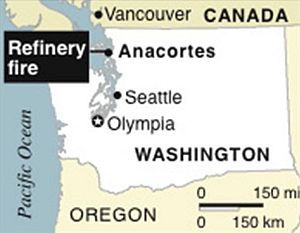
Map showing location of oil refinery at Anacortes, WA where a Shell Oil refinery in 2007 had a storage tank fire that injured three. In 2012, Shell was listed by CSB for hydrocarbon emissions at that location.

January 11, 2012
ExxonMobil Refinery
Beaumont, TX / “tank failure”

January 22, 2012
Flint Hills Refinery
St. Paul, MN / “vessel pressure excursion”

January 26, 2012
No. Tier Energy Refinery
St. Paul, MN / “hydrogen sulfide release
from mechanical integrity failure”

January 27, 2012
ConocoPhillips Refinery
Wood River, IL / “sulfuric acid release
from mechanical integrity failure”

January 31, 2012
Marathon Refinery
Garyville, LA / “hydrogen sulfide release
from mechanical integrity failure”

January 31, 2012
Flint Hills Refinery
Corpus Christi, TX / “hydrocarbon & hydrogen
fluoride release…mechanical integrity failure”

February 1, 2012
Alon Refinery
Big Spring, TX / “sulfur dioxide and hydrogen
sulfide release… vessel pressure excursion”

February 1, 2012
ConocoPhillips Refinery
Belle Chasse, LA / “hydrocarbon release
from a vessel pressure excursion.”

February 16, 2012
Husky Energy Refinery
Lima, OH / “benzene release from
a mechanical integrity failure”

February 17, 2012
Tesoro Refinery
Salt Lake City, UT / “refinery fire”

February 17, 2012
BP Refinery
Cherry Point, WA / “refinery fire”

February 22, 2012
Shell Refinery
Deer Park, TX / “tank failure”

February 23, 2012
Paulsboro Refinery (PBF Energy)
Paulsboro, NJ / “tank failure”

February 24, 2012
Citgo Refinery
Corpus Christi, TX / “refinery fire”

February 28, 2012
Flint Hills Refinery
Rosemount, MN / “hydrogen sulfide release
from a mechanical integrity failure”

February 28, 2012
Motiva Refinery
St. Charles, LA / “vessel pressure excursion”

February 28, 2012
Chalmette Refinery (ExxonMobil)
Chalmette, LA / “benzene release from
a mechanical integrity failure”

March 4, 2012
Flint Hills Refinery
North Pole, AK / “crude oil release
from a mechanical integrity failure”

March 6, 2012
Citgo Refinery
Corpus Christi, TX / “hydrogen fluoride
release…mechanical integrity failure”

March 6, 2012
Valero Refinery
Memphis, TN / “worker fatally injured,
and 2 other workers burned”

March 7, 2012
Tesoro Refinery
Martinez, CA /
“fire during a hot work activity”

March 8, 2012
Chevron Refinery
Pascagoula, MS / “benzene release from
a mechanical integrity failure”

March 13, 2012
Chevron Refinery
Pascagoula, MS / “heavy oil release
from a mechanical integrity failure”

March 14, 2012
Marathon Refinery
Texas City, TX / “benzene release from
a mechanical integrity failure”

March 16, 2012
PBF Energy Refinery
Delaware City, DE / “refinery fire”

March 19, 2012
Chevron Refinery
Pascagoula, MS / “hydrocarbon release
from a mechanical integrity failure”

March 23, 2012
Tesoro Refinery
Anacortes, WA / “hydrocarbon release
from a mechanical integrity failure”

March 24, 2012
ExxonMobil Refinery
Baytown, TX / “hydrocarbon release
from a mechanical integrity failure”

March 25, 2012
ExxonMobil Refinery
Billings, MT / “refinery fire”

March 27, 2012
BP Refinery
Texas City, TX “hydrogen fluoride
release…mechanical integrity failure”

April 11, 2012
Total Refinery
Port Arthur, TX / “hydrocarbon release
from a mechanical integrity failure”

April 13, 2012
ConocoPhillips Refinery
Rodeo, CA / “refinery fire”

April 16, 2012
Flint Hills Refinery
Corpus Christi, TX / “hydrocarbon release
from a mechanical integrity failure”

April 17, 2012
Citgo Refinery
Lemont, IL / “crane fell over and
damaged utility piping”

April 19, 2012
Flint Hills Refinery
Corpus Christi, TX / “hydrocarbon release
from a mechanical integrity failure”

April 20, 2012
BP Refinery
Texas City, TX / “refinery fire”

April 24, 2012
ConocoPhillips Refinery
Sweeny, TX / “hydrocarbon release
from a mechanical integrity failure”

May 8, 2012
Sunoco Refinery
Philadelphia, PA / “refinery fire”

May 8, 2012
Sinclair Refinery
Sinclair, WY / “4 workers injured in fire”

May 8, 2012
LyondellBasell Refinery
Houston, TX / “hydrocarbon release
from a mechanical integrity failure”

May 9, 2012
Sunoco Refinery
Philadelphia, PA / “refinery fire”

May 11, 2012
CVR Energy Refinery
Wynnewood, OK / “hydrogen sulfide
release….mechanical integrity failure”

May 12, 2012
Motiva Refinery
Port Arthur, TX / “refinery fire”

May 15, 2012
Citgo Refinery
Corpus Christi, TX / “hydrogen fluoride
release….mechanical integrity failure”

May 17, 2012
Shell Refinery
Deer Park , TX / “hydrogen sulfide
release…mechanical integrity failure”

May 21, 2012
Flint Hills Refinery
Corpus Christi, TX / “benzene & hydrogen
sulfide release…mechanical integrity failure”

May 24, 2012
Montana Refining Co. Refinery
Great Falls, MT / “refinery fire”

May 25, 2012
Valero Refinery
Memphis, TN / “hydrocarbon release from
a mechanical integrity failure”

May 28, 2012
Sinclair Refinery
Sinclair, WY / “2 workers injured from a fire”

May 29, 2012
PBF Energy Refinery
Delaware City, DE / “propylene release from
overpressure event”

May 31, 2012
Valero Refinery
Houston, TX / “hydrocarbon release from
a mechanical integrity failure”

June 7, 2012
Shell Refinery
Deer Park, TX / “hydrogen and hydrocarbon
release due to loss-of-containment event”

June 7, 2012
Motiva Refinery
Norco, LA / ”hydrogen sulfide and
hydrocarbon release due to flare failure”

June 9, 2012
Motiva Refinery
Port Arthur, TX / “refinery fire”

June 9, 2012
BP Refinery
Texas City, TX / “hydrocarbon release due
to a mechanical integrity failure”

June 11, 2012
ExxonMobil Refinery
Torrance, CA / “refinery fire”

June 13, 2012
Total Refinery
Port Arthur, TX / “refinery fire”

June 15, 2012
ConocoPhillips Refinery
Rodeo, CA / “hydrogen sulfide release
from a tank failure”

June 20, 2012
Shell Refinery
Deer Park, Texas / “hydrocarbon release”

June 21, 2012
BP Refinery
Whiting, IN / “refinery fire”

June 23, 2012
Valero Refinery
Corpus Christi, TX / “hydrocarbon release
due to a mechanical integrity failure”

June 25, 2012
ExxonMobil Refinery
Baton Rouge, LA / “benzene release due
to a mechanical integrity failure”

June 28, 2012
ExxonMobil Refinery
Baytown, TX / “benzene release due to
a mechanical integrity failure”

June 28, 2012
Valero Refinery
McKee, TX / “propane release due to
a mechanical integrity failure”

July 2, 2012
Chevron Refinery
El Segundo, CA / “sulfuric acid release
due to a mechanical integrity failure”

July 14, 2012
Phillips 66 Refinery
Westlake, LA / “hydrocarbon release due to
a mechanical integrity failure”

July 16, 2012
Citgo Refinery
Corpus Christi, TX / “refinery fire”

July 22, 2012
Valero Refinery / Meraux, LA
“refinery fire”

July 22, 2012
Sunoco Point Breeze Refinery
Philadelphia, PA / “sulfuric acid release due
to a mechanical integrity failure”

July 23, 2012
BP Refinery
Whiting, IN / “refinery fire”

July 24, 2012
Flint Hills Refinery /Corpus Christi, TX
“hydrocarbon and hydrogen fluoride release
due to mechanical integrity failure”

August 2, 2012
Holly Frontier Refinery
Tulsa, OK / “refinery fire”

August 2, 2012
Chevron Refinery
Richmond, CA / “8,614 lbs of hydrogen sulfide
released…due to a mechanical integrity failure
on a compressor suction line”

August 5, 2012
Valero Refinery
Texas City, TX “hydrogen sulfide release
from an over-pressure event”

August 5, 2012
Sinclair Refinery
Sinclair, WY / “refinery fire”

August 6, 2012
Chevron Refinery
Richmond, CA / “refinery fire”

August 13, 2012
Shell Refinery
Martinez, CA / “refinery fire”

August 14, 2012
Shell Refinery
Martinez, CA / “hydrogen sulfide release
from a mechanical integrity failure”

August 14, 2012
BP Refinery / Whiting, IN
“2 workers injured in refinery fire”

August 22, 2012
Phillips 66 Refinery
Wood River, IL / “hydrogen sulfide release
due to a mechanical integrity failure”

August 24, 2012]
Sinclair Refinery
Sinclair, WY / “refinery fire”

August 25, 2012
LyondellBasell Refinery
Houston, TX / “hydrocarbon release due
to a mechanical integrity failure”

August 26, 2012
Flint Hills Refinery
Corpus Christi, TX / “hydrocarbon release
due to a mechanical integrity failure”

August 29, 2012
ExxonMobil Refinery / Beaumont, TX
“hydrogen sulfide & propylene release
due to a mechanical integrity failure”

August 29, 2012
Phillips 66 Refinery
Rodeo, CA / “refinery fire”

August 30, 2012
Holly Refinery / Woods Cross, UT
“high pressure excursion in a vessel
resulted in a hydrocarbon release with
offsite consequences”

September 5, 2012
Marathon Refinery / Detroit, MI
“worker injured following a fire”

September 8, 2012
Marathon Refinery / Detroit, MI
“chemical release with offsite consequences”

September 10, 2012
Tesoro Refinery / Martinez, CA
“sulfuric acid release due to a
mechanical integrity failure”

September 11, 2012
ExxonMobil Refinery / Baytown, TX
“carbon monoxide and hydrogen sulfide
release due to a mechanical integrity failure”

September 11, 2012
Marathon Refinery / Garyville, LA
“hydrogen sulfide release due to a
mechanical integrity failure”

September 14, 2012
Chevron Refinery / Pascagoula, MS
“hydrocarbon release due to a
mechanical integrity failure “

September 15, 2012
Tesoro Refinery / Martinez, CA
unspecified leak at refinery

September 21, 2012
PBF Energy Refinery / Delaware City, DE
“hydrocarbon release due to a
mechanical integrity failure”

September 24, 2012
Motiva Refinery / Norco, LA
“hydrogen sulfide release due to a
mechanical integrity failure”

September 28, 2012
CVR Energy Refinery / Wynnewood, OK
“1 worker killed and another worker
injured [later died] from explosion”

October 1, 2012
Motiva Refinery / Convent, LA
“refinery fire”

October 1, 2012
Placid Refinery / Port Allen, LA
“hydrogen fluoride release”

October 1, 2012
Valero Refinery / Port Arthur, TX
“hydrogen sulfide release from a
high pressure excursion”

October 3, 2012
ExxonMobil Refinery / Baytown, TX
“refinery fire”

October 3, 2012
Hess Corp. Refinery / Port Reading, NJ
“vapor cloud release ”

October 8, 2012
Phillips 66 Refinery / Rodeo, CA
“hydrocarbon release due to a
mechanical integrity failure”

October 9, 2012
Citgo Refinery / Corpus Christi, TX
“refinery fire”

October 17, 2012
Kern Oil Refinery / Bakersfield, CA
“vapor cloud release with offsite impact”

October 19, 2012
ExxonMobil Refinery / Joliet, IL
“hydrocarbon and hydrogen sulfide release
from a pressure excursion”

October 22, 2012
Citgo Refinery / Sulfur, LA
“hydrocarbon release due to a
mechanical integrity failure”

October 23, 2012
Chalmette Refinery / Chalmette, LA
“hydrogen sulfide release”

October 21, 2012
Tesoro Refinery / Martinez, CA
“refinery fire”

October 30, 2012
BP Refinery / Texas City, TX
“refinery fire”

November 3, 2012
Valero Refinery / Port Arthur, TX
“refinery fire”

November 8, 2012
Shell Refinery / Deer Park, TX
“benzene release due to a mechanical
integrity failure”

November 8, 2012
Tesoro Refinery / Martinez, CA
“vapor release”

November 24, 2012
Shell Refinery / Martinez, CA
“hydrogen sulfide release due to
a mechanical integrity failure or
a high pressure excursion”

November 27, 2012
Northern Tier Energy / St. Paul Park, MN
“hydrogen sulfide and hydrocarbon release”

December 1, 2012
ExxonMobil Refinery / Baton Rouge, LA
“benzene release due to a mechanical
integrity failure”

December 3, 2012
Valero Refinery / Memphis, TN
“hydrogen fluoride release killed
1 worker, injured 2 other workers
and 7 emergency responders”

December 5, 2012
Flint Hills Refinery / Corpus Christi, TX
‘hydrocarbon release due to a
mechanical integrity failure”

December 8, 2012
Motiva Refinery / Port Arthur, TX
“hydrogen sulfide release”

December 11, 2012
Phillips 66 Refinery / Wood River, IL
“refinery fire”

December 11, 2012
Alon Refinery / Big Spring, TX
“benzene release due to a mechanical
integrity failure”

December 11, 2012
Shell Refinery / Deer Park, TX
“hydrocarbon release due to a
mechanical integrity failure”

December 12, 2012
Shell Refinery / Anacortes, WA
“hydrocarbon release”

December 14, 2012
PBF Energy Refinery / Paulsboro, NJ
“hydrogen sulfide release due to a
pressure excursion”

December 15, 2012
Marathon Refinery / Garyville, LA
“hydrocarbon & hydrogen sulfide release
due to a mechanical integrity failure”

December 17, 2012
Motiva Refinery / Port Arthur, TX
“refinery fire”
_________________________________

CSB note: Incidents of hydrocarbon leaks into a cooling tower or releases to a flare system are not included in the above list.

Source: Appendix A: “Significant Petroleum Refinery Incidents in 2012” (pp. 98-102), U.S. Chemical Safety and Hazard Investigation Board (CSB), Chevron Richmond / Refinery Regulatory Report, May 2014.

_________________________________________


Afterword

For more than 100 years now, incidents like those listed above have been occurring throughout the oil refining sector in the U.S. and elsewhere. Beyond refineries, there are also drilling incidents, pipeline fires and spills, tank farm leaks, toxic emissions, offshore spills, river pollution, and/or various oilfield and refinery toxic waste issues. These are all part of the high price paid in environmental damage, worker deaths and injuries, and fenceline community impacts that occur on a near-daily basis from the fossil fuels and petrochemical industries.

While the fossil fuels role in climate change is obviously a central concern, the day-to-day operational impacts of oil, gas and petrochemical facilities – including leaks, spills, explosions, fires, emissions, venting, and flaring at those facilities – should not be overlooked or neglected by state and federal regulators. When added up on an annual and decades-long basis, these “chronic problems” comprise a major source of environmental damage, worker dangers, threats to public health and safety, and often, energy waste and inefficiency as well.

Graphic from the "Fort Worth Star-Telegram." Sources: EPA, American Petroleum Institute, and U.S. Agency for Toxic Substances and Disease Registry. Circa, 2012.

For the last two decades or more, some industry safety experts, labor unions, environmental activists, and community groups have argued for an “inherently safe” refining industry, meaning a better use of technology, facility design, maintenance, and operating standards that eliminate the possibility of plant incidents and toxic releases. As of this writing, however, only marginal progress in achieving that important and worthwhile goal has occurred. In the meantime, oil refining incidents such as those listed here for 2012, continue to occur in the 2020s.

For additional oil industry history at this website see any of the following:

“Beyond Texas City” – a 2007 report and survey by the United Steelworkers union, prompted by the 2005 BP Texas City refinery disaster, found continuing dangerous conditions throughout the unionized refineries they surveyed at that time. Click for PDF.

“Burning Philadelphia,” a story about the 1975 Gulf Oil Co. refinery fire in that city;

“Santa Barbara Oil Spill” about the 1969 Union Oil offshore oil well blow-out and pollution of California’s coastline;

“Texas City Disaster,” about BP’s 2005 Texas City, TX oil refinery explosion and fire that killed 15 workers and injured another 180;

“Barge Explodes in NY,” about a Bouchard gasoline transport barge docked at an ExxonMobil depot that exploded into a giant fireball in 2003, polluting waterways, shutting down water traffic, and shaking up Manhattan and beyond;

“Inferno at Whiting: 1955,” about an eight-day catastrophic Standard Oil/Amoco oil refinery explosion and fire near Chicago;

“Pipeline Fireball,” about a tragic 1999 gasoline pipeline explosion and inferno that ripped through an urban park and local creeks in Bellingham, WA, killing 4 boys and terrorizing local residents; and,

“Deepwater Horizon, Film & Spill,” a story about the making of the 2016 Hollywood film on the 2010 BP Gulf of Mexico oil rig disaster, plus a recap of the politics, media coverage, and corporate maneuvering during the actual BP oil spill.

Thanks for visiting — and if you like what you find here, please make a donation to help support the research, writing and continued publication of this website. Thank you. – Jack Doyle

Please Support
this Website

Donate Now

Thank You

____________________________________

Date Posted: 8 February 2023
Last Update: 8 February 2023

Comments to: jackdoyle47@gmail.com
Twitter: https://twitter.com/PopHistoryDig

Article Citation:
Jack Doyle, “125 Significant Incidents: U.S. Oil
Refineries,” PopHistoryDig.com, February 8, 2023.

____________________________________


Sources, Links & Additional Information

Steve Early’s 2017 book, “Refinery Town: Big Oil, Big Money, and the Remaking of an American City,” a community organizing/ local politics tale in battle with Chevron in Richmond, CA. Beacon Press, 248pp. Click for copy.
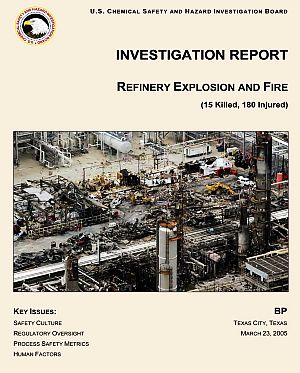
U.S. Chemical Safety Board’s report on the horrific & deadly 2005 BP Texas City, TX refinery explosion that killed 15 & injured 180. Click for copy.
Ronnie Green’s 2008 book featuring Louisiana resident Margie Richard’s 15 year fight with Shell Oil’s Norco, LA  refinery & chemical plant that polluted her community and sickened its residents, by Amistad publishers, 288pp. Click for copy.
Ronnie Green’s 2008 book featuring Louisiana resident Margie Richard’s 15 year fight with Shell Oil’s Norco, LA refinery & chemical plant that polluted her community and sickened its residents, by Amistad publishers, 288pp. Click for copy.
U.S. Chemical Safety Board’s report on a deadly February 1999 refinery fire at Tosco’s Avon Refinery in Martinez, CA that killed 4 workers and critically injured another. Click for copy.
2017 book: “One Minute After Sunrise: The Story of the Standard Oil Refinery Fire of 1955,” 246 pp. Click for copy.
CSB’s report on the July 2001 storage tank explosion at the Motiva oil refinery in Delaware City, DE where one worker was killed and eight others injured. That explosion also released 67 tons of acid vapors into the air and at least 97,000 gallons of sulfuric acid and petroleum products into waterways & the Delaware River, killing thousands of fish. Click for copy.
Related Reading: Scott Cole’s 2018 book, “Fallout,” about a community’s fight with oil industry pollution from a Unocal Oil refinery in California. Click for copy.
U.S. Chemical Safety Board’s investigation and report on the April 2010 explosion and fire at the Tesoro Anacortes, WA refinery that killed 7 people.
Stephen McGinty’s book, “Fire in the Night: The Piper Alpha Disaster,” about the July 1988 Occidental Petroleum disaster in the North Sea that killed 167 people. Click for copy.
Rachel Maddow’s 2019 book, “Blowout: Corrupted Democracy, Rogue State Russia, and the Richest, Most Destructive Industry on Earth,” 432 pp. Crown Books, 8,014 ratings on Amazon. Click for copy.
Daniel Yergin’s epic book, “The Prize: The Epic Quest for Oil, Money & Power,” winner of the Pulitzer Prize and a book that Business Week called “the best history of oil ever written.” 2009 paperback edition with a new epilogue. Click for copy.
Loren C. Steffy’s 2011 book, “Drowning in Oil: BP & the Reckless Pursuit of Profit,” McGraw-Hill. Click for copy.
Steve Coll’s 2012 book, “Private Empire: ExxonMobil and American Power,” Penguin Press, 685 pp. Winner of the Financial Times and Goldman Sachs Business Book of the Year Award 2012. Click for copy.
Jane Mayer’s 2016 book, “Dark Money: The Hidden History of the Billionaires Behind the Rise of the Radical Right,” Doubleday, 416 pp.  Click for copy.
Jane Mayer’s 2016 book, “Dark Money: The Hidden History of the Billionaires Behind the Rise of the Radical Right,” Doubleday, 416 pp. Click for copy.
Christopher Leonard’s 2019 book, “Kochland: The Secret History of Koch Industries and Corporate Power in America,” Simon & Schuster, 714 pp. Click for copy.

U.S. Chemical Safety and Hazard Investigation Board (CSB), “Interim Investigation Report, Chevron Richmond Refinery Fire,” CSB.gov, Washington, DC, April 2013.

U.S. Chemical Safety and Hazard Investigation Board (CSB), “Regulatory Report / Chevron Richmond Refinery Pipe Rupture and Fire,” Chevron Richmond Refinery, #4 Crude Unit, Richmond, California, August 6,2012 and Appendix A: Significant Petroleum Refinery Incidents in 2012, pp. 98-102, No.2012-03-I-CA, May 2014,

CSB, “Animation of Fire at Chevron’s Rich-mond Refinery, August 6, 2012,” YouTube .com, posted, April 2013.

Jaxon Van Derbeken, “Chevron Ignored Risk in ’11, Workers Say; Richmond; They Warned of Corrosion After ’11 Fire, Papers Show,” SFGate.com / San Francisco Chronicle, Octo-ber 13, 2012.

“Fire at Exxon’s Beaumont, Texas, Refinery Injures 12 Workers,” Reuters.com, April 17, 2013.

Erwin Seba, “U.S. EPA Cites Chevron for Environmental Violations from 2012 Fire,” Reuters.com, December 17, 2013.

U.S. Chemical Safety and Hazard Investigation Board, “CSB Releases Board Approved Regulatory Report on Chevron Refinery Fire – Proposes a More Rigorous Refinery Industry Regulatory System in California,” CSB.gov, Washington, DC, November 10, 2014.

Terry Hillig, “Roxana Lawsuit Alleges Pollution From Refinery,” St. Louis Post-Dispatch, March 21, 2012.

Steve Mason, EPA Region 6 Emergency Readiness Team, Response & Prevention Branch, Dallas, Texas 75202, “Alon Refinery Fire, Big Spring, Texas, Final Report,” May 1, 2008.

Bill Rigby, Erwin Seba. “Five Dead in Tesoro Anacortes Refinery Fire,” Reuters.com, April 2, 2010.

“Husky Officials Confirm Benzene Leak,” HomeTownStations.comMPRnews.org (Minnesota Public Radio), September 4, 2018.

“Photos: Smoke, Tension and Evacuations Follow Superior Refinery Fire,” MPRnews.org (Minnesota Public Radio), April 26, 2018.

“Odor Coming From Husky Refinery,” Home TownStations.com (Lima, OH), November 23, 2014.

Dave Fehling, “Tons Of Chemicals Leak From Shell Oil Refinery In Deer Park,” Houston PublicMedia.org (Houston Public Media, a service of the University of Houston), August 13, 2015.

Associated Press, “Fire Crews Respond to Blaze at Washington BP Refinery,” CTV news.ca, February 17, 2012.

Phuong Le, Associated Press, “Cherry Point Refinery Shut Down as Fire Investigation Is Launched,” SeattleTimes.com, February 18, 2012.

Teri Biebel, “6.6 Million Gallons of Crude Oil Spilled in Paulsboro, NJ,” SkyTruth.org, February 24, 2012.

Julie Kliegman, “Did the Koch Brothers Run an Alaskan Oil Refinery into the Ground?” [re: Flint Hills refiinery], PolitiFact.com, April 21, 2014.

“CSB Deploys to Investigate Release of Hydrofluoric Acid at CITGO Refinery in Corpus Christi, Texas,” CSB.gov, March 6, 2012.

Randy Kreider, “Feds Investigate Dangerous Acid Leak at Texas Citgo Refinery; Release of Acid at Citgo Refinery Follows 2009 Explosion at Same Site,” ABCnews.go.com, March 9, 2012.

“Refinery Events, March 16, 2012 – March 22, 2012,” assets.USW.org, United Steelworkers.

Barbara Powell, “Gasoline Advances After Sunoco Refinery Fire, Inventory Decline,” Bloomberg.com, May 9, 2012.

“Refinery Events, May 4, 2012 – May 10, 2012,” assets.USW.org, United Steelworkers.

Associated Press, “BP Fined $81,500 for Safety Violations at Washington Refinery,” OregonLive.com, August 30, 2012.

Terrence Henry (KUT, Austin, Texas), “Exxon Refinery in Baytown Releases Massive Amount of Chemicals,” NPR.org (a reporting project of NPR member stations), September 12, 2012.

Lauren McGaughy, “ExxonMobil Baton Rouge Refinery Did Not Disclose Accident, Inspect Corroded Pipes: Uncensored EPA Report,” Nola.com / The Times Picayune, February 21, 2013.

“EPA Reveals Corrosion, Failures Plaguing ExxonMobil Refinery,” PaintSquare.com, Wednesday, March 6, 2013.

Leeann Sinpatanasakul, “Hydrogen Fluoride – A Toxic Chemical in Your Neighborhood?,” ForEffectiveGov.org, November 19, 2013.

Faimon A. Roberts, III and Della Hasselle, “Massive Flare at Chalmette Refinery an ‘Unplanned Event’ That Let Out ‘Awful’ Smell,” TheAdvocate.com (New Orleans, LA), March 12, 2018.

Mark Schleifstein, “ExxonMobil Chalmette Refinery Likely Cause of Odor in City on Wednesday, Coast Guard Says,” NOLA.com | The Times-Picayune, April 4, 2013.

Dow Jones Newswire, “Refinery Status: Benzene Leak Detected At Chevron’s Pasca-goula, Mississippi Refinery,” MarketScreener .com, September 18, 2012.

Antonia Juhasz, “The True Cost of Chevron: An Alternative Annual Report,” TrueCostof Chevron.com, 2009.

Jim Malewitz, Jolie McCullough, Ben Hasson and Lise Olsen, “A Deadly Industry; Assembled Data Shows How and Where U.S. Refinery Workers Continue to Die,” Texas Tribune / Houston Chronicle, March 22, 2015.

Dow Jones News, “Refinery Status: Sunoco Philadelphia Refinery Fire Shuts Girard Point Crude Unit,” May 9, 2012.

United Steelworkers, “Refinery Events, May 4, 2012–May 10, 2012,” Assets.USW.org (obtained from the Department of Energy (DOE) website).

Jane Kay, Cheryl Katz, “Pollution, Poverty and People of Color: Living with Industry. Low-income residents in North Richmond, Calif., Save Money on Shelter, but Pay the Price in Health, “ Scientific American, June 4, 2012.

United Steelworkers, “Refinery Events, June 8, 2012–June 14, 2012,” Assets.USW.org (obtained from the Department of Energy (DOE) website)

Dan Wallach, “Fire at Motiva Shuts Down New Unit,” BeaumontEnterprise.com, June 12, 2012.

“Fire Breaks out at Meraux Refinery; No Injuries Reported in Early Morning Incident,” WDSU.com / WDSU-TV News, New Orleans, LA, Updated, July 22, 2012.

Loretta Park, “Woods Cross Refinery Cleans Up After Oil Sprays Neighborhood,” Standard .net / Standard Examiner (Ogden, UT), August 31, 2012.

Associated Press, “Employee Hurt in Refinery Fire; Authorities Say a Fire at a Marathon Petroleum Co. Refinery in the Detroit Area Has Injured an Employee,” September 5, 2012.

“Port Reading Hess Workers Evacuated after Vapor Cloud Develops from Leaking Propane Truck,” NJ.com, October 3, 2012.

Josh Mogerman, “ExxonMobil Mess: Refinery Spews Oil Into Suburban Skies,” Chicagoist .com, October 20, 2012.

“Chemical Leak at Refinery Prompts Road Closures,” BakersfieldNow.com, October 18, 2012.

“Valero Reports Hydrogen Cyanide Release at Its 142,000 b/d Corpus Christi, Texas Refinery” (reported Nov 27; stack test, Oct 24), Refinery Events, November 30, 2012—December 6, 2012, Assets.USW.org, United Steelworkers (obtained from the Department of Energy website).

Lauren McGaughy, “ExxonMobil Baton Rouge Plant Inspection Report Raises Concerns; Activists Request Full Accounting of June Benzene Spill,” NOLA.com | The Times Pica-yune, December 20, 2012.

“Benzene Leaks from Pipeline at ExxonMobil’s 503,000 b/d Baton Rouge, LA Refinery, December 1,” Refinery Events, November 30, 2012—December 6, 2012, Assets.USW.org, United Steelworkers (obtained from the Department of Energy website).

News Report, “Man Dies from Exposure to Dangerous Chemical at Valero Refinery,” WMC-TV / ActionNews5.com, December 3, 2012.

“Flint Hills Reports Cumene Unit Emissions During Repairs at Its 288,468 b/d Corpus Christi, Texas Refinery December 5,” Refinery Events, November 30, 2012—December 6, 2012, Assets.USW.org, United Steelworkers (obtained from the Department of Energy website).

Erwin Seba, “Troubled Motiva Refinery Crude Unit Shut by Small Fire,” Reuters.com, December 12, 2012.

Kristen Lombardi and Andrea Fuller, “’Upsets’: Chemical Releases Disrupt Lives but Rarely Result in Punishment,” NBCnews.com, May 21, 2013.

U.S. EPA, Washington, DC, “Shell Deer Park Settlement,” EPA.gov, July 10, 2013.

Office of Public Affairs, U.S. Department of Justice, “Shell Oil to Spend Over $115 Million to Reduce Harmful Air Pollution at Houston Area Refinery and Chemical Plant,” Justice .gov, July 10, 2013.

“EPA Records Reveal [ExxonMobil Joliet] Oil Refinery Safety Questions,” ABC7Chicago .com, August 2, 2013.

Susan Buchanan, “ExxonMobil Denies its Baton Rouge Plants Had Safety Violations,” LouisianaWeekly.com, January 21, 2014.

“ExxonMobil Refinery Incidents over Years Include Fires, Explosions,” DailyBreeze.com (Hermosa Beach, CA), March 1, 2015 / updated, September 6, 2017.

Jim Malewitz, “A Deadly Industry: Assembled Data Shows How and Where U.S. Refinery Workers Continue to Die,” EHStoday.com, March 31, 2015.

Dave Fehling, “Tons Of Chemicals Leak From Shell Oil Refinery In Deer Park; More Details Are Surfacing about a Big Leak of a Potentially Cancer-causing Chemical from a Refinery near Houston,” HoustonPublicMedia.org, News, August 13, 2015.

“1 Dead and 1 Injured after Chemical Exposure at Placid in Port Allen,” TheWestSideJournal .com, March 9, 2016.

Jeff Johnson, “Inherently Safer Design at Refineries Proposed in California,” Chemical & Engineering News, July 25, 2016.

CSB, “ExxonMobil Torrance Refinery Investi-gation Report,” CSB.gov, May 2017.

Steve Early, “5 Years After Wake-up Call on Refinery Safety, More Work Needed,” San Francisco Chronicle, August 2, 2017.

U.S. Chemical Safety and Hazard Investigation Board (CSB), Investigation Report, “LPG Fire at Valero – McKee Refinery (Four Injured, Total Refinery Evacuation, and Extended Shutdown), Valero Energy Corporation, Sunray, Texas, February 16, 2007,” CSB.gov, Report Issued: July 2008.

United Steelworkers / Tony Mazzocchi / Center for Health, Safety and Environmental Education, “A Risk Too Great: Hydrofluoric Acid in U.S. Refineries,” April 2013.

Robert Collier, “Part 2: The Most Dangerous Chemical You’ve Never Heard Of,” TheNextGeneration.org, August 15, 2013.

Jim Morris, Executive Editor; Chris Hamby, “Use of Toxic Acid Puts Millions at Risk,” PublicIntegrity.org, February 24, 2011, updated, May 19, 2014.

Environmental Justice and Health Alliance For Chemical Policy Reform, “Who’s in Danger? Race, Poverty, and Chemical Disasters: A Demographic Analysis of Chemical Disaster Vulnerability Zones,” ComingCleanInc.org, May 2014.

Sally Hayati, “Hydrofluoric Acid Incidents In Torrance & Elsewhere: A Partial Chronology,” Torrance Refinery Action Alliance / SafeTorranceRefinery.org, October 7, 2015.

“Powerful Explosion Rocks Oil Refinery, Injuring at Least 11; Smoke Could Be Seen for Miles and Evacuations Were Ordered at Nearby Neighborhoods,” ABCNews.com, April 26, 2018 (TV news report on Husky Oil Refinery explosion, Superior, WI).

Mike Hughlett, “Husky Refinery Explosion in Wis. Prompts Recommendation to Review Use of Hydrogen Fluoride; After Husky Energy Incident Led to Evacuation, Panel Asks EPA to Revisit Guidelines,” StarTribune.com / Minneap-olis Star Tribune, April 26, 2019.

U. S. Environmental Protection Agency (EPA), Hydrogen Fluoride Study: Report to Congress, [Section 112(N)(6), Clean Air Act as Amended], Final Report, December 26, 2019.

Forrest Wilder, “The Fire This Time” [Citgo Refinery], TexasObserver.org, August 19, 2009.

Jasmine Babbs, SFSU, “Exxon Mobil Beaumont Refinery,” PGEproject.WordPress .com, 2017.

Reuters, “Marathon Refinery Fire In Detroit Extinguished With No Injuries, Town Partially Evacuated,” HuffPost.com, April 27, 2013.

Jim Malewitz, Jolie McCullough, Ben Hasson and Lise Olsen, “A Deadly Industry: Assembled Data Shows How and Where Refinery Workers Continue to Die,” TexasTribune.org (Texas Tribune / Houston Chronicle), March 22, 2015.

Nick Green, “33 Accidents Happened at Oil Refineries as EPA Delayed Updating Disaster Rule, Says Environmentalist Group,” DailyBreeze.com (Torrance, CA), April 3, 2018.

Contra Costa Health Services (Contra Costa County, CA), “Major Accidents at Chemical/ Refinery Plants in Contra Costa County, CA” (more than 60 incidents listed, 1992-2018), CChealth.org.

Joe Guillen, “Duggan Threatens Suit over Marathon Refinery Emissions,” Detroit Free Press, January 28, 2016.

Aaron Mondry, “Two Hospitalized After Vapor Leak at Marathon Refinery; Officials Say There’s No Health Risk, But Residents Are Wary,” Detroit.Curbed.com, September 13, 2019.

“Valero Meraux Oil Refinery Restarts Crude Unit After July Fire,” Bloomberg.com, October 8, 2012.

“Update: BP Cuts Refinery Rates by 30 Percent after Coker Fire at Its 413,000 b/d Whiting, Indiana Refinery July 23,” Refinery Events, July 20, 2012—July 26, 2012, United Steelworkers, Assets.USW.org.

Mark Schleifstein, “Louisiana Refinery Accidents Decline, But Accident Emissions Rise, Louisiana Bucket Brigade Reports,” NOLA.com | The Times-Picayune, December 4, 2012.

Ben Lefebvre and Alison Sider, Dow Jones Newswires, “Motiva’s Giant Texas Refinery Battered by Accidents After $10bn Upgrade,” HydrocarbonProcessing.com, August 2013.

U.S. Office of Homeland Security, “Daily Open Source Infrastructure Report: 30 July 2012,” DHS.gov.

“2nd Man Dies After Wynnewood Refinery Explosion,” KOKO5 News, October 16, 2012.

Juliet Linderman, “Shell Chemical Equipment Failure Causes Flame and Flares in St. Charles,” NOLA.com | The Times-Picayune, December 4, 2012.

“Contractor Killed at PBF Oil Refinery [Paulsboro, NJ] in Greenwich Township,” NJ.com, January, 2, 2015.

Mike Phillips, “Blaze at Delaware City Refinery Sends Black Smoke Billowing Into the Air,” WDEL.com, February 3, 2019.

Heather Rogers, “Erasing Mossville: How Pollution Killed A Louisiana Town,” TheIntercept.com, November 4 2015.

Rebecca Sobel, “Oil Refineries Threatening U.S. Communities With Cancer-Causing Air Pollution; New Mexico Refinery Among 10 Others Refineries Releasing Excessive Amounts of Benzene into Local Neighborhoods,” WildEarthGuardians.org, February 6, 2020.

Associated Press, “Refinery Fire Extinguished in South Texas, No Injuries”(third party pipeline at Citgo Refinery, Corps Christi, TX), APNews.com, February 17, 2020.

Clyde Hughes & Danielle Haynes, “Major Oil Refinery Fire Shuts Down Los Angeles Freeway,” UPI.com (w ABCNews video), Feb. 26, 2020 (Marathon Petroleum oil refinery, Carson, CA).

Jeremy P. Jacobs, “Anger over Dirty Air Intensifies in Calif.’S Oil Hub,” EEnews.net, April 29,2020.

News Release, EPA Region 10, “EPA Penalizes Shell for Anacortes Refinery Release; Company Pays $191,000 Penalty for 2015 Event That Sickened Locals,” EPA.gov, February 10, 2021.

Mark Schleifstein, “After Last Year’s Fire at Meraux Refinery, Valero Fined $58K For Safety Violations,” NOLA.com, April 12, 2021.

“Shell Refinery Flaring Burn-Off / Deer Park, TX 12.7.21,” YouTube.com.

Kylee Bond, Kenny Lopez, “Explosion Confirmed at Marathon Garyville Refinery,” WGNO.com (WGNO-TV News), Garyville, LA, February 21, 2022.

Michael Esealuka, “Marathon Refinery Explosion Puts Workers, Community At Risk,” HealthyGulf.org, February 22, 2022.

Associated Press, “Explosion at Marathon Refinery in Garyville Injures 6 Workers; Cause under Investigation; It’s One of the Largest Refineries in the Country,” NOLA.com (news), February 22, 2022.

Aliya Uteuova, “U.S, Oil Refineries Spewing Cancer-Causing Benzene into Communities, Report Finds. Analysis Shows Alarming Level of Benzene at Fence-Line of Facilities in Texas, Louisiana, Pennsylvania, Indiana and US Virgin Islands,” TheGuardian.com, May 14, 2022.

Reuters News, “Six Injured in Fire at Phillips 66 Texas Refinery Tank Farm,” Reuters.com, January 17, 2023.