Tag Archives: New York magazine history

“The Trump Dump”
New York Magazine, 2016

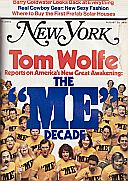
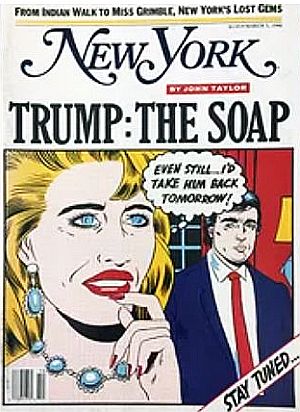
A New York magazine edition of March 5, 1990. The magazine has covered Trump’s business, cultural, political and life-style activities for decades, to the present day.
On January 29, 2016, New York Magazine released a story online it described as “Our Trump Dump” – the magazine’s “Look Back on the GOP Prince’s Days as an NYC Clown.”

This accounting of Donald Trump’s days in New York City, came out just as he entered the fray of the presidential race in 2016 – the year he would surprise pundits with an electoral college win over Democratic candidate – and former first lady, U.S. Senator, and Secretary of State – Hilary Clinton.

This Trump history may be regarded by many as “old news” – and true enough, it is that. But it is still a useful look at a part of Trump’s life during a revealing time in New York city: – i.e., Donald Trump as realtor, playboy, cultural star, and self-promoter. And in these various roles, Trump then received scrutiny by the New York media, and not least, New York magazine.

As the magazine’s editors would explain in one of the opening paragraphs for its January 2016 “Trump Dump” story:

…Trump went into business in 1968, the same year New York came into being. “The first time anyone heard much about Donald Trump was about five years ago,” contributing editor Marie Brenner wrote in a 1980 profile. “And it all sounded very fishy.” But over the succeeding years, this magazine got to know Trump intimately, chronicling his deals, his bankruptcies, his marriages, his affairs, his casinos, his yacht, his children, his vendettas, his television show, his marketing schemes, and his presidential campaigns. He occasioned and survived multiple bans by editors skeptical that there was anything about Trump left to say. He graced the magazine’s cover numerous times…

…And so, as hordes of Iowan Republicans race to declare Donald Trump their pick to be the nation’s next president, we went into New York’s archives to find our favorite Trump moments…
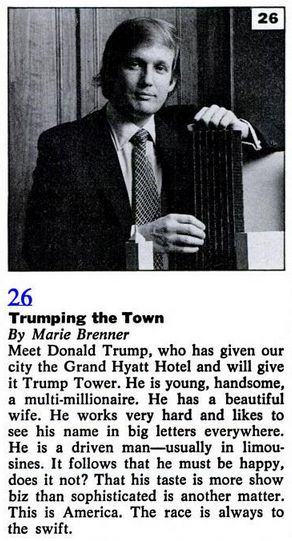
New York magazine contents page describing Donald Trump in  November 1980 story, “Trumping The Town.”
New York magazine contents page describing Donald Trump in November 1980 story, “Trumping The Town.”

As the editors also explained, Trump’s first appearance in New York magazine was in 1976, a few months after President Ford told New York to drop dead, the city then in desperate financial straits. Trump, then 29, an unknown real-estate developer with a grandiose plan for a convention center seeking big tax breaks, ended up in a feud with hotel mogul Bob Tisch, all of which New York covered in that first Trump story. But many more were to follow.


…If You Missed It

What follows below is a selected portion of New York magazine’s 2016 “Trump Dump” story, to give readers an idea of what’s covered there in more detail. Listed below, for example, are the descriptive section heads the magazine used in compiling the full story on-line. Each of these sections at the New York website, includes a related short summary, typically with links to other publications and/or fuller treatments in New York magazine pieces.

The section heads included here are also complimented with a right-hand column of several of the New York magazine covers that were featured or referred to in the “Trump Dump” compilation.

The general intent here is simply to re-introduce this story to readers who may have missed it years ago, directing them to the New York magazine compilation of useful and informative Trump history up through September 2016.

These stories, while older Trump history known to many, may still offer readers insight into Donald Trump’s various business and cultural activities in the Big Apple and beyond during the 1950s-2016 period. Most of these New York stories are well-written and lively accounts, and some quite revealing of Trump’s personality, values, behavior, and dealings with others in those times. Later in the piece, other Trump stories and magazine covers by The New Yorker, Time magazine, The Economist, Politico.com, and some New York tabloids will also appear. But first, consider New York‘s “Trump Dump.”

___________________________________________________

May 19. 1980, New York magazine cover, “The Men Who Own New York,” Young Donald Trump among them, top left.
Nov 16, 1987. New York cover: “Trump On Trump: How I Do My Deals - Excerpts From His New Book.”
November 9, 1992: New York magazine cover, “Fighting Back: Trump Scrambles off the Canvas.”
1994: “Trump’s Near-Death Experience” - He claws way back from the abyss – thanks to luck, bluster & Chinese billionaires.


“The Trump Dump”
New York Magazine, 2016


Chapter 1:
Faking It, Making It

(1946-1982)

He Stole His Brother’s Toys
He Picked His First Development Fight
He Seduced Ivana
He Loved Studio 54
He Learned His Positive Thinking From
the Master
He Tried to Manipulate a Village
Voice Reporter
He Built Trump Tower

 
Chapter 2:
The Heyday

(1983-1989)

His Tower Defined the Decade
He Tried to Topple the NFL
He Blew Up Palm Beach
He Retained Joe McCarthy’s Favorite Law-yer
He Didn’t Pay Retail
He Tried to Build the World’s Tallest Sky-scraper – And Lost
He Began to Consider Himself Presidential Material
He Became a Best-Selling Author
He Won Nixon’s Endorsement
He Bought the Plaza
He Advised Mike Tyson on His Fights
He Advised Mike Tyson on His Marriage
He Called for the Execution of Black Teens (Who Were Innocent)
He Buried a Documentary That Ultimately Screened Just Twice
His Womanizing Caught Up to Him

 
Chapter 3:
Debts and Defiance

(1990-2003)

He Began to Lose His Mojo
He Rebounded!
He Gambled on Atlantic City
He Owed the Banks Billions
He Fell Off the Billionaire List – Loudly and Homophobically
His Father Bought Him $3.5 Million in Chips at His Own Casino
He Ran Into Macaulay Culkin
He Blew Up at Barbara Corcoran
He Picked a Fight With the Cuomo Family
He Had a Thing for Princess Di
He Swore He Was a Really Good Dad
He Bought the GM Building, Predicting the Apple Store
He Started Selling Models
He Became a Rap Icon
He Impressed At Least One Architecture Critic
He Began to Mull the White House Again
He Buried His Face in Rudy Giuliani’s Bosom
He Lost the GM Building

 
Chapter 4:
Celebrity Grotesque

(2004-2015)

He Had an Idea for a Reality Show You’re Gonna Love
He One-Upped Monopoly (Or at Least Tried)
He Dominated the Ratings (At Least by His Telling)
He Was Skewered by Muppets
He Swore He Was a Billionaire
He Patented Himself
He Let Rosie O’Donnell Get Under His Skin
He Almost Shaved His Head
He Monetized His Appetites
He Dabbled in What Certainly Looked Like a Pyramid Scheme
He Married Off His Daughter — To a Jew!
He Wouldn’t Let Oliver Stone Near His Hair
He Was the Most Entertaining of All the Birthers
He Hawked Sunscreen
He Entered the Republican Primary Race,
Shot to the Top of the Pack, and Shows
No Signs of Losing (last entry, Sept 2015)

Concludes with a quote from Donald Trump’s 1987 book, Trump: The Art of The Deal:

Trump: “You can’t con people, at least not for long. You can create excitement, you can do wonderful promotion and get all kinds of press, and you can throw in a little hyperbole. But if you don’t deliver the goods, people will eventually catch on.”

** Click here to visit full New York magazine “Trump Dump” story from January 29, 2016.


NYmag Sample Stories
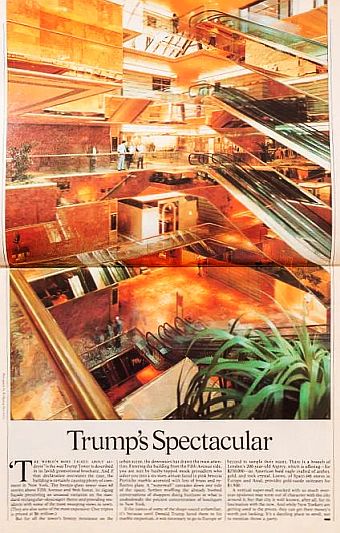
New York’s May 2, 1983 edition, ran a two-page spread (turned sideways) on the Trump Tower’s six-story interior atrium.
In its reporting on Donald Trump, New York magazine also covered Trump’s architectural accomplishments, even as it would criticize his methods, politics, and deal-making in securing building locations, financing, tax breaks, labor and management contracts, etc.

When the Trump Tower was completed in 1983, for example, New York lauded the building, offering a headline atop its May 2nd, 1983 cover that read:, “Trump’s Spec-tacular Atrium on Fifth Avenue.” Inside that edition, the magazine also ran a two-page, enlarged, “turn-it-sideways” photo of the building’s six-story interior atrium.

Said the magazine, describing the Trump Tower on the contents page:

“With its 68 stories of bronze glass and its dazzling six-story atrium, its pricey boutiques and pricier apartments, its mock grenadiers and its cascading ‘waterwall,’ the Trump Tower, the ‘world’s most talked about address,’ is getting a lot of talk.”

The magazine also explained that Trump, who became the most recognized New York City builder of the 1980s, was not content with just real estate:

“Trump Tower begat a litter of Trump- branded condo buildings — Trump Parc, Trump Plaza, Trump Palace — but Trump himself was not content to remain a mere real-estate developer. He expanded into Atlantic City casinos, bought the Eastern Airlines shuttle (which he renamed Trump Air), sponsored a professional cycling event called the Tour de Trump. But perhaps his most audacious move came in taking on the entire National Football League” Not all of these ventures would fare the way Trump had hoped, with some falling far short of Trump’s vision, some incurring huge debt and other troubles [see, for example, 2013 ESPN documentary, Small Potatoes: Who Killed the USFL ]. In some of his subsequent real estate ventures, he would also do battle with renters not willing to leave their apartments.

Feb 1985. NY magazine cover story of Donald Trump’s battle with tenants of a building he wanted for a new project.
In February 1985, New York magazine published a story by Tony Schwartz titled, “A Different Kind of Donald Trump Story.” It was about Trump’s failed attempts to forcibly and illegally evict rent-controlled tenants from a building on Central Park South he had acquired in 1982.

A group of tenants in that building – located at a desirable New York City location, 100 Central Park South, with some units looking into the park – had organized to block Trump from raising the building in order to build a new tower there and on an adjoining property. Trump hired a management company to deal with the property and begin eviction proceedings. Tenants charged they were soon receiving reduced services, and repairs had been stopped as well. Soon, the legal wars began, but the tenants held their ground. And New York magazine told the story.

In the end, Trump never realized his original project for that site. But the value of the property soared in the booming 1980s New York City real estate market. By the late 1990s, Trump converted the building into condominiums, though some of renters were allowed to remain at lower-than-market level rents. Among the residents, as of 2016, was Trump’s son Eric, who also served on the condo board.


Doing His Deals

But New York magazine stories also helped to sell Donald Trump and make him a cultural figure in New York and beyond. In November 1987, for example, just prior to publication of Trump’s first book, The Art of The Deal, New York ran extensive excerpts from the book over a generous 14 pages. Trump had collaborated with Tony Schwartz on the book – the writer who did the earlier story on Trump’s battle with Central Park South renters. Along with the excerpts from Trump’s The Art of the Deal, the magazine also included an update of how some of Trump’s deals actually fared in the real world.
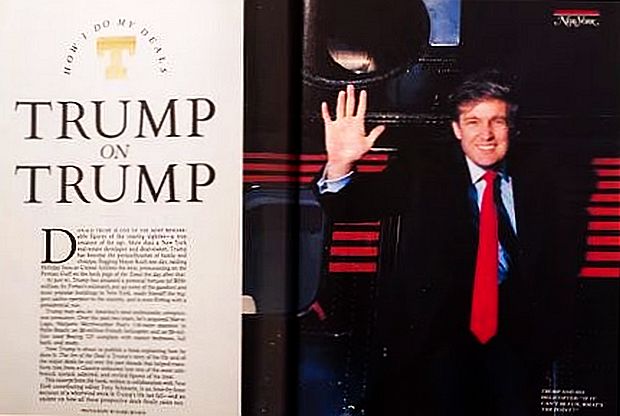
Part of a 14-page spread New York magazine offered on Trump with its November 16, 1987 story, “Trump on Trump: How I Do My Deals,” with extensive excerpts from Trump’s first book, “The Art of the Deal.”

As introduction to the November 1987 New York story on the Trump book, the magazine described Trump as follows:

…Donald Trump is one of the most remarkable figures of the roaring eighties – a true creature of the age. More than a New York real estate developer and deal-maker, Trump has become the personification of hustle and chutzpah, flogging Mayor Koch one day, raiding Holiday Inns or United Airlines the next, pronouncing on the Persian Gulf on the back page of the Times the day after that.

At just 41, Trump has amassed a personal fortune (of $850 million by Forbes estimate), put up some of the gaudiest and most popular buildings in New York, made himself the biggest casino operator in the country, and is even flirting with a presidential run.

Trump’s 1987 book, “The Art of the Deal.” Click for copy.

Trump may also be America’s most enthusiastic conspicuous consumers. Over the past two years, he’s acquired Mar-a-Lago, Marjorie Merriweather Post’s 118-room mansion n Palm Beach; an $8 million French helicopter; and an $8 million used Boeing 727 complete with master bedroom, full bath and study….

And with that, the magazine then ran its excepts from the book. That exposure no doubt helped move the book in the New York market and beyond.

Published by Random House in November 1987, a promotional campaign at the book’s release included a celebrity-thick release party at Trump Tower; Trump making the rounds on the TV talk-show circuit; and a number of magazine covers on Trump and the book.

The Art of the Deal became a huge hit, selling 835,000 copies in hardcover alone. After that showing, Random House reportedly paid Trump a $2.4 million advance for a sequel. Trump, however, by all accounts, did not write the book; Tony Schwartz did, reportedly to his great regret (see Wikipedia profile of the Trump book, which includes history on Tony Schwartz).
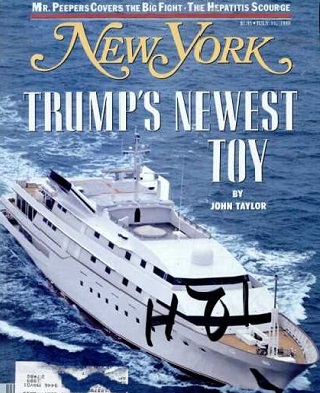
July 1988 New York magazine cover story on Trump’s yacht.


Big Yacht

Among other New York magazine cover stories in the “Trump Dump,” is a July 11th, 1988 story that focused on his yacht – or as New York’s cover story headline put it: “Trump’s Newest Toy.”

The magazine further explained on its contents page:

“It cost him nearly $30 million, and he says it was a bargain. He calls it the “ultimate toy,” but he plans to use it for business. It’s Donald Trumps new yacht, which he introduced to his New York Fiends at a July 4 bash on the East River. The 292-foot yacht will soon be docked at a marina in Atlantic City, where Trump will use it entertain the high rollers at his casinos….”

That story also included a detailed description and graphic of the boat’s various decks, its size relative to other commercial and military boats, and photos of some of its elaborately-decorated rooms. In a separate story, Newsweek magazine would call it “the world’s most luxurious yacht.”

The yacht was originally built in 1980 for Saudi businessman and billionaire, Adnan Khashoggi, for $100 million. Trump named it the Trump Princess. Although for a time he talked about having a bigger yacht built to accommodate all his high-roller friends – one perhaps 400 feet in size – that never came to pass. The Trump Princess, meanwhile, was sold in 1991.
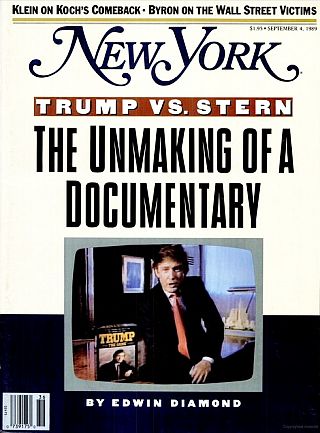
September 4, 1989 edition: “Trump vs. Stern: The Unmaking of A Documentary,” about once-blocked documentary film about Trump.


Blocked Film

One of the stories featured in New York magazine’s 2016 “Trump Dump” was a cover story that appeared in the September 4th, 1989 edition of the magazine regarding a documentary film that was being made about Trump, and backed by Leonard Stern, a competing New York real-estate developer.

At the time, Stern owned The Village Voice and another publication, 7 Days, which had probed some of Trump’s activities. In 1988 Stern was also financing work on a documentary film titled, “Trump: What’s the Deal?”

According to New York, as Trump learned that the film was being made, he began to try and stop it from being aired, and in the process, became “really nasty, spreading a rumor that Stern’s wife of 18 months, Allison, had repeatedly phoned his office asking for a date,” which she called “absurd.”

In any case, New York magazine’s story, “Trump vs. Stern: The Unmaking of a Documentary,” by Edwin Diamond, laid out all the details on the Trump-Stern fight over the film. The story ran for eight pages with screen shots from the film, its history, and quotes from its principals. Trump threatened lawsuits and used business connections to block the film on TV, although it was later screened briefly at a small theater in Bridgehampton, New York in July 1991 – but only for two showings.
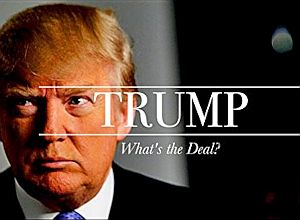
Title card for once-blocked documentary film, “Trump: What’ The Deal,” now available. Click for film at Amazon.
The film then remained unavailable thereafter — in fact, for more than 20 years, even after Trump announced he was running for president in 2015. However, in September 2015, producer Libby Handros posted it online for streaming, by then using a different title, “The New Trump. The Old Trump. The Same Trump.” But today, the film can be found online, or at any of the streaming providers, using its original title, “Trump: What’s The Deal.”

According to Trump author, David Cay Johnston, writing in The National Memo in August 2015, “the documentary shows Trump manipulating politicians and the criminal justice system, pocketing millions in taxpayer welfare, not paying people he hired, doing some of his biggest deals with mobsters, retaining a cocaine dealer as his helicopter pilot, and evidently benefitting from having his sister working in the Justice Department before winning appointment as a federal judge.” As of August 2024, Amazon’s Prime Video described the film as follows: “Donald Trump is one of the richest and most famous men in America, but on what foundation has his success been built? From accusations of harassment to repeated flirtations with bankruptcy, his very public business career has been one of artifice and intrigue. Originally produced in 1991, “Donald Trump: What’s the Deal?” investigates the unscrupulous reality behind this most public of figures.”


Tabloid Coverage
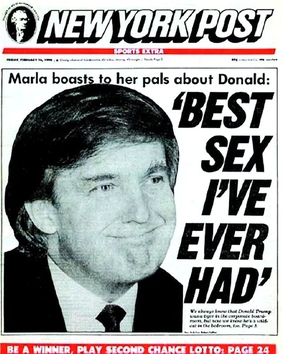
February 16, 1990. Famous cover of New York Post re: Marla on Trump.
In early 1990 came some big Trump news – about his affair with Marla Maples and the beginning of the end of his marriage to Ivana. And it was the February 1990 front-page headline and cover photo of a grinning Donald Trump in the New York Post that got the most attention – as Marla reportedly said about Trump, it was the best sex she ever had. (see also Wikipedia’s account of this story, FYI).

Thereafter, the tabloids – especially the New York Post and the New York Daily News – exploded with the news about Trump, Ivana, and Marla, offering nearly non-stop coverage and front-page stories for the next few weeks.

New York magazine, for its part, added its own coverage, beginning with the March 5, 1990 cover story noted at the top of this story – “Trump The Soap.” And in subsequent months and years, other stories on Ivana and Marla would continue to be a part of the Trump media swirl, especially in the New York City tabloids (more on the tabloids later below).

Ivana and Trump had married in 1977, divorced in December 1990. Trump married Maples in 1993 and they divorced in 1999.

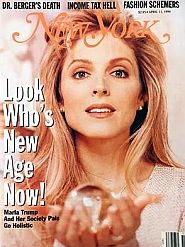
New York magazine, meanwhile, continued to include stories about Trump’s marriages, affairs, divorce, and family – some of these mentioned in the “Trump Dump” compilation. An October 1990 cover story by Michael Gross, “Ivana’s New Life,” focused on the life of first wife, Ivana, then not yet divorced, but beginning to plan her new life after Donald’s affair with Marla Maples. Maples, for her part, would get her own New York cover story a few years later, on April 11, 1994 with then Marla Trump on the cover, headlined, “Look Who’s New Age Now: Marla Trump And Her Society Pals Go Holistic.”
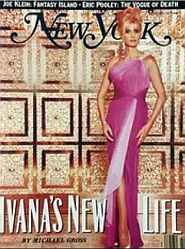
NY mag, October 15, 1990. “Ivana’s New Life,” i.e., after Trump.
NY mag, April 11, 1994. Marla Trump. “Look Who’s New Age Now.”
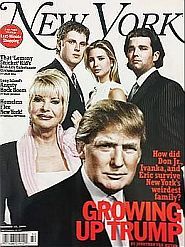
NY mag, December 13, 2004. “Growing Up Trump.”

Regarding Trump’s role as a father, a cover story by Jonathan Von Meter of December 2004 was titled, “Growing Up Trump: How Did Don Jr., Ivanka, and Eric Survive New York’s Weirdest Family?” On the magazine’s contents page that story was given a longer title: “Did Their Father Really Know Best? In a City Full of Narcissistic Competitive Parents, Donald and His Ecx-Wife Ivana Trump Seem to Have Won the Prize. Could Their Three Kids Really Have Survived Such Mythic Over-The-Top Dysfunction?”


More Trump…

New York magazine’s “Trump Dump” also includes other Trump history. A “Trump World” section of New York‘s January 16, 1995 edition, included reporting claiming that Princess Diana and Prince Charles were applying for membership at Mar-a-Logo, plus another report that Diana was negotiating to buy a $3.5 million apartment in Trump Tower, both of which were denied by a Palace spokesman. New York also reported that Trump had repeatedly sent flowers to Diana after her marriage ended. But according to Diana friend, Selina Scott in London’s Daily Mail, Trump gave Princess Diana “the creeps.”

Portion of a “Trump World” report from New York magazine’s January 16, 1995 edition noting alleged interest by Princess Diana and Prince Charles in joining Mar-a-Lago, and separately, that Princess Diana was said to negotiating for a Trump Tower apartment – both denied by Palace spokesman.

Other New York stories noted in the “Trump Dump” focused on Trump’s earlier attempted presidential bids – briefly in October 1987 and also, briefly again, in January 2000 with the Reform Party – the latter coming with another Trump book, The America We Deserve. The January 2004 premiere of Trump’s NBC TV show, The Apprentice, is also covered, and a 2005 Muppetts segment about an orange-haired “Donald Grump” – who has more and better trash than anyone else — is also mentioned. More serious matters at the “Trump Dump” involved a January 2006 entry, when Trump sued Timothy O’Brien for libel, as O’Brien’s 2005 book, TrumpNation, found at the time that Trump’s real worth was around $150-$250s million, not the billions Trump claimed.
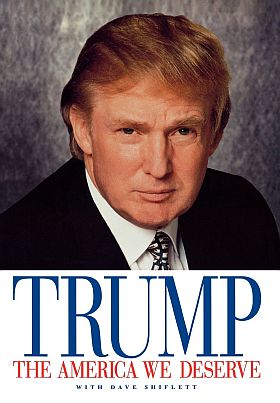
Donald Trump’s Jan 2000 book, “Trump: The America We Deserve,” came at 2nd Presidential bid. Click for copy.
Tim O’Brien’s “TrumpNation” book of 2005 brought a $5 billion Donald Trump lawsuit. Click for copy.

Trump then sued O’Brien, seeking $2.5 billion in compensatory damages and $2.5 billion in punitive damages. The lawsuit was dismissed in 2009, and an appeals court affirmed the decision in 2011. A new edition of TrumpNation was published in June 2016 that included O’Brien’s introduction that criticized Trump and also noted his 2016 presidential campaign.

Other New York / “Trump Dump” entries included background on Jared Kushner and family when Jared and Ivanka married in October 2009. President Barack Obama’s remarks on Trump at the White House Correspondents’ Dinner in April 2011 – when Trump became the butt of Obama’s jokes – is also included.
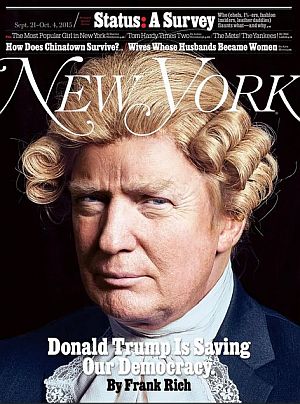
New York’s Sept 2015 cover story argued that Donald Trump’s campaign may actually be saving Democracy.
And the final New York cover story to be referenced in the “Trump Dump” compilation came with a September 2015 cover treatment showing a digitally dressed-up Donald Trump in George Washington-like patriotic garb with the tag line: “Donald Trump Is Saving Our Democracy.”

The accompanying story, by Frank Rich, held that Trump’s chaos, was actually doing America’s democratic system a favor by “exposing all its phoniness and corruption,” and changing it, and maybe, perhaps, strengthening it for the better.

Throughout his long piece, Rich pulled in elements from journalism, film, politics past, and more to make his points. And while he missed the mark in a few of his predictions, he did succeed in raising some interesting observations about Trump’s impact – which may still hold in 2024.

Trump, he explained, “has performed a public service by exposing, however crudely and at times inadvertently, the posturings of both the Repub-licans and the Democrats and the foolishness and obsolescence of much of the political culture they share.” …And that “Trump may be injecting American democracy with steroids…”

“…[T]he Trump campaign,” explains Rich, “has already made a difference. Far from being a threat to democracy or a freak show unworthy of serious coverage, it matters because it’s taking a much-needed wrecking ball to some of what has made our sterile politics and dysfunctional government as bankrupt as Trump’s Atlantic City casinos….” This was, of course, before Trump won the 2016 election, and before the Trump wrecking ball took a swing at the Constitution on January 6, 2021.


Other Media

April 1984. New York Times Magazine cover story: “The Expanding Empire of Donald Trump,” by William Geist.
New York’s “Trump Dump” included references and/or links to other New York and national media when relevant to one of its Trump stories. Among those cited, for example, were: The New York Times, New York Post, National Journal, Bloomberg, Vanity Fair, The New Yorker, The Village Voice, Washington Post, and others.

Many of these publications had their own Donald Trump coverage during those years, including detailed profiles, featured cover stories, and more, often with photos of Trump on their magazine covers or front pages.

The New York Times Magazine, for example, offered an April 1984 cover story shown at right, with Trump in the cover photo standing in the ornate atrium of his Trump Tower, along with cover tag line, “The Expanding Empire of Donald Trump.”

Coverage of Trump in those years generally ran the gamut, from flattering and praiseworthy, to critical and probing.


How Rich?

One Trump cover story by Forbes magazine of May 14, 1990 targeted his much self-promoted billionaire status. Forbes essentially dropped him from its “Forbes 400 richest list” after investigating his financial standing. That cover, shown below, depicts a scowling Donald Trump with the tagline: “How Much is Donald Really Worth Now?”
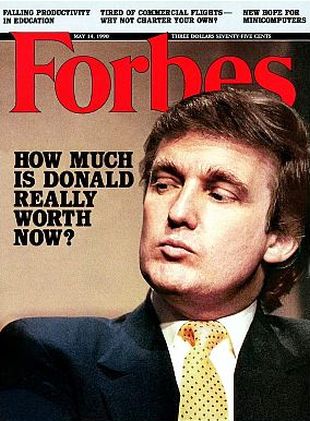
Donald Trump on the cover of Forbes for the first time, May 14, 1990. The story inside, explained Forbes, “offered a devastating look at his finances.”
Forbes, in a later 2023 story, offered a bit of history on Trump and the Forbes 400:

…He conned his way into sharing a spot on the inaugural [Forbes 400] list in 1982 with his father, Fred Trump, by convincing a reporter that he held a larger percentage of Fred’s fortune than he actually did. Trump secured massive loans that led to massive bankruptcies, and he fell off the list in 1990, when Forbes exposed deep problems with his debt-fueled empire, ultimately putting his net worth “within hailing distance of zero.” But Trump emerged from those troubles and regained a legitimate spot on the 400. He remained on the list from 1996 until 2021, when six years of polarization and one year of Covid finally caught up to him, dropping him from the ranks once again.


Time Magazine

Time magazine has also covered Donald Trump as he rose to fame in New York and beyond — in fact, for more than 25 years now — including dozens of Time magazine Trump covers.

Donald Trump first landed on Time’s cover on January 16, 1989 with the headline “This Man May Turn You Green With Envy – or Just Turn You Off. Flaunting It is His Game, and Trump is His Name.”

Trump, in fact, has held a special place in his self-boosterism for Time magazine covers. In his early days as President, in January 2016, he boasted at a CIA appearance about his Time magazine covers: “I have been on their cover like 14 or 15 times. I think we have the all-time record in the history of Time Magazine…. I’ve been on the cover 15 times this year. I don’t think that’s a record that could ever be broken.” Time magazine’s creative director, C.W. Pine, would later correct the record, noting that as of January 2016, Trump had been on 11 covers, and did not then hold the record of most Time magazine covers.
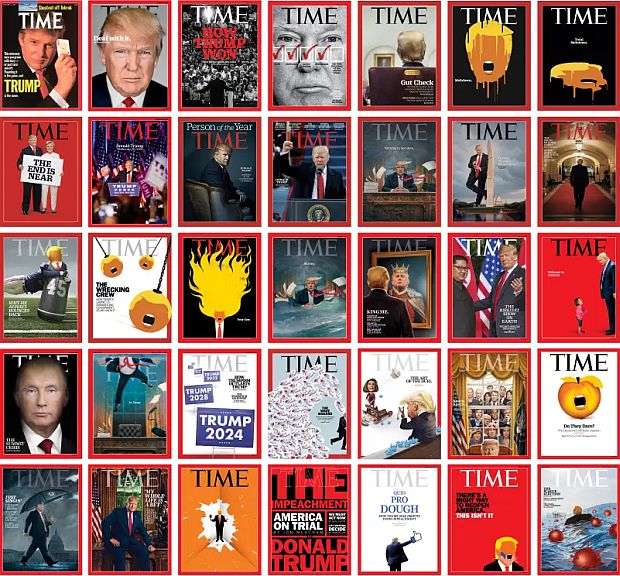
A sampling of Time magazine covers as of January 2021 with various photos, caricatures, and other renditions of Donald Trump making news, controversy, and/or chaos as he went, dating from 1989. (Click for Amazon page of Trump magazine covers).

However, since 2016, as the graphic above illustrates, Trump does have many more Time covers to his credit, with more than 35 as of 2021, though these covers do not always render him in a stately or flattering way, to say the least. Still, as Time’s C. W. Pine noted in 2021, Richard Nixon had more at 55 covers, and Ronald Regan, 46. True, with more Donald Trump chaos and controversy ahead, he may eventually eclipse Nixon and Reagan for the most Time covers.
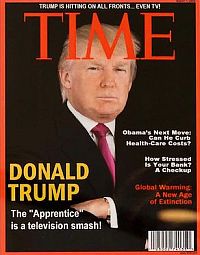
Fake March 1, 2009 editions of Time magazine found at 7 Trump Golf Clubs.
Curiously, however, as one footnote in the Time cover sweepstakes, in June 2017 the Washington Post found that framed, fake Donald Trump Time covers were found hung on the walls at seven of Trump’s golf clubs — five in the U.S. and two abroad. The fake March 1st, 2009 editions of the Time cover — looking much like the real thing to most unsuspecting viewers — featured Trump in a stately pose with associated story taglines. However, the Post did not find any definitive proof as to who made the fake covers or how they came to be displayed at those Trump Golf Club locations. After the Washington Post story appeared, Time requested the clubs remove the framed fake editions. (more on Time later below).

Shenanigans aside, however, the media – all media; print, electronic, and digital – have been happy about the arrival, antics, and controversy that is Donald Trump, whether in New York, Washington, or anywhere else. Trump boosts circulation, sells books, gets eyeballs, and raises TV, streaming, and podcast viewer/listener share. But it was perhaps the New York tabloids that first sent Trump into the Big Leagues of front-page obsession.


Tabloid King

Trump himself observed of his tabloid coverage during his 1990 marital troubles: “Papers like the Daily News and the New York Post were selling an extra thirty thousand copies whenever they splashed the Trump story across their front pages. In view of the money they were making off Ivana’s and my problems, they weren’t about to let the story drop.” Indeed, the Trump fervor went well beyond Ivana and Marla, and would continue for years, as Politico.com noted, “with more tabloid covers marking Trump’s books, failed business deals, TV reality show and finally his presidential bid. If Trump is a made man, it was perhaps the tabloids that did the making.” By mid -2016, Politico’s Media Issue compiled a collection of “the very best Trump covers” from the New York Post and New York Daily News – “nearly 100 in total.”

A partial collage of “New York Post” and “New York Daily News” front-page treatments of Donald Trump-related news that appeared regularly in the 1990s and beyond – Trump coverage that continues today for dozens of publications wide and far.

Michael Kruse, writing for Politico.com in its May/June 2016 media issue, offered some history on the tabloids and Trump:

…Donald Trump’s staying power as a celebrity and success as a presidential candidate is not because he’s some kind of emblem of wealth—it’s because he’s a product of the tabloids. In the 1970s, ’80s and ’90s, starting in the gossip pages of papers like the New York Post and the New York Daily News, the lines between news and entertainment began to blur more and matter less.“…[T]he tabloid writers used him and their papers thrived. But it turns out that he was using them too….” And Trump, the arriviste real estate mogul with attention-grabbing projects and personality to match, was a perfect character. “He was this guy who walked out of tabloid heaven,” says Larry Hackett, who worked for the News. “He was rich. He was vulgar. He was a city guy … and the women… Business, sex and a guy who loves the attention. You couldn’t beat it.” So the tabloid writers used him and their papers thrived. But it turns out that he was using them too. To keep his name in print, to build his brand, to learn the kinds of lessons that have helped him put together a run for the White House the likes of which has never been seen. Talk to some of those tabloid writers now and they can see—with some discomfort—that the seeds of Trump’s celebrity were nurtured in their notebooks….

The tabloids, certainly, were not alone, as the above review of New York’s “Trump Dump” makes clear. And as Trump edged into presidential politics – at first, with a few false starts, but full on by 2015 – more mainstream magazines began feature coverage of him, with Trump showing up on more and more covers.

Trump, in fact, delights in his magazine covers – as Washington Post reporter, Dan Balz, discovered during an October 2015 visit with Trump at his New York office, receiving a guided tour of his “awards wall.” Part of that wall was filled with framed versions of some of Trump’s favorite magazine covers, as he explains in the 2015 Washington Post video clip. below:

As the camera in the above interview pans the top of Trump’s desk – with a stunning view of Central Park out the window of Trump’s office high up in the Trump Tower – piles of other recent magazines featuring Trump can bee seen on his desk – Rolling Stone, Newsweek, The Economist, Time, New York, BloombergBusinessweek, and others. Trump remarks during the interview, that there are so many covers he doesn’t have room for all of them on his wall.

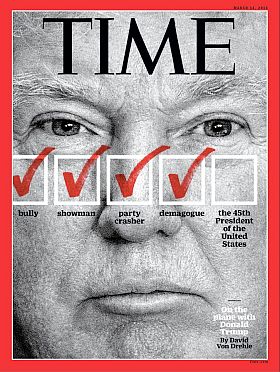
When Trump is asked if he had a favorite, Trump replies that he thought the recent issue of Time magazine (August 31, 2015) — showing him in a portrait-like pose, with the tag line, “Deal With It,” a generally positive story about his surprising rise in the Republican ranks via his unorthodox campaign style — was a “good one.” Some seven months later, however — as Trump was headed for the Republican nomination after months on the campaign trail revealing his tactics — he might not have thought the Time story and cover that appeared then (March 14th, 2016) was a “good one.” That issue, as shown below, had a close-up of Trump’s face filling the entire page with ballot-box check-off options displayed across the page, each separately labeled: “bully,” “showman,” “party crasher,” “demagogue” — all checked – and a remaining one, “the 45th President of the United States,” left unchecked. No, this magazine cover was likely not a candidate for Trump’s wall of greatest hits.

August 31, 2015 edition of Time -- a "good one."
March 14th, 2016 edition of Time -- maybe not so good.

Still, as those reporting on Trump would come to understand, all Trump media coverage – any coverage, in fact – is good coverage, as far as Trump is concerned. David Von Drehle, for example, reporting for Time in the “checked-boxes” issue, interviewed Trump aboard his plane as he campaigned, with Trump then laying out his media philosophy.

According to Von Drehle’s account: “what matters more than accuracy [to Trump] is the sheer fact of being covered. Own the airwaves, own the campaign, run the world. To be certain that I’ve grasped this point, he expands on the theme: ‘You see what this is, right? It’s ratings. I go on one of these shows and the ratings double. They triple. And that gives you power. It’s not the polls. It’s the ratings’.”

It’s as if Trump views his life as permanently on television, and he’s in a constant game of ratings – ratings secured by any means, honorable or not. P.T. Barnum, indeed. It’s the coverage, stupid!

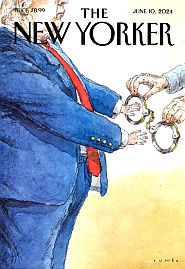
As magazine editors, artists and creative directors learned more about Trump as he campaigned and later governed, their covers of him became more overtly critical. Consider for example, a selection of some New Yorker covers: one from February 2016 with former presidents huddled around a TV with disapproving expressions while watching Trump speak; another from 2019 with prominent Republicans shining his shoes; and a third from June 2024 with Trump being handcuffed.

New Yorker: Feb 1, 2016.
New Yorker: June 3, 2019.
New Yorker: June 10, 2024.

The Economist, as well, has also offered critical and negative Trump imagery, as shown below: a December 2015 cover with the tag line “Playing With Fear,” as a Trump rendering is shown standing with anti-immigration populist politicians, Marine Le Pen of France and Viktor Orban of Hungary; an October 2016 cover heading into the U.S. Presidential election with the headline, “The Debasing of American Politics,” depicting Trump imagery and takeover effects on a stylized Republican elephant; and a February 2017 cover showing Trump in MAGA ball cap about to throw a Molotov cocktail, and headlined, “An Insurgent in the White House.”

The Economist: December 2015.
The Economist: October 2016.
The Economist: Feb 2017.

New York magazine, meanwhile, continued its coverage of Trump as he became president and thereafter, as a few samples below illustrate. One New York edition in early April 2018, for example, featured a close-up of Donald Trump’s laughing face, filling the entire page, but also fitted with pig’s snout. In small white type, at three places on the cover, the title begins: “Not Collusion… Not Incompetence…. Not Cruelty… It’s The Corruption, Stupid: Why Self-Dealing Is His Biggest Political Liability.” Inside that edition, a collection of stories were focused on then Trump Administration corruption.

2018: New York's April 2-15 edition, focused on corruption in the Trump Administration.
2020: New York September 14-27 edition, “Defeating Trump in November Will Not Be Enough.”
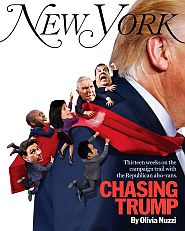
2023: October 9-22 edition, “Chasing Trump” - 13 Weeks on the Campaign Trail with Republican Also-Rans.

New York editor, Eric Bates, explained how the idea for the April 2018 cover first arose: “Reading the news every day, we were struck by the constant drip-drip of reports of corruption by the Trump administration. We wanted to find a way to bring together all the ways that Trump and his circle are using the presidency to enrich themselves into one comprehensive list — something that would drive home the unprecedented scale and of the self-dealing and thievery. It was clear that Trump hasn’t drained the swamp — he’s just cornering the market on it.” The two additional New York covers shown above include a September 2020 cover that features Trump in a swearing-in pose in a court-like setting or hearing room with the tagline: “The Case For Consequences: Defeating Trump in November Will Not Be Enough (September 14 – 27, 2020 edition). And an October 2023 New York cover showing the scramble of Republican candidates trying to challenge Trump for the 2024 Republican nomination with tag line, “Chasing Trump.”
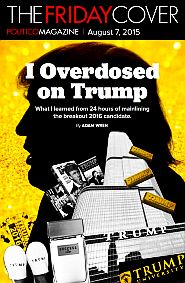
Politico.com magazine, Friday Cover, August 7, 2015.
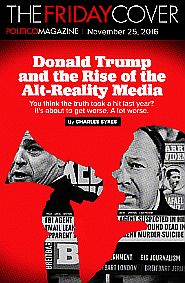
Politico.com magazine, Friday Cover, November 25, 2016.
Politico.com magazine, Friday Cover, October 7, 2016.

And then there is Politico.com, the online digital news magazine on politics. Shown above are three sample “Friday Covers” from Politico Magazine on Trump — among dozens at Politico on Trump since 2015. The first, above left, is an August 15, 2015 edition with the title line, “I Overdosed on Trump: What I Leaned From 24 Hours of Mainlining The Breakout 2016 Candidate,” by Adam Wren. A second sample, from November 25, 2016, “Donald Trump And the rise of the Alt-Right Media: You Think the Truth Took A Hit Last Year? It’s About To Get Worse. A Lot Worse,” by Charles Sykes. And a third sample with the title, “Trump and The Crash of ‘08: The Celebrity Developer Says He Called the Financial Crisis. Here’s What Really Happened,” by Michael Kruse.

“Trumpian Truths”
Michael Kruse & Politico.com
October 2020

1. Attention is power.
2. Words don’t matter.
3. Everything’s a show.
4. People are props.
5. The crowd knows.
6. Conflict is the key.
7. Nothing motivates like fear.
8. Division works.
9. Life’s a fight.
10. Chaos is fuel.
11. There’s no such thing as
+++going too far.
12. Bigger is always better.
13. The answer to any problem
+++is always more Trump.
14. Exhaust the enemy.
15. It’s good to be selfish.
16. Altruism is for losers.
17. Trusting is for losers.
18. Loyalty is for losers.
19. Taking blame? For losers.
20. Losing is for losers.
21. Sometimes winning means
+++not losing now.
22. Sometimes winning is just winning
+++that hasn’t happened yet.
23. And sometimes winning is whining.
24. Reality doesn’t matter.
25. The past doesn’t matter.
26. The future doesn’t matter.
27. Nothing, actually, matters.
28. Create your own world.
29. Tell your own story.
30. Shame is for losers.
31. There is no subtext.
32. Everything’s a transaction.
33. Nothing’s on the level.
34. The ends justify the means.
35. You can’t be stopped if nobody
+++stops you.
36. People aren’t inherently good.
37. People look out for themselves.
38. People don’t change.
39. You are who you are.
40. No slight is too small.
41. Never turn the other cheek.
42. Nothing worse than weakness.
43. The loneliness is bottomless.
44. Everybody needs to be seen.
45. Nothing’s ever over.

Like New York magazine’s “Trump Dump,” Politico did something similar with its Trump reporting by Michael Kruse, who covered Trump extensively for more than five years, filing more than 60 stories.

On the eve of the November 2020 election, Politico and Kruse assembled some 46 of their “Friday Covers” as visual aide, as Kruse then wrote a detailed piece listing “45 Self-Evident Truths About Donald Trump.”

Kruse also explained the scope of his October 29, 2020 piece with an introduction, as follows below, in part:

…It has been well-documented that the 45th president operates with evident disregard for norms and rules. But over the past 5 ½ years of reporting I have determined that he abides by a firm code of conduct as predictable as it is confounding. In more than 60 stories in the Politico Magazine oeuvre that came to be known as “Trumpology,” I documented how his unswerving allegiance to a certain set of principles, unprincipled as they might seem to some, elevated him to the pinnacle of global power. If widespread polling holds true on Election Day, these same traits and tics, and rock-ribbed beliefs, might also be the reasons he’s ousted from office.

Much has been made recently of this election [i.e., 2020 election] as a referendum on the president not just as a politician with a set of policies, but as a person. This list—compiled using excerpts from my pieces and my interviews with sources who have known him most of his life—is the distillation of his worldview, a condensed sketch of Donald Trump as a man. And no matter what happens, and whether or not he retains his grip on the White House or decamps in defeat to Mar-a-Lago, these truths will continue to guide his behavior—and the way we perceive it.

Displayed here in the sidebar at right are the section heads only from the Kruse/Politico story of October 29, 2020. Readers are encouraged to go there via this linked title, “45 Self-Evident Truths About Donald Trump,” for the full story.

* * * * *

Politico’s Trump stories, as well as the New York magazine stories and others profiled here, are, of course, only a portion of the larger media world following Donald Trump since he began his rise in the 1970s. While the focus here has been largely on magazines, there are also countless books about Trump and a number of documentary films about him – all covering his biography, his business history, his campaign history, his presidential term, and more. Some of these are listed and shown below in “Sources.”

As this story is posted in early September 2024, the November presidential election is nearly two months away. And likely battles over Trump’s yet-to-be-resolved legal issues are still to come as well, some possibly stretching well into 2025. So there will certainly be continued media coverage of the Trump circus, with magazines, tabloids, TV, and social media all doing their part to capture all the Trumpian news, imagery, entertainment and outrage likely to come. Yet for sure, during the last decade or so, much gratitude is owed to the Fourth Estate for investigating, reporting, and doing its best to reveal and hold to account the real Donald Trump and the risks he poses still for our nation going forward. Hopefully, the results to come this November will bring us closer to historic political normalcy than what we’ve had since Trump’s arrival.

See also at this website, “Trump on Film: A Partial Listing, 1990-2024,” covering some 30 Trump films. For additional stories on Publishing and/or Politics, see those respective category links. There is also a separate “Topics page” on Magazine History.

Thanks for visiting – and if you like what you find here, please make a donation to help support the research, writing, and continued publication of this website. Thank you. – Jack Doyle.

Please Support
this Website

Donate Now

Thank You

____________________________________

Date Posted: September 8, 2024
Last Update: September 18, 2024

Comments to:+ jackdoyle47@gmail.com
Twitter: https://twitter.com/PopHistoryDig
BlueSky: jackdoyle.bsky.social

Article Citation:
Jack Doyle, “The Trump Dump: New York Magazine,
2016,”PopHistoryDig.com, September 8, 2024.

____________________________________


Related Books & Film at Amazon.com


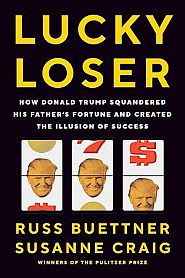
New book, Sept 2024 > How Trump Squandered a Fortune & Created the Illusion of Success. Click for Amazon.
“The Accidental President,” 2021 documentary film on how Donald Trump won the 2016 election. Click for film,
Charles J. Sykes’ book, “How the Right Lost Its Mind,” w/George Will blurb, 2018 edition, Click for Amazon.


Sources, Links & Additional Information
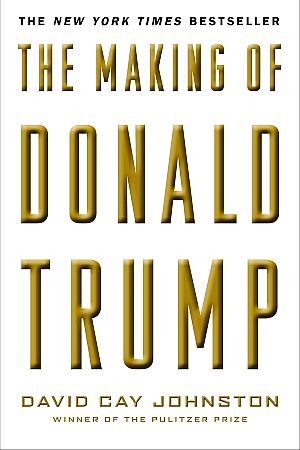
Pulitzer Prize- winning reporter, David Cay Johnston’s 2016 book, “The Making of Donald Trump,” 286 pp. One review noted the book “carefully fleshes out the details of Trump's known biography...with solid documentation.” Click for copy.
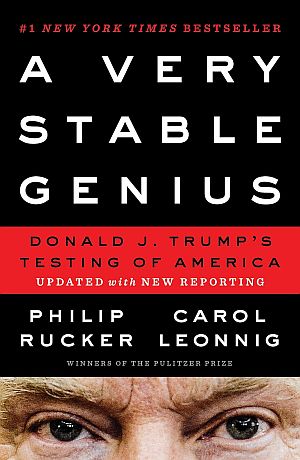
Philip Rucker & Carol Leonnig’s book, “A Very Stable Genius: Donald J. Trump's Testing of America,”  2021 paperback edition, Penguin Books, 512 pp.  Click for copy.
Philip Rucker & Carol Leonnig’s book, “A Very Stable Genius: Donald J. Trump's Testing of America,” 2021 paperback edition, Penguin Books, 512 pp. Click for copy.
PBS Frontline documentary, “Trump's Road to the White House,” an investigation of how Donald Trump defied expectations to win the presidency in 2016. Through interviews with key players, the film shows how Trump rallied millions of supporters, defeated adversaries, and who he brought with him to the White House. Click for DVD.
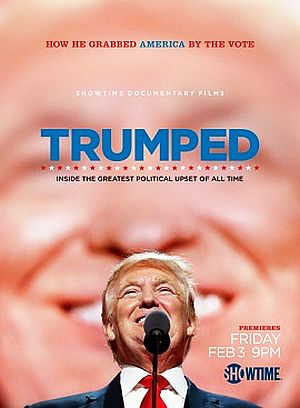
2017 documentary “Trumped: Inside the Greatest Political Upset of All Time,” w/ Mark Halperin, John Heilemann & Mark McKinnon who follow the rise of Trump from the primaries & debates to election night 2016. Click for Amazon.
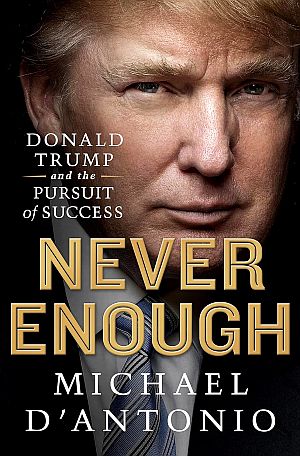
Michael D'Antonio’s 2015 book, “Never Enough: Donald Trump and the Pursuit of Success,” Thomas Dunne Books, 400 pp. Click for Amazon.
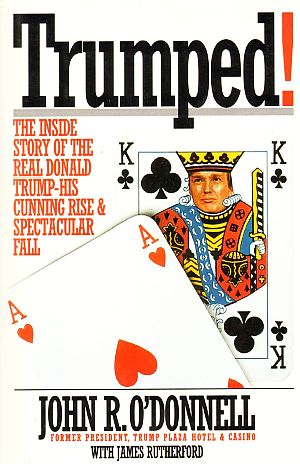
John R. O'Donnell, former President of Trump Plaza Hotel & Casino, tells his story in 1991 book, “Trumped!: The Inside Story of the Real Donald Trump - His Cunning Rise and Spectacular Fall,” Simon & Schuster. Click for copy.
PBS/Frontline 2018 documentary film, “Trump's Takeover,” reporting on President Trump's battle for control of the GOP in his first year as President. Click for Amazon.
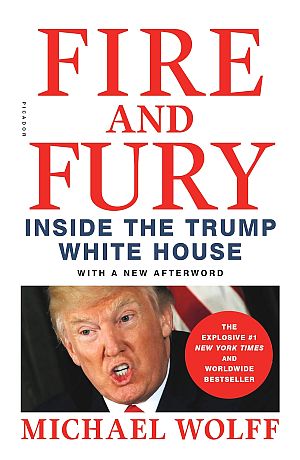
Michael Wolff’s best-selling 2018 book, “Fire and Fury: Inside the Trump White House,” 352 pp. Click for Amazon.
Bob Woodward’s 2018 best-seller, “Fear: Trump in the White House,” Click for Amazon.
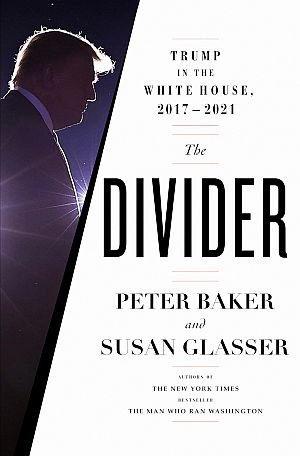
Peter Baker & Susan Glasser’s 2022 book, “The Divider: Trump in the White House, 2017-2021,”Doubleday,  752 pp.  Click for Amazon.
Peter Baker & Susan Glasser’s 2022 book, “The Divider: Trump in the White House, 2017-2021,”Doubleday, 752 pp. Click for Amazon.
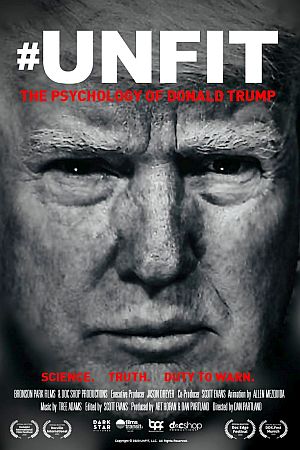
2020 documentary film, “Unfit: The Psychology of Donald Trump.” Is Donald Trump fit to hold the office of President?  Analysis of Trump by leading U.S. mental health professionals and Republican strategists. 1 hr 24 min, Click for Amazon.
2020 documentary film, “Unfit: The Psychology of Donald Trump.” Is Donald Trump fit to hold the office of President? Analysis of Trump by leading U.S. mental health professionals and Republican strategists. 1 hr 24 min, Click for Amazon.
Congressman Jamie Raskin’s 2022 bok, “Unthinkable: Trauma, Truth, and the Trials of American Democracy,” Harper, 448 pp.  Click for Amazon.
Congressman Jamie Raskin’s 2022 bok, “Unthinkable: Trauma, Truth, and the Trials of American Democracy,” Harper, 448 pp. Click for Amazon.
“The January 6th Report” (December 2022), The Select Committee to Investigate the January 6th Attack on the U. S. Capitol, Preface by The New Yorker’s David Remnick and Epilogue by Congressman Jamie Raskin. Click for Amazon.
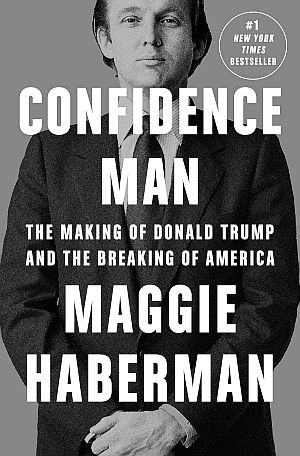
New York Times reporter, Maggie Haberman’s 2022 book, “Confidence Man: The Making of Donald Trump and the Breaking of America,” Penguin, 608 pp. Click for Amazon.
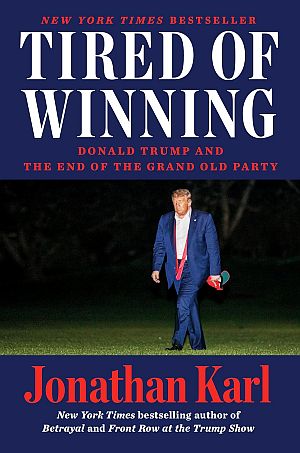
Jonathan Karl’s 2023 book, “Tired of Winning: Donald Trump and the End of the Grand Old Party,” Dutton, 336 pp.  Click for Amazon.
Jonathan Karl’s 2023 book, “Tired of Winning: Donald Trump and the End of the Grand Old Party,” Dutton, 336 pp. Click for Amazon.
Anthony T. Michalisko’s 2018 book, “President Trump's Tweets 2016: General Election Edition,” 253 pp.  Click for Amazon.
Anthony T. Michalisko’s 2018 book, “President Trump's Tweets 2016: General Election Edition,” 253 pp. Click for Amazon.

Donald Trump, Best-Selling Books page at Amazon .com. Click to visit.

Andrew Rice and Nick Tabor, “Our Trump Dump: New York Magazine’s Look Back on the GOP Prince’s Days as an NYC Clown,” New York, January 29, 2016.

“Developer [ i.e., Donald Trump] Proposes a Convention Center in Midtown,” New York Times, December 18, 1975, p. 49.

Dan Dorfman, The Bottom Line, “Will New York Get A New Hotel; The Trump-and-Tisch Tiff,” New York, April 26, 1976, pp 11 -12.

Wayne Barrett, “How a Young Donald Trump Forced His Way from Avenue Z to Manhattan,” The Village Voice (originally published: January 15, 1979).

Howard Blum, “Trump: The Development of a Manhattan Developer,” New York Times, August 26, 1980, pp. B-1, B-4.

Marie Brenner, “Trumping The Town,” New York, November 17, 1980, pp. 26-37.

“Trump’s Spectacular,” New York, May 2, 1983, pp. 30-31.

Marylin Bender, “The Empire and Ego of Donald Trump,” New York Times, August 7, 1983, Section 3, Page 1

By William E. Geist, “The Expanding Empire of Donald Trump,” New York Times Magazine, April 8, 1984, Section 6, p. 28.

Martin Gottlieb, “Trump Says He Wants to Build World’s Tallest Tower at East Side River Site,” New York Times, July 31, 1984, p. B-1.

Carter Wiseman, Cityscape, “Donald Trump’s Fantasy Island,” New York, January 20, 1986, pp, 51-53.

George James, “Trump Drops 5-Year Effort to Evict Tenants,” New York Times, March 5, 1986.

Peter Blauner, “Ice Capades: Donald Trump Takes on the Wollman Rink,” New York, June 23, 1986. p. 25.

“Will The Peacock Roost in Jersey” [re: Trump & TV City], New York, September 8, 1986, p. 15.

Intelligencer, ”Trump Getting New Park View,” New York, October 20, 1986, p. 13.

Joe Klein, “Koch Agonistes: The Mayor and the Big Questions,” New York, July 13, 1987, pp, 29-32.

“Trump Stages a Campaign Event in New Hampshire,” Boston.com, October 1987.

“Trump: The Art of the Deal,” [and Tony Schwartz], Wikipedia.org.

Julie Baumgold, “Mr. Lucky and The Champs: Going To The Big Fight With Donald Trump,” New York, February 15, 1988, pp. 34-40.

Sarah Bernard, “The Plaza Lives!”, New York, April 21, 2005.

Liz Smith, “Donald Trump – Because His Buildings And His Books And His Ego Are So Much Bigger Than Life” (part of New York’s 20th Anniversary Special Featuring “The Top 20: The Most Important New Yorkers for 1988″), New York, April 25, 1988, pp. 113-114.

Intelligencer, “Trump Takes The Pepsi Challenge,” New York, June 13, 1988, p. 13.

David Johnston and Michael Schurman, “Trump’s Ship Comes In – To Cheers” [Atlantic City, NJ], Philadelphia Inquirer, July 10, 1988.

John Taylor, “Trump’s Newest Toy,” New York, July 11, 1988, pp.20-26.

Bill Barol, “Trump Ahoy; The World’s Most Buoyant Billionaire Unveils His New Plaything; The World’s Most Luxurious Yacht,” Newsweek, July 18, 1988. Pp. 62-63.

William H, Meyers, “The Great Plaza Plot: Jockeying for One of the World’s Great Hotels,”(In the Global Bidding for the Old Hotel, Robert Bass Won Out, But Donald Trump Persevered), The Business World / New York Times Magazine, September 25, 1988.

Intelligencer, “Him Again: Donald’s Depart-ment Stores,” New York, December 12, 1988, p. 13.

John Taylor, Circus of Ambition: The Culture of Wealth and Power in the Eighties, 1989.

Otto Friedrich, “Flashy Symbol of an Acquisitive Age: Donald Trump; Young, Handsome and Ridiculously Rich, Donald Trump Loves Making Deals and Money, Loathes Losing and Has an Ego as Big as the Ritz — er, Plaza,” Time, January 16, 1989.

James Barron, “TV Film on Trump Can’t Find a Station,” New York Times, August 19, 1989, p. 27.

Edwin Diamond, “Trump vs. Stern: The Unmaking of A Documentary,” New York, September 4, 1989, pp, 30-38.

“Trump: What’s the Deal?,” Wikipedia.org.

John Taylor, “Trump The Soap; Stay Tuned…”(cover story), New York, March 1990, pp. 30-37.

“Best Sex I’ve Ever Had,” Wikipedia.org.

Edwin Diamond, Media, “Trump Week: Bonfire of The Inanities,” New York, March 5, 1990, pp, 22-23.

“How Much is Donald Trump Really Worth Now?” (cover story), Forbes, May 14, 1990.

Joanna Molloy, Intelligencer, “Trump’s Book: The Forbes ‘Bombshell’,” New York, May 21, 1990, p. 11.

John Taylor, “Fantasy Island: My Weekend at The Taj,” New York, May 21, 1990, p. 48-55.

Christopher Byron, The Bottom Line, “Trump Is US: Signs of A Shrinking City Economy,” New York, June 18, 1990, pp. 18, 22.

Marie Brenner, “After the Gold Rush, Unfortunately for Donald and Ivana Trump, All That Glittered Wasn’t Gold. But the Reign of New York’s Self-Created Imperial Couple Isn’t over Yet. Donald’s Midas Touch May Be Tarnished, but the Banks Are Still Throwing Money at Him, While Ivana Is Busy Brokering a Future of Her Own,” Vanity Fair, September 1990.

Michael Gross, “Ivana’s New Life,” New York (cover story), October 15, 1990, pp. 40-50.

“Trump Castle Complaint; NJ Casino Control Commission Complaint Regarding Fred Trump’s Purchase of $3.5 Million in Chips.” Scribd.com, April 1991.

Christopher Byron, The Bottom Line, “Who’s Laughing Now? Trump Stays Afloat,” New York, April 22, 1991, pp.19-20.

Susan Heller Anderson, “Chronicle,” New York Times, July 5, 1991, p. D-6.

David S. Hilzenrath and Michelle Singletary, “Trump Went Broke, But Stayed on Top; Fearing a Bankruptcy Quagmire, Lenders Made Deals with Developer,” Washington Post, November 29, 1992.

Lisa Birnbach, Cover tagline: “An Exclusive Weekend with Donald Trump in Palm Beach As He Hypes (and hypes and hypes) his Mar-a-Lago Club,” New York, February 12, 1996.

Wayne Barrett, Trump: The Deals and the Downfall, 1992. Click for Amazon.

Julie Baumgold, “Fighting Back: Trump Scrambles Off The Canvas,” New York, November 9, 1992, pp. 36-46.

Craig Horowitz, “Trump Gets Lucky (cover story); The King of Hype Almost Bit It. Now, Thanks to a Very Sweet Deal with Some Chinese Billionaires to Develop the West Side Rail Yards, He’s Starting to Get Back That 1980s Smirk,” New York, August 15, 1994, pp. 20-26.

“Trump World,” New York, January 16, 1995, p.14.

Hugo Lindgren, Cityside, “Railroaded: The Rail Yard Was Supposed To Give Donald Trump Sixteen Luxury Towers and The City A Waterfront Park. Two Bad a Highways Runs Through It,” New York, March 17, 1997, pp. 28-29.

Chris Smith, “The Main Event: How Whitman Ended Up Getting Trumped,” New York, November 3, 1997.

Associated Press (NY), “Donald Trump Regretting Not Asking Out Princess Diana,” Daily News (Bowling Green, KY, Sunday, November 2, 1997, p. 16-C.

Claire Duffin, “’He Gives Me the Creeps’: What Princess Diana Said about Donald Trump after He ‘Bombarded Her with Flowers When Her Marriage Broke Up’,” The Daily Mail (UK), August 16, 2015.

Johanna Berkman, “Fashion Faux Pas,” New York, February 8, 1999.

Herbert Muschamp, “Trump, His Gilded Taste, and Me… Architecture as Personality,” New York Times, Arts & Leisure, Sunday, December 19, 1999, pp. 1, 52.

Walter Kirn, “In Trump We Trust” (review of Trump book, The America We Deserve), “Trump’s platform? Arrest Castro; Oprah in the Cabinet; No hotels for China, among other modest proposals,” New York, January 17, 2000.

Andrew Rice, “The Tummler of Turtle Bay: As Trump Monster Surpasses U.N., Alberto Vilar Puts Up $1 Million,” Observer.com, March 6, 2000.

James Traub, “Trumpologies,” New York Times Magazine, September 12, 2004.

Jonathan Van Meter, “Growing Up Trump: How Did Don Jr., Ivanka, and Eric Survive New York’s Weirdest Family” (cover), New York, December 13, 2004.

Lloyd Grove, “Can Barbara Walters’s Career Survive Rosie and Donald’s War?– Barbara Falters,” NYmag.com, March 5, 2007.

“Donald Trump on Failure, “ May 19, 2009, from “The Failure Interview Series; 9 Prominent People Talk About Their Failures,” PsychologyToday.com, May & July, 2009.

Gabriel Sherman, “The Legacy” [Jared Kushner], New York, July 10, 2009.

Jessica Pressler, “If I Can’t Trust Donald Trump, Who Can I Trust?,” New York, January 21, 2011.

“Trump Sends Investigators to Hawaii to Look Into Obama,” CNN.com, April 4, 2011.

Jim Swift, “Trump: The Documentary,” WashingtonExaminer.com, August 1, 2015.

Michael Scherer, “The Donald Has Landed: Deal With It; Trump’s 2016 Hit Show Is Driving the Political Elite Crazy,” Time, August 20, 2015 (story date). Final issue with Donald Trump cover photo, August 31, 2015 (original story also incorporated 8 short videos with Trump).

“Donald Trump Is…13 Historians Scour the Past for Trumpian Precedents,” Politico Magazine / Politico.com, August 29, 2015.

S.V. Dáte, “The 1 Easy Way Donald Trump Could Have Been Even Richer: Doing Nothing By Putting His Inheritance into the Stock Market Back in the 1970s, Trump Might Have Been ‘Really Rich’ Without All the Drama,” NationalJournal.com, September 2, 2015.

Michael Barbaro, “Donald Trump, Praised by Former President Nixon, Biography Says; Former President Richard Nixon Sent Donald Trump a Letter in 1987,” New York Times, September 8. 2015.

Michael Barbaro, “Donald Trump Likens His Schooling to Military Service in Book [Never Enough],” New York Times, September 8, 2015.

Frank Rich, “Donald Trump Is Saving Our Democracy: The Importance of Donald Trump,” NYmag.com, September 20, 2015.

William D. Cohan, “Decades-Old Questions Over Trump’s Wealth and Education,” New York Times, September 28, 2015.

“Trump’s Alliance With National Enquirer,” New York, October 2015.

Graydon Carter, “Steel Traps and Short Fing-ers… Graydon Carter Reveals the Presidential Candidate’s Thin-Skinned Response to a Favorite 25-Year-Old Epithet, VanityFair .com, October 7, 2015.

Gabriel Sherman, “Donald Trump’s Alliance With the National Enquirer,” NYmag.com, October 30, 2015.

David Von Drehle, “Donald Trump’s Wild Ride,” Time.com, March 3, 2016.

Charlotte Triggs and Sandra Sobieraj Westfall, Cover story, “Who Is the Real Donald Trump? ‘I’m a Much Nicer Person Than People Would Think,’ He Insists; Donald Trump Speaks to People About His Presidential Campaign – and Controversy,” People.com, March 30, 2016.

Jonathan Mahler, “Tenants Thwarted Donald Trump’s Central Park Real Estate Ambitions,” New York Times, April 18, 2016.

Susan Mulcahy, “Confessions of a Trump Tabloid Scribe; How New York’s Gossip Pages Helped Turn a Lying Real Estate Developer into a Celebrity Phenom,” Politico.com, April 29, 2016.

Manuela Tobias, Optics, “Shameless Mogul Found in Breathless Tabs! A Quarter-Century of Donald Trump in the Tabloids,” Politico.com, May/June 2016.

Michael Kruse, “Tales From the Tabloids: Six New York Writers Remember the Donald’s Early Years in the Public Eye,” Politico.com, May/June 2016.

Jane Mayer, “Donald Trump’s Ghostwriter Tells All,” The New Yorker, July 25, 2016.

Callum Borchers, “Donald Trump Should Hate This Time Magazine Cover, But He’ll Probably Hang it in His Office,” Washington Post / WashPost.com, August 11, 2016 (with video, Dan Balz, “Donald Trump Gives Us A Tour of His Trump Tower Office,” Washington Post video, 2:32 minutes, 2015).

“The Many (Magazine) Faces of Donald Trump,” Time.com, September 2, 2016 [sample covers].

The Data Team, Tracking Trump, Presidential Candidate, “Donald Trump’s Rise Seen Through the Economist’s Covers; From Novelty Outsider to Republican Presidential Candidate,” The Economist / Economist.com, October 13th, 2016.

Christopher Bonanos, “A History of the Trumps on New York’s Cover,” New York, October 31, 2016.

David Cay Johnston, “Trump: Documentary The Donald Suppressed, Free At Last”, The National Memo, August 1, 2015.

Jesse Kornbluth, “25 Years Ago, A Documentary Called ‘Trump: What’s the Deal?’ Told The Truth About Trump. Trump Threatened To Sue. It Was Never Shown. You Can See It Now,” The Huffington Post, April 19, 2016.

Charlie Lyne, “Trump: What’s the Deal?: a distinctly 90s takedown,” The Guardian, August 15, 2015.

“Trump’s Crazy Rise, in 22 Magazine Covers; How Magazines Around the World Have Documented Trump Since He Began His Political Ascent,” Politico.com, May/June 2017.

Collection by Lynnette Heber, “Magazine Covers on Trump,” Pinterest.com, 43 Pins.

“The Life of Donald Trump — Told Through New York Post Covers,” HollywoodReporter .com.

Rahel Gebreyes, “Mike Tyson Just Endorsed Donald Trump; ‘He Should Be President of the United States’,” HuffPost.com, October 26, 2015.

Alex Kuczynski, “Melania Trump’s American Dream; Donald Trump’s First Lady Talks Candidly about Her Husband’s Controversial Presidential Bid, the Secrets to Their Happy Marriage, and Why She’s Stayed out of the Spotlight—Until Now,” HarpersBazaar.com, January 6, 2016,

Peter Grant and Alexandra Berzon, “Trump and His Debts: A Narrow Escape; He Cut Deal with Banks, Took Cash out of Casinos to Weather 1990s Bind,” Wall Street Journal /WSJ.com, updated January 4, 2016 ( w/video).

Ike Swetlitz, “Donald Trump, Bad Science, and the Vitamin Company That Went Bust,” Stat.com, March 2, 2016; originally published on Nov. 4, 2015 (w/video).

Kyle Ligman, “The Trump of Magazines Past,” New York Times, May 18, 2016.

Frank Rich, “Trump’s Appeasers; Why Charles Lindbergh is a Cautionary Tale for Republican Leaders,” NYmag.com, October 31, 2016.

Michael Scherer, “2016 Person of the Year: Donald Trump,” Time, December 19, 2016.

Jonathan Chait, “How the Loyal Opposition Will Work in Trump’s America,” NYmag.com, November 2016.

Caitlin Flanagan, “The People’s Princess Ivanka Trump Is Hard at Work in Washington — But for Whom?,” TheCut.com, May 2017.

David A. Fahrenthold, “A Time Magazine with Trump on the Cover Hangs in His Golf Clubs. It’s Fake; Breaking Down Trump’s Fake Time Magazine Cover,” Washington Post, June 27, 2017 ( w/video).

Kalhan Rosenblatt, “Time Asks Donald Trump’s Golf Clubs to Remove Phony Magazine Cover; Trump Has Repeatedly Appeared on the Cover of Time in the Last Year. But the Cover Hanging in at Least Four of His Clubs Is a Phony,” NBCnews.com, June 28, 2017.

Jake Nevins, “’As a Satirist, I Can Barely Keep Up’: The Stories Behind the Trump Magazine Covers, The Artists Who Have Found Inspiration, and a Deep Well of Satire, in a Chaotic Administration Reveal the Thinking Behind Some of the Most Notable Covers of the Past Seven Months,” TheGuardian.com, August 24, 2017.

Aude White, “On The Cover: It’s The Corruption, Stupid,” NYmag.com, April 2018.

Jonathan Greenberg, “Trump Lied to Me About His Wealth to Get onto the Forbes 400. Here Are the Tapes; Posing as ‘John Barron,’ He Claimed He Owned Most of His Father’s Real Estate Empire,” WashingtonPost.com, Outlook, April 20, 2018.

Nick Hilton. “A Visual History of Trump Magazine Covers, A Thematic Organization of How Trump Has Been Illustrated by the Media, from Pre-Election to Now,” Medium.com, April 23, 2018.

David Barstow, Susanne Craig and Russ Buettner, “Trump Engaged in Suspect Tax Schemes as He Reaped Riches from His Father; The President Has Long Sold Himself as a Self-Made Billionaire, But a Times Investigation Found That He Received at Least $413 Million in Today’s Dollars from His Father’s Real Estate Empire, Much of it Through Tax Dodges in the 1990s,” NYTimes.com, October 2, 2018.

Dan Alexander, “Why We Took Trump Off The Forbes 400 During His Decade Of Tax Losses,” Forbes.com, May 8, 2019.

Russ Buettner and Susanne Craig, “Decade in the Red: Trump Tax Figures Show over $1 Billion in Business Losses; Newly Obtained Tax Information Reveals That from 1985 to 1994, Donald J. Trump’s Businesses Were in Far Bleaker Condition than Was Previously Known,” NYTimes.com, May 8, 2019.

Michael Kruse, “The Escalator Ride That Changed America: It Seemed like a Stunt When Donald Trump Rode Down to Make His Presidential Announcement, And Maybe it Was. But Nothing Would Be the Same Again. The Full Oral History of That Moment, From People Who Were There,” Politicao.com, June 14, 2019.

Michael Kruse, The Friday Cover, “Trump’s Art of the Steal: How Donald Trump Rode to Power by Parroting Other People’s Fringe Ideas, Got Himself Impeached for It — and Might Prevail Anyway,” Politico.com, January 10, 2020.

Aude White, On The Cover: “Inside Trump’s Reelection Campaign,” NYmag.com, Aug. 16, 2020.

Michael Kruse, Trumpology, “45 Self-Evident Truths About Donald Trump; After Five Years, We Have Learned Who He Really Is,” Politico.com, October 29, 2020.

D.W. Pine (Creative Director at TIME), “The Stories Behind Donald Trump’s TIME Covers,” Time.com, January 19, 2021.

“The Trump Era in Covers; Our Editors Pick out 13 Covers That Chronicled a Presidency like No Other,” The Economist, January 19th, 2021.

Mary Trump’s best-selling 2022 book, Too Much and Never Enough: How My Family Created The World’s Most Dangerous Man, Simon & Schuster, 240 pp. Click for copy.

Dan Alexander, “Donald Trump Drops Off The Forbes 400 For Second Time In 3 Years; As the New York Attorney General Accuses Donald Trump of Fraud, Forbes Answers the Question at the Heart of the Case: What Is He Really Worth?,” Forbes.com, October 3, 2023,

Patrice Taddonio, “Jan. 6, Three Years Later: 10 Documentaries to Watch,” PBS.org/WGBH, January 5, 2024.


Books at Amazon.com

Cropped cover of Melissa Murray / Andrew Weissmann book on Trump Indictments. Click for copy.
Sen. Amy Klobuchar’s 2022 book, “Antitrust: Taking on Monopoly Power...,” Click for copy.
Liz Cheney’s 2023 book, “Oath and Honor: A Memoir and a Warning.”  Little, Brown, 384 pp. Click for copy.
Liz Cheney’s 2023 book, “Oath and Honor: A Memoir and a Warning.” Little, Brown, 384 pp. Click for copy.

“Murdoch’s NY Deals”
1976-1977

Jan 17, 1977: Rupert Murdoch depicted on Time magazine cover as the invading King Kong of New York publishing world, with Time’s editors offering a Murdoch-esque news banner. Click for copy.
     In was mid-January 1977, and Jimmy Carter was about to be sworn in as President of the United States.  But in the newspaper and magazine business, the big news of the day was an audacious New York media grab by a then little-known Australian newspaper mogul named Rupert Murdoch.

By late January 1977, Murdoch would own two premier New York media companies: the New York Post newspaper and New York Magazine Co., which then published three magazines: New York, The Village Voice, and New West.

     Rupert Murdoch in the 1970s was just getting started on his global media empire, and by today’s standards, his 1976-77 New York acquisitions seem tame. Yet these deals, and the changes Murdoch undertook with them at the time, shook things up in the media print world and hinted at his grander plans ahead.

In later years, Murdoch would create the Fox television network and acquire the Wall Street Journal, among other properties. His 1976-77 deals, though, were the first signs that Murdoch would be a determined player in the U.S. market. 

These New York deals, however, were not the first Murdoch had made in America.

Murdoch and wife Anna in Texas, 1973.
     In 1973 he acquired two newspapers in Texas — The San Antonio Express and The San Antonio News — for $18 million.  The following year, he entered the U.S. supermarket tabloid business launching a brand new paper then called The National Star.  More on these later.

     By 1976, however, Murdoch had set his sights on the bigger eastern cities.  He had looked at the possibility of acquiring some major women’s magazines, such as Redbook and Ladies’ Home Journal.  But he was also considering starting a daily paper in either New York City or Boston, and that’s when the New York Post became available.

     The New York Post had roots that dated to 1801, and one of its founders was Alexander Hamilton. For years it was known as the New York Evening Post, and described itself as the nation’s oldest, continuously-published daily newspaper.


The New York Post

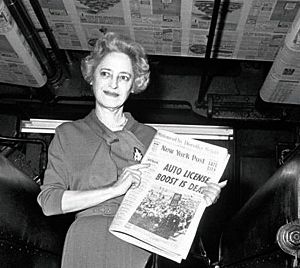
Dorothy Schiff, the publisher of The New York Post, with the presses running overhead in 1963.
At the time Murdoch became interested in the New York Post it was owned by Dorothy Schiff, the granddaughter of Jacob H. Schiff, a New York city financier and social welfare advocate.  Dorothy Schiff had purchased the paper in 1939.  Under her tenure the New York Post was devoted to liberalism, supporting trade unions and social welfare.  It was the only New York City daily to support Adlai Stevenson, the Democratic candidate for president, in 1952 and 1956.  Among some of its popular columnists were: Drew Pearson, Eleanor Roosevelt, Max Lerner, Murray Kempton, Pete Hamill, Earl Wilson and Eric Sevareid.  It also had well a respected theater critic and Broadway columnist.  Under Schiff’s direction, the paper increased its circulation by two thirds.  The Post had undertaken stories critical of New York master builder Robert Moses, “slum clearance,” and J. Edgar Hoover, among others.  It is also known for its 17-part series on communist witch-hunter, U.S. Senator Joseph McCarthy —  headlined, “Smear, Inc.: Joe McCarthy’s One-Man Mob.”  By 1976, The New York Post was the only surviving afternoon daily in New York City, with a circulation of about 500,000.

     When Murdoch remarked to Schiff at one meeting that he was thinking about launching a new paper in Boston or New York, Schiff, then 73, told him she was thinking of selling the Post.  According to one account of the deal that followed, “Murdoch pounced, wrapping up the $30 million sale in three weeks of secret negotiations.”  He acquired the paper by late November 1976.


Dec 20, 1971.
Dec 20, 1971.
Apr 22, 1974.
Apr 22, 1974.
Mar 17, 1975.
Mar 17, 1975.
Aug 23, 1976.
Aug 23, 1976.

New York Magazine Co.

     After Murdoch made the Post deal, he moved next on the New York Magazine Co.  This company was run by Clay Felker, an innovative editor and writer who had worked at various newspapers and magazines including Life, Sports Illustrated, Time, Esquire, and The New York Herald Tribune.

     The flagship publication of the New York Magazine Co. was New York magazine, a weekly focused on culture, politics, and New York City style.  New York magazine was begun in 1964 by Felker as a Sunday supplement enclosed with The New York Herald Tribune.  After the Tribune folded in 1968, Felker and graphic designer Milton Glaser (who later invented the “I Love NY” logo) reintroduced New York as a glossy, stand-alone magazine.

     New York initially was intended to compete with The New Yorker  — and an earlier, scathing piece about the New Yorker’s “mumified” reporting in April 1965 when New York was still a Tribune supplement, had already set off a war between the two.

But New York magazine also became known for its own unique enterprise: helping launch and define what would be called the “new journalism” — a departure from the more objective norm of journalism to a form of narrative and point-of-view journalism relying on characters, dialogue, participant authors, and/or fictional devices.

Clay Felker in 1976 at ‘The Village Voice.’
     Felker was the visionary in the enterprise. The magazine, under his leadership, “set about revising the hierarchies of urban experience,” Sarah Bernard and Aaron Latham would write in a 2008 retrospective on New York magazine, continuing:

“Felker had observed something new happening in the city, and he’d brought his own outsider’s sense of romance and a fascination with power and status. The magazine he made had a new palette of interests, with no brow distinctions. Restaurants were as important as business, or politics. Everything that went on in a city dweller’s mind was something to be curious about.”

 
The magazine, with Milt Glaser’s help, also did clever things with design, text, and illustration, also departing from the norm. New York magazine would become a model for many city and other magazines that would follow it in years to come.

New York’s writers, editors, and contributors were some of the most talented to come out of the late 1960s and 1970s, including: Tom Wolfe, Jimmy Breslin, Nora Ephron, Kurt Andersen, Gloria Steinem, Gail Sheey, John Heilemann, Nick Cohn, Ken Auletta, Richard Reeves, Aaron Latham, Dick Schaap, Michael Kramer, John Simon, Pete Hamill, Gael Greene, Walter Bernard, Bill Flanagan, Anna Wintour, James Brady, Lally Weymouth, Andy Tobias, Judy Daniels, Laurie Jones, Nancy Newhouse, Nick Pileggi, Mark Jacobson, Robert Benton, Byron Dobell, Mimi Sheraton, Gael Greene, Dorothy Seiberling, Amanda Urban, Walter Bernard, and others. 

But Clay Felker was the visionary leader and editorial maestro. As Tom Wolfe would put it, “he created the hottest magazine in America in the second half of the twentieth century: New York.”

Milt Glaser & Walter Bernard at New York magazine offices pondering a cover design,  1974. (Photo: Cosmos Sarchiapone).
Milt Glaser & Walter Bernard at New York magazine offices pondering a cover design, 1974. (Photo: Cosmos Sarchiapone).
     New York in the 1960s and 1970s under Felker and Glaser covered the national topics of the day as well as New York’s cultural scene and its movers and shakers.

Tom Wolfe, wrote one of the magazine’s early features on 1960s’ psychedelic cultural renegade Ken Kesey and his band of pranksters, a story that later became the Wolfe novel, The Electric Kool-Aid Acid Test

Gloria Steinem wrote about women’s issues for New York.  She also wrote on the 1968 presidential election.  Felker helped her launch her own publication in 1971, MS magazine, using New York to launch a sample insert issue (see cover above). 

New York also covered New York sports stars, the arts, and national politics. In 1969, it did a story on Joe Namath, flamboyant quarterback of the New York Jets. In the 1970s, Richard Nixon and the Watergate scandal were covered closely. 

In 1976, Nick Cohn wrote a New York story titled, “Tribal Rites of the New Saturday Night,” an account of a young working-class Brooklyn guy who spent his evenings at a local disco club — a story that became a sensation and helped spawn the film Saturday Night Fever.

     The New York Magazine Co. also owned two other publications — The Village Voice and New West.  The Village Voice, originally established by writer Norman Mailer and others in October 1955, was merged with Felker’s company in 1974, continuing as The Village Voice.  The newest member of the New York Magazine group by 1977 was New West, which Felker had launched in Los Angeles, California in 1976, modeled after New York.  The circulation of each of the magazines at the time of Murdoch’s takeover in 1977 was as follows: New York, 375,000; the Village Voice, 162,000; and New West, 290,000.  So, how did Rupert Murdoch come to own this company?


Murdoch vs. Felker

Rupert Murdoch & Clay Felker in East Hampton, NY in the 1970s, when the two newspapermen were “pals.”
     Clay Felker had met Rupert Murdoch in the early 1970s at the home of Washington Post Chairman, Katharine Graham.  Felker, by this time had established his reputation as an innovator, and a gifted though somewhat erratic editor.  He and Murdoch got on well at first, and by some accounts became “great pals.”  In fact, Felker had introduced Murdoch to New York Post publisher Dorothy Schiff in 1974, at Felker’s East Hampton beach house.  The two newspaper men had explored the possibility of undertaking a few business ventures together.  Felker also confided in Murdoch about some difficulties he was having with his board of directors, as there had been some feuding about Felker’s “high living and low profits,” as one report later put it.  Felker wanted to be chairman of the New York Magazine Co., but his board denied him that post — as well as his demand for a salary increase and company purchase of his Manhattan duplex.  Felker had exceeded his budget for the launch of New West, and was reported as having spent lavishly on visiting staff, office space, and cut-rate introductory subscriptions.  Meanwhile, the New York Magazine Co. was a publicly-held company, and its stock in 1976 was not appreciating, as the company had suffered a loss.

Milton Glaser, Lally Weymouth, Clay Felker, and Katharine Graham in 1976. (Photo: Jill Krementz)
     Felker, then looking for some allies on his board, had asked Murdoch if he would be interested in buying a stake in the company. Some of Felker’s board members weren’t always cooperative and a few held sizeable stakes in the company. When Felker acquired the Village Voice in 1974, Carter Burden, the former owner of the Voice, received about 24 percent of the New York Magazine Co. stock.  Murdoch told Felker he would be happy buy into the New York Magazine Co., but he wanted control of the company, which Felker would not agree to.  The strategy of enlisting Murdoch’s help was soon dropped by Felker — but not Murdoch.

     Murdoch saw another publishing asset to add to his New York base and began negotiating directly with the top shareholders at the New York Magazine Co.  He wanted the whole company.  Felker then sought allies in defense of Murdoch’s moves, eventually enlisting Katharine Graham of the Washington Post, who agreed to match Murdoch bid for bid — starting at $7 a share, then $7.50, then $8.25, matching his offers.  But Murdoch by January 1, 1977 made a direct deal with Carter Burden, who then held the largest chunk of the company.  Murdoch also lined up more than a dozen other shareholders in the New York Magazine Co. and soon held over 50 percent of the company.  In the end, Murdock paid something on the order of $7.6 million for the New York Magazine Company.

Clay Felker addressing the troops at the Village Voice amidst Rupert Murdoch takeover in 1977. (Photo: James Hamilton).
     Felker had tried a variety of strategies to stop Murdoch, and at one point did get a temporary injunction from U.S. District Court judge to block some stock sales to Murdoch.  Felker had also lined up potential allies for cash, including British industrialist Sir James Goldsmith, Cincinnati financier Carl Lindner, and some unidentified New York real estate interests.  But the prospect of a protracted court battle with Murdoch soon dissuaded these backers.  In the battle with Murdoch, Felker also had the support of his New York staff, who were not keen on the idea of working for Murdoch.  They held press conferences and walked out at one point, some complaining that Murdoch would bring “trash” journalism to the enterprise.  They also met with Murdoch’s lawyers, arguing if they left, the enterprise would be devalued.  They were told in reply, according to Ken Auletta, that it didn’t matter what they thought or did, as writers they were merely “furniture” in the equation.

“New West” magazine, had a look & tone much like “New York,” but it also helped to put the company in jeopardy.
     On the inside of the New York Magazine Co., however, there was a perspective that Felker had made the company vulnerable with the New West project, enabling Murdoch to make his deal.  Here’s one observation from Alan Patricof, an early board chairman at New York:

“…He [Felker] always wanted to be respected as a businessman.  Then he wanted to start New West.  We didn’t have the money to do it.  Clay was determined to do it.  We reluctantly supported him.  Clay spent freely, and he really wanted to create this footprint on both sides of the country.  I remember going to Clay in ’76 saying, “Clay, we’re going to have to find some way of resolving this” — but he didn’t do much about it.  Then Rupert Murdoch came along and was prepared to pay a premium on the price at the time.  He knew that he was going to be buying something where Clay was not happy about it, and it wasn’t until the very last second, when the board had gone very far with Rupert, very far, at the midnight hour, that Clay produced Katharine Graham, but it was too late by then.  He had plenty of time, but he didn’t want to face up to it.  I have to tell you, it was one of the most reluctant sales I ever made…”

“…It was a time that we all thought the power was really with the writers, with the creative people, and in a way we learned what they learned in Holly-wood:  That’s not the way it is.  The power is with the money…”
                     – Richard Reeves
     In the end, Murdoch won.  Felker was not happy with the loss of his dream enterprise.  At the first directors’ meeting following the deal, Murdoch demanded two seats on the New York Magazine Co. board — and got them.  He also said to Felker at the time that he thought Felker was “an editorial genius” and wanted him to stay and run the magazine.  Felker refused.  In his departure from the company, Felker was paid $1.5 million for his shares plus his $120,000 salary for three years.  The managing editors of New York, the Voice and New West, as well as the ten most senior New York writers, were all given two-year contracts by Murdoch.  Clay Felker, meanwhile, went on to other magazines and editorial projects, briefly tried Hollywood, and later took a faculty position at the University of California at Berkeley.  In 1995 he was honored with the creation of the Felker Magazine Center at Berkeley.  After battling throat cancer for some years, he passed away in July 2008 at age 82 and was eulogized and fondly remembered by many of his former New York staff. 

     Richard Reeves, one of the early writers at New York, offered this observation on Felker, Murdoch, and the magazine changing hands in1977:

“…The story was Clay was a great editor and a bad businessman, and Murdoch sensed that.  He was like a wolf or a shark.  He could sense there was blood in the water, and he made his move.  It was a time that we all thought the power was really with the writers, with the creative people, and in a way we learned what they learned in Hollywood:  That’s not the way it is.  The power is with the money.  While we wrote about that all the time, and while Clay understood that intellectually, as a businessman I don’t think that he did.”


Measuring Murdoch

     Now that Murdoch owned New York, The Village Voice, and the New York Post, the city’s publishing establishment began to size up their new neighbor and the kind of journalism he might be bringing their way.  They looked at his record in Australia and the U.K, and what he had done in San Antonio and with his new national U.S. tabloid, The Star.  What they found was not encouraging.

Rupert Murdoch shown with copies of his London newspapers “The Sun” and “The Times,” the latter of which he would acquire in 1981.
     Rupert Murdoch, born into an Australian newspaper family in 1931, was educated at Oxford in England and began his rise back home with one newspaper, the Adelaide News.  But he soon began acquiring suburban and provincial newspapers throughout Australia.  In 1956 he bought a Sunday paper in Perth for $400,000.  He was also successful launching the Channel Nine TV station begun in Adelaide, a station that became profitable.  In 1960, he spent $4 million for the Sydney Daily Mirror, a tabloid-styled paper.  He also acquired a small, Sydney-based recording company, Festival Records.  In 1964, he ventured to New Zealand acquiring a daily in Wellington called The Dominion.  That same year back home, he established a new newspaper called The Australian, the nation’s first national daily newspaper.  The Australian was intended by Murdoch to be a “quality” newspaper, and one with political influence.

     By 1968 Murdoch’s holdings included newspapers, magazines and broadcasting stations worth an estimated $50 million.  He then turned to the U.K., making a bid in 1969 for the largest-selling British Sunday newspaper, The News of the World. With $20 million he outbid British book publisher Robert Maxwell and won controlling interest of the “Sunday scandal sheet,” as some called it.  News of the World then had a circulation of about 6 million.  A year later, also in London, he acquired The Sun, a daily broadsheet newspaper associated with Labor politics; a paper then in poor condition with a circulation of about 950,000.  The Sun had begun in 1964 with noble aspirations, designed to tap into the lifestyle changes of the 1960s and the rise of the young, upwardly-mobile professionals, including career-oriented women.  Murdock and his editors turned it into a tabloid, shifted the emphasis away from Labor politics, and moved to more titillating topics using a formula of “sex, sport and sensation.”

First edition of The Sun (U.K.) under Rupert Murdoch, Monday, Nov 17, 1969.
     The Sun’s first edition of November 17, 1969 ran with the front-page headline “Horse Dope Sensation,” billed as an “exclusive” — a story about a racing trainer admitting he had doped his horses.  Some of the stories inside that edition featured gossip on the “playboy Prince of Wales” — the 21-year-old Charles “sowing his wild oats” with 20-year-old daughter of the Duke of Westminster.  The Rolling Stones were also given some ink in the center of that edition, focused partly on the clothed and unclothed ladies they encountered in their rock ‘n roll travels.  Other stories in subsequent issues would focus on sex scandals.  At one point, Murdoch’s other London paper, The News of the World, began rehashing the memoirs of a famous call girl named Christine Keeler — a former model and showgirl whose affair with a British government minister in 1963 rocked the Conservative government of Harold Macmillan.  U.K. talk show host David Frost brought Murdoch on TV at one point to grill him about the Keeler material his paper was then running.  Some critics began calling Murdoch the “dirty digger” — digger being a slang term for an Australian.  Murdoch seemed unscathed by the criticism, happy to see his newspapers’ circulation rising.  In fact, the use of titillating material in Murdoch’s papers was just getting started.


“Page Three Girls”

     In November 1970 — about a year after The Sun’s first edition — a nude photo of German model Stephanie Rahn appeared on page three of The Sun.  It was the first nude photo, shot from the side with breast area exposed, that a major circulation U.K. newspaper had run.  Murdoch, out of the country when the photo ran, was reportedly upset over the move at first, but after the circulation numbers rose, accepted it.  Page Three girls boosted circulation — from about 1 million in 1969 to 3.8 million in 1977 by one count — and made The Sun one of the most popular newspapers in the U.K.Thereafter, “the Page Three girl” became a regular feature.  A year earlier, Murdoch’s first edition of The Sun had included a “glamour page” using clothed models, some with unbuttoned shirts or in otherwise provocative poses, but none that were nude or topless.  With the Stephanie Rahn photo of November 1970, however, a new era had begun, as the Page Three girls were gradually shown in more overtly topless and/or suggestive poses.  Over the next four years The Sun published photos of topless Page Three girls intermittently, going daily with the feature in 1975.  Although controversy ensued, the Page Three girls boosted circulation — from about 1 million in 1969 to 3.8 million in 1977 by one count — and made The Sun one of the most popular newspapers in the U.K.  Competing U.K. tabloids the Daily Mirror and Daily Star, instituted similar features in their papers.  Today, “Page Three” and “Page 3” are registered trademarks of News International Ltd, the parent company of The Sun.  In 1999, The Sun also launched a Page Three website, Page3.com, complete with online archive.

Excerpts from this book ran in The Sun. Click for book.
     The Sun newspaper in the 1970s also ran feature stories with headlines such as, “Do Men Still Want To Marry A Virgin?” and “The Way into a Woman’s Bed.”  The Sun would also run serializations of best-selling erotic books.  Portions of The Sensuous Woman by “J” (Joan Garrity), first published in 1969, were run in Murdoch’s Sun at a time when copies of the book were being seized by British customs, causing a stir in London, but providing some free publicity for Murdoch’s newspaper.

     The Sun also ran excerpts from Jacqueline Suzann’s 1969 novel, The Love Machine.  Through the 1970s, The Sun would overtake the Daily Mirror to become the UK’s biggest selling daily.  Back in Australia, meanwhile, Murdoch in 1972 acquired another Sydney newspaper, The Daily Telegraph, a morning tabloid.  But he also began looking elsewhere around the world.


Murdoch in Texas

     By 1973, Murdoch had turned his attention to America, buying up his first two newspapers in San Antonio, Texas — the San Antonio Express and San Antonio Evening News from the Harte-Hanks news group.  Reportedly, Murdoch flew into town and made the deal in a single day, signing the papers at the airport, but leaving instructions on his way out to turn one of the papers “into a screamer.”

Rupert Murdoch with wife Anna and Robert G. Marbut, of Harte-Hanks Newspapers in San Antonio, 1973 (photo: San Antonio Express-News).
     Under Murdoch, the San Antonio News became a tabloid-styled paper, while the San Antonio Express retained its original, conservative format.  Neither the San Antonio Express nor the Evening News showed much interest in politics.  Neither paper’s reporters covered state or national political conventions, but sportswriters would travel wide and far to cover the San Antonio Spurs basketball team.  Murdoch pitted his San Antonio News against Hearst’s San Antonio Light in a circulation battle which brought out the worst in both.  “Murdoch provided a daily diet of rape and mayhem, tortured tots, and killer bees,” reported Time magazine of Murdoch’s 1970s San Antonio paper.  One classic story in the San Antonio News during that time was about a divorced epileptic, who told police she was buried alive in a bathtub full of wet cement and later hanged upside down in the nude, with the News recounting a bizarre horror story of rape, torture, and starvation.

An example of San Antonio News “rack-card” advertising, 1970s.
     In addition, because single-copy sales were a major part of the News‘ circulation, news-stand “rack card” advertising became part of the hype.  Rack cards are poster-size advertisements attached to the paper’s vending machines and newspaper racks.  These cards often feature attention-grabbing headlines touting stories in the paper.  San Antonio News rack-card advertising went the extra mile, shouting out the newspaper’s latest story lines, using bizarre and sordid-type headlines such as: “Midget Robs Undertaker at Midnight”; “Dissolve Old Man in Acid!”; “Gunned-Down Pregnant Cat Fights for Life”; “Vampire Killer Stalks City”; “Sewer Boy Still Missing”; and “Animal Auschwitz.”  And the actual front-page headlines that appeared in the paper were often of a similar vein. In 1976, Texas Monthly magazine ran an article critical of Murdoch’s San Antonio News, titled, “Weirdo Paper Plagues S.A.”  In the piece, the writer took the paper to task for its diet of strange stories:

“…Readers of the News are learning things that five years ago they never dreamed they might be privileged to know: ‘Nude Principal Dead in Motel,’ for example, or ‘Armies of Insects Marching on S.A.’.  The front pages regularly impart disconcerting information:  ‘Handless Body Found.’  Or, ‘Screaming Mom Slain.’  Or, ‘Uncle Tortures Tots with Hot Fork.’ …The columns of the paper are populated by an unforgettable (and recyclable) cast of characters: tots, oldsters, thugs, nudies, grannies, moms.”

     Time magazine, in one January 1977 review of Murdoch’s San Antonio paper, observed that “the front page of the News is virtually devoid of substantial news.”  Only “the diligent reader,” concluded Time, would discover any meaningful reporting on politics or national policy issues.


The Star

An April 1978 edition of “The Star” then featuring Cher and assorted other stories.
     Murdoch in 1974 also started from scratch a new tabloid he named The National Star.  It was designed as a U.S. supermarket paper to compete with the established National Enquirer tabloid.  The Star, as it would become known, was initially an unstapled tabloid printed on newsprint.  In a few years’ time, however, it became hugely successful, although at first it ran well behind the Enquirer.  Murdoch spent millions on a TV ad campaign to promote it and he burned through a series of editors as well.  But by 1977, The Star was making a profit and reaching about 1.6 million readers weekly.  By the early 1980s, it was almost even with the Enquirer, at close to 4 million.  Although based in New York, some portion of The Star’s production was printed on Murdoch’s San Antonio, Texas presses, and a version of The Star was also inserted as a Sunday supplement in the San Antonio papers.  Both The Star and The Enquirer did their commerce in front-page titillation, typically using the most current celebrity news coupled with headlines of the off-beat, outrageous, and/or scandalous.  Murdoch, meanwhile, had begun living in the U.S. by 1974, splitting his time between his New York city office and a more spacious family residence upstate.

     But in 1977, what Murdoch’s New York city neighbors in the publishing biz wanted to know was: would his tabloid publishing style from the U.K., San Antonio, and The Star now carry over into the New York Post, New York magazine, and the Village Voice?


Murdoch in New York

     Some of the fears about what Rupert Murdoch would do with his New York acquisitions were realized, but some weren’t.  The New York Post turned for the worst, according to some, but New York and The Village Voice, by most accounts, did not seem to change substantially.

April 23, 1979.
April 23, 1979.
March 16, 1981.
March 16, 1981.
Jan 31, 1983.
Jan 31, 1983.
June 1985.
June 1985.

     At New York, Murdoch initially had a succession of editors in the 1970s, followed by Edward Kosner, of Newsweek, who Murdoch hired in 1980.  Murdoch also acquired another magazine, Cue, a listings magazine that had covered the city for more than 50 years.  Murdoch folded Cue into New York, which added value to New York with a going-out guide, while eliminating a competitor.  New York’s content, meanwhile, tended toward a mix of news- magazine-style, trendy pieces, articles on shopping and consumer topics, and close coverage of the glitzy 1980s New York scene epitomized by financiers Donald Trump and Saul Steinberg.  Other stories focused on national and New York political figures or the major issues of the day.  The magazine was profitable for most of the 1980s and its stories sometimes permeated popular culture, as in mid-1985 when the term “Brat Pack”was coined by New York — used in a cover story to describe a group of young Hollywood film stars that variously included: Emilio Estevez, Anthony Michael Hall, Rob Lowe, Andrew McCarthy, Demi Moore, Judd Nelson, Molly Ringwald, Ally Sheedy, Tom Cruise, C. Thomas Howell, Matt Dillon, Ralph Macchio, Charlie Sheen, and James Spader.  Meanwhile, given New York’s survival and good standing through the 1980s, the earlier worries of Murdoch trashing the magazine seemed over done.  Even his critics would later concede that he did not fundamentally change New York magazine.

Village Voice, March 1981.
     “In 1977, I was working for New York magazine when Murdoch bought it,” explained Ken Auletta in a 1995 Frontline documentary for PBS.  “We all feared he would tart up our journalism, so more than 40 of us quit.  But he didn’t care.  And as it turned out, we were wrong.  He didn’t change the magazine.  But some thought he did desecrate the Post.  He made it more conservative and he replaced one quarter of the staff with tabloid warriors from his empire.”

     Over at The Village Voice, meanwhile, many employees there also feared for the paper’s quality under Murdoch, at least initially.  And Murdoch did make a number of personnel changes at the Voice, but largely allowed the paper run itself.  Some found in subsequent years that the Voice had actually become closer to its original form, hitting a steady circulation of about150,000, where it remained for several years.  In 1981, The Voice received a Pulitzer Prize for the feature writing of Teresa Carpenter.

     The biggest changes that Murdoch brought to his acquired New York publications, however, were those that came at the New York Post.


Murdoch’s Post

New York Post's "blackout special" edition, July 14, 1977.
     At the Post, Murdoch initially became an active presence in the newsroom, according to some, especially punching up the paper’s headlines and copy.  Celebrities got more play, too.  Early on, Murdoch’s editors created a “Page Six,” gossip column at the Post, and before long there were stories about Woody Allen’s love life, ice skater Dorothy Hamill dating Dean Martin’s son, and a piece noting that Muhammad Ali wanted to star in an all-black remake of Ben-Hur.  In March 1977, The Post ran 21 items on Farrah Fawcett-Majors, then a big star of the popular Charlie’s Angels TV show.  Stories at the Post also became shorter; photos and headlines, larger.  And as it turned out, the summer of 1977 was a ripe time for Murdoch-styled journalism, beyond just celebrities.

     First, it was the summer of the great New York city blackout of July 13-14, 1977 that created near panic in the city for about two days, during which the city suffered heavy looting and civil unrest.  Over 3,000 people were arrested.  “They [The New York Post] handled the blackout stories by exaggeration and by scare headlines over their stories and on their front pages,” recalled Thomas Kiernan on a PBS Frontline TV documentary.  “The impression was created that there was an impending threat of a kind of race war in New York.”  The Post published a “Blackout Special” on the first day following the blackout with the giant front-page headline: “24 Hours of Terror,” also noting in smaller headlines that New York Governor Carey “fears a new blackout” and that Grand Central Station was “crippled.”  Inside the paper was a special pullout section headlined, “A City Ravaged.”  New York City’s deputy mayor, Osborn Elliott, sent a letter to Murdoch during the crisis suggesting his paper had made the situation worse.  Mayor Abe Beame was more direct, calling Murdoch an “Australian carpetbagger” who “came here to line his pockets by peddling fiction in the guise of news.”  Across town, at the rival Daily News, Pete Hamill wrote: “Something vaguely sickening is happening to that newspaper, and it is spreading through the city’s psychic life like a stain.”

NY Post “Son-of-Sam” story, August 10, 1977.
     The second big story for the New York Post and other New York papers that summer was the “Son-of-Sam” murder spree.  “Son of Sam was just a godsend for the Post,” said James Brady ” — you know, a good serial killer.  He was targeting people in lover’s lane, primarily attractive young women of a certain physical description, and he was sending these wacky notes.”  Steve Dunleavy, who covered that story for the Post, added that Son of Sam “really changed the city” during the killer’s rampage.  The sale of locks and guns soared.  “The Son of Sam virtually gave New York City this massive nervous breakdown,” said Dunleavy.  And Murdoch’s Post was in the thick of it, whipping up the fear and fervor.  “It was half truth, half speculation,” said Thomas Kiernan.  “That was Murdoch journalism.”  Among the headlines the Post ran as the killer increased his range in city was one on August 1st that declared: “No One Is Safe from Son of Sam.”  On August 10, 1977, when the police finally caught Son of Sam — whose name was David Berkowitz  — Murdoch’s Post ran the banner headline shown above.  Inside this edition, the Post ran sixteen related stories along with 36 photographs.  There was also the first in a series of installments from a crime novel “that might have inspired” the Son of Sam killer.  The New York Post that day sold more than 1 million copies, nearly twice its average daily circulation.

August 18, 1977 NY Post Elvis Presley story & drug revelations from Steve Dunleavy book.
     After Son of Sam, it was on to other stories.  The August 17th, 1977 issue of the New York Post — like other newspapers that day — ran a front-page story on the death of rock ‘n roll singer, Elvis Presley.  But the Post had a special angle on the Elvis story, thanks to reporter Steve Dunleavy, whose book “Elvis: What Happened?” had just been published.  Excerpts from the controversial book, including allegations of Presley’s extensive drug use, had been slated to run the following week.  However, with Presley’s death, the Post printed the first installment in its paper that day, with a front page box boasting “exclusive ” material along with headline: “New Book Tells of His Decline in Drug Nightmare.”  The story helped push the relatively unknown book into the spotlight.

     In addition to the 1977 front-page stories covering Elvis, the blackout, and Son-of-Sam, Murdoch also put his Post squarely in the middle of the New York city politics — and particularly so in the promotion of Ed Koch for mayor.  Koch, then a U.S. Congressman, later recalled in a PBS Frontline documentary, a phone call he received one day in 1977 from Murdoch:

…When the phone rang, the voice on the other end said something like, “Congressman Koch, please.”  I said, “Speaking.”  He said, “Congressman, this is Rupert,” and I guess I was still a little sleepy maybe.  I said to myself, “Rupert?  Rupert?  Rupert’s not a Jewish name.  Who could be calling me at 7:00 o’clock in the morning named Rupert?”  And then suddenly, because he was speaking, I realized it was Rupert, the Australian.  I mean, the voice came through.  And I said, “Yes, Rupert?”  He said, “Congressman, we’re going to endorse you today on the front page of the New York Post and I hope it helps.”  I said, “Rupert, you’ve elected me.”

Ed Koch: Former U.S. Congressman who Rupert Murdoch’s NY Post helped elect mayor in 1977. Click for book.
     Ken Auletta added, that The Post did not just support Koch, “it anointed him.”  Koch would also reiterate in later interviews that the Post’s endorsement transformed his campaign.  “I wouldn’t have won without it,” he would later tell The New Yorker’s John Cassidy.

     In 1977, Koch ran in the Democratic primary against incumbent mayor Abe Beame.  Also in the primary were candidates Bella Abzug, Mario Cuomo, and others.  Koch ran to the right of the other candidates, on a “law and order” platform, using the blackout and crime as major issues, promising to restore public safety.  Still, Rupert Murdoch’s decision to have the Post endorse Koch in both the primary and the general election was key. 

     According to one poll, only 4% of voters even knew who Koch was before Murdoch’s Post endorsed him. Koch proceeded to win the initial vote in the Democratic primary as well as a runoff between he and Cuomo. In the general election, too, Koch prevailed, not only crushing Roy M. Goodman, the Republican candidate, but also beating Cuomo for a third time, as Cuomo ran on the Liberal Party ticket. Journalist Jonathan Mahler, who would write the 2005 book The Bronx is Burning, later observed: “Murdoch had wagered that Koch represented his best shot at becoming a kingmaker in his new town.”

Jonathan Mahler’s book on 1977 also covers Rupert Murdoch & the NY Post. Click for copy.
     Murdoch’s Post, meanwhile, would continue to collect criticism for its political coverage, both during the 1977 mayoral race as well as subsequent gubernatorial and presidential elections.  During the month before the 1977 mayoral primary, the Post’s early editions ran nothing unfavorable about Ed Koch, but there were unflattering stories about Koch’s opponents, including Mario Cuomo.  One of the latter used the headline, “The Blond Millionairess Whose Big Bucks Back Cuomo.”  Koch also received more favorable front-page headlines and more front-page ink in the Post than all of the other candidates, including the incumbent, Mayor Abraham Beame, who had already lashed out at Murdoch, calling him an “Australian carpetbagger.”

     Ken Auletta, later writing for the New Yorker, would also observe: “When Murdoch endorsed Edward I. Koch for mayor…, his support spilled over onto the news pages of the Post, with the paper regularly publishing glowing stories about Koch and sometimes savage accounts of his four primary opponents.”  But after the election, adds Auletta, “fifty of the sixty reporters on the paper signed a petition of protest to Murdoch.”  Murdoch reportedly invited them to quit, and twelve did.

The New York Post was one of a few newspapers to run Jimmy Carter’s June 1979 quote about Ted Kennedy on its front page.
     As the 1980 presidential race was gearing up, The Post would sometimes jump into the fray with a controversial front page, as it did in the June 1979 example at left when incumbent Democratic president Jimmy Carter and U.S. Senator Edward Kennedy appeared to be the likely contestants for the Democratic nomination.  The Post was one of the few newspapers nationally to run the full quote on its front page.  On television that evening, the CBS’s Evening News substitute anchor, Bob Schieffer, alluded to Carter’s remark without quoting it directly, as a copy of the New York Post’s front-page headline was projected on a screen behind him.

     Later in the 1980 presidential race between Carter and Ronald Reagan, Murdoch’s Post supported Reagan.  And some of the Post‘s news columns during the campaign used headlines that tilted to Reagan such as: “Reagan: I’ll Save the Middle Class” — a headline which ran in red ink on the front page.  Other Post stories featured celebrities for Reagan but not Carter, with headlines such as, “Stars Want Ron to Get the Part.”  The Post also ran a headline the day before the Reagan-Carter election that said, “Kohmeni Pulls Strings,”a slam on Carter’s then difficult going with a hostage situation, then a hot-button election issue.

Rupert Murdoch in the New York Post press room with a copy of a Ronald-Reagan era edition of the paper, 1980s.
     In January 1982, a front-page headline in the Post proposed “Ed Koch for Governor” even though Koch had not entered the race.  In fact, ten days earlier in the Post’s discussion of some11 possible candidates, Koch wasn’t even mentioned.  But the Post charged ahead on behalf of Koch.  It invited readers to fill out Koch-for-Governor coupons on its news pages every weekday for the two weeks.  Simultaneously, the Post ran news headlines such as, “Apple Loves Koch.”  Mayor Koch eventually entered the gubernatorial primary, which he proceeded to lose to Mario Cuomo.  Still, Cuomo was steamed about the ink the Post had given Koch.  When most papers endorse candidates, Cuomo explained, “you get one column on the editorial page.  With Rupert, he turns the whole paper over to you.”

     In any case, within five years of making his New York acquisitions, Rupert Murdoch had become something of a political broker and kingmaker, both locally and nationally, by virtue of his media holdings.  And there was much more to come.  “Murdoch says he loves newspapers because they give him the power to help shape the public mind and, as always, he loves to win,” observed Ken Auletta in the 1995 Frontline documentary.  Robert Spitzler, who had been managing editor at the New York Post, added in that same documentary:

“Rupert is a power junkie, in the sense that he enjoys the company of people with power. He also holds them in a certain degree of contempt…

When Rupert first came to New York, he was an Australian of no particular reputation. He bought the New York Post, suddenly he becomes an intimate, so to speak, with mayors, with governors and the president. You can’t ignore a guy who runs a New York newspaper….”

The New York Post’s “Headless Body In Topless Bar” headline of April 15, 1983. Click for book.
     Meanwhile, out on the newsstands, Murdoch’s New York Post continued to shock with the best of them, using sensational and gritty headlines to sell its papers.  One of the all-time classics in the outrageous headline department is the New York Post’s April 1983 classic, “Headless Body in Topless Bar,” shown at left, which described a robbery at a Brooklyn strip club in which the gunman herded all the customers into one room, shooting and decapitating the tavern owner.

     Other front page headlines at the Post could play to the popular hero of the moment, such as New York city subway rider Bernie Goetz who turned to vigilantism in December 1984 when he shot four would-be muggers on the New York subway.  The incident made headlines for months at the Post and elsewhere.  In 1985, when Goetz turned himself in, the Post ran the front-page headline, “I Am Death Wish Vigilante.”  Other classic front-page headlines in the Post during the first Murdoch era ran the gamut of stories — crime, politics, sex, sports and scandal.  The Post in recent years apparently became quite happy with the notice its front-page headlines received, as it compiled a collection of them in a 2008 book using the title, Headless Body in Topless Bar: The Best Headlines from America’s Favorite Newspaper.


Change & Sell Off

     Rupert Murdoch’s media reach in the 1980s and 1990s was extending more into broadcast and satellite television, although print and publishing would remain important to Murdoch.  Still, his 1976-77 New York publishing acquisitions — the New York Post, New York magazine, The Village Voice — as well as his San Antonio newspapers and supermarket tabloid, The Star, were all sold off during the late 1980s and early 1990s for various reasons.  Among these sell-offs, however, the New York Post would be re-acquired by Murdoch later.  More on that in a moment.

Rupert Murdoch, against a wall of his various publications at his New York Post office, 1985.
     In September 1985, Murdoch became a naturalized U.S. citizen primarily to satisfy legal requirements enabling him to become an owner of American television stations.  In that year, Murdoch acquired 20th Century Fox film studios as well as $1.55 billion worth of TV stations in New York, Los Angeles, Chicago, Dallas, Houston, Boston and Washington, DC.  These stations then reached some 22 percent of all television households in the U.S., and combined with the Fox film studio, they provided the structure and distribution network for studio programs and a fourth U.S. broadcast television network, the Fox Broadcasting Co.  Murdoch would continue buying up newspapers, however, as he acquired several in 1987 and also U.S. book publisher Harper & Row, combining that publisher two years later with another, Collins, to form HarperCollins.  Murdoch’s News Corp. by then was the world’s largest newspaper publisher, controlling, for example, about 60 percent of Australian newspapers and thirty-five percent of U.K. newspapers.  In 1989 he also began Sky television in the U.K., an expensive undertaking in the subscription satellite TV business.  In the course of all the media buying and selling, Murdoch was incurring debt and running up against regulatory restrictions.

     In 1985 he put the Village Voice up for sale when the U.S. Federal Communications Commission (FCC) blocked his purchase of a New York radio station unless he sold off one of his New York papers.  So at that point, he sold the Voice to Leonard Stern, heir to the Hartz Mountain pet food company, for $55 million.  But Murdoch was also confronting cross-ownership media rules in other parts of his burgeoning U.S. empire — and in the process, coming up against some unfriendly politicians. Among the latter was U.S. Senator Ted Kennedy, who Murdoch’s papers and TV stations had covered in some unflattering ways, including dredging up and re-broadcasting some old news about Kennedy’s 1969 Chappaquiddick, Massachusetts automobile accident, in which a Senate aide named Mary Jo Kopechne had been killed.

     Murdoch, however, had enjoyed a “temporary” waiver under FCC rules enabling him to own both a newspaper and a broadcast station in the same city.  Murdoch profited from that waiver in New York, Boston, and other markets where he owned newspapers and broadcast stations.  However, by the late 1980s,One headline in the  Herald read: “Kennedy’s Vendetta,” calling the Sen- ator “fat boy” in a front- page editorial.   Ted Kennedy and Senator Fritz Hollings backed a rider to a budget bill that ordered the FCC to strictly enforce the media ownership rules, eliminating waivers such as that held by Murdoch.  So Murdoch went to war.  He turned his Boston Herald and New York Post headline writers loose on Kennedy.  One headline in the Herald read: “Kennedy’s Vendetta” and included some prose in a front-page editorial calling Kennedy “fat boy.”  The New York Post ran one headline during the controversy that announced, “It’s War on Post Busters.”  In addition, Murdoch went on CNN’s “Crossfire” TV show to publicly plead his case.  “We’re keeping the Boston Herald in spite of Senator Kennedy,” he said.  Murdoch explained he would sell his small Boston TV station if necessary, but keep the newspaper.  However, in the end, Murdoch was forced to sell off the Boston Herald.  In New York, he would also sell off the New York Post for $37.6 million, as he could not give up his New York TV station since it was the flagship for his new Fox television network.  But Murdoch wasn’t finished with the New York Post in 1988; he would return.  In the meantime, however, he went shopping elsewhere, acquiring TV Guide and others at Triangle Publications for $3 billion.

After Rupert Murdoch re-acquired the New York Post in 1993, creative headlines continued to appear, as in the Barry Bonds “hypodermic needle” home run record story.
     By the early 1990s, feeling the bite of mounting debt in some of his other ventures, Murdoch began selling off a few more of his U.S. publishing properties.  Among these was the supermarket tabloid, The Star, which he sold to the GP Group, the National Enquirer’s parent, for $400 million in cash and stocks.  At the time, the Star’s 3.6 million weekly circulation was just below National Enquirer’s 4.1 million.  Murdoch also sold off his San Antonio newspapers in 1992 — by this time, combined into one paper, The San Antonio Express-News.  Murdoch’s News Corp was then struggling from some earlier debt restructuring and needed cash.  So he sold The San Antonio Express-News to the Hearst Corporation for $185 million.

     Through the 1980s and 1990s, Murdoch was buying and selling media properties as the situation and his expansion plans required.  In 1993, the New York Post came on the block again, as it was in poor shape financially and nearly bankrupt.  But in order for Murdoch’s News Corp. to acquire the Post, a waiver from the same FCC rules that required him to shed the paper five years earlier was required.  This time, a number of politicians, including Democratic New York governor Mario Cuomo, came to Murdoch’s support and persuaded the FCC to grant him a permanent waiver from the cross-ownership rules.  Without that ruling, the New York Post would have shut down, but instead, under Murdoch’s renewed direction, the Post more or less picked up where it left off when Murdoch first owned it.  In recent years, criticism of the paper’s style and sensationalism has appeared in selected articles and at various websites, including one list of documented 1997-2009 items at Wikipedia.org.

Rupert Murdoch on the July 2006 cover of Wired magazine: “Rupert Murdoch, Teen Idol! – News Corp & The Future of My Space”(later sold for big loss; “huge mistake,” Murdoch would later say).

     Rupert Murdoch, meanwhile, continued to build his media empire through the 2000s, acquiring most notably in recent years, MySpace.com in 2005 for $580 million, and the Wall Street Journal in July 2007 for $5 billion. The MySpace deal, however, proved to be a bad bet for Murdoch, and by June 2011 that company was sold for a gigantic loss, fetching only a reported $35 million sales price. Some compared it to another bad deal of the new internet age – the Time-Warner purchase of AOL, covered in the Ted Turner story at this website.

For additional stories at this website on newspaper and magazine history, see for example:

“Empire Newhouse, 1920s-2012” (the rise of Sam Newhouse and family as newspaper/ magazine/ publishing powers and “culture makers,” with magazines such as Vanity Fair and The New Yorker, among others);

Newsweek Sold!, 1961″ (history of the Washington Post’s acquisition of Newsweek, Ben Bradlee/Phil Graham role, and more recent history through Newsweek’s demise and the Jeff Bezos acquisition of the Washington Post);

“FDR & Vanity Fair, 1930s” (politics & publishing during the New Deal era);

“Ted Turner & CNN, 1980s-1990s” (rise of Turner’s all-news cable TV channel, CNN, and his impact on the media industry); and

“Rockwell & Race, 1963-1968,” (Norman Rockwell’s art on this topic at The Saturday Evening Post and Look magazine).

Thanks for visiting – and if you like what you find here, please make a donation to help support the research and writing at this website. Thank you. – Jack Doyle

Please Support
this Website

Donate Now

Thank You

____________________________

Date Posted: 25 September 2010
Last Update: 25 July 2021
Comments to:  jackdoyle47@gmail.com

BlueSky: jackdoyle.bsky.social

Article Citation:
Jack Doyle, “Murdoch’s NY Deals, 1976-1977,”
PopHistoryDig.com, September 25, 2010.

____________________________


Sources, Links & Additional Information

Michael Wolff’s book, “The Man Who Owns The News: Inside the Secret World of Rupert Murdoch,” 2018 paperback, Vintage, 480 pp. Click for copy.
Irwin Stelzer’s 2018 book, “The Murdoch Method: Observations on Rupert Murdoch's Management of a Media Empire,” Pegasus Books,  368 pp.  Click for copy.
Irwin Stelzer’s 2018 book, “The Murdoch Method: Observations on Rupert Murdoch's Management of a Media Empire,” Pegasus Books, 368 pp. Click for copy.
Harold Evans’ book, “Good Times, Bad Times: The Explosive Inside Story of Rupert Murdoch,” 2011 paperback, Open Road Media, 602pp.  Click for copy.
Harold Evans’ book, “Good Times, Bad Times: The Explosive Inside Story of Rupert Murdoch,” 2011 paperback, Open Road Media, 602pp. Click for copy.
Gabriel Sherman’s book, “The Loudest Voice in the Room: How the Brilliant, Bombastic Roger Ailes Built Fox News--and Divided a Country,” 2017 paperback, 576 pp.  Click for copy.
Gabriel Sherman’s book, “The Loudest Voice in the Room: How the Brilliant, Bombastic Roger Ailes Built Fox News--and Divided a Country,” 2017 paperback, 576 pp. Click for copy.
Neil Chenoweth’s 2002 book, “Rupert Murdoch: The Untold Story of the World's Greatest Media Wizard,” Crown Business, 416 pp.  Click for copy.
Neil Chenoweth’s 2002 book, “Rupert Murdoch: The Untold Story of the World's Greatest Media Wizard,” Crown Business, 416 pp. Click for copy.
Brian Stelter’s 2020 book, “Hoax: Donald Trump, Fox News, and the Dangerous Distortion of Truth,” Atria/One Signal, 368 pp.  Click for copy.
Brian Stelter’s 2020 book, “Hoax: Donald Trump, Fox News, and the Dangerous Distortion of Truth,” Atria/One Signal, 368 pp. Click for copy.

“The Battle of New York,” Time, Monday, January 17, 1977.

David Gelman, “Press Lord Captures Gotham,” Newsweek, January 17, 1977.

“The Press: Krusty Kay Tightens Her Grip,” Time, Monday, February 7, 1977.

“The Press: California’s Magazine War” (re: New West magazine), Time, Monday, August 29, 1977.

David Gunzerath, “Rupert K. Murdoch, U.S./ Australian Media Executive,” The Museum of Broadcast Communications.

“New York Post,” Wikipedia.org.

Bill Abrams, “Murdoch Will Sell the Village Voice to Stern of Hartz – Controversial Chief of Firm That Produces Pet Food to Pay $55 Million,” Wall Street Journal, June 21, 1985.

Jennifer Senior, “Tabloid Queen” (Book Review of, The Lady Upstairs: Dorothy Schiff and The New York Post, by Marilyn Nissenson, St. Martin’s Press), New York Times, April 22, 2007

James Brady, “On Media: Feats Of Clay,” Forbes, October 5, 2006.

Kurt Andersen, ‘Clay Felker, 1925-2008,” New York, July 1, 2008.

Joe Garofoli, “Media Maestro Clay Felker Dies At 82,” San Francisco Chronicle, July 2, 2008.

Tom Wolfe, “A City Built of Clay,” New York, July 6, 2008

Sarah Bernard & Aaron Latham, “My God, What Trouble You Could Cause!” (re: Clay Felker), New York,  July 6, 2008.

“A Look Back at Memorable Covers From Felker’s Career,” New York, July 6, 2008.

Robert J. Bliwise, “The Master of New York: Clay Felker,” Duke Magazine, Duke Universtiy, date

Robert Struckman, “Clay Felker, Master of the Magazine,” NewWest.net, July 1, 2008.

“The Power Game”, New York Magazine (cover story), December 23, 1968. Click for related book by Clay Felker (ed).”

Stacy Perman, “The Heart [symbol] and Mind of Milton Glaser,” Business Week, January 4, 2006, and Slide Show.

Michael Wolff, “’35 Years’ The Story of New York,” New York, March 31, 2003.

Editors, New York Magazine, Highbrow, Lowbrow, Brilliant, Despicable: Fifty Years of New York Magazine, 2017 edition, Simon & Schuster; illustrated, 432 pp. Click for copy.

“Who’s Afraid of Rupert Murdoch?,” Frontline, PBS, WGBH Educational Foundation, 1995.

“Village Voice Media, Inc.,” International Directory of Company Histories, Vol. 38. St. James Press, 2001.

James Fallows, “The Age of Murdoch,” Atlantic Monthly, September 2003, pp. 81-98.

Robert Kolarik, “San Antonio Express-News History, Part 3: Wild In The Streets,” San Antonio Express-News, July 10, 2008.

“The Sun (United Kingdom),” Wikipedia.org.

“Page Three,” Wikipedia.org (for more on topless photos used by The Sun)

Deirdre Carmody, “Clay Felker, Magazine Pioneer, Dies at 82,” New York Times, July 1, 2008.

“Founding Father of New Journalism,” Duke University, 2008.

Deirdre Carmody, (1995-04-09). “Conversations / Clay Felker; He Created Magazines by Marrying New Journalism to Consumerism,” New York Times, April 9, 1995.

“Clay Felker,”Duke University (use Search option there).

Dennis Mclellan, “Clay Felker, 82; Editor of New York Magazine Led New Journalism Charge,” Los Angeles Times, July 2, 2008.

Marc Weingarten, The Gang That Wouldn’t Write Straight, 2006.

Laurence Zuckerman, Ted Gup, and Lawrence Malkin, “Fat Boy vs. the Dirty Digger,” Time, Monday, January 18, 1988.

John Cassidy, “Murdoch’s Game,” The New Yorker, October 16, 2006.

Ken Auletta, “Promises, Promises,” The New Yorker, July 2, 2007.

Martin Phillips, “We Are 40 Tomorrow,” The Sun, November 16, 2009.

Mary Braid, “Page Three Girls – The Naked Truth,” BBC News Online, Tuesday, September 14, 2004.

Torin Douglas, “Forty Years of The Sun,” BBC News Online, Tuesday, September 14, 2004.

David Blum, “Hollywood’s Brat Pack,” New York, June 10, 1985, pp. 40-47.

Jonathan Mahler, Ladies and Gentlemen, The Bronx Is Burning: 1977, Baseball, Politics, and the Battle for the Soul of a City, New York: Farrar, Straus and Giroux, March 2005, 368 pp.

Mitchell Stephens, “His News Is Bad News,” Newsday, April 2, 1993.

“A Fun Bookstore Find: Collected NY Post headlines,” VisualEditors.com, Tuesday, January 19, 2010.

Jonathan Mahler, “What Rupert Wrought,” New York, May 21, 2005

“50 Years/50 Covers,” VillageVoice.com.

“Press: Whip His What?,” Time, Monday, Jun. 25, 1979

Steve Stecklow, Aaron O. Patrick, Martin Peers & Andrew Higgins, “Calling the Shots: In Murdoch’s Career, a Hand on The News; His Aggressive Style Can Blur Boundaries; ‘Buck Stops With Me’,” Wall Street Journal, June 5, 2007.

Allan R. Gold, “Kennedy and Paper Battle in Boston,” New York Times, January 7, 1988.

Allan R. Gold, “Kennedy vs. Murdoch: Test of Motives,” New York Times, January 11, 1988.

New York Post Staff, Headless Body in Topless Bar: The Best Headlines from America’s Favorite Newspaper, March 25, 2008, 208 pp.

Steven Cuozzo, It’s Alive! How America’s Oldest Newspaper Cheated Death and Why it Matters, New York: Times Books, 1996, 342 pp. Click for copy.

Paul Farhi, “Murdoch, All Business: The Media Mogul Keeps Making Bets Amid Strains in His Global Empire.” Washington Post, February 12, 1995.

David M. Alpern, “What Makes Rupert Run?” Newsweek, March 12, 1984.

Thomas Kiernan, Citizen Murdoch: The Unexpurgated Story of Rupert Murdoch–The World’s Most Powerful and Controversial Media Lord, 1986, Dodd Mead, 337 pp. Click for copy.

Thomas Moore and Marta F. Dorion, “Citizen Murdoch Presses for More.” Fortune, July 6, 1987.

William H. Meyers, “Murdoch’s Global Power Play,” New York Times, June 12, 1988.

Roger Cohen, “Rupert Murdoch’s Biggest Gamble.” New York Times, October 21, 1990.

Richard Brooks, “Murdoch: A Press Baron Re-Born.” Toronto Star, September 12, 1993.

Elizabeth Jensen and Daniel Pearl, “One Dogged Lawyer Shakes Murdoch Empire.” Wall Street Journal, April 6, 1995.

Nick Davies, Hack Attack: The Inside Story of How the Truth Caught Up with Rupert Murdoch, 2014, Farrar, Straus and Giroux, 448 pp. Click for copy.

Christopher Williams, The Battle for Sky: The Murdochs, Disney, Comcast and the Future of Entertainment, 2019, Bloomsbury Business, 272 pp. Click for copy.

____________________________