
Soundtrack album cover for 1966 film, “Arabesque,” showing Gregory Peck in scene with Sophia Loren. Click for Amazon.
Music Player
“Arabesque” – 1966
The film, which is loosely based on The Cypher, a 1961 novel by Alex Gordon. has its moments, but the musical score, by Henry Mancini, is especially notable, particularly it’s opening theme (above) and its later uses, which include upbeat Middle-Eastern flavored instrumental scores that fit the film’s scenes. Mancini’s score for Arabesque was nominated for a 1966 Grammy Award for Best Original Score for film or TV, but Maurice Jarre’s score for Doctor Zhivago took the prize.

Poster for the 1966 Stanley Donen film, “Arabesque,” starring Sophia Loren and Gregory Peck. Click for Amazon film options.
The nature of the plot is believed to be found in a hieroglyphic code. Sophia Loren — seemingly Beshraavi’s mistress — is not all that she seems, to be revealed later.
The professor, however, needs her help, as Beshraavi forcibly retains him until the code is deciphered, afterwhich, as Loren explains to him, Beshraavi will kill him.
Loren, in any case, helps him escape from Beshraavi. However, later she repeatedly seems to double-cross Peck, leaving him to doubt who’s side she’s really on.
Eventually, the pair form an alliance and work together to decipher a plot to assassinate the Prime Minister, and set out to stop it. But once the hidden meaning of the cypher is revealed, Peck and Loren become hunted prey and the chase is on.
The film, in its day, was part of the James Bond “007-genre” of spy-type thrillers that proliferated in film and TV during the mid-and-late 1960s And while Arabesque was highly publicized, it didn’t rise to the same level as the Bond films, though it did reasonably well at the box office. Sophia Loren was then at the height of her stunning good looks, and in the film became something of a fashion show for her various and seductive outfits.
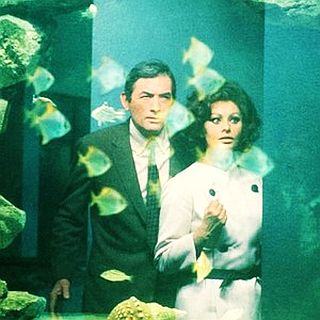
Zoo chase segment, aquarium scene, with Gregory Peck and Sophia Loren in “Arabesque,” as they are being pursued by a gunman.
Music Player
“Arabesque/Zoo Chase” – 1966
Despite their adventure-filled efforts to save prime minister from the plot, he appears to be shot down while making a speech at the London airport. However, it is then that Loren reveals to Peck that she is actually a spy for the real prime minister, and that the man shot down was one of Beshraavi’s employees.
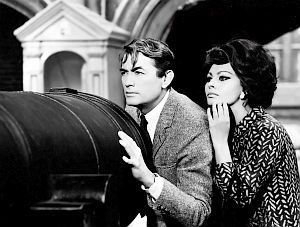
Professor David Pollock (Peck) and Yasmin Azir (Loren) on one of their adventures in “Arabesque.”
Peck and Loren then proceed to rescue the prime minister; but as they flee across the open countryside, Beshraavi comes after them in a helicopter.
In the resulting fray, Peck manages to hurl a steel ladder into the helicopter’s blades as it approaches at one point, bringing it down into a deadly crash.
As the film ends, Loren decides to give up spy craft and follow professor Pollock back to the peaceful academic life at Oxford.
Mancini’s Music

RCA Victor magazine ad touting Mancini’s film score for “Arabesque” and available album.
RCA Victor also hyped the soundtrack album in full-page trade magazine advertisement amid four photos from the film and a “MANCINI” headline centered with blurb that read: “Mancini sets a fast pace for profits with a new album of music form the fast action movie Arabesque.”
At the bottom of the ad, a photo of Mancini, the album cover and more promo followed: “The tremendous popularity of music from spy and chase films will create big demand for this great new album of original film music by Henry Mancini… an album loaded with musical excitement and one that [his] millions of fans will surely want to add to their collection….”
Mancini’s music in this film, of course, is only one of many scores and other works he composed for film and television over his 40- plus year career, making him one of the more popular film-score producers of the 20th century.

John Caps’ 2012 book, “Henry Mancini: Reinventing Film Music,” University of Illinois Press, 278 pp. Click for Amazon.
Having musical interests at a young age, Mancini would rise to become one of the most popular film-score composers in modern times, winning four Oscars and 20 Grammys.
He has also had several popular TV show themes, including, “Peter Gunn,” “Mr. Lucky,” “Remington Steele” and The Thorn Birds miniseries.
For other spy-related book and film stories at this website see: “The Bourne Profitability.” and two James Bond stories with book, film, and music elements – “Goldfinger: 1959-1963” and “You Only Live Twice: Film & Music, 1967.” Additional story choices can be found at “Music in Film: Songs & Soundtracks: 1950s-2010s.”
Thanks for visiting — and if you like what you find here, please make a donation to help support the research, writing, and continued publication of this website. Thank you. – Jack Doyle
|
Please Support Thank You |
____________________________________
Date Posted: 22 January 2025
Last Update: 22 January 2025
Comments to: jackdoyle47@gmail.com
BlueSky: jackdoyle.bsky.social
Article Citation:
Jack Doyle, “Arabesque, w/Mancini Music, 1966,”
PopHistoryDig.com, January 22, 2025.
____________________________________
Film Collection & Books at Amazon.com…
 “The Gregory Peck Film Collection,” includes, To Kill a Mockingbird, Cape Fear, Arabesque. Click for Amazon. |
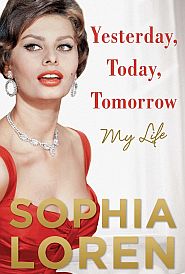 Sophia Loren, “Yesterday, Today, Tomorrow: My Life,” 2014, Atria Books, 352 pp. Click for Amazon. |
 Jon Burlingame’s “Dreamsville: Henry Mancini, Peter Gunn, and Music for TV Noir,” 318 pp. Click for Amazon |
Sources, Links & Additional Information
“Arabesque” (1966), AFI Catalog of Feature Films, The First 100 Years 1893–1993, AFI.com.
“Arabesque (1966 film),” Wikipedia.org.
Grace Glueck, “The Screen: ‘Arabesque’ Arrives at the Music Hall: Sophia Loren Starred With Gregory Peck; Tale of Arab Intrigue Makes a Chase Film,” New York Times, May 6, 1966.
Brian Hannan, “The Magnificent 60s: Arabesque (1966),” TheMagnificent60s.com, October 18, 2020.
Alex Gordon, The Cipher, 1966, Pyramid Books, paperback, 205 pp. Click for Amazon.
Songs and Themes by Mancini: A Collection of Outstanding Compositions from Motion Pictures, Northern Music Corporation, 1965 (includes 11 songs: Blue Pianolo; Free and Easy; Lonely Winter; Tana’s Theme; Theme for a Crazy Chick; To Know You is to Love You; Too Little Time; Toy Tiger; The Ways of Love; What’s It Gonna Be; Young Love).
Henry Mancini & Gene Lees, Did They Mention the Music? The Autobiography of Henry Mancini, 2001, Cooper Square Press, 312 pp. Click for Amazon.
_________________________________
Books on Film Music at Amazon.com…
 “100 Greatest Film Scores.” Click for copy. |
 “Hearing the Movies: Music & Sound in Film.” Click for copy. |
 “50 Best Soundtracks.” Click for copy. |