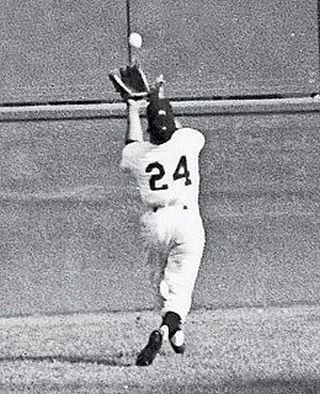
Sept 1954. Willie Mays, deep in center field at the Polo Grounds, running full speed with his back to home plate, about to make an incredible catch of Vic Wertz’s 425' blast during Game 1 of the 1954 Giants v. Cleveland Indians World Series. More details on this catch later below.
America then was in the second year of Dwight D. Eisenhower’s presidency, a time of prosperity and growth that would extend through most of the 1950s – an era when The Saturday Evening Post was one of the nation’s most popular weekly magazines.
In politics, Senator Joe McCarthy (R-WI) was then hunting communists in government, holding his “Army-McCarthy hearings” that year. And in a bit of overdue social progress, on May 17th, the U.S. Supreme Court ruled in Brown v. Board of Education that segregated schools were unconstitutional — touching off a decades long fight.
In music, among top hits that year – still largely in the crooner era – were: “Rags to Riches” by Tony Bennett, “Oh My Pa Pa” by Eddie Fisher, “Make Love to Me” by Jo Stafford, “Wanted” by Perry Como, “Sh-Boom” by The Crew Cuts, “Mr. Sandman” by The Chordettes, and others. But there was also a new young singer on the horizon named Elvis Presley who had released his first single, a cover of “That’s All Right” on Sun Records.
Best-selling books that September included those by John Steinbeck, William Faulkner, and Irving Stone. In film, Seven Brides for Seven Brothers, Dragnet, and Sabrina were among popular movies that month.
Major League baseball, meanwhile, was then in something of a golden era, more popular than professional football or basketball, providing inspiration for millions of kids who dreamed of becoming big leaguers, also offering televised coverage of regular-season games. And in the New York region, there was a surfeit of baseball teams and talent: the New York Yankees had Mickey Mantle and Yogi Berra; the Brooklyn Dodgers had Jackie Robinson and Duke Snider, and the New York Giants had Willie Mays, a rising young star who had led his team to the World Series.
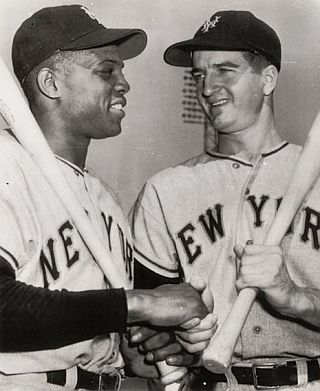
Willie Mays & Don Mueller, both NY Giants, battled down to the wire for National League batting title, each compiling an average of .340 or better, with Mays winning at .345.
But that fall, on September 24th, the first game of the best-of-seven baseball championship World Series would begin. The Giants of the National League were hosting the American League champion Cleveland Indians. The first two games of the Series were played at the Polo Grounds stadium in New York.
The Cleveland Indians that year were heavily favored to win the Series, having compiled a phenomenal 111–43 win-loss record. The Indians had some very strong pitching that year with Early Wynn (23–11) and Bob Lemon (23–7) plus others including an aging Bob Feller (13–3) and some top relievers. Cleveland also led their league in home runs (156) and had stand-out performers in Bobby Ávila (.341 avg., 112 runs scored); Larry Doby (.272, 32 HRs, 126 RBIs) and Al Rosen (.300, 24 HRs, 102 RBIs). Doby, who joined Cleveland in July 1947, was the first African American to play in the American League, and the second to integrate major league baseball, following Jackie Robinson. (See Gary Webster’s book on the 1954 Indians for more details — .721: A History of The 1954 Cleveland Indians. Click for Amazon).
The New York Giants, for their part, had taken the National League pennant with a 97-57 record, and had top-flight pitching as well, with Johnny Antonelli (21–7, 2.30 ERA), Rubén Gómez (17–9, 2.88) and 37-year-old Sal Maglie (14–6, 3.26). The Giants also had some notable relief pitching with Hoyt Wilhelm (12–7, 2.10, 7 saves) and Marv Grissom (10–7, 2.35, 19 saves). The Giants pitching staff also led the NL in shutouts that year with 17. The Giants had a solid, consistent lineup that year, with plenty of firepower at the plate.

1954 United Press photo of New York Giants players in their clubhouse – shortstop Alvin Dark; outfielder Monte Irvin; catcher Wes Westrum, and center-fielder, Willie Mays.
Game 1 of the World Series was played in the cavernous sports stadium known as the Polo Grounds, which had somewhat unorthodox dimensions for baseball, but nonetheless, had been home to the New York Giants for years, and also for a time (1913-1922), the New York Yankees.

Simplified sketch of the Polo Grounds stadium showing foul line and outfield dimensions. Click for book.
In the game, the Indians had jumped out to a 2-0 lead in the first inning. In the third inning, the Giants came back with two runs to tie the score.
For the next few innings, neither team scored. But then in the eighth inning with the score still tied at 2-2, the Indians were threatening.
Giants starting pitcher Sal Maglie walked Indians lead off hitter Larry Doby. Al Rosen then singled, putting him on first and moving Doby to second, now in scoring position with a hit.
New York manager Leo Durocher then summoned left-handed relief pitcher Don Liddle to pitch to Cleveland’s Vic Wertz, a left-handed batter.
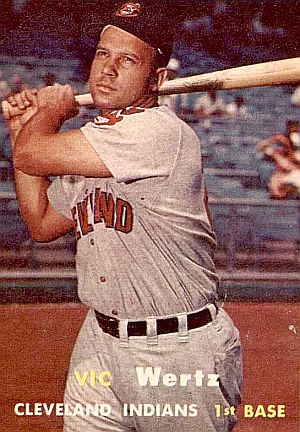
Cleveland's Vic Wertz shown on a 1950s baseball card.
Wertz, in fact, was already responsible for the Indians’ 2 runs scored in the first inning, having hit a triple driving in two men then on base.
Attendance that day at the Polo Grounds was 52,751. In the Ken Burns documentary film, Baseball, narrator John Chancellor, describing the setting that day at the Polo Grounds as Wertz came to bat, explains: “No one there would ever forget the remarkable play they saw that afternoon. The score is tied, 2-2- in the 8th inning…Cleveland at bat, Don Liddle on the mound. Vic Wertz comes to the plate…”
Facing the new relief pitcher, Liddle, Wertz worked the count to two balls and one strike. Then on the fourth pitch, Wertz unloaded, hitting a powerful drive into the air toward center field.
Jack Brickhouse, calling the game for NBC television, along with Russ Hodges, described the Mays catch to viewers as follows:
Brickhouse: There’s a long drive… way back at center field… way back, back, it is a… Oh my! Caught by Mays! The runner on second, Doby, is able to go to third. Willie Mays just brought this crowd to its feet with a catch which must have been an optical illusion to a lot of people! …Boy! [pause] …Notice where that 483 foot mark is in center field? The ball itself — Russ, you know this ballpark better than anyone else I know — had to go about 460, didn’t it?
Hodges: It certainly did, and I don’t see how Willie did it, but he’s been doing it all year.
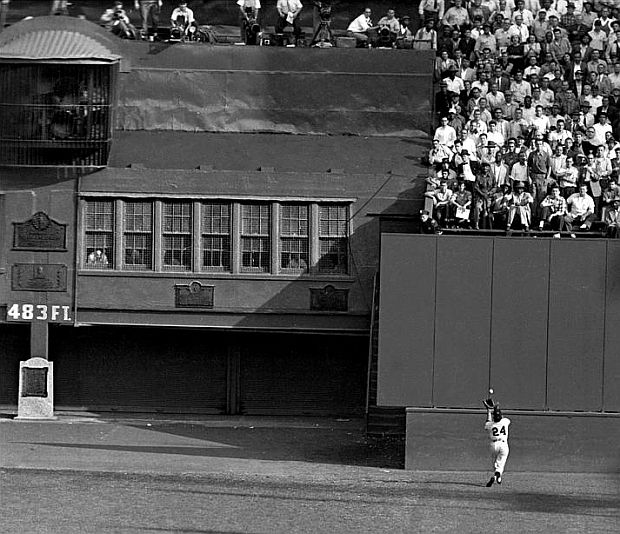
Photo of NY Giants’ Willie Mays about to make the catch on Vic Wertz’s 8th inning shot for the Cleveland Indians to the farthest reaches of the cavernous Polo Grounds center field during Game 1 of the 1954 World Series.
In many, if not most ballparks of that era, the Wertz 420-425 foot shot would have been a home run, which would have given the Indians a 4-2 lead, possibly changing the outcome of that game. But on this day, that wasn’t to be, as Willie Mays was in center field and he ran it down, making the amazing catch.
Over the years, in baseball lore, the Mays feat has simply been called “The Catch” – and those paying attention in that golden era of baseball know exactly what that means.
Bob Costas, on camera in Ken Burns’ documentary film, Baseball, gave his take on Mays’ phenomenal feat, offering a brief and insightful tutorial on the kinds of thinking and calculations that ballplayers make in seconds as a play unfolds, and what goes on in an outfielder’s head as a ball is hit in his direction, and what Willie Mays might have been calculating in that moment:
Bob Costas, on camera in the Ken Burns’ documentary film, “Baseball,” as he made his commentary on the Willie Mays catch and more. Click for his baseball book, “Fair Ball”.
“…It was more than just a great catch. It was a catch no one had ever seen before. When that ball left Wertz’s bat – and this is one of the great things about baseball, where you calculate so many things simultaneously: A ball’s hit into the gap. How good is the outfielder’s arm? Where is the cut-off man? A quick look and a glance; the runner’s between first and second base. How fast is that runner? How many outs? Should he try for third? Is his history that he’s daring? Will he try for third? What’s the third base coach doing? – And you take in all these things and with depth perception and try and calculate in those fleeting seconds: What are the possibilities? Well, when the ball left Vic Wertz’s bat in the massive Polo Grounds, where it was headed and where Mays was standing, there was only one possibility: Could he [Mays] get to it before it was an inside-the-park home run? Could he hold it to a triple? Catching it was out of the question. And he turned and ran to a place where no one can go to get that ball, starting where he started, with the ball as it was hit. So it was more than just a great acrobatic play. It was a play, that until that point, was outside the realm of possibility in baseball.”
…And it wasn’t just the catch Mays made, but also the throw he made after he caught it, whirling around and throwing it into the infield – a fair piece away – which kept the lead runner from scoring…
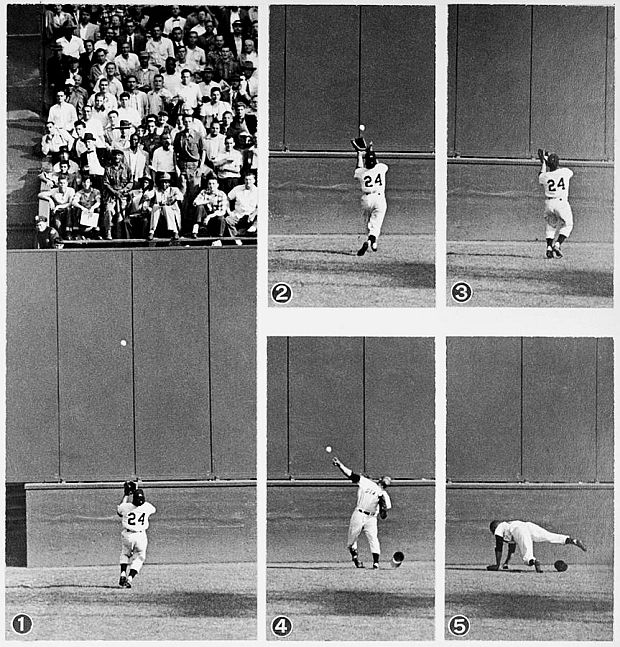
Sequence of photos of Willie Mays making the 1954 World Series catch of Vic Wertz’s 420-foot blast at the Polo Grounds, showing Mays recovering after catch to make throw to hold 2 runners. Click for “A Day In The Bleachers” book.
The Giants, after the play by Mays, managed to keep the game tied at 2-to-2, sending it into extra innings. But by the tenth inning, it was Vic Wertz once again who, as lead-off hitter that inning, sent another shot into the outfield, this time for a double. (Wertz, in fact, went 4-for-5 that day). The Indians, however, were unable to capitalize on the Wertz hit. Then in the bottom of the 10th inning, came Giant’s pinch-hitter Dusty Rhodes, who, with two Giants already on base, hit a three-run, walk-off home run to take Game 1 of the Series, 5-2.
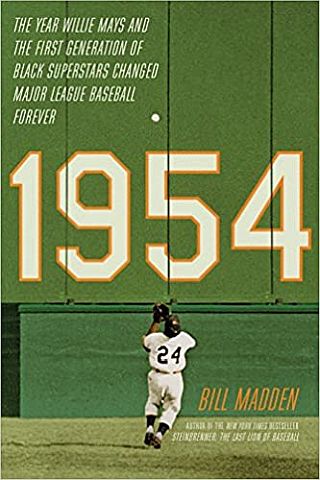
Bill Madden’s 2014 book, “1954: The Year Willie Mays and the First Generation of Black Superstars Changed Major League Baseball Forever.” Click for copy.
But alas, the Giants would surprise the bookmakers, and sweep the Indians in four games, taking the Series. The Giants, however, moved west to San Francisco in 1958, and would not win another World Series until 2010.
Bob Feller of the Indians would later say of the Mays catch: “There’s three things that made the catch memorable: One, it was a great play. Two, it was in a World Series. And three, it was on national television.” However, Mays himself didn’t necessarily believe it was his greatest catch, and he would later describe other good catches he made, including a running bare-handed catch he made at Forbes Field in Pittsburgh in 1951.
But those who saw the Wertz catch, either in person, on TV, or later on film, would agree that it was certainly something very special and very athletic.
And even before “The Catch,” Mays had wowed fans and sportswriters with his defensive abilities, as Time magazine observed in a July 1954 cover story: “…Once, when he dove out from under his cap (Mays frequently loses his cap) to catch a sinking line drive, he reached back, caught his cap in one hand and the ball in the other. Against the Dodgers one day, he raced into right center after a long fly, snagged it with prodigious stretch, spun completely around, off balance, and rifled a perfect strike to the plate to throw out the Dodgers’ speedy Billy Cox. Around big-league locker rooms, that play is still referred to as ‘The Throw’.”
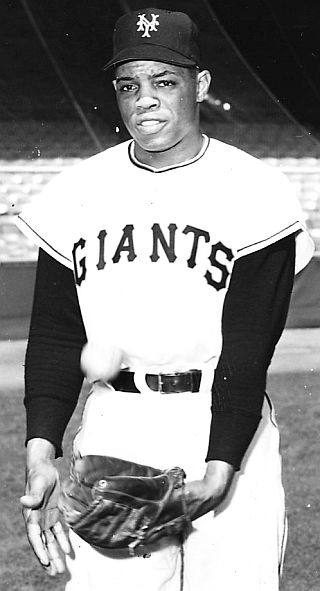
1954. Willie Mays, 23 years old, offering a “basket catch” pose for photographer. Sporting News / Greene.
In later years, the baseball cognoscenti would describe him as the quintessential “five tool player” – one who could run, catch, throw, hit, and hit for power.
Born in Westfield, Alabama in 1931, Mays played multiple sports at Fairfield Industrial High School.
In basketball, he led players at all-black high schools in Jefferson County in scoring, and in football he played quarterback, fullback, and punter.
In 1948, still in high school, he joined the Birmingham Black Barons in the Negro professional League, playing with them until he was signed by the Giants in 1950 after finishing high school.
His Major League debut with the Giants came in 1951 when he won the Rookie of the Year honors after hitting 20 home runs to help the Giants win their first pennant in 14 years.
With the Giants through the 1950s and 1960s, Mays would compile a Hall of Fame career that would mark him as one of the all-time great, all-around players.
In December 1954, while he was playing winter baseball in Puerto Rico, Mays was notified that he had been voted the National League’s Most Valuable Player for 1954.
In New York, Mays had endeared himself to the city and Giant’s fans, being an enthusiastic team member and regular good guy, found occasionally on New York streets playing stick ball with kids. “…[H]e plays baseball with a boy’s glee, a pro’s sureness and a champion’s flair,” wrote Time magazine in July 1954.
By 1959, Willie Mays the highest-paid player in baseball with a $75,000 contract that year (worth about $810,000 in today’s money). On April 30th, 1961, Mays had one of his best games hitting four home runs and driving in eight runs against the Milwaukee Braves at County Stadium.

Book by Willie Mays & John Shea, “24: Life Stories and Lessons From the Say Hey Kid,” St. Martin’s Press, 352 pp. Click for copy.
Unlike New York, San Francisco fans had been slow to warm to Mays, but with his great play and positive manner, he eventually won them over. When the club built its new stadium, later named Oracle Park, a nine-foot-tall bronze statue of Mays, depicting him at bat with his trademark follow-through swing across his body – bat in one hand at the end and leaning into a run – was dedicated at the park entrance in March 2000.
Mays ended his career with the New York Mets after a midseason trade, retiring after that team’s trip to the 1973 World Series.
Willie Mays finished his career with a batting average of .302. He would also drive in more than 100 runs in ten different seasons, and score more than 100 runs in twelve consecutive years. At retirement, he held the NL record for career runs scored (2,062), ranked second behind Stan Musial in games played (2,992), third in home runs (660), at bats (10,881), runs batted in (1,903), total bases (6,066), extra-base hits (1,323) and walks (1,464), fourth in hits (3,293), and fifth in slugging percentage (.557).
Mays had also won Gold Glove Awards 12 times, a record for outfielders (shared by Roberto Clemente). He is also baseball’s all-time leader in outfield putouts, with 7,095. And his 24 appearances on an All-Star Game roster place him in a tie with Stan Musial for second all-time, behind only Hank Aaron’s 25. On January 23, 1979, in his first year of eligibility, Willie Mays was elected to the Baseball Hall of Fame.
Don Zimmer, who had long experience as a baseball player and coach, remarked, “In the National League in the 1950s, there were two opposing players who stood out over all the others — Stan Musial and Willie Mays. … I’ve always said that Willie Mays was the best player I ever saw. … [H]e could have been an All-Star at any position.”
Longtime sports columnist for the Washington Post, Thomas Boswell, recently offered this take on one possible statistical interpretation of Willie Mays’ baseball value:
“Baseball fans love debates, especially ones we know will never get settled. Wins Above Replace-ment is a modern stat with imperfections. But, for today, the all-time leaders among everyday players make an interesting top five: 1. Barry Bonds (162.8), who gets a big asterisk from me; 2. Babe Ruth (162.2, not including his pitching); 3. Willie Mays (156.2); 4. Ty Cobb (151.5); and 5. [Hank] Aaron (143.1).”
In June 2015, Willie Mays was awarded the Presidential Medal of Freedom by President Barack Obama, who said the time: “In his quiet example while excelling on one of America’s biggest stages, (he) helped carry forward the banner of civil rights…It’s because of giants like Willie that someone like me could even think about running for president.”
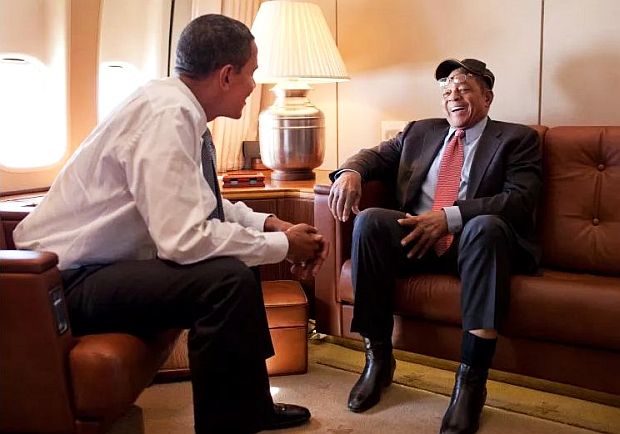
July 14, 2009. Aboard Air Force One en route to the MLB All-Star Game in St. Louis, President Barack Obama, having a conversation with Willie Mays. Source: The White House/Pete Souza/Associated Press.
Willie Mays passed away on June 18th, 2024. He was 93 years old.
Readers of this story may also like, “A Season of Hurt: Aaron Chasing Ruth,” which offers a detailed profile of Hank Aaron’s baseball biography and the racism he endured in his career and during the last few years of closing in on, and surpassing, Babe Ruth’s career home run record.
Additional baseball history at this website can be found at “Baseball Stories, 1900s-2000s,” a topics page with links to more than a dozen baseball-related stories, including one on Jackie Robinson. For sports generally, see the “Annals of Sport” category page. There is also a topics page on “Civil Rights Stories.”
Thanks for visiting — and if you like what you find here, please make a donation to help support the research, writing and continued publication of this website. Thank you. – Jack Doyle.
|
Please Support Thank You |
____________________________________
Date Posted: 23 June 2024
Last Update: 23 June 2024
Comments to: jackdoyle47@gmail.com
Article Citation:
Jack Doyle, “The Catch: Willie Mays, 1954,”
PopHistoryDig.com, June 23, 2024.
____________________________________
Baseball Books & Film at Amazon.com…
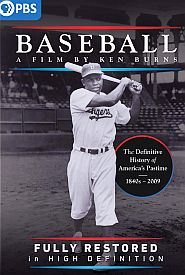 “Baseball: A Film By Ken Burns,” – the definitive history; fully restored in high definition, 2021, blue-ray or DVD. Click for Amazon. |
 Ben Lindbergh & Travis Sawchik’s best-selling 2020 book, “The MVP Machine,” building baseball talent. Basic Books, 416 pp. Click for book. |
 Joe Posnanski’s 2020 best seller, “The Baseball 100,” the 100 greatest players, with foreword by George Will. Simon & Schuster. Click for copy. |
Sources, Links & Additional Information
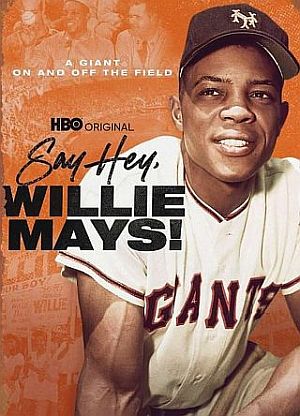 “Say Hey, Willie Mays,” Prime Video at Amazon. The life of Willie Mays is explored in this documentary film; 1hr 38 min. Click for film. |
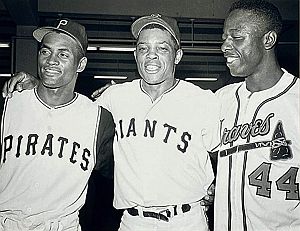 R. Clemente, W. Mays & H.Aaron. Click for special framed photo collage with career stats on each player. |
 Cover of Arnold Hano’s 1966 biography, “Willie Mays,” Grosset & Dunlap, hardback edition, Click for copy. |
“He Come to Play,” Time (Willie Mays cover story), July 26, 1954.
“Polo Grounds,” Wikipedia.org.
“1954 World Series,” Wikipedia.org.
“Willie Mays: Say Hey, for 1959!,” Sports Illustrated, April 13, 1959.
“Baseball 7th Inning – The Capital of Base-ball,” YouTube.com (from 1994 Documentary film by Ken Burns, Baseball), posted, March 26, 2020.
“The Catch (baseball),” Wikipedia.org.
Paul Liotta, “On the Anniversary of Willie Mays’ ‘Catch,’ a Look at Baseball’s Best Playoff Snags,” New York Daily News, September 29, 2015.
Dave Sheinin, “Willie Mays Broke Barriers His Own Way. White Fans Embraced Him. Jackie Robinson Criticized Him. But Mays, Baseball’s Greatest Living Player, Paved the Way for the Game’s Black Stars,” WashingtonPost.com, August 17, 2021.
Andrew Hoyem, Book Review, “’Willie Mays’,” by James S. Hirsch, San Francisco Chronicle, February 7, 2010.
Gary Webster, “.721: A History of the 1954 Cleveland Indians,” Journal of Baseball History and Culture, March 2014, 22(2):154-156.
Harvey Frommer (author), Monte Irvin (foreword), New York City Baseball: The Last Golden Age, 1947-1957, University of Wiscon-sin Press; 2004. Click for copy.
Arnold Hano, A Day in the Bleachers, Cambridge: Da Capo Press, 2004. Click for copy.
George F. Will, “Calling Willie Mays a ‘Natural’ Was to Underrate His Craft and Smarts. His Athleticism and Ebullience Encouraged the Perception of Him as Man-Child Effortlessly Matched Against Grown Men. Don’t Believe It,” WashingtonPost.com, June 18, 2024.
Associated Press, “Timeline of Willie Mays’ Career,” June 18, 2024.
Richard Goldstein, “Willie Mays, Baseball’s Electrifying Player of Power and Grace, Is Dead at 93; Mays, the Say Hey Kid, Was the Game’s Exuberant Embodiment of the Complete Player. Some Say He Was the Greatest of Them All.” NYtimes .com, June 18, 2024, updated June 21, 2024.
Thomas Boswell, “Willie Mays Was as Good — and as Cool — as Anyone Who Ever Played. I Met Mays. I Watched Mays for Decades. I Can Still Hardly Believe What I Saw,” Washington Post.com, June 19, 2024.
“Willie Mays and Barack Obama’s Four Iconic Encounters: ‘Inspiration’,” Newsweek.com, June 19, 2024.
Brian Gross, “A Statistical Appreciation: The Legacy of Willie Mays Through His Iconic Baseball Cards and Career Numbers. A Year-by-Year Look at Mays’s Legendary Career…” WashingtonPost.com, June 19, 2024.
Kevin B. Blackistone, “The Enduring Power of Willie Mays and the Catch. Nearly 70 Years since Willie Mays Made the Catch in the 1954 World Series, the Moment Remains a Part of Our Collective Sports Psyche,” WashingtonPost.com, June 22, 2024.
_________________________________________________________
Baseball Books & Film at Amazon.com…
 Robert Peterson’s book, “Only the Ball Was White” a history of black baseball players & teams, 1992. Oxford Univ. Press, 416 pp. Click for book. |
 2011baseball film, “Moneyball,” based on a true story, starring Brad Pitt, Jonah Hill & others. Click for film at Amazon. |
 Joe Posnanski’s 2007 book, “The Soul of Baseball: A Road Trip Through Buck O'Neil's America,” William Morrow, 304 pp. Click for copy. |