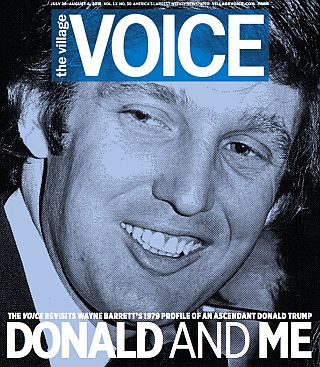
July-August 2015 edition of “The Village Voice” – shortly after Trump began his 2016 presidential bid – revisited historic 1979 reporting by Wayne Barrett, which covered Trump’s shady deal-making on earlier NY city projects.
Barrett was best known for his reporting on, and books about, New York politicians such as Rudy Giuliani and Ed Koch, and also, Donald Trump. Other targets included Roger Stone, advisor / troublemaker for Richard Nixon and Donald Trump; New York Governors Mario and Andrew Cuomo, Rev. Al Sharpton, former U..S. Senator Alfonse D’Amato (R-NY), and Roy Cohn, lawyer and Donald Trump mentor and enabler.
Barrett, in fact, was the first journalist to uncover, in some detail, Donald Trump’s early New York business practices, insider deals, and deceptions. He began reporting on Trump in the late 1970s when he focused on two prominent Trump-related real estate development projects in New York City — the Hyatt Hotel in midtown, and a proposed convention center on the West Side.
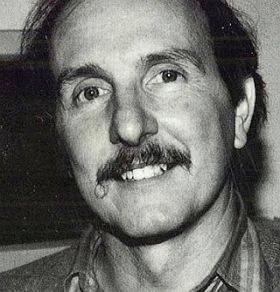
1990, Wayne Barrett, investigative reporter for “The Village Voice” of New York.
On January 15th, 1979, The Village Voice published the first part of Barrett’s Trump story on its front page, – “Like Father, Like Son: Anatomy of a Young Power Broker” (photo below). That story was Barrett’s opening salvo on Donald Trump, covering his origins, connections with his Brooklyn-based real estate father, Fred Trump, and Donald’s early rise into his Manhattan real estate ventures. Barrett uncovered potential racial bias and the use of massive tax breaks in some of the Trump ventures. He exposed the political connections of Fred Trump, showcasing how Donald followed and leveraged his father’s political ties – and not least, those with New York Mayor Abe Beame, who would help Donald with his Manhattan projects.
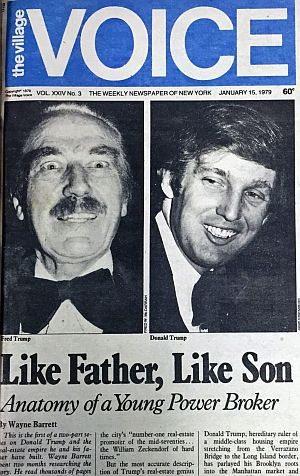
First of a 2-part story on Donald Trump real estate connections with his father in Brooklyn, Jan 15, 1979.
Early on, during the course of Barrett’s investigations, Trump learned of Barrett’s sleuthing, and surprised him with a telephone call out of the blue.
Barrett at the time had filed a Freedom of Information Act request and was by himself in a secure conference room at the offices of the State Urban Development Corporation working his way through thousands of pages of state and city records. It was then that a telephone began ringing in a nearby empty conference room. While Barrett hesitated at first hearing the phone, he did answer it, only to here a voice on the other end say: “Wayne! This is Donald! I hear you’re doing a story on me!”
Barrett was stunned at Trump’s call, since he thought no one really knew he was at that office. It turned out, however, that some insider or clerk at those offices had tipped off Trump that a reporter was looking into his files.
But the phone call to Barrett was classic Trump, designed in part to show Barrett that he had “long reach,” knew a lot of people, and could be a kind of unseen, hovering presence. Still, Barrett engaged with Trump, met with him, and would do a series of some 15 interviews with him while working on his Trump Manhattan project pieces for The Village Voice. Trump, meanwhile, would push the envelope with Barrett.
“…You know, Wayne, you don’t have to live in Brownsville. I can get you an apartment.”
– Donald Trump phone call
But when that didn’t work, and Trump realized Barrett was uncovering some unflattering history, he threatened to sue Barrett, also invoking the name of Roy Cohn, his pugnacious lawyer and politically-connected mentor.

January 22, 1979 - “Donald Trump Cuts the Cards: The Deals of a Young Power Broker,” by Wayne Barrett.
Barrret’s other investigation into early Trump came with Trump’s move to replace the old Commodore Hotel at Grand Central Station with another hotel, a development that would become the Grand Hyatt. For this Trump project Barrett published another Village Voice piece on February 26, 1979, headlined “A Seamless Web,” in which he detailed a number of the players and dealing involved, but honed in especially on the role of Donald Trump, as he explained:
…In previous stories, I detailed the conflicts and serpentine relationships that made up Trump’s convention-center deal (Voice, January 22), but in acquiring the contract for the Commodore renovation, Trump outdid himself. He persuaded city and state officials to designate him developer on a site he didn’t own — or even have an option to own. Later, he got a binding lease and acquisition agreement from the city and state, though he had no financing commitment to back him up…. ( The Commodore caper is part shill game, part intrigue. Its apologists make it part soap opera. But the size of the deal’s subsidies — it is perhaps the most costly incentive project in city history — make it news )….
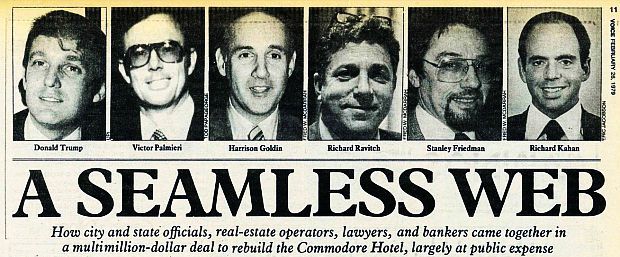
Top-of-page layout with photos of principal players and headline for a Wayne Barrett piece published in The Village Voice, February 26, 1979, which detailed the roles of various players in what would become the Grand Hyatt development project, and especially the role of Donald Trump.
Barrett later explained in a June 2016 Vox.com interview how his early relationship with Trump changed after Trump realized he was getting to some damaging truths about his deal making with New York city projects: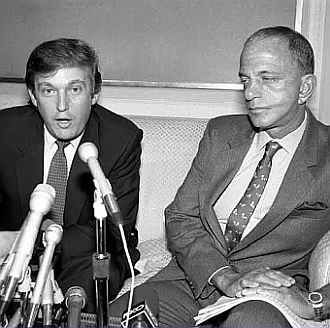
Donald Trump and his lawyer, Roy Cohn, circa 1980s. Cohn became a “Svengali”-type mentor/advisor to Trump, who counseled an aggressive, double-down, never-retreat style, which Trump adopted in both his business and political careers. Click for 2026 book on Roy Cohn.
…The early pieces that I wrote about him resulted in a federal grand jury in the Eastern District. He could see what I had found about his two earliest deals. By the time we closed out the interviews, he was aware that I’d caught him in a few things that could be very disturbing to the public image he was then trying to craft. Obviously he didn’t get indicted, but I had the goods enough to raise real ethical questions about his conduct.
That’s when he started taking me seriously… I think he just thought I was a guy he could play with. He got a lot less chatty. And then we get the libel letter — Roy Cohn sent a libel letter to the Voice before the first piece was published. So that was the one-two punch….
Roy Cohn. New York lawyer, Roy Cohn, became a key influence on Trump. Cohn was previously famous in the 1950s as a manipulative congressional aide to Sen Joe McCarthy’s communist witch hunts that terrorized America, and ruined numerous civil servant and Hollywood careers before McCarthyism self-immolated. “…if you could sit down with Roy Cohn and be charmed…there was something wrong with you.”
– Wayne Barrett Of Cohn’s sinister brand of influence, Barrett would say, “if you could sit down with Roy Cohn and be charmed…there was something wrong with you.” Donald Trump was charmed by Roy Cohn, and would adopt his modus operandi. “Donald was looking for the dark side,” Barrett would say, and that’s what Roy Cohn would bring to him. “…[Trump] understood that the dark side was the way of power…” Roy Cohn became a kind of Svengali to Trump, who adopted Cohn’s aggressive, double-down, never-retreat style in both his business and political careers. But for Barrett, who had interviewed and met Cohn many times, the impression was clear – “he was the most satanic figure I ever met in my life. He was almost reptilian…”
Trump Book
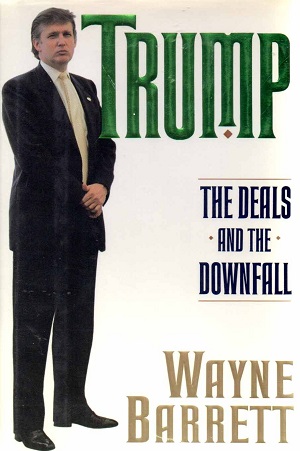
First edition of Wayne Barrett’s book, “Trump: The Deals and The Downfall,” was published by Harper Collins in 1992. Click for Amazon.
Included among the book’s key revelations are detailed allegations that Trump was subject to a bribery investigation in 1979 and a racketeering investigation two years later, stemming from his involvement in New York city construction projects. The book also covered Trump’s involvements and financial difficulties with his Atlantic City casinos.
During the period covered in Barrett’s book, Trump was beset by a string of bankruptcies, a scandal-plagued public divorce, and a forced retreat from public view – which accounts for “the downfall” part of Barrett’s book. Interestingly, as the book was being prepared for publication, Trump found out about it, and called Barrett seeking, unsuccessfully, to have “the downfall” part of the title removed. While Trump did have his difficulties in those years, his fall from prominence would prove temporary and would not deter his more ruinous terms as President.

Village Voice reporter, Wayne Barrett, in later years.
However, Barrett’s 1992 book on Trump did not do well, in large part because it came at a time when interest in Trump’s rising star had collapsed along with his business failures and debt problems. The book was also not reviewed by the New York Times, for example, and became something of a flop. But there were other venues — including a January 1992 radio interview with Barrett by Terri Gross on her NPR / “Fresh Air” program — that highlighted what Barrett had learned about Trump in the book. And the years would eventually turn in Barrett’s favor. His research, and his 1992 book all had something of a second coming when Donald Trump began to set his sights on the White House in 2015-2016. Barrett and book then began to be recognized by reporters as a primary source, while Barrett’s Brooklyn home became something of a “mecca” for journalists now focusing on Trump, visiting with Barrett and his voluminous Trump files and documents.
2016 Edition
In fact, Barrett’s 1992 book would rise Phoenix-like from the ashes of the 1990s, given Trump’s improbable political ascent nearly 25 years later. The book was republished, expanded, and retitled as: Trump: The Greatest Show on Earth: The Deals, The Downfall, The Reinvention. The “new and improved” Barrett book — appearing in mid-2016 ahead of that fall’s presidential election — would be regarded as “a rich and layered…excavation of the dirty-dealing, insiderism, and blind greed that made Trump a powerful figure in 1980s New York.”
Amazon’s description of the re-issued book in 2016 — with a new and scorching introduction by Barrett — noted the following: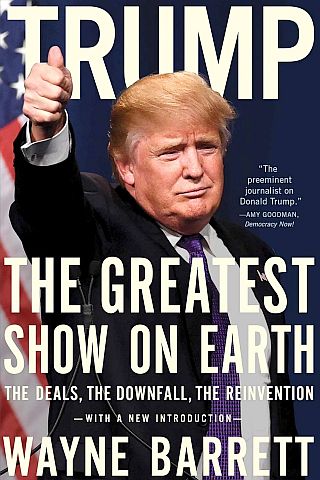
Wayne Barrett’s 1992 book was republished in 2016 as Trump began his run for the White House, in an expanded edition with new introduction and re-titled, “Trump: The Greatest Show on Earth: The Deals, The Downfall, The Reinvention.” Click for Amazon.
Donald Trump claims that his success as a “self-made” businessman and real estate developer proves that he will make an effective president, but this devastating investigative account by legendary reporter Wayne Barrett proves otherwise. Back in print for the first time in years, Barrett’s seminal book reveals how Trump put together the biggest deal of his life—Trump Tower—through manipulation and deceit; how he worked with questionable characters from the mafia and city politics; and how it all nearly came crashing down. Here is a vivid and inglorious portrait of the man who wants now to be the most powerful man in the world.
In Trump: The Greatest Show in the World—The Deals, the Downfall, the Reinvention, Barrett unravels the myth and reveals the truth behind the mogul’s wheelings and dealings. After decades covering him, few reporters know Trump as Barrett does. Instead of the canny businessman that Trump claims in his own books, Barrett explores how Trump exploited his father’s banking and political connections to finance and grease his first major deals. Barrett’s investigative biography takes us from the days of Donald’s lonely youth to his brash entry into the real estate market, and to the back room deals behind his New York, Atlantic City and Florida projects.
Jennifer Gonnerman, writing in The New Yorker just after the 2016 election, noted: “There may be no journalist in the nation who knows more about Trump than Barrett.” Timothy O’Brien, who was a research assistant to Barrett on the 1992 Trump book – and who later wrote his own book, TrumpNation – called Barrett’s work on Trump “foundational.” Barrett, he said, “took Trump seriously long before anyone else did, and most of the work that followed Wayne’s was built upon his insights.”
In a new foreword to his re-issued Trump book, Barrett himself – ever the excoriating journalist – criticized the “cowardly silence” of the press on the role of race in the 2016 presidential campaign. “In a season of broadcast blunders, the worst was the race coverup, with vacuous analysts, especially on primary nights, going on and on about anything but race explaining the Trump tide,” Barrett wrote. He also had harsh criticism of TV news. “All of my life, I have believed and said, we’re in the truth-telling business. Our job is to tell truth,” he told CNN. “I can’t say that anymore about broadcast journalism.”
|
NY-PBS Interview Trump, Race, Media 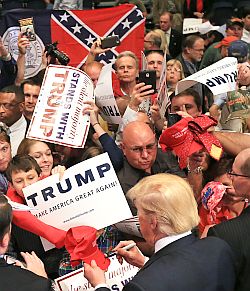 Donald Trump rally, 30 November 2015, Macon, GA. Matt Ryan: …Certainly most people are surprised that [Trump is] so close to getting the GOP nomination. You’ve known him for decades and have followed him closely as anyone else. I mean, how surprised are you? Wayne Barrett…Well, I never thought he’d go this far;.I don’t think he ever thought he would go this far. He and Roger Stone I think decided to do this thing, for some crazy reason…I don’t think either of them ever expected to be where they are today….And it’s a commentary on the state of the Republican Party more than it is a commentary on the state of the country…Barrett charged that the Republican Party, since the time of Lee Atwater, was built in part on a kind of naked racism, though covered up in subtler form – that is, until Trump came along and made it more explicit. You know, if you go [back] decades, since Lee Atwater, or before, you know building a party where part of it, at least, is rooted in naked racism. Then somebody, eventually, is going to come along and hit that nerve… I think these rallies that [Trump] has… It’s almost like – there’s an air of racial solidarity about it – that’s really what it’s speaking to in a way – that sometimes he’s pretty explicit about that. But even if he’s not being explicit about that, you feel in the air when you watch these things. This is “white boys talking to white boys,” you know. We already understand the real message here. And the party has done a good job of covering that up for a long time, of keeping a curtain on top of what was really become the White People ‘s Party of America. But Donald, has cut through all of that cloth, and making it much more explicit. And eventually, somebody was going to do that. And with his skills – which are pretty remarkable skills as a public personality – and with the aid of broadcast journalism…. I think print journalism has been okay, really, The coverage of him [Trump] in print has been okay. Mattt Ryan: He’s dominated the cable new shows; there’s no question. Television journalism, in Barrett’s view, was not doing its job; not airing the right stories. “It’s completely determined by the narrative they’re trying to sell.”Wayne Barrett: I’m talking about – you’re in the business…But the normal thing is if The New York Times runs an investigative piece – which they’ve done three or four excellent pieces on Donald – they at least get discussed on cable TV – but that doesn’t happen. Washington Post guys have done marvelous stuff; Politico, marvelous stuff. These are the major news organizations in the United States. They can’t get a minute of air time, these stories. You know, usually you get the reporter who wrote the story on the air. There’s a discussion; What does this mean? What does that mean? So, print is doing its job. I think that they can do a better job, but they’ve done a reasonable job. And television just won’t do what it’s supposed to do, what it does with every email story about Hillary [Clinton]– if there’s one line of news in it, it’s on the air all night.. But you know, it’s been remarkable how television journalism – I’ve always thought ratings was part of it. But I thought there was some journalistic accountability here. But there appears to be none. Its completely determined by the narrative they’re trying to sell. Matt Ryan: Well, Wayne, Thank you for your time. |
Politico’s Luncheon
In late spring 2016, Politico – the digital publisher known in the U.S. for its Politico website and magazine – hosted a roundtable discussion with five prominent biographers and journalists who had chronicled Donald Trump and family over decades, including: Wayne Barrett. Among the others attending were: Gwenda Blair, author, The Trumps: Three Generations That Built an Empire (2000); Michael D’Antonio, author, Never Enough: Donald Trump and the Pursuit of Success (2015); Harry Hurt III, author, Lost Tycoon: The Many Lives of Donald J. Trump (1993); and, Timothy O’Brien, author, TrumpNation: The Art of Being the Donald (2005).
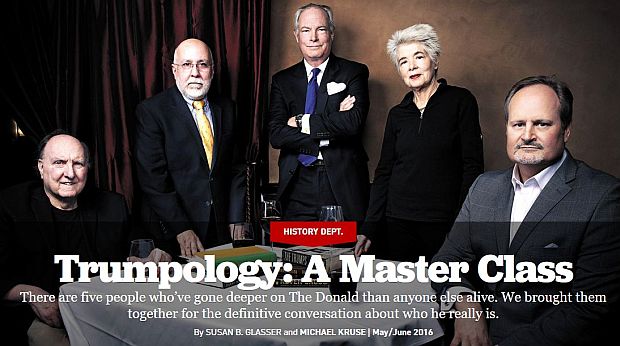
In its May/June 2016 edition, “Politico” magazine published its roundtable discussion with five writers who then had written extensively about Donald Trump and/or Trump family history – shown here from left to right: Wayne Barrett, Michael D'Antonio, Harry Hurt III, Gwenda Blair, and Timothy O'Brien. Click for the full story at Politico.
This group – plus Politico moderators Susan B. Glasser and Michael Kruse – gathered for lunch, appropriately, at the Trump Grill inside Trump Tower in Manhattan. Trump by then was wining primaries in his 2016 presidential bid, and there was rising interest on just who this guy was. The discussion of these journalists with Politico was later published in the May/June 2016 edition of Politico’s online magazine. In a brief introduction to their session with the five Trump authors and what transpired at their luncheon, Glasser and Kruse noted that: “…the conversation ranged from the emotional wounds that drive Trump to the roots of his demagoguery to his alleged ties to the mob. The rest of the media might still be struggling to explain Trump’s political rise, but these five writers saw his ambition—and ego—from the very early days. Here’s how Trump the candidate came to be.”
Each of these Trump authors – including Barrett – had interesting nuggets, insights, and revelations about their experiences with, and reporting about, Donald Trump – from his earliest days in New York, his relationships with his father, his branding, his TV and film conceptions of himself, and more, plus reaction to his then surprising rise as a presidential candidate. It’s a worthwhile interview to read, still relevant in 2026. Click on the photo above for the full Politico story and transcript.
Book on Barrett
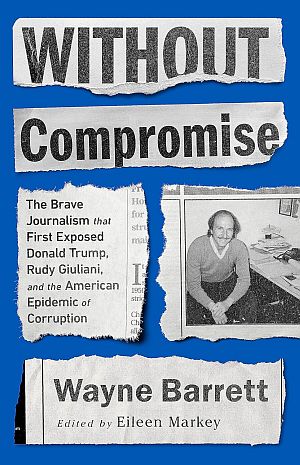
2020 book, “Without Compromise,” Eileen Markey, editor. Click for Amazon w/video.
Without Compromise is a collection of groundbreaking investigations by Wayne Barrett, the first anthology of Barrett’s investigative work, It is accompanied by essays from colleagues and those he trained.. Inlcuding: Joe Conason, Kim Phillips-Fein, Errol Louis, Gerson Borrero,Tom Robbins,Tracie MacMillan, Peter Noel, Adam Fifield, Jarrett Murphy, Andrea Bernstein, Jennifer Gonnerman, and Mac Barrett.
As the Amazon entry on the book notes “In an age of lies, fog, and propaganda, when the profession of journalism is degraded by the White House and the industry is under financial threat, Barrett reminds us that facts, when clearly accumulated, are our best defense of democracy.”
A Salon.com description also adds:
A collection of groundbreaking investigations by Wayne Barrett … With piercing moral clarity and exacting rigor, Wayne Barrett tracked political corruption in the pages of The Village Voice fact by fact, document by document for 40 years. The first to report on the scams and crooked deals that fueled the rise of Donald Trump in 1979, Barrett went on to expose the shady dealings of small-time slum lords and powerful New York City politicians alike, from Ed Koch to Rudy Giuliani to Michael Bloomberg.
Jane Mayer, author of Dark Money, noted in her comment on the book about Barrett: “As Donald Trump rose to power no journalist busted him earlier or better than the late investigative reporter Wayne Barrett, whose indispensable work is gathered in Without Compromise.“…Barrett’s pieces provide an x-ray into Trump’s soul, and into the civic corruption that fueled his rise….”
– Jane Meyer Barrett’s pieces provide an x-ray into Trump’s soul, and into the civic corruption that fueled his rise. These stories are essential reading, alive with fresh insights and information illuminating today’s politics, and remind us that rigorous journalism is still democracy’s best defense.”
Trump predictably and true to form – according to one account by Politico’s Michael Kruse – used his typical arsenal of epithets over the years to disparage Barrett, calling him “a very bad writer,” “a second-rate writer” and “a jerk.” Trump also ranked Barrett as “one of the three worst journalists of all time,” a remark which Barrett took as “a great honor.” Reportedly, Barrett would say of this last Trump slur, seeing it as a mark of high praise – “I want it inscribed on my tombstone.”
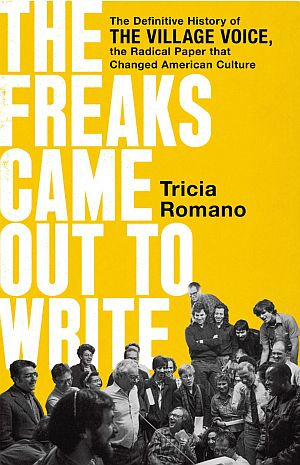
Tricia Romano, “The Freaks Came Out to Write: The Definitive History of the Village Voice, the Radical Paper That Changed American Culture,” 2024, Public Affairs Press, 608 pp, including sections on Wayne Barrett. Click for Amazon.
Wayne Barrett died in Manhattan on January 19, 2017, from complications of interstitial lung disease and lung cancer. Coincidentally, Barrett died the day before Trump was inaugurated as president — but no doubt, observing from the hereafter of the resulting Trump wreckage since then to tell the rest of us – “told you so.”
More Trump. See also at this website, additional history on Donald Trump, including: “Trump on Film: A Partial Listing, 1990-2024,” covering some 30 Trump films. More magazine treatments of Trump at this website include:, “The Trump Dump: New York Magazine, 2016,” profiling a special issue of that magazine, and also, “Trump Send-Ups, Spy Magazine, 1980s-1990s,” reviewing Trump spoofs and satire in that magazine. Other stories at this website mentioning Trump include: “Political Science: Randy Newman Music,” regarding nuclear weapons; “I Won’t Back Down” about the use of Tom Petty song in political campaigns; and “Shields, Brooks, Trump,” regarding some press reaction to earlier Trump remarks in 2017.
Thanks for visiting – and if you like what you find here, please make a donation to help support the research, writing, and continued publication of this website. Thank you. – Jack Doyle
|
Please Support Thank You |
____________________________________
Date Posted: 27 October 2026
Last Update: 27 October 2026
Comments to: jackdoyle47@gmail.com
Article Citation:
Jack Doyle, “Barrett on Trump: Early Warnings,
1970s-2010s,” PopHistoryDig.com, October 27, 2026.
Twitter: JackDoyle/PopHistoryDig
BlueSky: jackdoyle.bsky.social
____________________________________
Trump-Era Books at Amazon.com…
 M. Haberman & J. Swan, “Regime Change: Inside the Imperial Presi-dency of Donald Trump,” 2026, Simon & Schuster, 496pp. Click for Amazon. |
 Andrew Weissmann, “Liar's Kingdom: How to Stop Trump’s Deceit and Save America,,” 2026, Little, Brown & Co., 240 pp. Click for Amazon. |
 Charles J. Sykes’ book, “How the Right Lost Its Mind,” with George Will blurb on front cover, 2018 edition, Click for Amazon. |
Sources, Links & Additional Information
 Gwenda Blair, “The Trumps: Three Generations of Builders and a President,” 2001, Simon & Schuster, 592 pp. Click for Amazon. |
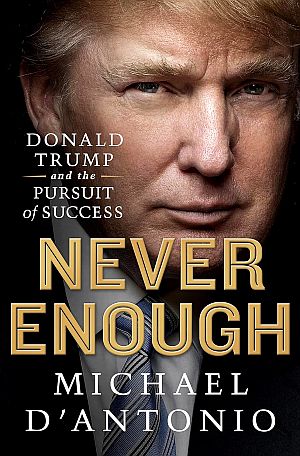 Michael D'Antonio’s 2015 book, “Never Enough: Donald Trump and the Pursuit of Success,” Thomas Dunne Books, 400 pp. Click for Amazon. |
 Kai Bird with Susan Goldmark, “American Scoundrel: Roy Cohn's Dark Journey From Joe McCarthy to Donald Trump,” 2026, Scriber, 528pp. Click for Amazon. |
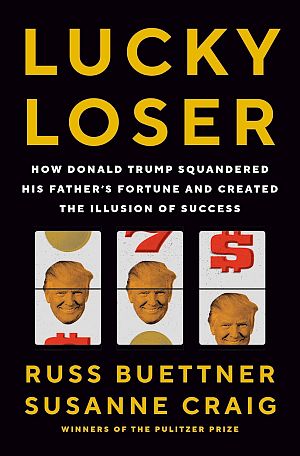 Russ Buettner & Susanne Craig, “Lucky Loser: How Donald Trump Squandered His Father's Fortune and Created the Illusion of Success,” 2024, Penguin Press, 528pp. Click for Amazon. |
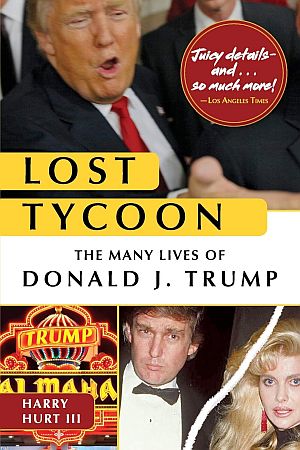 Harry Hurt III, “Lost Tycoon: The Many Lives of Donald J. Trump,” 2016, Echo Point Books & Media, 436pp. Click for Amazon. |
“Wayne Barrett,” Wikipedia.org.
Wayne Barrett, “How a Young Donald Trump Forced His Way From Avenue Z to Manhattan,” The Village Voice, January 15, 1979.
Wayne Barrett, “Donald Trump Cuts the Cards: The Deals of a Young Power Broker,” The Village Voice, January 22, 1979.
Wayne Barrett, “The Dirty Deal That Helped Make Donald Trump [also titled, “A Seamless Web”]; How City and State Officials, Real Estate Operators, Lawyers, and Bankers Came Together in a Multimillion-dollar Deal to Rebuild the Commodore Hotel, Largely at Public Expense,” The Village Voice, February 26, 1979.
Wayne Barrett, “The Birthday Boy: Roy Cohn is 52 at 54; A Big Apple Rogue’s Gallery Turned out to Celebrate “The Man Who Symbolizes Evil to Many in this City’,” The village Voice, March 5, 1979.
Joe Conason, “Beware When ‘Three Big Fat Men’ From the Trump Organization Knock on Your Door; How Would Donald Trump Feel If Some Corporation Evicted His Ill and Aging Parent, Without Notice or Compassion, Removing All Possessions to Some Unknown Location?,” The Village Voice, May 5, 1980.
Wayne Barrett. “Will Trump Get Casbah Giveaway?,” The Village Voice, April 7, 1981.
Wayne Barrett, “Donald Trump: Demolishing Affirmative Action,” The Village Voice, July 29, 1981.
Michael Sorkin, “Dump the Trump; The Centerpiece of the Scheme, the 150-Story Erection, Is Trump’s Third Go at the ‘World’s Tallest Building.’ … Was Ever a Man More Preoccupied with Getting it up in Public?,” The Village Voice, December 24, 1985.
Wayne Barrett, David Swanson, “Donald Trump’s Tower of Trouble; Meet the Medicaid Cheats, Coke Dealers, Mobsters — and Those Who May Have Gotten a Touch Too Friendly with Mobsters — Who Call Trump Tower Home,” The Village Voice, December 17, 1991.
Wayne Barrett, “How Donald Trump Managed To Turn Triumph Into Disaster; When Donald Trump Dumped on Ed Koch, He Doomed His Own Greatest Project. In This Tale of Two Egos, Trump Makes the Biggest Mistake of His Career and Hastens His Demise,” The Village Voice, December 17, 1991.
Wayne Barrett, “Donald Trump’s Political Football; How Donald Trump Sacked the Cuomo Team and Turned the State’s Losses — Including Two Football Teams and Hopes for a New Stadium — Into Personal Gain,” The Village Voice, January 14, 1992.
Wayne Barrett, “Donald Trump’s Seduction of Mario Cuomo; Trump Surrounded Himself with the Governor’s Lawyers, Aides, Son — Even His Bodyguard —To Get New York’s Top Pol on His Side,” The Village Voice, January 14, 1992.
Adam Weinstein, “If You Dig Political Muckraking, Thank Wayne Barrett,” Mother Jones.com, January 5, 2011.
Richard Pérez-Peña, “The (Ex) Voice of the Village,” New York Times, February 25, 2011.
Karen Tumulty and Nia-Malika Henderson, “Donald Trump Says He Won’t Run for President in 2012,” Washington Post, May 16, 2011.
Wayne Barrett, “Inside Donald Trump’s Empire: Why He Didn’t Run for President in 2012,” The Daily Beast, May 26, 2011.
Gail Ablow, “The Trump Files, Part One: Investigative Reporters Have Been Digging into the Candidate’s Business Dealings from the past and Present. Here’s Our Roundup Just in Time for the Weekend.” Bill Moyers.com, February 26, 2016.
Gail Ablow, “The Trump Files, Part Two: Our Trump Files Are Expanding. Readers Have Sent in Additional Pieces and New Investigations Are Unfolding. Here’s Our Latest Lineup of Recommended Reading,” BillMoyers.com, March 16, 2016.
Matt Ryan, “Wayne Barrett Reflects on His Decades Covering Donald Trump,” NYnow.wmht.org (NY PBS) May 3, 2016 (video interview with Barrett begins about half-way in, at 12:00 minute mark following New York Now TV segment, WMLT, Troy, NY).
Susan B. Glasser and Michael Kruse, “Trumpology: A Master Class: There Are Five People Who’ve Gone Deeper on the Donald than Anyone Else Alive. We Brought Them Together for the Definitive Conversation about Who He Really is,” Politico.com, May/June 2016.
Wayne Barrett, “Donald Trump’s Billionaire-Backed Super-PAC Also Paying Rudy Giuliani’s Law Firms,” The Daily Beast, November 5, 2016.
Jennifer Gonnerman, “Wayne Barrett, Who Wrote the Book on Trump, Is Still Reporting,” The New Yorker, November 10, 2016.
Alex Shephard & Theodore Ross, “There’s No Check on Trump Except Reality: A Q&A With Wayne Barrett. The Veteran New York Journalist Dishes on Trump, Giuliani, and More,” NewRepublic.com, December 1, 2016.
Sam Roberts, “Wayne Barrett, Fierce Muckraker at The Village Voice, Dies at 71,” New York Times, January 19, 2017.
Michael Kruse, “The Muckraker Who Tormented Trump; Wayne Barrett Died the Day Before the Inauguration of a Man Whose Rise He Labored for Decades to Prevent,” Politico.com, January 20, 2017.
Adam Weinstein, “Wayne Barrett Exposed the Real Trump. Now There’s Only One Way to Honor Him;.Remembering the Legendary Village Voice Reporter Who Launched an Army of Muckrakers,” MotherJones.com, January 21, 2017.
Tom Robbins, “Wayne Barrett: A Brilliant New York Beacon and Political Warrior for Justice,” The Village Voice, January 24, 2017.
“An Incomplete Timeline of Donald J. Trump and His Associates’ Pillaging of the United States of America,” Dumplord.com, (includes a wide ranging and somewhat rambling collection of various dates, news stories, etc. on Donald Trump and his father, and Trump associates, 1930s to 2020).
Tricia Romano, “A Brief Oral History of Wayne Barrett, the First Journalist to Doggedly Cover Donald Trump,” Vanity Fair.com, February 12, 2024.
Barrett & Muckrakers at Amazon.com…
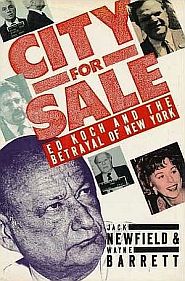 Newfield & Barrett, “City For Sale: Ed Koch and The Betrayal of New York,” 1988, HarperCollins, 466 pp. Click for Amazon. |
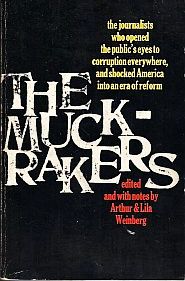 Arthur & Lila Weinberg, “The Muckrakers”- Journalists Exposing Corruption, 1902-1912, Putnam, 1964. Click for Amazon. |
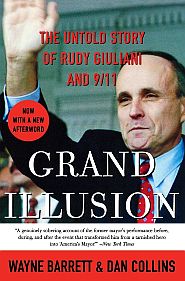 Wayne Barrett, Dan Collins, “Grand Illusion: The Untold Story of Rudy Giuliani & 9/11,” 2007, Harper Collins, 402pp. Click for Amazon. |