Among notable moments in the history of film-making is Steven Spielberg’s depiction of the absolute horrors of the June 1944 Allied landing at Omaha Beach during WWII. The unforgettable scenes come in his seminal 1998 film, Saving Private Ryan. As its title suggests, the film is primarily about the wartime trials of one D-Day platoon, led by Captain John Miller (Tom Hanks), on a mission to find and remove from battle, one Private Ryan (Matt Damon) and send him home, he being the sole surviving son after his three brothers were killed elsewhere in WWII action. But for many, the most memorable and wrenchingly impactful part of the film is its opening D-Day invasion scenes of the horrific carnage American soldiers faced, scrambling for their lives on Omaha Beach (that film clip in a moment; but first, some context).

Map of Allied Forces landing areas along beaches of Normandy for D-Day invasion, June 6, 1944. Thousands of soldiers embarked from multiple locations in Great Britain, crossing the English Channel. Click for books about Normandy & D-Day.
The Omaha Beach landing was part of a much larger Allied Forces D-Day invasion of Normandy, France on that June day. The Germans, expecting and planning for an Allied invasion, had long fortified their positions all along the Normandy coast and beyond, as Hitler had built his “Atlantic Wall.” Included as part of these defense fortifications at Omaha and elsewhere, were concrete bunkers outfitted with high-caliber machine guns, some on high cliffs overlooking the beaches below, with a clear sight line to the surf. Some of the beach areas were also interlaced with hidden mines, heavy metal cross-like structures known “hedgehogs,” barbed-wire lines, and more.
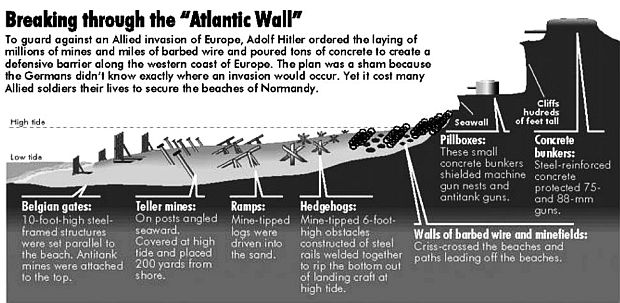
Graphic showing variety of German fortifications on Normandy beaches, creating a deadly maze of entrapments, explosives & obstacles for incoming Allied troops, also facing withering machine-gun fire from bluffs above. Click for “Atlantic Wall” books.
So, it is this fortified beach and coastal setting where the opening scenes of Saving Private Ryan occur. Spielberg puts viewers into the landing craft and among the American soldiers as the vessels are shown bobbing in the sea, approaching the fortified shoreline. To have been an 18-19 year old kid aboard those landing craft, about to step into the horrors of war and possibly death in minutes, is truly a soul-wrenching terror to contemplate. To have been an 18-19 year old kid aboard those landing craft, about to step into the horrors of war and possibly death in minutes, is truly a soul-wrenching terror to contemplate. Some are shown vomiting, others are praying. The Tom Hanks character is shown with hand shaking as he attempts to drink from his canteen. Then the landing craft gate drops open, and all hell breaks loose.
Within seconds, before even taking a step forward from the craft, the first few rows of soldiers are shot immediately from incoming machine-gun fire, dropping where they stood, some with their heads snapping back from the bullet’s impact. Others jump over the sides and plunge into water over their heads, sinking in a tangle of equipment and floating bodies. The action is non-stop thereafter, with Spielberg capturing all the horrific nuance of the bloody beach scene – the sound of bullets pinging off the metal hedgehogs, men losing their limbs from explosions, one picking up his severed arm in a daze, others thrown into the air from explosions. The Hanks character on the beach had one soldier beside him killed instantly by incoming fire, and later, as he tried to carry a wounded soldier, he turns after an explosion to find he is only dragging part of a shredded body. Truly a gruesome hell is shown.
At one point, the Hanks character is seen in a slow-motion daze as has he surveys the hell around him – men on fire, others with intestines bulging out of their wounds, and some hysterically seeking cover behind the metal hedgehogs. The Hanks character soon pulls it together and rallies his men to get off the beach and move inland to attack the German bunkers (The clip below from Saving Private Ryan runs about 9:20 horrifying minutes. Most images are disturbing).
When the film came out in July 1998, there were reports of some veterans having to leave theaters after viewing the opening scene, unable to finish watching the remainder of Saving Private Ryan; the memories were just too powerful. There were also some critics who called the violence in the Omaha beach scene excessive and over the top. Spielberg, for his part, was steadfast in believing the horrific scene was a necessary depiction for history, wanting to show the reality and horrors of war.
One influence on the film’s script was a famous book by noted WWII historian, Stephen E. Ambrose, D-Day June 6, 1944: The Climactic Battle of World War II (1994). Spielberg had also done some of his own research, interviewing D-Day veterans who had been at the Omaha beach battle about their experiences. In fact, many World War II veterans described the opening of Saving Private Ryan as depicting the most realistic representation of combat. One veteran interviewed by Time magazine noted: “I remember when I walked out into the lobby of the moviehouse, not a single person coming out of that showing said one word… Everybody was stunned by it …”
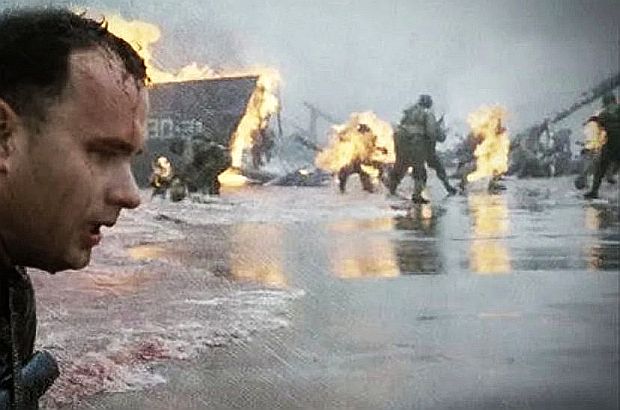
Screenshot from “Saving Private Ryan” showing the Tom Hanks character, Captain Miller, in his daze sequence surveying the ongoing carnage around him at the Omaha beach landing. He soon recovers to lead his men off the beach.
Spielberg had a long-standing interest in WWII history. As a teenager, he had made war films and would later say, “it was the seminal conversation inside my family. My parents talked about the Holocaust and they talked about combat and war. … My dad was a veteran … he had many veterans over to the house, and I became absolutely obsessed … based on my father’s stories, recollections, and also based on all the WWII movies.”
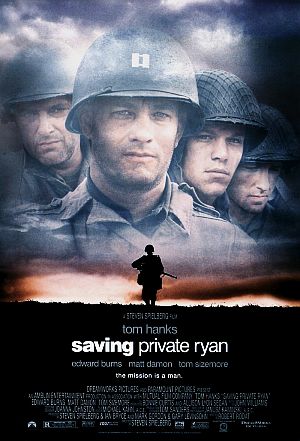
Film poster for Steven Spielberg's 1998 film, “Saving Private Ryan,” starring Tom Hanks. Click for film at Amazon.
The first day of shooting … I was in the back of the landing craft, and that ramp went down and I saw the first 1-2-3-4 rows of guys just getting blown to bits. In my head, of course, I knew it was special effects, but I still wasn’t prepared for how tactile it was. The air literally went pink and the noise was deafening and there’s bits and pieces of stuff falling all on top of you and it was horrifying.
In fact, some of those later viewing the final film found the opening scene so disturbing and thought-provoking that it overshadowed the rest of the film. And indeed, in some ways, Saving Private Ryan is really a film with two parts – one being the opening Omaha Beach landing, and the remainder about the mission to find and save Private Ryan.
Throughout the second part of the film, there are various situations, challenges, and choices that occur for Captain Miller and his men, some raising questions on morality, the rules of war, heroism, and more. Does it make sense to endanger the lives of 8 men to save one from harm’s way? Is it OK to shoot surrendering Germans — or set one free? And how about capping the captain – or at least, disobeying his orders? There is also a famous scene of cowardice in the film, when the translator character, Upham, more academic than combatant, is paralyzed with fear and fails to come to the aide of a nearby fellow American soldier, Mellish, who is being knifed to death by larger German soldier in a horrendous face-to-face scene. These quandaries and further horrors are left to viewers and critics to ponder, which an ample review literature suggests they have.
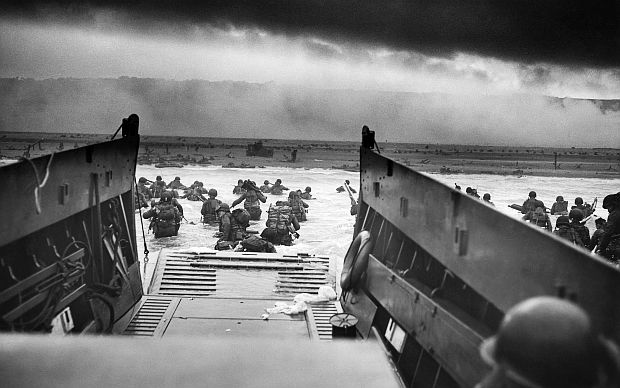
Cropped version of famous WWII photo titled, “Into the Jaws of Death,” taken on D-Day, June 6, 1944, by Robert F. Sargent, a chief photographers mate in the U.S. Coast Guard. It depicts soldiers from U.S. Army infantry divisions disembarking from landing craft and wading ashore at Omaha Beach.
Still, the primary and most enduring message of Saving Private Ryan – coming right at the outset with the Omaha Beach landing horrors – is the heroic sacrifice ordinary men made in that time of fascist threat, giving life and limb to set the world on a better path. Spielberg is not preachy about this, allowing his camera to tell that story, as the machine-gun horrors and spilling of guts burnish that message more deeply than any words alone could.
|
1943-1945
“Monumental D-Day” The actual D-Day invasion was a monumental undertaking, still among the largest mobilizations of troops, support personnel, and military hardware ever undertaken. Planning by a team under American General Dwight D. Eisenhower had begun in December 1943. Logistically, a major ramp-up of industrial supplies had begun in the UK, plus tons of material shipped into Britain from America across the North Atlantic Ocean. Earlier Allied strategic bombing of Germany, begun in 1942, had weakened Germany’s industrial base, also draining some German manpower and resources away from Normandy to home defenses. Allied aerial reconnaissance and intelligence of German coastal defenses also aided invasion planning.  Anthony Richards’ book, “D-Day and Normandy: A Visual History,” Imperial War Museums, 232 pp. Click for copy. The Allies used over 5,000 ships and landing craft to bring more than 150,000 troops on five beaches in Normandy. The landing craft – also known as Higgins boats – were dispatched to the beachhead from larger ships offshore. Each boat held 36 men, and about 12,500 of the landing craft were deployed. In all, nearly 160,000 troops crossed the English Channel on June 6th, 1944, and more than two million Allied troops were in France by the end of August. Establishing the beachhead was critical and costly, but it was just the first step. In the three months after D-Day, the Allies launched additional offensives inland, facing determined German resistance and counter-offensives. Still, less than a year following the D-Day invasion, on May 7, 1945, Germany would surrender. The toll of D-Day dead and wounded was horrific for both sides. Casualties were heaviest at Omaha Beach. More than 4,000 Allied troops, half of them American soldiers, lost their lives in the D-Day invasion, and thousands more were wounded. German casualties on D-Day have been estimated at 4,000 to 9,000. 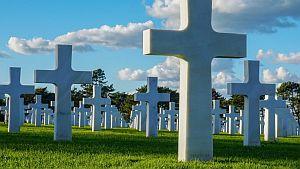 A portion of the gravesites at the Normandy American Cemetery near Omaha Beach. |
Critical Acclaim
Saving Private Ryan, meanwhile, became one of the 1998’s most successful films, earning critical acclaim and a slew of movie awards. Generally, film critics had positive reviews of the film, placing it high in the pantheon of outstanding WWII films, some marking it as “best ever.” In fact, some 60 film critics at the time named Saving Private Ryan the best picture of the year. Janet Maslin of the New York Times, in her comprehensive July 1998 review, called it “the finest war movie of our time” and a film with “immense dignity.” She also used terms such as “viscerally enthralling” and “soberly magnificent” in praising the film. One review of Saving Private Ryan in Toronto’s Globe and Mail called it “a horror movie based on history, offering some of the most spectacularly brutal, viscerally intense battle scenes ever brought to a Hollywood movie.” Newsweek’s Maitland McDonagh, said the film “raises Hollywood’s depiction of war to a new level,” and Gary Kamiya at Salon.com concluded the film “will forever change the way people imagine the most important event in 20th century history. That is no small achievement.”

July 13, 1998 edition of Newsweek magazine lauding Spielberg’s film with “War-is-Hell” cover treatment.
Adjusted for 2023, Saving Private Ryan’s total theatrical box office gross would be equivalent to about $900 million – this on a 2023-equivalent budget of $122 million–$131 million (i.e., $65–$70 million in 1998 ). To keep the budget low, Spielberg and Hanks initially took minimal upfront salaries in exchange for a guaranteed 17.5 percent of the gross profits, equivalent to 35 cents of every dollar earned. In the end, this pay agreement earned them an estimated $30–$40 million each of the box office.
Nominated for a host of awards across a range of categories at American and other film and theatrical organizations, Saving Private Ryan won awards for Best Drama and Best Director at the 1999 Golden Globe Awards. At the 71st Academy Awards, it won for Best Director, Best Cinematography, Best Film Editing. Best Sound, and Best Sound Effects Editing. It was also nominated in other categories at these and other awards ceremonies. The film’s unexpected Oscar loss to Shakespeare in Love for Best Picture was viewed as one of the biggest upsets in the awards history. A later poll of Academy voters in 2015 suggested that, given another opportunity, they would have voted Saving Private Ryan as Best Picture. A more complete listing of Saving Private Ryan’s film awards and nominations can be found at the film’s Wikipedia page. In 2014, the film was also selected for preservation in the United States National Film Registry by the Library of Congress, found to be “culturally, historically, or aesthetically significant.”
Spielberg had preceded Saving Private Ryan with his award-inning Holocaust opus, Schindler’s List in 1993, and had also done Empire of the Sun in 1987, films which also involved WWII. But after Saving Private Ryan, Spielberg’s interest in more World War II films would continue, as he and Tom Hanks would partner on three more WWII productions.
 Spielberg & Hanks present, “Band of Brothers,” 10-part HBO series. Click for Amazon. |
 Spielberg, Hanks & Goetzman, “The Pacific,” 10-part HBO series. Click for Amazon. |
In 2001, Spielberg and Hanks co-produced Band of Brothers, the popular ten-part HBO miniseries based on Stephen E. Ambrose’s book of the same name. In 2010, Spielberg co-produced the 2010 miniseries, The Pacific, centered on the WWII battles in the Pacific Theater, this time with Hanks and also Gary Goetzman. Most recently, again with Hanks, came a third World War II miniseries in February 2024, Masters of the Air, based on the book by Donald L. Miller. Spielberg has also worked with Clint Eastwood, co-producing 2006’s Flags of Our Fathers and Letters from Iwo Jima with Robert Lorenz. Hanks, meanwhile, separately, wrote the screenplay for and starred in the 2020 film, Greyhound, about an American battleship protecting U.S. merchant marine supply fleets menaced by German submarines in the North Atlantic during WWII, based on the 1955 novel The Good Shepherd by C. S. Forester.
For another WWII-related story at this website see, “Firebombing Japan: 67 Cities, 1945”. See also, “The Pentagon Papers,” a freedom-of-the-press story involving Vietnam War-era secret documents and other papers, some of which then Defense Secretary, Robert McNamara, commissioned for an historic review of that war. A related Steven Spielberg film, The Post, is also part of the Pentagon Papers story.
Thanks for visiting – and if you like what you find here, please make a donation to help support the research, writing and continued publication of this website. Thank you. – Jack Doyle
|
Please Support Thank You |
____________________________________
Date Posted: 10 June 2024
Last Update: 7 June 2025
Comments to: jackdoyle47@gmail.com
BlueSky: https://bsky.app/profile/jackdoyle.bsky.social
Twitter: https://twitter.com/PopHistoryDig
Article Citation:
Jack Doyle, “Spielberg’s D-Day: Saving Private Ryan, 1998,”
PopHistoryDig.com, June 10, 20240.
____________________________________
Books at Amazon.com…
 Stephen Ambrose’s best-selling book, “Band of Brothers... From Normandy to Hitler's Eagle's Nest,” w/new forward by Tom Hanks. Click for copy. |
 Donald Miller’s 2006 book, “Masters of the Air: America's Bomber Boys Who Fought the Air War Against Nazi Germany.” Click for copy. |
 John C. McManus’ 2014 book, “The Dead and Those About to Die: D-Day: The Big Red One at Omaha Beach,” 400 pp. Click for copy. |
Sources, Links & Additional Information
 “The Longest Day” (1962) is another famous American film about D-Day based on the 1959 book by Cornelius Ryan. The 3-hour film was produced by Darryl F. Zanuck for 20th Century Fox, and is famous in part for its international cast, which, among others, includes: John Wayne, Robert Mitchum, Richard Burton, Sean Connery, Henry Fonda, Red Buttons, Peter Lawford, Eddie Albert, Rod Steiger, George Segal, Robert Wagner, and Paul Anka. Click for DVD at Amazon. |
 Cornelius Ryan first published his best-selling book, “The Longest Day” in 1959. He spent three years interviewing hundreds of D-day survivors in the U.S. and Europe and also gleaned information from American, British, and German war documents as well as diaries of the great generals. His book sold million of copies. Click for Amazon. |
U.S. Department of Defense, “Remembering D-Day,” Defense.gov (with timeline & interactive map).
“Saving Private Ryan,” Wikipedia.org.
Paul Joyce, “Simple History: The D-Day Landings,” PaulJoyce.co.uk, October 25, 2021.
Stephen Hunter, “Spielberg’s War: It’s Hell,” Washington Post, Friday, July 24, 1998.
Janet Maslin, “’Saving Private Ryan’: A Soberly Magnificent New War Film,” New York Times, July 24, 1998.
Richard Schickel, “Cinema: Steven Spielberg: Reel War,” Time, July 27, 1998.
“User Reviews, Saving Private Ryan” (1998), IMDB.com.
“Saving Private Ryan, Critic Reviews,” MetaCritic.com.
“The 10 Things you Need to Know About D-Day,” IWM.org.uk.
Will Humphries, “D-Day Anniversary: British Soldiers Who Gave Their Lives Are Remem-bered at Last (at Normandy),” The Times (London), June 6 2019.
“Operation Overlord,” Wikipedia.org.
“Remembering D-Day: The 75th Anniversary,” The Duncan Banner / DuncanBanner.com (CNHI Oklahoma), June 6, 2019.
Olivia B. Waxman, “What’s the Most Accurate D-Day Movie? Here’s What 3 Movies Got Right—and Wrong,” Time.com, June 5, 2019, updated: March 30, 2020.
“Normandy Landings,” Wikipedia.org.
John Wrathall, “Horrifyingly Graphic” (Saving Private Ryan reviewed in 1998), Sight and Sound / BFI.org.uk (British Film Institute), September 1998.
Howard Zinn, “Private Ryan Saves War,” The Progressive, October 2, 1998 (also at HowardZinn.org).
“Saving Private Ryan” Symposium The National World War II Museum (film’s 20th anniversary), C-SPAN.org, June 7, 2018.
John Biguenet, “The Profound Contradiction of Saving Private Ryan,” The Atlantic, June 5, 2014.
Chris Vognar, “With ‘Masters of the Air,’ a 10-Year Dream Lifts Off: The Apple TV+ Series from Steven Spielberg and Tom Hanks Is an Heir to Their World War Ii Epic “Band of Brothers,” Set this Time among a Group of Bomber Pilots,” New York Times, January 26, 2024, updated February. 1, 2024.
“Steven Spielberg,” Wikipedia.org.
Mark Allison, “How Saving Private Ryan’s D-Day Sequence Changed the Way We See War,” BBC.com, June 6, 2024.
C. Todd Lopez, “President Recalls U.S. Military Heroism During WWII at French Ceremony,” DOD News, June 7, 2024.
Tommy Lethbridge, “The Most Realistic D-Day Movie Came Out 23 Years Before Saving Private Ryan,” ScreenRant.com, June 2024.
_________________________________________________
More Books at Amazon.com…
 Robert J. Niemi, “100 Great War Movies: The Real History Behind the Films,” 2024, Bloomsbury Academic, 390 pp. Click for Amazon. |
 Martha Raddatz (ABC News correspondent), “The Hero Next Door: Stories of Patriotism and Purpose,” 2026, Simon & Schuster, 368 pp. |
 Arnaud Devillard, et al., “Steven Spielberg. All the Films: The Story Behind Every Movie...”, 2023, Black Dog & Leventhal, 504 pp. |