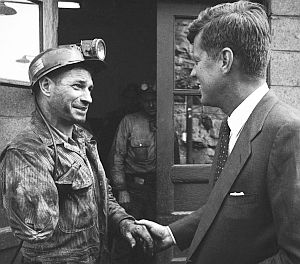
April 1960: JFK greets a one-armed miner near Mullens, WV while on the campaign trail for the West Virginia primary election. Photo: Hank Walker, Time/Life.
But in April 1960, Kennedy won the Wisconsin primary, beating rival Senator Hubert Humphrey of Minnesota. Kennedy’s victory was helped by Catholic voters in some districts. Yet, in many non-Catholic districts, Kennedy did not have a strong showing. That meant the next primary that year – in West Virginia, a state that was 95 percent Protestant – would be a more telling test of Kennedy’s non-Catholic appeal. But West Virginia was uncharted territory for Kennedy. As he had done elsewhere in the country in his early informal campaign, Kennedy had visited West Virginia a few times in 1958 and 1959. But now in 1960, ahead of the May 10th primary, he enlisted all the help he could find with friends and family members fanning out across the state to help him get his message out. JFK himself was also a tireless candidate, traveling throughout the rural state to visit voters wherever he could – though engaging voters directly was difficult due to that state’s rugged terrain.
But it would be West Virginia’s coalfields and coal towns – mostly in the southern part of the state – that would provide Kennedy with a new kind of political education and voter support that would help him gain the Democratic presidential nomination.

April 26th, 1960: JFK meeting with a group of coal miners during a shift change at the Pocahontas Fuel Company’s Itmann mine, near the town of Mullens, West Virginia, in Wyoming County. Photo, Hank Walker.
The coal industry then was in the midst of a pretty brutal downturn. No longer the primary fuel source for home heating, locomotive engines, or industrial factories – as oil and gas replaced coal in many of those uses – coal’s share of the nation’s energy supply had dropped precipitously, from 51 percent in 1945 to 23 percent in 1960. West Virginia’s coal production of 173 million tons in 1947 had fallen to less then 120 million tons by 1960. In addition, increasing mechanization of coal mining in the 1950s had wiped out tens of thousands of jobs. West Virginia’s coal miners – more than 116,400 in 1947 — had fallen to 42,900 in 1960. Local economies in more than 20 of the state’s 55 counties were hit hard. Some counties like Mingo and McDowell had 25-to-40 percent of their populations in need of paltry federal food packages (a minimal system then used prior to food stamps).
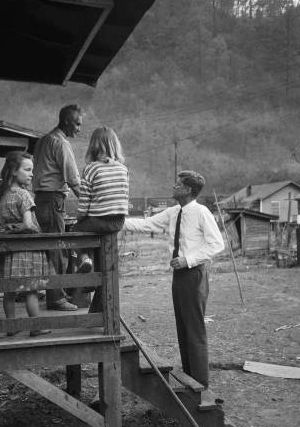
April 1960: JFK campaigning in rural West Virginia in advance of the state's May 10th primary.
On April 6th, 1960, Kennedy spoke with coal miners at Slab Fork Mine in Raleigh County, a county that had experienced a 20 percent population decline between 1950 and 1960. Kennedy gathered with the miners near the mine entrance, shook hands, and answered questions from miners, holding a microphone between himself and the miners as the exchanges were being filmed by a local TV crew. Kennedy’s answers were crisp and made good sense, as he ticked off a list of several policy actions that could be taken to address coal-related economic issues of concern to the miners.
Kennedy also visited miners in the state’s southern-most county, McDowell – where coal mining dated to the early 1890s after the first rail lines came in. By the 1950s, McDowell had become the state’s leading coal producer, a prosperous place with a population of more than 100,000. Yet in 1960, when Kennedy arrived, a decline has set in, part due to the mechanization of the mines, and Kennedy was seeing its effects.
As he traveled around the state, he learned about the hardships people were facing there and how they were living. As one reporter noted: “He saw wives line up for surplus government food. He heard about kids who saved their school milk for younger siblings at home. He passed abandoned miners’ houses with boards over the windows…” Additional accounts noted his remarks as he made campaign stops throughout the state:
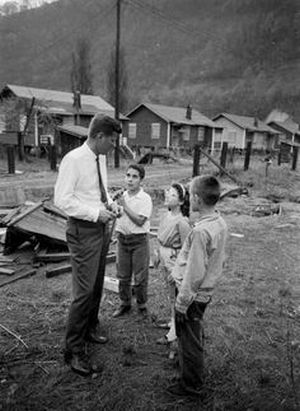
Kennedy talking with children as he campaigned in West Virginia for the state's May 1960 primary.
Clarksburg, April 18, 1960:
“…We talk about new industries and new products for the future – and we must. But we must also do something right now, before those new industries and jobs are here, about those who are unemployed now, who can’t find a job and who can’t get by on an average unemployment check of $23 a week…There are more than 60,000 of those men in West Virginia today and only half of them are drawing unemployment compensation. It is a double failure of our civilization if we cannot permit them to pay their bills and feed their families while looking for another job.”
Bethany College, April 19, 1960:
“…Today the United States is living better than ever before. We have more swimming pools, freezers, boats and air-conditioners than the world has ever seen. ‘But the test of our progress,’ said Franklin Roosevelt, ‘is not whether we add more to the abundance of those who have much; it is whether we provide enough for those who have too little.’ By that test, the last several years have been years of economic failure.”
Glenwood, April 26 1960:
“…Thousands of your citizens — 14,000 here in Mercer County alone — are forced to struggle for subsistence on a diet which consists primarily of flour, rice and cornmeal. A diet which does not permit a healthy, decent existence, a diet which is causing malnutrition, chronic diseases and physical handicaps, a diet which is a disgrace to a country which has the most abundant and richest food supply in the history of the world.”
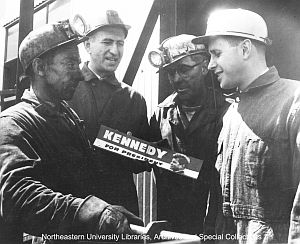
April 28, 1960. JFK campaigner, 'Bunny' Solomon (North-eastern University, MA, top center) with coal miners in Tioga, WW, displaying "Kennedy For President” bumper sticker.
Author Teddy White would later observe about JFK’s discovery of hunger in West Virginia when writing on the 1960 election campaign in his classic book, The Making of a President:
“…[Senator Hubert] Humphrey, who had known hunger in boyhood, was the natural workingman’s candidate – but Kennedy’s shock at the suffering he saw in West Virginia was so fresh that it communicated itself with the emotion of original discovery. Kennedy, from boyhood to manhood, had never known hunger. Now, arriving in West Virginia from a brief rest in the sun and the luxury of Montego Bay, he could scarcely believe that human beings were forced to eat and live on these cans of dry relief rations, which he fingered like artifacts from another civilization. ‘Imagine,’ he said to one of the assistants one night, ‘just imagine kids who never drink milk.’ Of all the emotional experiences of his pre-Convention campaign, Kennedy’s exposure to the misery of the mining fields probably changed him most as a man (emphasis added); and as he gave tongue to his indignation, one could sense him winning friends.”

Campaigning in Amherst, West Virginia, Kennedy addresses miners from atop a station wagon, April 1960. photo Hank Walker
In April and early May 1960, Kennedy made more than 20 campaign trips to West Virginia, according to the state’s Division of Culture and History. During those visits, he made 96 campaign stops at 63 different cities and towns. He told his listeners as he campaigned that the outcome of the West Virginia primary would determine whether he would have a chance at the Democratic nomination. “Help me,” he said during his speeches, “and I will help you,” he promised, should he be elected president.
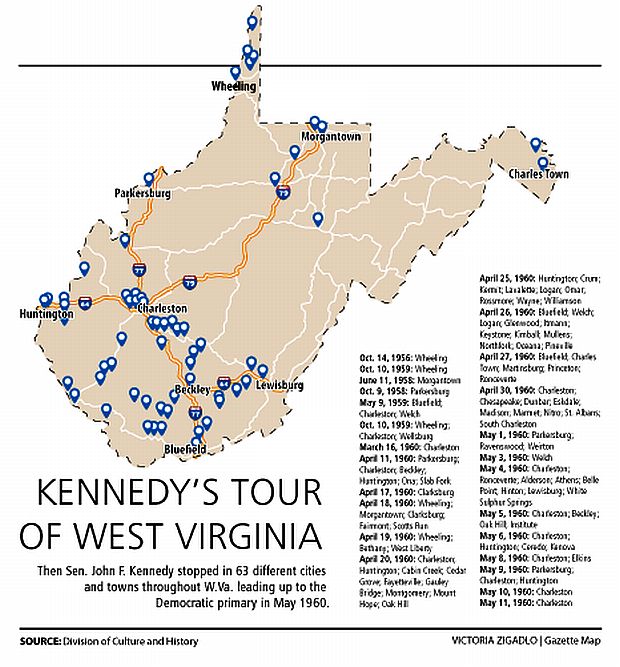
Map compiled by The Gazette newspaper of Charleston, WV, based on information from the West Virginia Division of Culture & History, showing JFK campaign stops, some dating to 1956, but most prior to the May 1960 primary.
Kennedy defeated Hubert Humphrey in the West Virginia primary with more than 60 percent of the vote, helping dispel doubts that he could win in Protestant territory and that Americans would support a Roman Catholic nominee. He then secured the Democratic presidential nomination at the party’s convention that July in Los Angeles, followed by his November 1960 victory over Vice President Richard M. Nixon to become President of the United States.
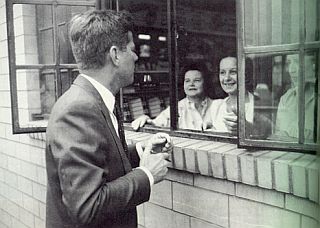
JFK signing autographs for workers at the Amherst Coal Company Grill in West Virginia during 1960 campaign stop.
After he was elected president, on January 21, 1961, his second day in office, Kennedy issued his first executive order: a pilot food-stamp program to increase the amount of food distributed to needy people in economically distressed areas. And the first food stamps in this program were issued in McDowell County.
In May 1961, about a year after he had campaigned there, now President Kennedy sent his Secretary of Agriculture to Welch, WV to deliver the nation’s first food stamps — $95 worth — to Alderson Muncy, an unemployed mineworker with 13 children. Three years later, McDowell County would become one of the principal counties in President Lyndon Johnson’s federal War on Poverty legislative effort.
JFK returned to West Virginia in June 1963 for the state’s centennial commemoration. Speaking on the steps of the state capitol in Charleston, he acknowledged that he “would not be where I am now… had it not been for the people of West Virginia.” Five months later, President John F. Kennedy was felled by an assassin’s bullet in Dallas, Texas. To this day, however, photos of JFK can be found hung on the walls of West Virginia homes, alongside those of Jesus Christ, FDR, union leader John L. Lewis, or some such mixture of honored souls.
Some years later, JFK’s daughter, Caroline, would also come to know something of life in the coalfields…
|
Caroline’s Coal Project During the summer of 1973, Caroline Kennedy, daughter of John F. and Jacqueline Kennedy, then 15½ years old, undertook a brief school project in the coal region of Eastern Tennessee’s Campbell County. At home in Massachusetts, while attending Concord Academy, Caroline had developed an interest in film and photography, and that summer she would work on a documentary film about earlier coal mining and coal camps in Tennessee. During this project, she stayed at the home of former Catholic nun and community advocate, Marie Cirillo, in the Rose’s Creek area near Eagen, Tennessee. Caroline came to Tennessee with a high school friend, Allyson Riclitis, who were among eight students helping to make a film history of the area. 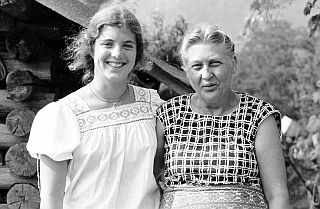 July 1973: Caroline Kennedy, left, poses with local resident Pauline Huddleston at Huddleston's home in Eagan, Tennessee. 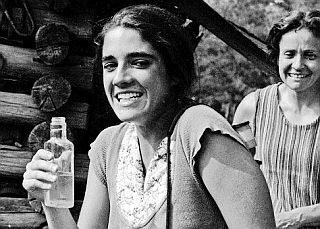 July 1973. Caroline’s friend, Allyson Riclitis, about to sample some local moonshine as Marie Cirillo looks on. Photo, C. Kennedy. By 1973, Cirillo, among other projects, had obtained a grant for an oral history project on earlier coal mining in the region and “coal camp” towns that had formerly existed there. The Clearfork area of Tennessee was then made up of twelve unincorporated communities located between the towns of Jellico, Tennessee, and Middlesboro, Kentucky. As Cirillo would later explain: “When I arrived there, the company towns had been dismantled, mainly because of the shift from deep mining to strip mining as new technology made that possible. Big machines now dug the coal. Production no longer required people, so the companies tore down the miners’ homes because they no longer had to provide housing. That was when people realized for the first time that over the years the companies had bought up most of the land.” 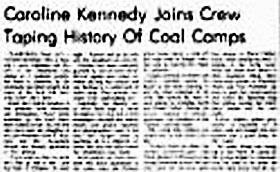 Rough copy of July 1973 AP wire story: 'Caroline Kennedy Joins Crew Taping History of Coal Camps'.  Marie Cirillo some years later, undated photo. 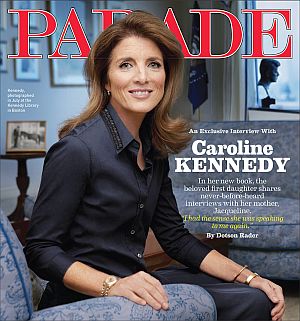 Caroline Kennedy profiled by Parade magazine in Sept 2011 at release of her book, “Jacqueline Kennedy: Historic Conversations on Life with John F. Kennedy.” Click for book. Kennedy, a graduate of Harvard and Columbia Law school, went on to publish several books, and became involved in the JFK Presidential Library and the Profile of Courage Awards. She also served as America’s ambassador to Japan during the Obama Administration. |
See also at this website additional stories on JFK’s “road to the White House,” including separate stories on his campaigning in 1957, 1958, 1959, and 1960, as well as other related stories such as, ““The Jack Pack, 1958-1960”, covering campaign help he received from Frank Sinatra and his “Rat Pack”. See also the “Kennedy History” page for other stories on the Kennedy family.
Thanks for visiting — and if you like what you find here, please make a donation to help support the research, writing and continued publication of this website. Thank you. – Jack Doyle
|
Please Support Thank You |
____________________________________
Date Posted: 17 January 2025
Last Update: 17 January 2025
Comments to: jackdoyle47@gmail.com
BlueSky: jackdoyle.bsky.social
Article Citation:
Jack Doyle, “JFK & West Virginia: 1960,”
PopHistoryDig.com, January 17, 2025.
____________________________________
JFK History at Amazon.com…
 Fredrik Logevall’s 2021 book, “JFK: Coming of Age in the American Century, 1917-1956.” Click for copy. |
 Tom Oliphant & Curtis Wilkie's book, “The Road to Camelot: Inside JFK's Five-Year Campaign.” Click for copy. |
 James W. Douglass’s 2010 book, “JFK and the Unspeakable: Why He Died and Why It Matters.” Click for copy. |
Sources, Links & Additional Information
 Richard Robbins’ 2020 book, “JFK Rising: The 1960 West Virginia Primary and the Emergence of John F. Kennedy.” Click for copy. |
 Book by JFK aides, Kenny O'Donnell & Dave Powers, "Johnny, We Hardly Knew Ye," paperback. Click for book. |
 "Coal: A Human History", by Barbara Freese, 2016 edition. Click on this book and those below for Amazon. |
John F. Kennedy
Dallas Boothe, “Kennedy Says Primaries Important; Thinks People Should Have Right To Choose Presidential Nominee,” Raleigh Register, April 12, 1960.
“Kennedy Raps Food Program; Says GOP Failed To Make Enough Food Available,” Raleigh Register, April 20, 1960.
“The Kennedy Boys Return to Stump; Robert and Teddy Campaign for John in West Virginia but Women Stay Out,” New York Times, May 1, 1960.
“April 6, 1960 – Senator John F. Kennedy Talking With Coal Miners in Raleigh County, West Virginia,” YouTube.com, posted by HelmerReenberg, January 28, 2009.
David Gutman, “He [JFK] Never Forgot West Virginia,” Gazette-Mail (West Virginia), Thursday, November 21, 2013.
Rick Hampson, “When W.Va. Lost its Voice: JFK’s Death Still Resonates,” USA Today, October 29, 2013.
Bill Archer, “John F. Kennedy Wins the Hearts of Southern West Virginia Coalfield Voters,” Bluefield Daily Telegraph (Bluefield, WV), November 22, 2013.
Phil Kabler, Statehouse Reporter, “Historic 1960 Humphrey-Kennedy Debate Took Place in WV,” Gazette-Mail, Monday, July 27, 2015.
_________________________
Caroline Kennedy
Associated Press (Clairfield, TN), “Kennedy Daughter Helps Make Film,” The Lewiston Daily, Sunday, July 3, 1973.
Hildegarde Hannum, ed., “Marie Cirillo: Stories From an Appalachian Community,” Twentieth Annual E. F. Schumacher Lectures, Salisbury, CT, October 2000.
Associated Press, “Caroline Summer Sweetheart Of Coal Mine Camps,” The Indianapolis Star (Indianapolis, IN), July 8, 1973, p. 3.
Associated Press (Clairfield, TN ), “Caroline Kennedy Joins Crew Taping History Of Coal Camps,” The La Crosse Tribune (La Crosse, Wisconsin), July 10, 1973, p. 8.
“Caroline Kennedy Finds Quiet Among Hill Folk,” The Kansas City Times (Kansas City, MO), July 12, 1973, p. 24.
“People,” Time magazine, July 16, 1973.
UPI (Egan,TN), “Caroline Kennedy’s Job Ends,” Washington Post, July 19,1973.
Fred Brown, “Caroline Kennedy Recalls a Summer in Rose’s Creek,” Knoxville News-Sentinel, January 31, 1993.
Georgiana Vines, “For More than 40 Years, a Former Nun from New York Has Helped Appalachian Communities,” KnoxNews.com, March 27, 2010.
Georgiana Vines, “Marie Cirillo’s Career Serving Appalachia Ending,” Knoxville News Sentinel, August 25, 2013.
Merisa Tomczak, “Community Leader: Marie Cirillo,” Appalachian Student Health Coali-tion, Archive Project, June 2, 2015.
_____________________________________________________
Caroline Kennedy Books at Amazon.com…
 Ellen Alderman & Caroline Kennedy, “In Our Defense: The Bill of Rights in Action,” 1992, Avon, 430 pp. Click for Amazon. |
 “A Patriot's Handbook: Songs, Poems, Stories, and Speeches Celebrating the Land We Love,” 2003, Grand Central Pub, 688 pp. Click for Amazon. |
 Caroline Kennedy & Ellen Alderman, “The Right to Privacy,” 1997, Vintage Paperback, 432 pp. Click for Amazon. |