“Over the Rainbow” – or more accurately, “Somewhere Over The Rainbow” – is a 1939 song made famously popular by the movie The Wizard of Oz. In that classic and much-loved film, a young Judy Garland, playing Dorothy, memorably performed the tune following a scene in which she and her dog, Toto, have had a dust up with a nasty neighbor, and is then told by her Auntie Em to “find a place to stay out of trouble.” Somewhat befuddled, Dorothy, then on her Kansas farm, posits the question to her canine companion, “Do you suppose there is such a place, Toto?” Concluding to herself, “there must be,” she says. But it’s not a place you can get to by a boat, or a train, she explains. “It’s far, far away. Behind the moon, beyond the rain.” And with that, she breaks into song.

Early scene from 1939 film,”The Wizard of Oz,” when Judy Garland character “Dorothy” sings “Somewhere Over The Rainbow.” Click for full film clip with Judy Garland singing the song at YouTube.com.
“Somewhere Over the Rainbow,” of course, has been burnished in the hearts and minds of generations since 1939. It won the Academy Award for Best Original Song that year. And the Judy Garland song has gone on to great renown. The American Film Institute has named it the best movie song ever. In 2001, “Over the Rainbow” was voted the greatest song of the 20th century in a joint survey by the National Endowment for the Arts and the Recording Industry Association of America. In 2017, it was selected for induction into the National Recording Registry by the Library of Congress as being culturally significant.
|
“Over The Rainbow”
Somewhere over the rainbow Somewhere over the rainbow Someday I’ll wish upon a star Somewhere over the rainbow If happy little bluebirds fly |
At its core, however, “Over The Rainbow” is a song with simple words and sentiment, but with hopes and dreams as big as one might imagine. However, it became more than a teenager’s lament and longing for a happier place – though it was certainly that in the film. But today it is often described as a universal anthem for optimism; a song that offers consolation to troubled souls — and even nation states — during times of difficulty and hardship. And over the years, it has found lots of good meaning, however listeners might define those.
The song was composed in the late 1930s by Harold Arlen with lyrics by Yip Harburg.
At the time, the film’s producer, Arthur Freed, wanted a ballad that would rival a then popular song, “Someday My Prince Will Come,” from the 1937 Walt Disney film, Snow White and the Seven Dwarfs. And in the process of making The Wizard of Oz, after some twists and turns, “Over the Rainbow” became the film’s lead-off song, and a classic for the ages.
But the context of those times also gave that song additional weight and meaning. The decade of the 1930s had not been the best of times, certainly, as the Great Depression had ravaged America and would not end until 1939. Franklin Roosevelt’s New Deal from about 1933 onward did help bring a partial recovery, but times remained tough throughout the decade.
The late 1930s were also fraught with global concerns, and not least, the rise of Nazi fascism in Adolph Hitler’s Germany. Kristallnacht, for example, the “Night of Broken Glass,” when Jewish stores and shops were sacked by Hitler’s brown shirts, took place on the nights of November 9–10, 1938.
The Wizard of Oz, meanwhile, officially opened nationwide across America on August 25, 1939. Several days later, on September 1, 1939, Hitler invaded Poland, initiating World War II. The film and its “Over The Rainbow” song, gave filmgoers a hopeful lift in those times. And for years thereafter, film and song would become all-time classics.
In 1956 The Wizard of Oz soundtrack album was released by MGM to coincide with the TV premiere of the film, and would be re-released several times thereafter, including as a deluxe edition in 1995. “Over The Rainbow,” meanwhile, became Garland’s signature song, which she performed for thirty years. Her original 1939 Decca gramophone record of “Over the Rainbow” was inducted into the Grammy Hall of Fame in 1981.

Ray Charles as he appeared on the cover of his 2006 album, “Ray Sings, Basie Swings.”
Ray’s ‘Rainbow’
Ray Charles, of course, had his unique ways with songs, old and new, and his soulful presentations – from “Georgia on My Mind” (1960), “You Don’t Know Me” (1962), “That Lucky Old Sun” (1963), “Busted” (1963), “Crying Time” (1964) – to his moving rendition of “America The Beautiful,” are some of those from his outstanding and diverse catalog.
A versatile performer in blues, jazz, gospel, rock and country, Ray Charles’singles have appeared on the Billboard R&B chart, the Billboard Hot 100, and the Country & Western chart. Overall, in his nearly 50-year career, he turned out 127 singles, 54 studio albums, 7 live albums, and 39 compilations. He had multiple Top 40 hits across the Billboard universe – 61 on the R&B chart, 33 on the Hot 100, and eight on the Hot Country chart.

Ray Charles 1963 album “Recipe for Soul,” includes his cover of “Over the Rainbow” & others, such as, “Busted,” “That Lucky Old Sun,” and “Ol Man River.” Click for Amazon.
Music Player
“Over The Rainbow” – Ray Chalres
1963
Ray’s version leaves room for listeners to conjure any range of feeling or longings. He takes his time with the song, and moves slowly over the words, allowing thoughts to marinate in his tempo and cadence. The lyrics linger, and listeners can wander through their lifetimes — past, present or yet to come.
The Charles version, produced in 1963, also includes a dose of orchestral strings and background singers that may, for some listeners, make it a bit too saccharine or overdone by today’s standards. But even so, it’s still Ray’s voice and pacing that allow listeners to indulge memory, poignancy, and/or “what-ifs.”
All in all, Ray’s offering of “Over The Rainbow” is a moving rendition. He doesn’t push you into it, but brings you along, allowing you to find your own way.
Online Comment
Online, the Ray Charles version of “Over the Rainbow” has received notice through the comments of listeners hearing his version at one YouTube posting of June 2011. “…Hearing Ray’s rendition of this song, makes you forget that someone else originally wrote it,” offered ‘ameliaspencer6120,’ posting comment there. “He definitely makes it his own…” Another posting there – from ‘etevefromleicester’– also noted: “[This is] the first time I ever heard Ray sing this one – and it’s the most beautiful version I ever heard.” ”…I truly believe Ray could see things while singing this that the rest of us can’t….”– YouTube comment.Another YouTuber – ‘pixiedustinajar’– commenting on Ray’s version compared to others, noted: ”…Just spent some time listening to nearly every rendition of this song. This right here is THE best version!”
Some of those commenting at the YouTube posting noted hearing the Ray Charles version in the soundtrack for the 1993 TomHanks / Meg Ryan film, Sleepless in Seattle. And a couple others just added general comment, as ‘geraldthezamboniguy’ did, noting: “Ray Charles could sing the phone book and make it go platinum…” And similarly, in a separate post: “This man could sing ‘Happy Birthday’ and give you goose bumps…” said ‘tlee51ftw.’
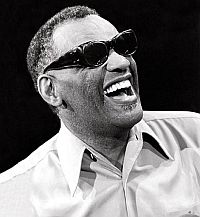
Ray Charles, circa 1960s.
Others noted the emotional power of Ray’s version: “Ray Charles can really pull on your heart strings,” said ‘vincentpolizzi764,’ while another, ‘lcx2846,’ allowed, “I cannot listen to this without tears in my eyes…” And ‘bryanaustin52,’ noted in his comment: “I’ve skipped over this version so many times and I’m sorry I did. Finally found the perfect version of this song. I truly believe Ray could see things while singing this that the rest of us can’t….”
For two other stories on Ray Charles music at this website, see: “Ray Sings America,” and, in a the later part of the Beatles story on their song, “Eleanor Rigby,” the Ray Charles version of that song is also included there with some background. Additional music story selections at this website can be found at the “Annals of Music” category page.
Thanks for visiting – and if you like what you find here, please make a donation to help support the research, writing, and continued publication of this website. Thank you. – Jack Doyle
|
Please Support Thank You |
____________________________________
Date Posted: 17 July 2026
Last Update: 18 July 2026
Comments to: jackdoyle47@gmail.com
Article Citation:
Jack Doyle, “Over The Rainbow” – Judy Garland to
Ray Charles,” PopHistoryDig.com, July 17, 2026.
Twitter: JackDoyle/PopHistoryDig
BlueSky: jackdoyle.bsky.social
____________________________________
Related Ray Charles Books & Film at Amazon.com…
 Ray Charles & David Ritz, “Brother Ray: Ray Charles' Own Story,” 2004, De Capo Press,383 pp. Click for Amazon. |
 Jamie Foxx stars in “Ray,” the classic 2004 American biographical film focusing on 30 years in the life of Ray Charles. Click for Amazon. |
 Mike Evans, “Ray Charles: The Birth of Soul,” 2007, Omnibus Press & Schirmer Trade Books,362 pp., Click for Amazon. |
Sources, Links & Additional Information
Philip Drost, “Why Over the Rainbow Remains Iconic 85 Years after the Wizard of Oz. The Song, Which Has Captured Hearts since 1939, Turned 85 this Year,” The Sunday Magazine / CBC Radio / CBC.ca, September 22, 2024.
“Over The Rainbow,” Wikipedia,org.
“The Wizard of Oz” (1939 film), Wikipedia.org.
Gary Shapiro, “’Over the Rainbow’: The Story Behind the Song of the Century,” Columbia.edu, November 15, 2017.
StevenStarkMusic, “Biography Of A Song “Somewhere Over The Rainbow,” YouTube.com, May 22, 2024.
Jon Hoem, “Wizard of Oz – Somewhere Over The Rainbow,” YouTube.com, March 17, 2011.
RC, “Ray Charles Somewhere Over the Rainbow,” YouTube.com, June 1, 2011.
__________________________________________
Related “Wizard of Oz” Items at Amazon.com…
 Frank Baum, “The Wonderful Wizard of Oz” (illustrated 1st Edition), 100th Anniversary OZ Collection, 200 pp, Click for Amazon |
 Judy Garland, “The Wizard Of Oz,” 1939 film (75th Anniversary edition). Amazon’s Choice - Prime Video, DVD, or Blue Ray. Click for Amazon. |
 Aljean Harmetz, “The Making of the Wizard of Oz: Movie Magic and Studio Power in the Prime of MGM,” 1998, Hyperion, 331pp. Click for Amazon. |
|
OZ Effects “Starman & Dark Side“ Apart from cover versions of “Over the Rainbow,” both song and The Wizard of Oz film have had other connections to rock stars and rock music of more recent years.  Some “Starman” lyrics. Click for Amazon. In another context, there is a rumored connection between The Wizard of Oz film and Pink Floyd’s famous 1973 album, Dark Side of the Moon. An urban legend of the mid-1990s had it that there were some uncanny parallels between the album’s music and various scenes, gestures, movements and speech of Wizard of Oz characters in the 1939 film. One wag had stated that if you started Dark Side’s music precisely on the third roar of the MGM lion at the outset of the film, all sorts of curious “synchronicities” would follow as the film rolled on. One website, in fact, compiled a list of 100 or so of these purported synchronicities. Yet, members of Pink Floyd have denied that there was any doing on their part to bring any of this about, and that whatever coincidences there may be between the film and their music, were are just that. See the story, “Dark Side’s 40 Years, 1973-2013” for history on the Pink Floyd album. |