Among important products of industrial innovation in the late 19th century – made “new-and-improved” with synthetic chemistry in the 20th century – is the automobile tire. However, with its global use and invincible design, the tire has also brought a legacy of lingering public safety and environmental concerns. Today’s tires, it is said, “can outlast the pyramids.” And indeed, millions and millions of them have made a pretty good run at doing just that, as waste tires have been discarded for decades, many in mountainous tire dumps across the U.S. and around the world. Millions more have gone up in flames in costly and dangerous “tire fires.” In addition, tires left in open dumps fill with rain water, becoming mosquito breeding grounds and public health threats.

For decades, millions of discarded automobile and truck tires have ended up in enormous tire dumps like this one.
The problem with the modern automobile tire – and by extension, truck, bus, tractor, earth mover, jet plane, and other tires – is that they are made too well. This, of course, is not a problem when your family is hurtling down the highway at 60 -to-70 miles per hour in your favorite sport utility vehicle equipped with what you hope are four invincible, steel-belted radials. Indeed, you are most thankful for, and quite appreciative of, every bit of the “keep-us-safe” technology and ingenuity found in the modern tire. However, after an inch or less of each tire’s “rubber-meets-the-road” interface is worn away, that’s when the modern tire – now headed for the discard pile – begins to become something of disposal nightmare, environmental menace, and public safety problem.
Once upon a time, circa 1900-1940, automobile and truck tires were mostly all-rubber concoctions, evolving with strengthening cotton chords and other ingredients such as carbon black. In the 1930s, for example, the rubber in tires could be reclaimed and the tires themselves retreaded, though many were still discarded. But the making of tires changed with WWII, especially when the Japanese seized the rubber plantations of southeast Asia. But even before WWII, the march of “progress” had begun to deliver more durable tire ingredients: synthetic cord and antioxidants were added by the 1920s; rayon tire cord came in 1937; and styrene butadiene rubber, a Du Pont invention, was an essential ingredient and major change agent by 1941 and thorughout WWII. Nylon cord came in 1947 along with the first tubeless tires. Michelin’s steel-belted radial tires arrived in 1948. Polybutadiene an polyisoprene polymers were used to enhance tire performance in 1955. Chlorobutyl or bromobutyl were
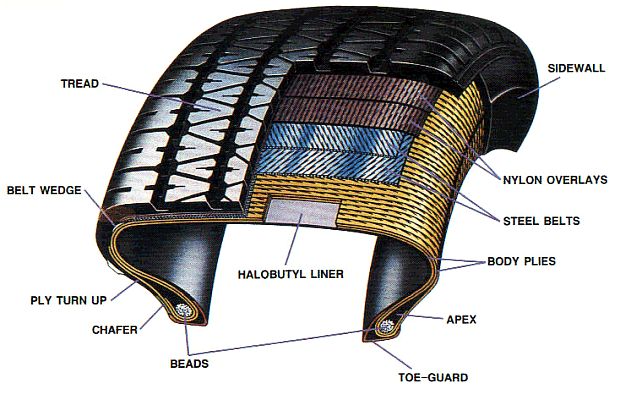
One cross-section of a modern tire’s construction and some of the chemical, synthetic and strengthening ingredients used to make them “high-speed and freeway worthy,” but also nearly invincible in their afterlife.
used for tubeless tire air retention by 1960. Polyester cord was used by Goodyear as reinforcing material in 1962 (in hundreds of million of tires through the 1990s), Aramid fiber, another Du Pont invention, was first used to reinforce radial tires by Goodyear in 1974. Radial tires dominated the new car market by 1975 and for replacement tires by 1980. High performance all-season tires were introduced by Goodyear 1986 – and other durability improvements and synthetic ingredients have continued to be used in tire construction since.
So when such indestructible (yet flammable) products are discarded – at a rate of about 300 million tires a year in the U.S. alone – roughly one scrapped tire per person per year – they can, and have presented, a monumental waste disposal problem. For decades now, discarded tires have created major waste problems in practically every one of America’s 51 states and throughout much of the world. Huge waste tire piles, tire storage warehouses, illegal waste tire dumps, and defunct or abandoned “tire recycling” operations – have all become environmental and/or public safety problems. In fact, historically in the U.S., it has been estimated that over the years, there may have been as many as 2-to-3 billion tires that accumulated in waste dumps and stockpiles. In the 1970s-thru-1990s period, in particular, waste tire dumping and tire fires became more or less “regular news” as citizens and public officials became more attentive to the problem. According to EPA, some 176 major tire fires occurred in the U.S. between 1971 and 1988 — and at least dozens more since then.
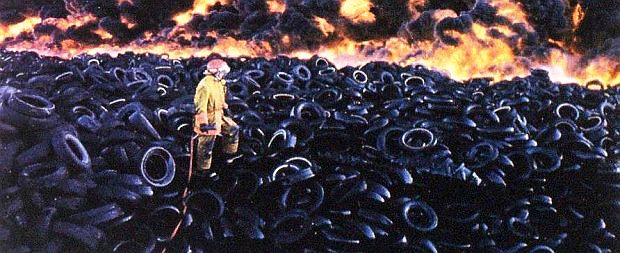
Fires at waste tire dumps – and also at junkyards, used tire collection warehouses, and tire recycling operations – have not been uncommon occurrences in the U.S., hitting a peak in the 1980s-1990s period, but still occurring through the 2020s, despite clean-ups in some states...
Once permitted for disposal in landfills, waste tires soon revealed a designed-in “defeat mechanism” that made them unwelcome as buried waste. Called “floaters” by those in the landfill biz, waste tires didn’t stay buried for long, as their airy hulls gave them a tendency to “rise up” or “float” to the top layers of the landfills, sometimes popping through the surface. As a result, beginning in the late 1980s, many states in the U.S. began to ban or phase-out whole tire disposal at landfills, though shredded tires are still land-filled in some areas. According to EPA, some 176 major tire fires occurred in the U.S. between 1971 and 1988 — and at least dozens more since then. But landfill restrictions on waste tires, encouraged tire-waste entrepreneurs to begin scrap-tire collections and other tire storage services, some operating dubious tire recycling, shredding, “oil-from-tires” schemes, and other ventures, some of which also became problematic.
Left in open outdoor piles and dumps, used and discarded whole tires – with their airy spaces and water-collecting hulls – make them ideal mosquito breeding habitat. And also, when scarp tires burned en masse at tire dumps – for whatever reason – they could spawn difficult-to-extinguish infernos that would take weeks, and in some cases, months to extinguish.
Waste tire fires in particular – whether at abandoned dumps, junk yards, used tire collections; defunct tire recycling enterprises, or stuffed-full warehouses with tires and/or tire shred – have created various public safety hazards and toxic dangers, sometimes with far-traveling smoke plumes. And battling tire fires with huge quantities of fire-fighting water – typically yield contaminated runoff reaching streams and rivers, and with time, seeping into water tables and residential wells. Fire-fighting retardants, chemicals and foams used in these battles – PFAS chemicals among them – can also leave unwelcome chemical residue with known toxic dangers.

Famous photographer, Edward Burtynsky, took this 1999 photo of a portion of the Westley, CA tire pile – titled “Oxford Tire Pile #8” – part of the stockpile that once fed a power plant for a time as “tire-derived fuel” to help reduce the piles. Yet, some 7 million tires still remained there, and on Sept 22, 1999, they ignited with a lightening strike, burning for almost an entire month, as municipal and county officials then advised: "the best thing to do is to let the fire burn itself out." Still, a big tire mess remained there for many years.
What about tire recycling? Well, yes, there is tire recycling, but it’s not quite what it sounds like. It is generously and somewhat erroneously stated, that some 76 percent of U.S. scrap tires are “recycled”. Among the largest category of “recycled” tires are those burned in power plants, cement kilns, or paper mills. Burning whole or shredded tires has become a big, industry-favored waste tire solution – an “out-of-sight-out-of-mind” solution; or so it seems. Yet the burning and incineration of tires can create a different – and some might say – more dangerous yield of airborne toxics, including dioxins and furans. Other recycled strategies include tire shred, and/or pulverized “crumb rubber” for athletic turf. But the final safety and public health word on incorporating crumb-rubber into athletic fields and playground turf appears to be “still-under-study.”
In the U.S., many states came slowly to the waste tire problem, and by the 1980s and 1990s, they began to discover that numerous tire dumps – large and small – had accumulated across their jurisdictions. By the early- and mid-1990s, states such as Pennsylvania and California had tens of millions of waste tires strewn across landfills, rural ravines, roadside dumps, warehouses, “here-today-gone-tomorrow” recycling operations, and other locations.
In 1996, Pennsylvania faced a severe waste tire crisis, with an estimated 36 million tires in dozens of illegal and abandoned dumps, large and small, all across the state. But in that year, two galvanizing events helped move the state legislature to action. In March 1996, arsonists set fire to an illegal dump of roughly 10,000 to 12,000 tires that were stashed beneath a section of the elevated Interstate Highway I-95 that wound its way through Philadelphia.

The March 1996 tire fire that broke out beneath a portion of Interstate Highway I-95 made front-page news, destroyed part of the highway & snarled traffic for months.
I-95 then and now, is not only a critical East coast interstate artery, it is also a major commuter route for the Philadelphia, PA/ Camden, NJ metro region.
The fire-damaged interstate was first shut down for nine days to make an emergency temporary fix, and thereafter, was traffic-restricted for months while final structural repairs were made. The repairs cost taxpayers over $6 million.
But then, in September 1996, Pennsylvania had another tire fire. This one a massive fire at a recycling scrap yard in rural Juniata County in central Pennsylvania north of the state capital, Harrisburg.
The operator, Mahantango Enterprises, had accumulated more than 1 million waste tires in a large field at the recycling site where there were also piles of shredded tires. In the early 1990s, Mahantango was shredding and processing about 5,000 tires a day — 1,250 of which come from the million or so stored in the nearby field and the rest from incoming collections. But by 1996, the Mahantango operation was on the state’s waste tire list, identified as a “potential problem site,” with 1.5 million tires. According to the PA-DEP, the cleanup at the site was then “active,” but apparently, not active enough. As early morning on September 27, 1996, a fire erupted at Mahantango Enterprises.
Arriving firefighters were greeted by “acre-wide mass of flames” burning across the area, according to one report. At least 20 fire companies from seven nearby counties had come to help fight the blaze.“They’ve got 2.5 acres of shredded tires burning,”said a Juniata county emergency dispatcher, the day of the fire. Another fire technician reported, “The plant itself is…toast,” referring to the recycling building. Thick, acrid smoke wafted across the area, and nearby residents were advised to stay indoors with windows and doors closed. The fire continued to burn and smolder for three days.
The Pennsylvania legislature, meanwhile, was then dealing with possible waste tire legislation, and the two fires – at Philadelphia and Juniata – helped underscore the urgency of that need. The debate in the Pennsylvania legislature over waste tire regulation and clean up had been going on since the late-1980s when early bills were proposed but never enacted. The two 1996 fires helped expedite the process. On December 19, 1996, Governor Tom Ridge signed the Waste Tire Recycling Act (Act 190) into law. This legislation changed how Pennsylvania managed waste tires with new funding streams to help remediate “legacy” tire piles, prioritizing the highest environmental risks, and also providing grants and tax credits to incentivize tire recycling and new end-markets for tire shred and crumb rubber.

As of 1996 there were some 36 million scrap tires in dumps across the state of Pennsylvania. As of 2008, this map portrays locations of known tire dumps still existing in the state at that time. In recent years, with new laws and clean-up efforts, something north of 30 million waste tires have been cleaned up at these and other locations in Pennsylvania, but a number of theses locations still hold waste tires as of 2026.
Pennsylvania has cleaned up many of its scrap tire dumps. Yet, as of early 2026, some waste tire piles still remain. There are also 12 documented “priority” tire dumps in the state that contain 10,000 or more tires each. These priority sites hold roughly 700,000 tires in total, and there are many smaller piles and illegal dump sites that continue to exist. Still, the state has cleaned up more than 31 million scrap tires to date.
Other states have also taken action, most during the 1980s and 1990s, continuing to this day, spending tens of millions of public dollars to clean up tire dumps throughout their jurisdictions. However, it is not always clear where the “cleaned up” tires go, as some may be going into export streams. Between 1990 and 1997, the Wisconsin DNR cleaned up 12 million tires at 162 tire dumps and other sites. Private parties in Wisconsin cleaned up an additional 4 million tires at 408 sites. Almost all the cleaned up Wisconsin waste tires were processed into fuel and used for generating energy or electricity at industries – that is, they were burned or incinerated in some way, which is controversial in its own right, given potentially toxic emissions.
Other states, like Maine, have been motivated by huge waste tire dumps in their states to take action. In the mid-1990s Maine estimated it had 318 waste tire dumps in the state which then accounted for some 22.3 million discarded tires. One of these sites – the largest in the state, the J.C. Bothelo dump site in Bowdoin, ME – then accounted for about 12 million waste tires.
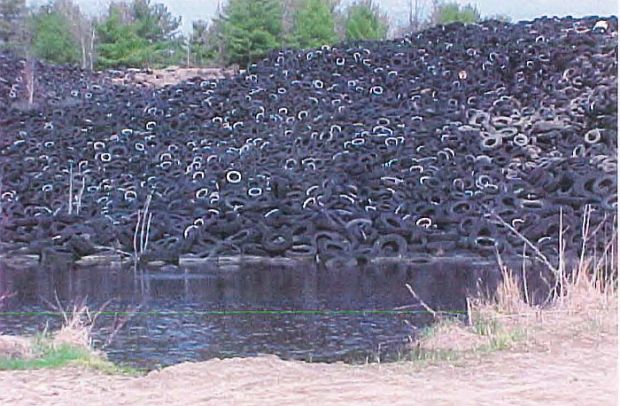
A portion of Botelho tire dump; Bowdoin. ME from earlier photo published in Maine DEP report, January 2000.
But Maine’s fight to clean up J.C. Bothelo site began would involve protracted legal action in the 1980s and early 1990s, with clean-up following through the early 2000s. In the 1980’s, the Maine DEP referred enforcement relating to the J.C. Bothelo site to the state’s Attorney General. A court-order followed to halt certain activities and practices at the site in 1989. That decision was appealed by Bothelo to the State Supreme Court and that court affirmed the trial judge’s decision on January 16, 1990. But thereafter, tire dumping continued at the site and Mr. Bothelo was found guilty of criminal contempt later that year. A permanent injunction prohibiting further dumping was granted by the Court in 1992. Mr. Bothelo apparently continued to dump tires at his site and was again found guilty of criminal contempt. This time he was also sentenced to 45 days in jail in 1993. The Superior Court then granted a supplementary injunction in 1997, which authorized the DEP to begin clean-up and abatement at the site. As of December 1999, some 2.2 million tires at the Bothelo site had been cleaned up, with additional clean-up activity scheduled thereafter. By early 2000, Maine had also cleaned up more than 3 million waste tires at six other sites. At the Bothell site, after more than a decade of remediation and clean-up ensued, the state shredded millions of tires. The tire shred from that site and others, would be repurposed as lightweight civil engineering fill for state highway infrastructure projects. Meanwhile, other states such as Texas, continue to address the waste tire problem in more recent years, and still have many dumps that still hold millions of waste tires.

This map of “unauthorized scrap tire sites” as of 2022 in Texas shows various waste tire dumps located across the state, ranging in size from several thousand tires per site, to some sites with up to 1-to-5 million tires each. The total number of waste tires at these sites was more than 12 million at the time.
Yet, despite state tire disposal laws and regulations, and successful clean up efforts in some states, tire dumping, tire fires, and waste-tire related public health problems continue throughout the U.S. and North America – and often much worse throughout the rest of the world.
In recent years, the state of Louisiana has had continuing problems with waste tires, touching all corners of the state — from the large burning pile of 100,000 waste tires in January 2022 at the bankrupt and shut down Cottonport Monofill tire recycling facility in rural Avoyelles Parish, to large illegal tire dumps in New Orleans East.

Graphic showing illegal waste tires collected in New Orleans, LA, during the 2010-2021 period.
Today’s tires, it seems – especially those with synthetic ingredients – amount to one of those “invent-first-ask-questions-later” products of modern synthetic chemistry that now burden society with their “externalities.” The inventors and manufacturers, of course, bear little of these “end-of life” tire costs, as tire fire-fighting and dump clean-ups are typically borne by taxpayers.
Of the 300 million scrap tires generated each year in the U.S., it is generously stated in industry documents that the lion’s share is “recycled” — which includes 44 percent that are burned as fuel in industrial applications, cement kilns, and power plants. Another 19 percent are processed into crumb rubber, shredded for landfill construction backfill, and used in rubber-modified asphalt. And 16 percent are retreaded or exported to other countries. That leaves about 21 percent – or about 60 million waste tires annually – that still end up as waste in landfills, stockpiles, or illegal dumps.
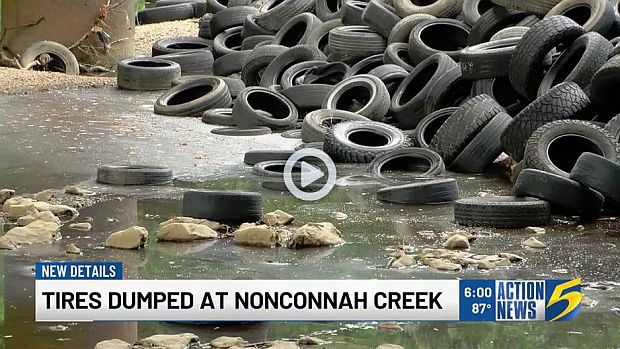
Screen shot of a TV news broadcast about a September 2025 waste tire dumping incident near Memphis, TN. While used tire dumping in the U.S. is not as big a problem as it once was, it still occurs. Click for video clip at YouTube.
And while the various fuel and waste-to-energy strategies are favored methods to “disappear” waste tires, such uses may actually be trading one kind of waste and pollution for another – i.e., a less-visible and perhaps more harmful form of airborne toxic waste. True, the volume of the problem is dealt with, but not the chemistry. Ideally, and preferably, the reuse of tire waste for the production of new tires would make tire manufacturing and use more of a “closed-loop” process. And perhaps that should be the goal. But given the various chemical, additive and strengthening ingredients in modern tire production, that remains a difficult challenge, if not an impossible proposition. At a minimum, however, there needs to be a reset on who is ultimately responsible. Tire manufacturers should be required to take full charge of waste-tire management and waste-tire solutions — plus full liability — for all end-of-life tire wastes.
|
Public Health Issue “Tire Dust” In addition to waste tire dumps, tire fires, and tire-bred mosquito problems, there is also another tire-related environmental and public health concern: tire dust. Turns out, tire dust is far from harmless. In fact, in normal, every-day driving, tires shed microscopic particles. These tire particles are released into the environment during driving, turning, breaking and normal tire wear. In the aggregate, when all moving vehicles around the globe are considered – or even those moving daily through one metro region – an immense volume of tiny particulate matter is generated. Ounces per vehicle add up. 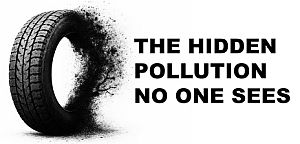 Title screen, (Tyre Dust Pollution), YouTube.com, Raw Green, Episode #43: December 3, 2025 (35 min). Rebecca Sutton, an environmental scientist with the San Francisco Estuary Institute, who has studied and reported on urban stormwater runoff, recently told Yale Environment 360: “We found extremely high levels of microplastics in our stormwater. Our estimated annual discharge of microplastics into San Francisco Bay from stormwater was 7 trillion particles, and half of that was suspected tire particles.” 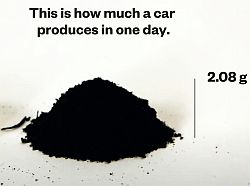 One estimate from the UK Dept of Transport, based on a single 15 km commute, reported 2.08 grams of tire particles shed per vehicle each day (about .073 ounce). Seemingly a tiny amount, which however, adds up in the aggregate of millions of vehicles driven millions of miles. One organic chemical – known as 6PPD – a widely used stabilizing ingredient added during tire manufacturing – is also known as an ”anti-degradant,” used to keep tires from cracking. In the environment, however, 6PPD can react with ozone to form 6PPD-quinone, which is highly toxic to fish and poses risks to ecosystems. The substance has also been found in human blood and urine. Other studies have detected tire wear particles in food sources like lettuce. According to Yale Environment 360, “tire rubber contains more than 400 chemicals and compounds, many of them carcinogenic, and research is only beginning to show how widespread the problems from tire dust may be.” A major hurdle for scientists and regulators, however, is that tire manufacturers are not legally required to disclose their exact chemical formulations. Stay tuned, as the research and regulation on this environmental and public health front is still in its early stages. |
Stay tuned to this website for periodic stories that will highlight case histories of waste tire dumps and tire fires that have occurred in the U.S. and North America since the 1980s. Other stories at this website also cover environmental history, and still others focus on case histories in the oil and petrochemical industries.
Thanks for visiting – and if you like what you find here, please make a donation to help support the research, writing, and continued publication of this website. Thank you. – Jack Doyle
|
Please Support Thank You |
____________________________________
Date Posted: June 18, 2026
Last Update: June 20, 2026
Comments to: jackdoyle47@gmail.com
Article Citation:
Jack Doyle, “Leaving Rubber: Waste Tires, 1980s-
2020s,” PopHistoryDig.com, June 18, 2026.
Twitter: https://twitter.com/PopHistoryDig
BlueSky: jackdoyle.bsky.social
____________________________________
Related Reading at Amazon.com…
 Richard Korman, “The Goodyear Story: An Inventor's Obsession and the Struggle for a Rubber Monopoly,” 2003, Encounter Books, 222pp. |
 Quentin R. Skrabec Jr., “Rubber: An American Industrial History” – includes the ‘rubber barons,” 2014, McFarlane, 244pp. Click for Amazon. |
 Gregg Mitman, “Empire of Rubber: Firestone’s Scramble for Land and Power in Liberia,” 2023, The New Press, 336 pp. Click for Amazon. |
Sources, Links & Additional Information
 “We Don't Want to Start That Tire Fire” is an academic casebook detailing the legal and environmental battle surrounding the 2008 Lafarge v. Ontario Environmental Review Tribunal case. The book explores the legal drama that unfolded when Lafarge, a multinational cement producer, sought government approval to burn "alternative fuels" like scrap tires and plastics at its plant near Bath, Ontario. Lafarge plants in the U.S. and Canada have been among those that have burned waste tires for fuel at its cement plants – and not without controversy. Click for book at Amazon. |
 U. S. Fire Administration, “Tire Recycling Facility Fire, January-February 2002, Nebraska City, Nebraska,” published, February 21, 2013, 50 pp. This report tells the tale of the EnTire Tire Recycling facility in Nebraska City, NE that burned for over eleven days in 2002. The tire recycling and shredding operation there involved formerly-used grain silos to store tire shred. An explosion occurred there during the firefighting effort, injuring thirteen firefighters. Multiple evacuations of up to a 30-block area were also ordered during the event. Over 40 agencies assisted during the fire at an estimated cost of .4 million. Report available at Amazon. |
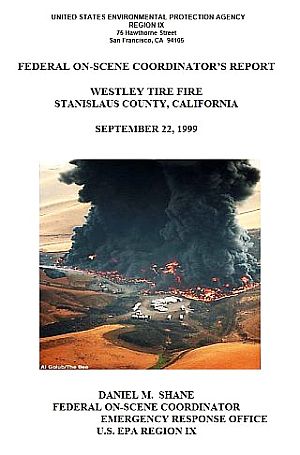 U.S. EPA, Region IX, San Francisco, CA, Federal On-Scene Coordinator’s Report, “Westley Tire Fire, Stanislaus County, California, September 22, 1999,” where 7 million illegally-piled tires owned by Oxford Tire Recycling were struck by lightening in a rural location and burned for 27 days, later becoming a Superfund site and resulting in a million settlement to local residents suffering health effects and/or property damage. The final environmental cleanup there wasn't completed until March 2007. |
 U. S. Fire Administration & Dept of Homeland Security, “Special Report: Scrap and Shredded Tire Fires,” Published, April 2013. Technical Report Series, 58 pp. This report examines seven case studies of tire fires typical of those occurring in the U.S. Click for copy at Amazon. |
 Trevor Letcher, et al., “Tire Waste and Recycling,” 2021, Academic Press, textbook, 650pp. Resource book for scientists, R&D professionals, engineers, manufacturers and academics dealing with or interested in the scrap tire problem. |
 S. Victor Fleischer, “The Goodyear Tire & Rubber Company: A Photographic History, 1898-1951,” University of Akron Press, July 2020, 296 pp. Click for Amazon. |
 Steve Love, David Giffels & Debbie Van Tassel (ed.), “Wheels of Fortune: The Story of Rubber in Akron,” 1998, University of Akron Press, 359 pp. Click for Amazon. |
 Joseph Louis Lisoni & Gail Landtbom Lisoni, “Where the Rubber Meets the Road: The Bridgestone/Firestone Conspiracy of Death & Destruction, A True Story,” 2019, Mill City Press, 274 pp. Click for Amazon. |
“Scrap Tires – Basic Information,” U.S. Environmental Protection Agency (EPA), EPA.gov, 2003.
“Tire Pile Fires Prevention, Response, Remediation,” EPA.gov, September 23, 2002.
“Tire Fire,” Wikipedia.org.
U.S. Fire Administration / Technical Report Series, Special Report: Scrap and Shredded Tire Fires, USFA-TR-093, December 1998.
“Radial Tire Spawned Industry Revolution,” Rubber & Plastics News, Special Issues, 100 Years Of The Pneumatic Tire, August 1988, pp. 100-103.
“Synthetic Rubber,” Wikipedia.org.
“In Danville, N.H., Mr. Hunt Tries to Get Rid of 15 Million Old Tires,” Wall Street Journal, September 1983.
Scott M. Rodell, “The Tire Inferno,” Environmental Action, December 1983-January 1984, p. 4.
“Tire Fires,” U.S. Environmental Protection Agency (EPA), EPA.gov.
David Sturm, “2 Million Tires Stored Illegally, Overflow Mt. Joy Twp. Quarry,” Intelligence Journal (Lancaster, PA), March 31, 1988, front page w/ photo.
“Superfund Liability In Tire Fires,” Scrap Tire News, Vol.3, No. 2, March/April, 1989, p. 1
New York State Department of Environmental Conservation, “Oil Spill Ills From Catskill Tire Fire,” WasteLine, Vol.2, No.4, July 1989, pp. 1, 9.
“Residents Evacuated in New York,” Scrap Tire News, Vol.3, No. 2, March/April, 1989, p. 1.
Mike Stoneberger, “Tire Fire Chemical Emissions and State Regulations Regarding the Storage of Waste Tires,” Air Toxics Unit, Permits Section, Division of Air Pollution Control, Illinois Environmental Protection Agency, 1988.
“Other Major Tire Fires,” Sidebar/Box, USA Today, February 22, 1990.
“Shrinking the Used-Tire Mountain,” New York Times, May 9, 1990, p. D-7
William Claiborne, “Candadian Blaze In Tire Dump Sets Off Protest,” Washington Post, May 19, 1990, p. A-17
Martin Pflieger, “Cement Plant Seeks Change In Tire-Burning,” The Morning Call (Allen-town, PA), September 24, 1991, p. B-5.
Martin Pflieger, “Firm Hails Tire Burning Study,” The Morning Call, June 26, 1992, p. B-1.
Clean Water Action, Pittsburgh, PA, Fact Sheet, “12 Reasons Not To Burn Tires At Kosmos,” 1993.
Don Hopey, “Ban On Test Burn For Tires Lifted,” Pittsburgh Post-Gazette, June 16, 1993, p. B-4
Editorial, “Tire Burn Test Poses Unnecessary Danger,” News Record (Warrendale, PA), July 14, 1993.
Susan Q. Stranahan, “Tires Roll On As Cheap Fuel,” The Philadelphia Inquirer, August 2, 1993, pp. C-1, C-10.
Goodyear Tire & Rubber Co., “Scrap Tires: At Goodyear, An Energy Asset,” Company Brochure, Public Affairs Dept, Akron, Ohio, October 1993.
Julia Bauer, “DEP: Tires Can Fuel Cement Kilns,” The Express-Times (Easton, PA), July 26, 1996, p. B-1.
Jeff Bailey, “Old Tires Fire Up The Imaginations of Myriad Inventors,” The Wall Street Journal, October 12, 1995, p. A-1.
“Tire Recycling,” Wikipedia.org.
David Templeton, “Washington, Pa., School, Homes Evacuated; Blaze Continues,” Pittsburgh Post-Gazette, February 28, 1997, p. A-1
Debra Smith, “The Great Everett Tire Fire, 25 Years Later,” The Daily Herald (Everett, WA), September 13, 2010.
“Somerset Tire Fire:,” JournalTimes.com (Wisconsin), October 18, 1986.
Bob Schieffer (on air), “Wisconsin Tire Fire,” CBS Evening News, Saturday, October 18, 1986, (tire fire near Somerset, WI, reported on CBS national TV newscast, with some details of the fire and scenes shown), Vanderbilt Television News Archive / Vanderbilt.edu.
U.S. Environmental Protection Agency, “Air Emissions From Scrap Tire Combustion,” EPA Publication·600/R·97·115, October1997, 120 pp (includes case studies and emissions sampling at Rhinehart Winchester, Virginia and Wisconsin Somerset tire fires).
United Press International (Hudson, CO), “Tire Mountain Fire Could Be Out by Sunday,” June 12, 1987.
U.S. Environmental Protection Agency, EPA Emergency Response Team, Region Three, “Federal On-Scene Coordinator’s Report For the Cochranville Tire Fire, Chester County, Pennsylvania,” CERCLA Emergency Response/Removal Action, April 27, 1988 Through May 10, 1988.”
Hank A. Howard, “Tires Burning By The Acre,” Fire Engineering, June 1, 1988.
UPI (Catskill, NY), “Tires Smoldering by the Millions,” UPI.com, February 26, 1989.
Sam Howe Verhovek, “Fiery ‘Mountains of Tires’ Defy Firefighters at Dump,” New York Times, March 1, 1989, p. B-1.
Adolphe V. Bernotas, Associated Press, “Huge Tire Pile Catches Fire; Could Burn For Days,” APnews.com, September 11, 1989.
Town of Danville, New Hampshire, “The Infamous Tire Fire – 1989,” Fire Department pages, TownofDanville.org.
Keith Schneider, “Worst Tire Inferno Has Put Focus on Disposal Problem,” New York Times, March 2, 1990.
Barry Came, “The Fire Mountain; Battling the Blaze at a Quebec Tire Dump,” Maclean’s, May 28, 1990.
Associated Press (Duryea, PA), “Massive Tire Fire Erupts At Controversial Recycling Center,” APnews.com, September 15, 1991.
Leanora Minai, “Tire Fire Spews Noxious Fumes In Duryea,” The Times Leader (Wilkes-Barre, PA), September 16, 1991, p. A-1.
“Tire Fire May Cost County $50,000,” Buffalo News, May 25, 1995.
“Tire Fire Undermines I-95 in Philadelphia,” New York Times, March 14, 1996.
Associated Press, “Kentucky Doesn’t Have Money To Clean Up Piles of Tires,” The Tennessean (Nashville, TN), December 1, 1996 p. 29.
Sheila Mccarthy and Norma Braude, “Dump Remains Unsightly Hazard Three Years after Tire Fire,” Buffalo News, May 11, 1998.
Torri Minton, Jason B. Johnson & Pamela J. Podger, “Lightning Strikes, Tires Blaze / Smoke Fills Valley Sky After Wild All-Night Storm,” SFGate.com, Thursday, September 23, 1999.
Daniel M. Shane, Federal On-Scene Coordinator’s Report, “Westley Tire Fire, Westley, Stanislaus County, California, September 22, 1999,” Emergency Response Office, U.S. Environmental Protection Agency, EPA Region IX, August 30, 2000.
News Release, “DEM Announces That Davis Tire Pile Cleanup Is Complete; More than Six Million Tires Removed; Court and State Officials Watch Last Load Leave Site,” Rhode Island Department of Environmental Management (DEM), Providence, RI, December 20, 2000.
Larry L. Wiles, “Shredded Rubber Tire Fire, Nebraska City, Nebraska,” FireEngineering .com, June 1, 2003.
“Raleigh, North Carolina Tire Fire Sends Huge Plume Of Smoke Into Sky,” Firehouse.com, June 3, 2004.
Kathie O. Warco, “Memories of Epic Washington Blaze Vivid for Those Who Fought Fire,” Observer-Reporter (Washing-ton, PA), February 27, 2007.
“East Chicago Tire Fire – FOX 32,” YouTube-.com, July 17, 2009.
Center for Health, Environment and Justice (CHEJ), Burning Rubber: Tire Incineration, Fact Pack, PUB101, November 2011, CHEJ.org, Falls Church, VA, 103pp,
Daniel Nolan, “25 Years Ago Today: The Hagersville Tire Fire That Burned 17 Days,” The Hamilton Spectator (Hamilton, NY), February 12, 2015.
Scott Huddleston, “Infamous Tire Dump to Be Cleared,” San Antonio Express-News, January 10, 2018.
Lauren Hernández, “Tire Fire in San Francisco Sends Nauseating Stink Through City,” SFgate.com, March 22, 2019.
Marjie Lundstrom, “No Verdict in Sight on Safety of Crumb Rubber Fields, Prompting Angst All Around; The Agencies Have Not Issued Any Safety Findings From Their Highly Anticipated Crumb Rubber Study,” Salon.com, April 22, 2019.
Ken Dixon, “As CT Struggles with Dumping of Tires, Lawmakers Pass Management Plan,” CTinsider.com (Connecticut), May 24, 2023.
Theodoros Grigoratos and Giorgio Martini, “Non-Exhaust Traffic Related Emissions. Brake and Tyre Wear PM,” European Commission, Joint Research Centre, Institute of Energy and Transport,” 2014.
Jim Robbins, “Road Hazard: Evidence Mounts on Toxic Pollution From Tires,” Yale Environment 360 / e360.Yale.edu, September 19, 2023.
Jules Struck, “Our Car Tires Are Poisoning Salmon—and Maybe Us, Too,” National Geographic, March 26, 2025.
Raw Green, Episode #43: “The Hidden Pollution No One Sees” (Tyre Dust Pollution), YouTube.com, December 3, 2025 (35 min).
The Pew Charitable Trust, “Breaking the Plastic Wave 2025: A Comprehensive Assessment of Pathways Towards Stopping Ocean Plastic Pollution,” December 2025, 152pp.
“Rubber Pollution” [includes tire and road wear particles], Wikipedia.org.
______________________________________________________