The Kennedy family of Massachusetts, famous for its members in prominent political posts during the 20th and early 21st centuries — not least, John F. Kennedy as President in 1960-63 — also figures in various involvements with coal, from investments to regulation. The paternal grandfather of JFK, RFK, and Ted Kennedy – Patrick J., or “P.J.”, as he was called – had an investment in the Suffolk Coal Company, an interest he held at the time of his death. “PJ’s” son, Joseph P. Kennedy – father of JFK, RFK and Ted Kennedy – is reported to have made a killing in a 1922 stock deal ($45 million in today’s money by some estimates) speculating on Ford Motor Company’s acquisition of the Pond Creek Coal Co. in Kentucky. And Robert F. Kennedy’s wife, Ethel Skakel (married in 1950) was the daughter of multi-millionaire George Skakel who was a principal in The Great Lakes Coal & Coke Company of the 1920s.
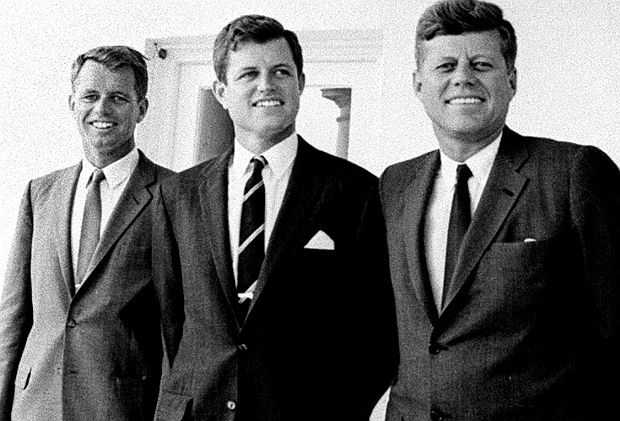
August 1963: The Kennedy brothers, from left, Robert, Edward and then-U.S. President John F. Kennedy, in Washington, D.C. (Associated Press). All three would become involved with helping to improve the lot of coal communities and coal miners in one way or another, whether through community assistance programs and/or federal regulation. The story here focuses on the activities of Bobby and Ted.
Yet in subsequent generations, as members of the Kennedy family coursed through American politics in the mid-20th century, they became involved variously with public policies aimed at helping coal communities — whether regulating strip mining, exposing corporate exploitation of coal-state resources, pushing deep-mine safety legislation, or securing economic support for hard-pressed coal communities. Kennedy family members generally worked to help coal miners and their communities, or to spotlight coal-related environmental problems and mine safety issues. Another story at this website, for example, has covered JFK’s focus on West Virginia coal communities as he campaigned for the White House in 1960. What follows here are the activities of his brothers, Bobby and Ted Kennedy, as they worked to bring national attention and/or federal regulation to coal mining communities and coal mine safety.
1968
RFK & Kentucky
After President John F. Kennedy’s assassination in 1963, his successor, President Lyndon Johnson, enacted the federal “War on Poverty,” inspired in part by the poverty found in Appalachia. Johnson’s programs were aimed at alleviating those conditions throughout the region. In February 1968, Robert Kennedy, then on the cusp of jumping into the race for president, toured a string of towns in the coal regions of southeastern Kentucky. He went there to see for himself how this part of Appalachia was faring. His two-day “poverty tour” in February 1968 covered some 200 miles and included stops at a number of towns, among them: Neon, Grassy Creek, Mousie, Fisty, Jackhorn, Cody, and others.

February 1968: Robert F. Kennedy, center, looking down, no top coat, with following crowd of onlookers, staff and media, as he makes his tour of Eastern Kentucky, here on Liberty St., Hazard, KY, photo, Paul Gordon. Click for RFK books at Amazon.
RFK, who had served as JFK’s Attorney General, was now a U.S. Senator from New York. And on this trip, he would make scheduled and unscheduled visits with the residents of Eastern Kentucky, including walking tours of small communities, roadside visits with individual families, stops at one-room schoolhouses, speeches at courthouses and colleges, and a look at one strip mine site. As a member of Senate’s Labor and Public Welfare Committee’s Subcommittee on Employment, Manpower and Poverty, Kennedy would also hold two field hearings soliciting the views of area residents. A one-room schoolhouse in Vortex hosted one of Kennedy’s hearings, and the other was held in a school gymnasium at Fleming-Neon.

Robert F. Kennedy greeting residents of Eastern Kentucky as he made his way across the region on his two-day tour.
In the town of Barwick in Breathitt County, Kennedy visited a one-room schoolhouse that was in session. He spoke with each student individually, asking them what they’d had to eat that day.
Reportedly, the teacher there, Bonnie Jean Carroll, always made sure the kids had a big meal at school to be sufficiently nourished. She would send the boys to walk two miles into town to get milk and other things, while the girls cooked. According to some local history assembled at the RFKinEKY.org website, “Bonnie and her students did a lot of cooking in the classroom; they made a big, hot meal every day.”

February 1968: Robert F. Kennedy in Neon, Kentucky where he listened to local residents tell of hardships.
Public Hearing
RFK and party traveled from Whitesburg to the gym in Fleming-Neon where they conducted a three-and-a-half hour hearing. Twenty eastern Kentuckians gave testimony, including: nationally known author and Kentucky native, Harry Caudill, Judge Wooton of Leslie County, LKLP director Stafford, coal miner Cliston Johnson, and David Zegeer of Beth-Elkhorn Coal Company.
Evarts High School student Tommy Duff testified about school conditions, while other students protested, some with paper bags over their heads. They were opposing, the proposed flooding of Kingdom Come Creek by the Beth-Elkhorn Coal Company, which would have displaced their community (In 1956, Consolidation Coal Company, which had been the dominant company in the area for decades, sold its coal interests to Bethlehem Steel, and their mining subsidiary was Beth-Elkhorn). During the hearing, Senator Kennedy also debated with David A. Zegeer of the Beth-Elkhorn asking whether Mr. Zegeer’s company had many stockholders from Kentucky. During the exchange with Zegeer, Kennedy asserted: “Outsiders have come in and exploited the great wealth of the area—with great profits going elsewhere in the country.”
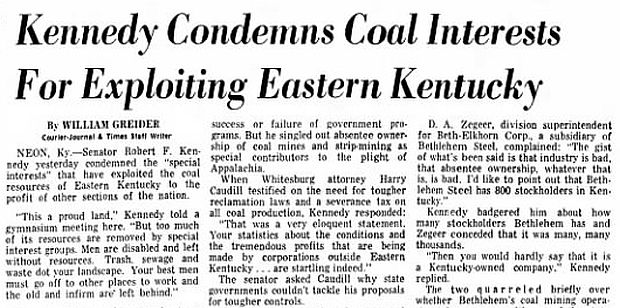
February 15, 1968. Front-page story from ‘The Courier Journal’ newspaper of Louisville, KY, covers RFK’s field hearing at Neon, KY with the headline “Kennedy Condemns Coal Interests For Exploiting Eastern Kentucky”.
Time magazine reported on RFK’s Kentucky visit, noting that he came with “a caravan of 36 cars crammed with out-of-state reporters, committee staffers and electronic gear.” At one stop, Time reported Kennedy being asked: “Why was a man reared to a multi-millionaire’s comforts concerned with the plight of Kentucky’s poor?” Some thought it a simple political calculation, a way to bring the spotlight on himself as a possible contender in that year’s presidential race. Yet others had noted a change in RFK with the assassination of his brother, and that he was looking at social issues in a new way.
 Harry Caudill, here walking with RFK, and among those who testified, wrote “Night Comes to The Cumberlands” (1962), a powerful indictment of Appalachian exploitation. Click for story. |
 Robert F. Kennedy, listening to a miner relay his concerns during a two-day tour in Neon, KY, February 1968. |
Bill Grieder, who covered Kennedy’s Kentucky trip for the Louisville Courier-Journal, noted in a later email recalling the trip: “…Reporters more sophisticated (and cynical) than I assured me he was merely prepping for his as yet unannounced presidential candidacy. Probably so, but you couldn’t imagine any politician slogging through all those hollows and decayed coal camps without some kind of deep conviction.”
Some of those who covered Kennedy on that trip, however, had a different reaction to him. Tom Bethell for one, reporting for The Mountain Eagle newspaper of Whitesburg, KY, had the opportunity to see him in a more private setting, and would later write:
“…[U]p close, Kennedy was harder to read….[I] was struck by how uncurious, even detached, Kennedy seemed when he wasn’t in a public setting. …I found myself riding with him in his car, en route to his next photo-op, and was shocked when a VISTA volunteer in the car tried to engage him in a conversation about what she had learned on the job, and he cut her off, rudely and brusquely. At that moment I thought he was every bit as arrogant as I’d sometimes heard he was, a stereotypically spoiled and entitled little rich kid if ever there was one, and I couldn’t imagine voting for Bobby Kennedy unless the only alternative was Richard Nixon.”
Bethell added, however, that his first impression “might have been completely wrong,” and that Kennedy “might have been a wonderful president, the first since Franklin Roosevelt to offer real and lasting hope for hard-pressed people, rural and urban alike. Or not….”
Back on the 1968 poverty tour, meanwhile, Time magazine quoted Cliston Johnson, 48, a partially disabled miner struggling to raise 15 children on $60 a month: “Whenever you get another kid to feed, just add a little more water to the gravy.” The government’s “gravy,” however – at the time, totaling some $450 million Federal aid to Appalachia since 1965 – had done little to help. Nor were private-sector companies setting up factories in that part of Appalachia, some dissuaded by the ravaged landscape. Kennedy, as Time reported, did not seem inclined toward more federal handouts, quoting him as saying: “Welfare’s not the answer. It’s jobs. It is a basic responsibility of our society to give every man an opportunity to work.” At the tiny school building in Vortex, Kennedy pulled in an overlfow crowd, where he asked questions about diet, clothing and schooling. Over and over again, he said: “This is not satisfactory, this is not acceptable.” And when he said, “We’ve got to do away with welfare,” the people applauded.
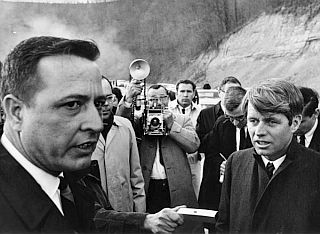 Senator Robert F. Kennedy talking with strip mine owner Bill Sturgill at the Yellow Creek mine site in Knott County, Kentucky, February 1968. |
 Matthew Algeo’s 2020 book on RFK’s Appalachia tour. Chicago Review Press, 268pp. Click for copy. |
Strip Mine Site
After leaving Hazard, Kentucky, Kennedy and entourage stopped, unannounced, at the Yellow Creek strip mining site Knott County. In trying to gain access to the site, Kennedy’s entourage was blocked by cars of the mine crew several times. After a contentious moment of negotiation between RFK and the mine’s security staff, mine owner Bill Sturgill allowed Kennedy and his group to access the site.
At the final stop of the Eastern Kentucky tour, in a filmed interview with an off-screen reporter on the streets of Prestonberg (see YouTube video), Kennedy was asked, “Is there anything significant that you’ve learned on this trip?” He answered as follows:
“…Well, people are still having a very, very difficult time… There’s hunger; considerable hunger in this part of the country. There’s no real hope for the future amongst many of these people… who have worked hard in the coal mines. And now the coal mines shut down, they have no place to go. There’s no hope for the future. There’s no industry moving in. The men are trained in government [job training] programs and there’s no jobs at the end of the training program because of the cutback – because of the demands on our federal budget in Washington and the war in Vietnam – even these training programs are being cutback. So people are being cut off, and they have no place to turn. And so they’re desperate and filled with despair. Seems to me that this country, as wealthy as we are, that this is an intolerable condition. It reflects on all of us. We can do things all over the rest of the world, but I think we should do something for our people here in our own country.”
RFK did not have the opportunity to do much of substance for Appalachia following his visit, since shortly thereafter he began his bid for the 1968 Democratic Presidential nomination. And tragically, like JFK, Bobby Kennedy was also taken by an assassin’s bullet. Kennedy was murdered June 5th, 1968, on the night of the California primary, shortly after he won that primary and had made his victory speech. It was four months after his visit to Eastern Kentucky.
In February 1972, New York Times reporter, George Vecsey, doing a four-year follow-up story on RFK’s Kentucky visit, noted: “…The issues have not changed much in four years. Poverty is everywhere; coal miners still die, and the hills are being torn apart ever faster by the strip miners.”
[Some years later, Bobby Kennedy’s son, RFK, Jr., prior to his teaming up with the Trump presidential campaign in 2024, and becoming Trump’s HHS Secretary in 2025, had worked for years as an environmentalist and riverkeeper. In the 1990s-2010s period, he participated in protests over mountain-top strip mining, coal export expansion, coal ash pollution, and more – while supporting wind & solar energy development. His 2004 book, Crimes Against Nature, was highly critical of George W. Bush, roll backs of environmental laws, and the fossil fuel industry, and it became a best-seller. In recent years, however, RFK, Jr. stirred concerns and controversy regarding some of his views on public health – not least being his positions on, and misinformation about, childhood and COVID-19 vaccines, also becoming a Donald Trump acolyte in his bid for the HHS post, resulting in a loss of some of his prior environmental and other supporters. His cousin, and JFK daughter, Caroline Kennedy, called his views on vaccines “dangerous” and said he was unqualified to be HHS secretary.]

U.S. Senator Edward Kennedy, Feb. 2004.
1969-2008
Ted Kennedy
Edward Moore “Ted” Kennedy served as a U.S. Senator from 1962 until his death in 2009. His service of 46 years in the U.S. Senate at that time made him the fourth-longest, continuously-serving senator in U.S. history. In those years, Kennedy became a friend of labor, and held forth on Senate committees helping to craft and watch over occupational health and safety matters. Kennedy was one of the Senate leaders who helped pass the Occupational Safety and Health Act of 1970, which created OSHA, the federal Occupational Safety and Health Administration. Prior to passage of the act, there were few federal health and safety protections for workers. And in later years, as well, Kennedy would help to defeat attempts to weaken the law.
Coal mine safety was also one of the areas Kennedy would become involved with as he sought improved worker health and safety regulation. For decades, coal-mine disasters had killed miners regularly. Some mine explosions and fires would kill dozens and even hundreds of miners at a time. The Coal Mine Health and Safety Act of 1969, generally known as “the Coal Act,” was the first meaningful law to help govern mining practices. It came about following the deaths of 78 miners at the November 1968 Farmington Mine Disaster in West Virginia.

West Virginia historic marker for the Farmington mine disaster, which killed 78 miners, and helped spur Congress to pass the Federal Coal Mine Health & Safety Act of 1969.
Indeed, a few years later more coal-related disasters would occur. In February 1972, at Buffalo Creek, West Virginia, 125 persons died when a coal waste dam burst sending a near tidal wave of coal waste water through a seventeen mile-long valley, leaving a trail of devastation as it went. In July 1972, at Blacksville, West Virginia, a fire was sparked by a continuous mining machine that came into contact with an electric wire, igniting the coal seam. Nine miners who had not been adequately trained in emergency procedures, became trapped and died in the mine.

Senator Kennedy in his younger years, shown here at a 1979 Judiciary Committee hearing.
New Law. These incidents and others stirred Washington to action again, as House and Senate committees investigated and held hearings. On February 11, 1977, S.717, the Federal Mine Safety and Health Amendments Act, was introduced by Sen. Harrison Williams (D-NJ), with Senator Kennedy and 25 others as cosponsors. The Harrison bill revised the 1969 Coal Act with the Mine Safety and Health Act of 1977, also known as “the Mine Act.” It was signed by President Carter in November 1977. This law consolidated federal health and safety regulations for coal and non-coal mining; moved the new Mine Safety and Health Administration (MSHA) to the Department of Labor; strengthened and expanded the rights of miners; and enhanced their protection from retaliation. Mining fatalities would drop sharply in subsequent years, but problems still remained.
The Reagan Years. In the 1980s, as the Reagan Administration and the mining industry sought to weaken mine safety regulations, Senator Kennedy and his staff geared up for battle, focusing a series of hearings on the lax regulatory oversight by Reagan’s MSHA. Kennedy described the record of that agency as “shameful and tragic,” and kept pressure on MSHA to strengthen its programs and enforcement. Among those who testified before Kennedy at a March 1987 hearing was J. Davitt McAteer, a lawyer and coal miner’s son who then headed the Occupational Safety and Health Law Center, a public interest group in Washington, D.C.“We know how to prevent many of the unnecessary deaths in the mines. What we seem to have lost is the will to do what good judg-ment and the law require.” – Senator Kennedy, 1987 McAteer testified that in a six-year period during the Reagan Administration, MSHA had muzzled many of its inspectors, dissolved its most successful criminal investigative team, and administratively reduced serious safety violations to minor ones. Since the Federal mine safety act’s adoption in 1969, McAteer stated there had been 2,029 fatal accidents in American coal mines, but only 38 attempts to prosecute those involved under criminal provisions of the law. Kennedy, referring to the Federal mine safety act and MSHA’s powers during the hearing, said: ”We know how to prevent many of the unnecessary deaths in the mines. What we seem to have lost is the will to do what good judgment and the law require. It makes me angry every time I hear about a miner killed because someone would not do his job.” Although no new mine safety legislation was enacted at that time, the Reagan administration did agree to hire about 100 additional mine inspectors, and also rescinded one rule that had reduced criminal convictions of negligent coal operators.
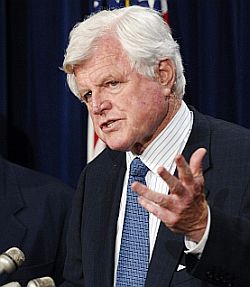
Ted Kennedy, 2005 press conference.
In July 2002, Kennedy, still chairman of the Senate Labor Committee, and the late Sen. Paul Wellstone (D-MN), chairman of its Subcommittee on Employment, Safety and Training, held hearings to investigate coal mine safety, focusing in part on MSHA’s enforcement at the Jim Walters Resources coal mine in Brookwood, Alabama where 13 miners had been killed in a September 2001 explosion. At the time, the mine had 31 outstanding violations, and MSHA inspectors had not returned to determine if they had been corrected. During the hearings, Kennedy called MSHA enforcement record “dismal,” while Wellstone noted that mine fatalities were rising but the Bush Administration had cut MSHA’s 2003 budget by 6 percent. However, as Kennedy and Wellstone tried to turn the spotlight on MSHA’s record, two weeks after their hearing, a few MSHA officials received high media attention and national praise in the successful rescue of 9 coal miners trapped in a flooded underground mine in Somerset County, Pennsylvania. MSHA reforms were then somewhat derailed. Then, several years later, there was another mine tragedy.
Sago Disaster

Associated Press map & reporting, Jan 2006.
A few days after the Sago Mine had exploded, Kennedy told an Associated Press reporter that Senate hearings were needed to determine how the tragedy happened. “We owe it to these miners and their families to find out what happened and whether this accident could have been prevented,” Kennedy said. “In addition, we should investigate the troubled history of repeated safety violations at the mine.”
Then, just few weeks following the Sago explosion, another West Virginia mine accident occurred this one on the morning of January 19, 2006, at the Aracoma Alma Mine in Logan County. The accident occurred when a conveyor belt in the Aracoma Alma Mine No. 1 at Melville in Logan County, West Virginia, caught fire. The conveyor belt ignited pouring smoke through the gaps in the wall and into the fresh air passageway that the miners were supposed to use for their escape, obscuring their vision and ultimately leading to the death of two of them by carbon monoxide poisoning when they became separated from 10 other members of their crew. The others held onto each other and edged through the air intake amid dense smoke to make their escape. At the time of the fire, the mine was owned by Aracoma Coal Company, a Massey Energy company.
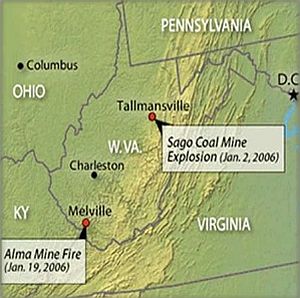
Map showing somewhat larger area and location of the Sago Mine and Alma Mine tragedies of January 2006.
Low Fines
At a hearing held March 2, 2006, by the Senate HELP committee (Committee on Health, Education, Labor and Pensions) to discuss the state of mine safety, Senator Kennedy was present to voice his concern about mine safety enforcement. In an impassioned statement, Kennedy said that fines as low as $60 give companies “little incentive to make safety improvements.” He added that while he understood that MSHA was then proposing to raise the maximum fines from $60,000 to $220,000, “such gestures are meaningless unless MSHA actually issues those fines.”
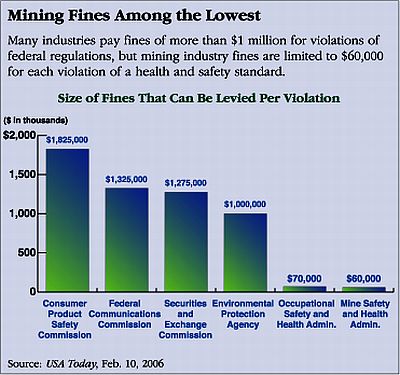
2006 Associated Press graphic showing dollar amounts of fines that then could be levied per infraction by various federal agencies, with mine safety fines being the lowest, a limitation Senator Kennedy & others found deplorable.
In the year prior to the Sago Mine disaster, the operator reportedly received over 200 safety citations, half of them being serious enough to potentially lead to injuries.
David G. Dye, then acting assistant secretary of MSHA, responding to Kennedy, said that the agency had collected $25 million in fines in 2005 and reductions were the result of actions taken by independent administrative law judges. He also said that the 1977 Mine Act “does not give MSHA the authority to preemptively close entire mines because of the frequency of violations.” Sen. Robert C. Byrd (D-WV), who grew up in a coal-mining community, said during the hearing that MSHA “had the legal authority to require higher fines” but “didn’t use it.”
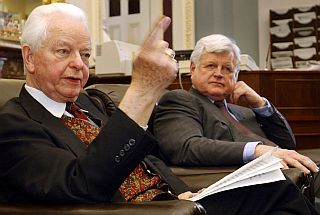
January 2003. AP file photo of Senators Robert Byrd (D-WV) and Ted Kennedy on Capitol Hill. photo, Susan Walsh.
Byrd, frustrated with the agency said at one point, “It’s been 25 years since mine safety rules have been updated,” Byrd said. “How long do we have to wait?”
Byrd, Kennedy, and others in the U.S. Senate did not wait. In 2006, Congress passed the Mine Improvement and New Emergency Response Act (the MINER Act), which President Bush signed into law June 15 2006. The new law required mine-specific emergency response plans in underground coal mines; installation of wireless communications equipment and tracking devices within three years; new regulations for mine rescue teams and sealing abandoned areas; and prompt notification of mine accidents. The MINER Act also raised maximum fines for accidents and gave the government the power to shut down mines when operators failed to pay fines. Senator Kennedy, meanwhile, continued to push for additional mine safety reforms, as yet another mine disaster occurred not long after the MINER Act passed.
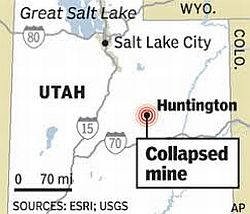
Map showing location of Crandall Canyon Mine.
In August 2007, the Crandall Canyon Mine, an underground coal mine in Utah’s Wasatch plateau near Huntington, made headlines when six miners were trapped by a mine collapse. Ten days later, three rescue workers were killed and six more injured as one of the walls of the tunnel exploded inward, toward the rescuers, as they attempted to reach the trapped miners.
On August 31, 2007 the search for the six trapped miners was called off and declared too dangerous for continued rescue efforts. The six men originally trapped were later declared dead and their bodies were never recovered. The mine was then operated by Genwal Resources Inc., an operating division of UtahAmerican, a subsidiary of the Murray Energy Corporation.
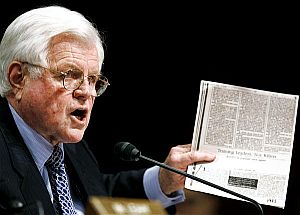
Senator Ted Kennedy, shown here in another Senate proceeding, had his committee staff compile a report on the Crandall Canyon mine collapse in Utah. Click for Ted Kennedy books.
“The loss of life at the mine, and the devastating emotional toll on families of the victims, underscore the urgent need for a thorough examination of our federal system of mine safety,” Kennedy said in his letter to Chao. In particular, Kennedy said he was “troubled” by reports that roof problems were not reported to MSHA, and that the roof had reportedly collapsed in other areas of the mine where workers were using a dangerous technique called “retreat mining.” Such reports, Kennedy said in his letter to Chao, “raise questions about the integrity of the mine operator’s reporting and the rigor of MSHA inspections.”

Cover of Senator Kennedy’s Committee report on the August 2007 disaster at Utah’s Crandall Canyon coal mine.
“The committee’s investigation has revealed that the owner of Crandall Canyon Mine, Murray Energy, disregarded dangerous conditions at the mine, failed to tell federal regulators about these dangers, conducted unauthorized mining and, as a result, exposed its miners to serious risks,” Kennedy said. The report also charged that the operator’s parent company, Ohio-based Murray Energy Corp., bullied MSHA to gain approval of its overall mining plan.
“MSHA also unconscionably failed to protect miners by hastily rubber-stamping the plan,” said Kennedy. “This is a clear case of callous disregard for the law and for safety standards, and hard-working miners lost their lives. This deserves a full criminal investigation by the Department of Justice.”
Kennedy’s report was followed by a report from the Labor Department’s Inspector General which found that MSHA failed to protect workers at the Crandall Canyon mine. That report blamed federal mining regulators for negligence in approving a roof-control plan for the mine. An audit of events preceding the two collapses found that lower-level MSHA officials skipped many of the agency’s own protocols in approving a roof control plan for the Crandall Canyon mine and could have been subject to “undue influence” by the mine’s operator. It also found that MSHA could not show it made the right decision when it approved risky retreat mining at Crandall Canyon and found the agency “negligent” in its duty to protect underground miners in the Crandall Canyon mine disaster, and in mines across the nation. Rep. George Miller’s (D-CA) House Education and Labor Committee also released a May 8, 2008 report on the Crandall Canyon disaster that repeated the call for a criminal investigation.
On July 24, 2008 MSHA issued one of its highest fines then to date for coal mine safety violations at the Crandall Canyon Mine. Genwal Resources was fined $1.34 million “for violations that directly contributed to the deaths of six miners last year,” plus nearly $300,000 for other violations. MSHA also levied a $220,000 fine against a mining consultant, Agapito Associates, “for faulty analysis of the mine’s design.”
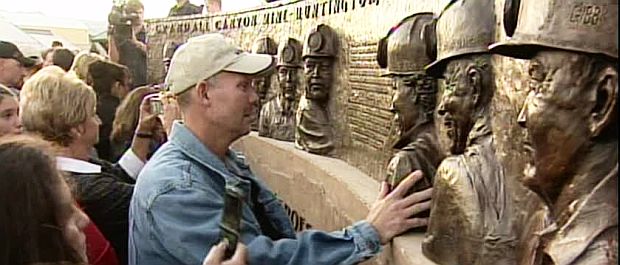
September 2008: Dedication of the memorial commemorating the lives of the 6 miners and 3 rescuers killed at the Crandall Canyon Mine in Huntington, Utah. The memorial is titled, 'Heroes Among Us', sculpture by Karen Jobe Templeton.
Coal mine health and safety to this day continues to be a vexing issue, with mine disasters such as the April 2010 coal mine explosion at the Upper Big Branch Mine in Raleigh County West Virginia that killed 29 coal miners, while black lung disease continues to diminish coal miner health and take their lives. Yet in recent decades, the efforts of public servants like Ted Kennedy and others have helped make coal mining and other workplaces safer than they might otherwise have been – although, to be sure, they are not as safe as they should be. In 2008, Senator Ted Kennedy was named one of the 50 most influential EHS leaders by Occupational Hazards magazine (now EHS Today) for his 40-plus years of advocating for workers’ rights and health and safety in the U.S. Senate. After a battle with a malignant brain tumor, diagnosed in May 2008, Ted Kennedy passed away in late August 2009.
For additional stories on coal at this website, see, for example, “Sixteen Tons: 1955-1956,” a story about a famous song, plus some history on coal mine safety, or visit the topics page, “Coal History: Selected Stories, 1950s-2010s,” offering 10 story choices. See also the “Kennedy History” page for stories in that category. And if you like what you find here, please make a donation to help support the research, writing and continued publication of this website. Thank you. – Jack Doyle
|
Please Support Thank You |
____________________________________
Date Posted: 18 February 2025
Last Update: 18 February 2025
Comments to: jackdoyle47@gmail.com
BlueSky: jackdoyle.bsky.social
Article Citation:
Jack Doyle, “Kennedy Coal History: 1968-2008,”
PopHistoryDig.com, February 18, 2025.
____________________________________
Kennedy Books at Amazon.com…
 Kerry Kennedy’s 2018 book, “Robert F. Kennedy: Ripples of Hope “(in conversation with others on her father’s impact). Click for copy. |
 Fredrik Logevall’s 2021 book, “JFK: Coming of Age in the American Century, 1917-1956.” Click for copy. |
 Neal Gabler’s 2022 book, “Against the Wind: Edward Kennedy and the Rise of Conservatism, 1976-2009,” Click for copy |
Sources, Links & Additional Information
 "Coal: A Human History", by Barbara Freese, 2016 edition. Click book covers here and below for Amazon links. |
 Gerald Stern's book on the 1972 Buffalo Creek disaster. |
 Thomas Andrews' 2008 book, "Killing for Coal". |
 Harry Caudill's 1983 book, "Theirs Be The Power". |
 Davitt McAteer's book on the 1907 Monongah mine disaster. |
Robert F. Kennedy
“Poverty: Misery at Vortex,” Time, February 23, 1968.
“Robert Kennedy in Eastern Kentucky 1968,” YouTube.com, posted March 30, 2010.
George Vecsey, “Vortex, Ky., Recalls Robert Kennedy,” New York Times, February 13, 1972.
“RFK in EKY,” The Robert F. Kennedy Perfor-mance Project, RFKinEKY.org.
“Barwick, KY: An Email From William Greider on RFK’s Visit to Barwick School,” RFKin-EKY.org.
Thomas N. Bethell, “Speak Your Piece: To Watch in 1968, and to Hope in 2007,” DailyYonder.com, July 15, 2007.
Trena KP, “How Did the People of Eastern Kentucky Respond to [Robert F.] Kennedy’s Visit?,” RFKinEKY.Blogspot, December 2, 2010.
Samira Jafari, Associated Press, “Poverty Tour Returns to Kentucky,” USAtoday.com, July 17,2007.
_________________________
Ted Kennedy
“Congress Clears Comprehensive Coal Mine Safety Bill,” CQ Almanac (Congressional Quarterly, Washington D.C., 1969.
Richard D. Lyons, “Appalachia Poor Hit Health Care; Kennedy Committee Is Told of Delays and Neglect,” New York Times, April 20, 1971.
“S.717, Federal Mine Safety and Health Amendments Act,” Congress.gov, 95th Congress, 1977-1978.
George Lobsenz, UPI, “Kennedy Charges Mine Safety Rules Dangerously Weakened,” UPI.com, March 11, 1987.
Ben A. Franklin, “Mine Safety Agency Accused of Lax Enforcement,” New York Times, March 12, 1987.
David S. Hilzenrath, “Mine Safety Nominee Defeated,” Washington Post, August 6, 1987.
Steven Greenhouse, “Rise in Mining Deaths Prompts Political Sparring,” New York Times, July 26, 2002.
Press Release, U.S. Senate Committee on Health, Education, Labor and Pensions, “Kennedy, HELP Committee Leaders Schedule Visit to West Virginia; Will Meet Sago Mine Families, Mine Workers; Check Progress of Investigation,” January 19, 2006.
“Senators Pay Visit to Sago Families: Jay, Ted Kennedy, Two From GOP, Vow to Find Answers for Victims’ Families,” Charleston Gazette (Charleston, WV), January 21, 2006.
Ian Urbina and Andrew W. Lehren, “U.S. Is Reducing Safety Penalties for Mine Flaws,” New York Times, March 2, 2006.
Pamela M. Prah, “Coal Mining Safety: Are Underground Miners Adequately Protected?,” CQ Researcher, Washington, DC: Congressional Quarterly Press, March 17, 2006 • Volume 16, Issue 11.
Emily Bazar, “Lawmakers on Both Sides Aim to Prevent Mine Disaster,” USA Today, May 17, 2006.
Alex Chadwick, “Sen. Kennedy on Mine Safety, Bush in Iraq,” Day To Day/NPR.org, June 13, 2006.
“Sago Mine Disaster,” Wikipedia.org.
Jan Austin (ed.), “Deaths Prompt Mine Safety Rewrite,” CQ Almanac 2006, Washington, DC: Congressional Quarterly, 2007.
Michael Rubinkam and Chelsea J. Carter, AP, “Senate Plans Hearing on Mine Collapse,” Washington Post, Thursday, August 23, 2007.
Thomas Burr, “Mine Probe: Congress Begins Crandall Canyon Cave-in Investigation,” The Salt Lake Tribune, August 23, 2007.
Thomas Burr, “Kennedy Blasts Mine Communication Breakdown at Crandall Canyon,” The Salt Lake Tribune, October 2, 2007.
U.S. Government Printing Office, S. Hrg. 110-730, “Current Mine Safety Disasters: Issues and Challenges,” Hearing of the Committee on Health, Education, Labor, and Pensions, United States Senate, One Hundred Tenth Congress, First Session, on Examining Issues and Challenges Facing Current Mine Safety, October 2, 2007.
Spencer S. Hsu, “Report Faults Mine Safety,” Washington Post, November 17, 2007.
Press Release, Senator Edward M. Kennedy, “Kennedy Releases New Report on Crandall Canyon Mine Disaster,” March 6, 2008.
Suzanne Struglinski, “Mine Report Pulls No Punches; Criminal Probe of MSHA, Murray Energy Urged,” DesertNews.com, March 7, 2008.
Thomas Burr, Robert Gehrke and Mike Gorrell, “Beyond Crandall: Feds Found Negligent; MSHA Fails Miners Nationwide, Probe Finds,” The Salt Lake Tribune, April 1, 2008.
“Crandall Canyon Mine,” Wikipedia.org.
John Hollenhorst, “Crandall Canyon Mine Memorial Unveiled,” KSL.com, September 14th, 2008.
“Interview with Thomas M. Rollins,” The Miller Center Foundation and the Edward M. Kennedy Institute for the United States Senate, EMKinstitute.org (Rollins discusses Senate confirmations, mine safety, the minimum wage and other Labor Committee topics), May 14, 2009.
John M. Broderaug, “Edward M. Kennedy, Senate Stalwart, Is Dead at 77,” New York Times, August 26, 2009.
Emery Jeffreys, “Kennedy, Working People’s Champion,” bytewriter.com, August 26, 2009.
Ken Ward Jr., “Sen. Edward Kennedy: A Friend to Coal Miners,” Gazette-Mail (West Virginia), August 28, 2009.
Davitt McAteer, “Mine Industry Is Gutting Safety Regulations,” Charleston Gazette-Mail, April 5, 2015.