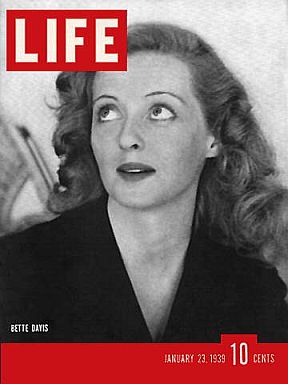
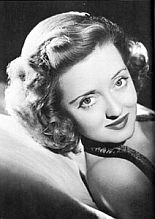
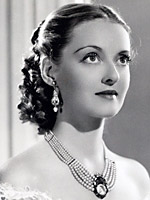
Bette Davis captured by photographer Alfred Eisenstaedt for Life magazine, January 23, 1939. Click for copy.
In May and June of 1981, the most popular song around was a tune about a Hollywood actress — or more precisely, about her eyes. “She’s got Bette Davis eyes” was the refrain made famous by the top-selling song of 1981, appropriately titled, “Bette Davis Eyes.” The song was performed by singer Kim Carnes, and was originally written in the mid-1970s by singer-songwriter Jackie DeShannon and Donna Weiss. DeShannon had also recorded a version of the song on her New Arrangement album of 1975. But it was the Kim Carnes version of the song in 1981 that became the big hit.
“Bette Davis Eyes,” in fact, became the third best-selling song of the entire 1980s decade, ranking only behind “Physical” by Olivia Newton John and “Endless Love” by Diana Ross and Lionel Richie. In 1981, it also won Grammy Awards for Song of the Year and Record of the year. Released on the EMI America label as a single in the spring of 1981, the song spent a total of nine weeks at #1 on the U.S. Billboard Hot 100 chart during May, June and July. It remained in the Top 40 for about 20 weeks. The Kim Carnes album containing the song — Mistaken Identity — also hit #1 and sold over eight million copies.
Song History
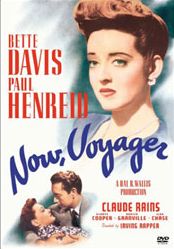
Jackie DeShannon has stated that she was moved to write “Bette Davis Eyes” in 1974 after seeing the classic 1942 film Now Voyager, and one scene in particular, in which actor Paul Henreid, smitten by Bette Davis, is falling over himself lighting cigarettes for her. In the lyrics for the song by DeShannon and writing partner Donna Weiss, an intriguing, teasing woman is presented (see lyrics below). Bette Davis, of course, was a Hollywood legend. She had appeared in more than 100 films. She was known in part, for her large, expressive eyes, her engaging repartee, and for her sometimes sassy film roles. More about Davis in a moment. First, the song.
DVD cover for 1942 film, 'Now, Voyager'. Click for DVD.
Music Player
“Bette Davis Eyes”
In 1980, Kim Carnes was a 34-year-old singer and songwriter who had experience in both Hollywood and the music business. She had begun her career at the age of 18 in Los Angeles, singing commercial jingles and doing nightclub work.
In the 1960s she joined the New Christy Minstrels folk troupe where she met Kenny Rogers and Dave Ellingson, later marrying Ellingson with whom she did some joint singing and songwriting. She also produced some solo albums in the 1970s and had a minor hit or two. Her songwriting, however, was more successful — with Frank Sinatra, David Cassidy, and Kenny Rogers, among others.
A duet she sang with Kenny Rogers, “Don’t Fall In Love With a Dreamer” in early 1980, became a Top 5 hit, and also had a related album, Gideon. About that time, Carnes was recording another album for EMI called Romance Dance and worked with producer/engineer Val Garay. The album charted and included Carnes’ first solo Top 10 hit, a version of Smokey Robinson’s “More Love.” Carnes and Garay then began work on a new album.
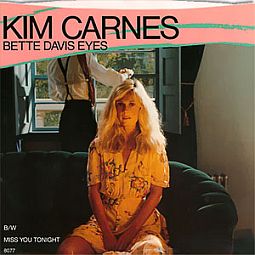
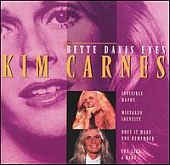
Cover for single of 'Bette Davis Eyes' by Kim Carnes released in 1981 by EMI. Click for digital.
During their search for material, songwriter Donna Weiss brought some of her songs over to the studio where Carnes and Garay were working. One was a demo for a newer version of the 1974 “Bette Davis Eyes” song. Karnes and Garay both liked the melody and the lyrics, but the total package wasn’t quite there yet. However, one of their band members — keyboardist Bill Cuomo — gave the tune a more contemporary arrangement, along with a half dozen other musicians backing up Carnes. As Carnes would later explain to Dick Clark: “It’s Bill Cuomo, my synthesizer player, who really came up with the new feel, changing the chords. The minute he came up with that, it fell into place.” Garay recalls that ‘Bette Davis Eyes’ was recorded live in a North Hollywood studio.” I think we did three takes and the one we used was take one,” he said. Carnes has also written about recording the song: “I heard this song about a year before I finally cut it. My band, Val Garay and I rehearsed it for three days before coming up with the right feel. It was a completely collaborative effort between all of us. The next day we cut this track ‘live’ with no over-dubs and got it on the second take…” The song quickly became a major hit, along with the album. In addition to Carnes’ Grammy award for the song, Garay was also nominated for Producer of the Year, but lost to Quincy Jones.
“Bette Davis Eyes” 1981
Her hair is Harlow gold
Her lips sweet surprise
Her hands are never cold
She’s got Bette Davis eyes
She’ll turn her music on you
You won’t have to think twice
She’s pure as New York snow
She got Bette Davis eyes
And she’ll tease you
She’ll unease you
All the better just to please you
She’s precocious and she knows just
What it takes to make a pro blush
She got Greta Garbo stand off sighs
She’s got Bette Davis eyes
She’ll let you take her home
It whets her appetite
She’ll lay you on her throne
She got Bette Davis eyes
She’ll take a tumble on you
Roll you like you were dice
Until you come out blue
She’s got Bette Davis eyes
She’ll expose you, when she snows you
Off your feet with the crumbs she throws you
She’s ferocious and she knows just
What it takes to make a pro blush
All the boys think she’s a spy
She’s got Bette Davis eyes
And she’ll tease you
She’ll unease you
All the better just to please ya
She’s precocious, and she knows just
What it takes to make a pro blush
All the boys think she’s a spy
She’s got Bette Davis eyes
She’ll tease you
She’ll unease you
Just to please ya
She’s got Bette Davis eyes
She’ll expose you, when she snows you
She knows ya
She’s got Bette Davis eyes
First Lady of Film
Bette Davis, meanwhile, was still very much alive when “Bette Davis Eyes” became a hit song in 1981. In fact, she was then still actively performing, appearing in TV and Hollywood films, and would continue doing so through 1989. Davis began her film career in 1930 after a stint on Broadway.
Born in Lowell, Massachusetts in April 1908, Davis had studied acting at the John Murray Anderson’s Dramatic School in New York where one of her classmates was Lucille Ball. In Hollywood, she was sometimes called “The First Lady of Film.”
During her career, Bette Davis appeared in more than 100 films. She gave notable performances in films such as Dangerous (1935) and Jezebel (1938), each of which earned her Oscars. In fact, she was nominated for an Academy Award five years in a row — 1938, 1939, 1940, 1941 and 1942. Another memorable performance by Davis came in All About Eve (1950) as the character Margo Channing.
Davis, right, in 'All About Eve' with Anne Baxter. Click for film.
“In her heyday, as the reigning female star at Warner Brothers,” wrote Terrence Rafferty of The New York Times in 2008, “she was as electrifying as Marlon Brando in the ’50s: volatile, sexy, challenging, fearlessly inventive. She looked moviegoers straight in the eye and dared them to look away.”
In Hollywood, Bette Davis also became the first woman to be president of the Motion Picture Academy of Arts and Sciences, elected to that post in 1941.
In 2008, on the 100th anniversary of Bette Davis’ birth, the U.S. Postal Service issued a commemorative stamp in her honor, the 14th in the Postal Service’s “Legends of Hollywood” series.
++
Madonna, Too
In addition to being the primary subject of Kim Carnes’ “Bette Davis Eyes,” the famous actress was also mentioned by name in Madonna’s #1 hit song of 1990, “Vogue”, which was Madonna’s tribute to the Golden Age of Hollywood. But Bette Davis herself reportedly liked Kim Carnes’ song and wrote to Carnes to tell her so. In liner notes from Carnes’ Gypsy Honeymoon album she writes about Bette Davis’s reaction to the song:
“…After the release of the record, Miss Davis sent me a note explaining how much she loved the song and that she was especially thrilled because her young grandson now considered her to be very contemporary. I developed a warm and special friendship with Miss Davis that lasted through the years. Shortly before her death, I sang the song live for her at a tribute held in her honor.”
_________________________
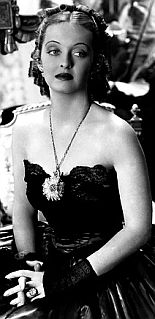
Featured at right, Bette Davis,
still shots, 1930s & 1940s. _________________________
“Eyes” – New Life
Over the years, meanwhile, the Kim Carnes version of the “Bette Davis Eyes” song has held up reasonably well. In fact, through the 1990s and beyond, the song was still being discovered by new listeners and recorded in new forms.
A CD version appeared in 1996. In late August 1997, EMI UK and EMI Music Group Australia released a dance version. And by 1998, “Bette Davis Eyes” still had enough appeal that Cleopatra Records released the song as a down-loadable MP3, selling on Amazon and other outlets. In late 2003, another dance version was released with several different mixes.
The cable TV channel VH-1 has also aired “Bette Davis Eyes” videos in programs such as “The Best Videos of the ’80s” and its “Pop-Up Videos” series. And last but not least, You Tubers have also produced some interesting video versions of “Bette Davis Eyes.”
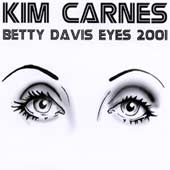
The visual image used for a 1998 MP3 version of 'Bette Davis Eyes' by Kim Carnes for Cleopatra Records. Click for CD.
Oneenterprising video maker at YouTubehas put together a nicely-done collage of Bette Davis stills that flash in sync with the Kim Carnes song — images that pretty much cover the film career of the famed movie star.
Kim Carnes’ song has no doubt helped to burnish the legacy of Bette Davis in popular culture. However, in more recent years, the FX TV show, Feud, has also brought new light on the career of Bette Davis. That series featured Bette Davis (played by Susan Sarandon) and Joan Crawford (played by Jessica Lange) in a dramatized version of the film rivalry that emerged between the two following their co-starring appearances in the 1962 film, What Ever Happened to Baby Jane?
The FX series premiered on March 5, 2017 and the Davis-Crawford episodes were well received by critics and viewers.
The Davis-Crawford feud is also the subject of Shaun Considine’s 1989 book, Bette and Joan: The Divine Feud, which was re-released in 2017 at the time of the FX TV show in paperback and e-book editions. In any case, there is ample reading and viewing material available on the life and career of Bette Davis, some noted below.
Fred Bronson, “The Top Songs of 1981” and “The Top 100 Songs of The Eighties,” Billboard’s Hottest Hot 100 Hits, 4th Edition, New York: Billboard Books, pp. 405-406 and p. 490.
Kim Carnes, album liner notes, Gypsy Honeymoon:The Best of Kim Carnes (1993).
“Kim Carnes’s Greatest Hit of All,” Members.AOL.com.
DivasTheSite.com, Bette Davis background and listing of Bette Davis books & DVDs. Site visited in 2008.
Terrence Rafferty, “The Bold and the Bad and the Bumpy Nights,” New York Times, March 30, 2008.
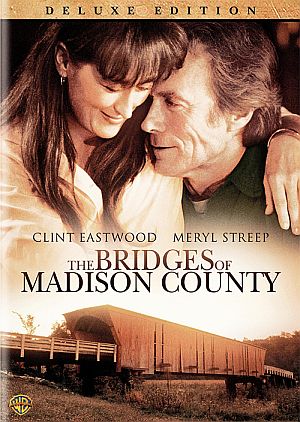
Cover of deluxe edition DVD of the 1995 film issued by Warner Home Video in June 2008. Click for video or DVD.
A surprise best-selling book that dominated the charts in 1993-94 was The Bridges of Madison County, a story about an Iowa farm wife who meets a National Geographic photographer by chance while her family is away at the Illinois State Fair.
The two strangers from different worlds — Robert Kincaid, the free-roaming, globe-trotting photographer, and Francesca Johnson, the Iowa-bound farm wife — strike up an intense, short-lived love affair. However, reality and responsibility soon intrude and the affair ends. The two lovers, torn by separation, return to their previous lives with thoughts of what might have been.
The Bridges of Madison County, set in mid-1960s Iowa with its rustic covered bridges, tells their story. The book became a word-of-mouth sensation and dominated bestseller lists all across America. It was followed in 1995 by a well-received Hollywood film with Meryl Streep and Clint Eastwood in the lead roles.
Throughout the early- and mid-1990s, there was notable TV and radio coverage of the story, the book, and the film, as well as marketing of related books, music, photography, and Iowa tourism. How this story swept over America is quite a tale in its own right. First, a look at the book’s author and then its storyline, told below with screen shots from the 1995 film.
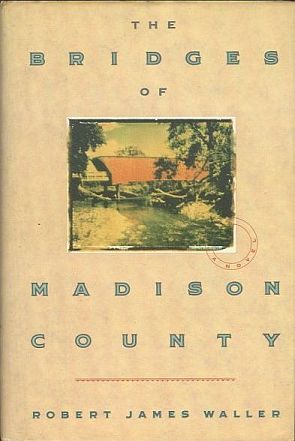
1st edition of 'Bridges,' Warner Books. Click for copy.
Robert James Waller on The Charlie Rose Show, February 1993, after his book was No. 1 on the NY Times bestseller list.
The Author
The Bridges of Madison County came from a somewhat unexpected and unknown author — a Midwest born and bred economics professor named Robert James Waller.
Born in 1939, Waller grew up in Rockford, Iowa. He received both his BA (1962) and MA (1964) from the University of Northern Iowa (UNI), where he also met his wife.
By 1968 he added a Ph.D in business from Indiana University. Later that year, returning to UNI, he became a professor of economics and business management, rising to dean of the College of Business there in 1980.
Although active in his academic field, Waller also had interests in music and writing. In 1988, he published a collection of essays with Iowa State University Press, followed later by three more collections. He was also something of a photographer, and one day he was out taking pictures of covered bridges in Madison County, Iowa. That’s when he first got the idea for his book.
“The actual book was written after I’d been down photographing the bridges…,” Waller explained during a 1993 interview on The Charlie Rose Show.
“Did it come to you in a moment?,” asked Rose.
“Absolutely,” answered Waller. “It struck me; it came to me in a three-hour drive across the flatlands of Iowa in my truck” (on his way home). Also figuring into Waller’s inspiration was a line from a song he had written, which he describes as, “I know you have your own dreams too, Francesca.” The name Robert Kincaid also came to him as he drove home.
When Waller arrived home he fired up his computer and began writing in a non-stop mode, he explained, “for two weeks, sleeping two or three hours a night….”
Rose interjects, “and it flowed?”
“Oh, it was given to me,” said Waller. “I never knew where the next line was coming from, but when I got to it, it was there. And I know that’s hard, I’m sure, for people to believe. [But] it’s true…”
What Waller had created was the story of an Italian WWII bride named Francesca brought back to middle America to live the life of an Iowa farm wife; a woman committed to her marriage and family until one day when a stranger happens into her life.
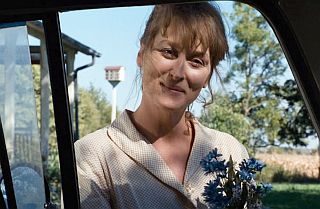
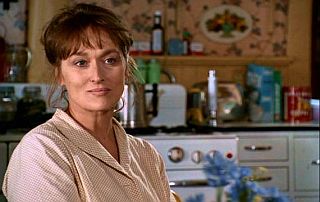
Francesca Johnson, standing on her farmhouse porch after sending her family off to the state fair.
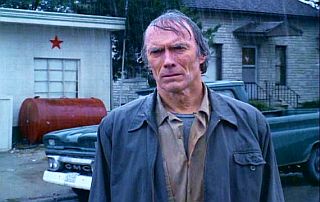
A stranger, Robert Kincaid, a photographer, stops by asking for directions to the Roseman covered bridge.
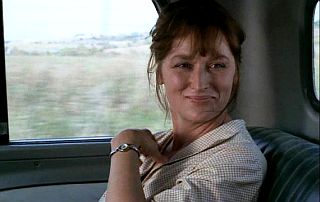
After failing to easily describe how to get to the Roseman bridge, Francesca offers to ride along with Kincaid to show him the way...
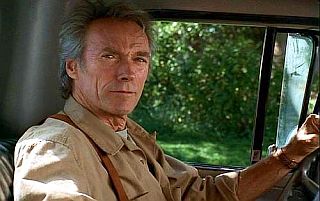
In Kincaid’s truck, Francesca learns about his work, as they listen to jazz music on the truck radio.
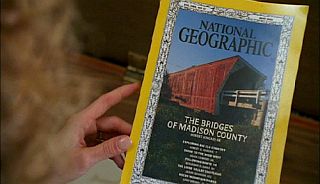
Kincaid explains that he is working for National Geographic and will need to photograph the bridge from many different perspectives.
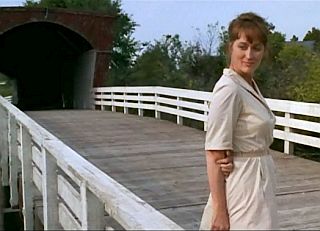
Francesca walks on the bridge as Kincaid sets up his equipment on the ground below.
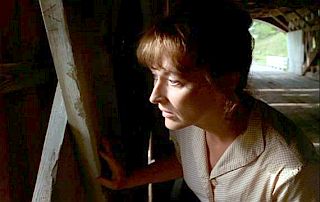
From the bridge, Francesca observes Kincaid at work...
Kincaid gives wildflowers to Francesca as thanks for bringing him to the bridge, explaining he will have to return and shoot again the next day. Back at her farmhouse, she invites him in for ice tea.
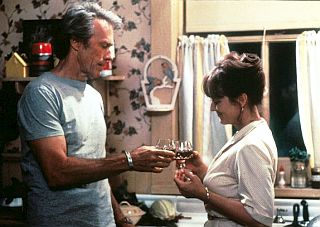
In Francesca’s kitchen, the two share a few beers, cigarettes, storytelling, and later, dinner.
Later that evening they share some brandy, but Kincaid takes his leave, needing to rise early for the next day’s shoot. (screen shots continue below at "Hollywood Film").
The Story
Robert Kincaid is 52 years old when he arrives in Iowa on a professional photographic assignment. It is August 1965. He has come to Iowa from his walk-up apartment in Bellingham, Washington to take pictures of historic covered bridges for National Geographic. There are seven bridges he will photograph, all in Madison County, Iowa.
Kincaid is an independent sort who has been around. He has served in the military, and was once married for five years to an aspiring folk singer. However, his time on the road put a strain on that marriage. Still, at middle age, while he has not given up on the prospect of a longer-term relationship, he has not gone out of his way to look for one.
Kincaid has a weathered, handsome look physically. He features himself as something of a contrarian, and is not always comfortable with the ways of the modern world. He also has another side; a bit softer, more creative, quoting famous poets now and then.
Francesca Johnson is a 45 year-old farm wife, married to Richard Johnson, a good but unromantic Iowa farm man who she met in her native Italy during World War II. Johnson made Francesca his war bride and she consented because of his kindness and the promise of America.
Francesca is filling the traditional role of mother and homemaker, focused on husband and family. Yet she is also educated, has a degree in comparative literature, and has done some teaching at the local high school. By 1965, Francesca and Richard have two teenage kids. She dearly loves her family, but is often isolated in her simple, mundane life, lacking intellectual engagement.
So, in August 1965, with her family away at the Illinois State Fair for several days, her life suddenly takes a new turn when Robert Kincaid pulls his pickup truck into her farm driveway. He has stopped to ask for directions to the Roseman covered bridge .
To The Bridge
Since the rural roads to the Roseman Bridge are not clearly marked, and Francesca has difficulty explaining how to get there, she offers to show him the way, riding along in his pick-up truck. When they arrive at Roseman bridge, she watches him work as he shoots the bridge. Kincaid takes various shots of the bridge, some at a distance. However, he is losing the light he needs for certain shots and will return the next day to shoot more.
When they arrive back at Francesca’s homeplace, she asks him in for a glass of iced tea, and after a bit of conversation, invites him to stay for dinner. In her farm kitchen, he helps her prepare vegetables for the meal, they share a few beers from his cooler, and exchange their life stories. After dinner they take a short walk in the pasture, followed by coffee and brandy back in the kitchen.
The evening ends as Kincaid takes his leave, needing to rise early for the next day’s shoot. But something in Francesca has been stirred.
Francesca’s Note
Knowing that Kincaid will return to the bridge the next day, she drives there later that night and tacks up a note where she knows Kincaid will find it. It is an invitation to dinner the following evening.
At dinner the next evening at her home, Robert and Francesca realize they have fallen in love, as their affair begins. During their four days together, they have much intimacy and tender conversation. He asks her to come away with him, but she cannot because of her sense of responsibility to her husband and family. Robert still wants her to leave with him and she actually packs her bags to go with him at one point. But in the end, she cannot abandon her husband and her two children. She explains that she could never bring such pain and humiliation to her family. She knows they would not survive the gossip and censure that would certainly follow such an event in the conservative farming community.
Kincaid reluctantly leaves to continue his life of travel and photography, but Francesca is always on his mind and he on hers. They have only a couple of written contacts over the years, but never meet again, each holding fast to memories of their affair. During their four days together, Francesca gave Robert an ornate, hand-wrought medallion with her name etched on the back.
Years Later
After Kincaid has died, a package reaches Francesca that contains his cameras, the medallion she had given him, the old note she had tacked to the bridge, and other items. There is also an explanatory letter that informs Francesca that Kincaid has passed away. She also learns that his cremated remains were scattered at the Roseman Bridge.
Francesca’s own husband by this time, Richard — whom she tended in late-life illness — has passed away, and she lives out her days alone remembering her time with Robert. One day, a neighbor finds Francesca dead, slumped over her kitchen table. She was 69. Francesca, however, has left instructions requesting that she be cremated and her ashes scattered at Roseman Bridge. This is something of a puzzle to her two grown and married children, since the family plan had been to bury her alongside their father.
In the book, the story is set up with an opening preface and frame of reference set in 1989, shortly after Francesca’s death. Her passing has brought her two grown children back to the Iowa farm who later discover the details of their mother’s affair. For Francesca has left them an explanatory letter, along with her journals and a box full of Robert Kincaid mementos. In the book’s preface, the two grown children have contacted the story’s narrator, a writer, asking him to tell their mother’s special love story, which then becomes the novel.
Waller’s Book
Back in the real Iowa, meanwhile, before the story ever became a film or a book, author Robert Waller was left in July-August 1990 with a completed manuscript and not much more. In fact, he would later say he was not overly enamored with the idea of publishing it as a book, even though several of his local trusted readers had really liked the story and encouraged him to publish. During a later interview on The Charlie Rose Show, Waller said he was content to have written it just for himself and a few friends as something he felt he had to do. He also noted that at the time he was fairly content as a full professor, was completing a book on economic philosophy, and was not particularly thrilled by the prospect of the New York publishing scene and book marketing. However, a friend at Iowa State University press who had published some of his collected essays helped Waller move toward publication. And gradually the right connections and referrals were made and a literary agent in New York was engaged.
After a couple of rejections in New York, Warner Books, part of the Time-Warner Corporation, offered to publish Waller’s book. It was September 1990. As later recounted in David Comfort’s book, An Insider’s Guide to Publishing, Warner offered a $32,000 advance. Later that year, Waller received some additional good news: that Steven Spielberg was interested in buying the book’s movie rights for his film unit, Amblin Entertainment. This was long before before the book’s publication. Still, a film on the book was no sure thing.Steven Spielberg optioned the movie rights 8 months before the book’s publi- cation. Hundreds of books are acquired every year for films, but very few ever make it to the big screen. Word was, however, that some of Spielberg’s people — namely Kathleen Kennedy, then president at Amblin — liked the storyline involving an older couple.
Kennedy had read the book when it was in galley form before its publication. “I loved it,” she would say in one interview, “and I thought that Waller had tapped into something universal.” According to Newsweek, Spielberg told Kennedy, “If you love it, buy it.” So Kennedy optioned the rights for $25,000 eight months before the book was published and later paid 10 times that amount for the film rights. “This was like catching a tidal wave that nobody saw coming,” Lucy Fisher, a Warner Brothers v.p. told Newsweek.
Meanwhile, in April 1992, the first hardback copies of The Bridges of Madison County went to market. The initial print run by Warner was a generous 29,000 copies for a first-time novel. However, the book’s initial reception was not great. Some early reviews in 1992 were not very good. Kirkus Reviews noted in January 1992: “Here’s a Hallmark card for all those who have loved and lost: a mushy memorial to a brief encounter in the Midwest.” The Kirkus reviewer also commented, somewhat skeptically, on the book’s sales prospects: “For as fake and pretentious as it is, this first novel is based on hard-nosed commercial calculations. The publisher, promising a big push, clearly expects its silly goose to lay a golden egg, and, who knows, maybe it will.” Library Journal in March 1992 charged the book had a “contrived, unrealistic dialog,” while the The Washington Post in early April called the storyline “trite.” But other reviewers were kinder. Publishers Weekly in April 1992 called the book “quietly powerful and thoroughly credible,” adding that “scenes between the lovers are movingly evoked…” Entertainment Weekly in June 1992 noted the story “seems likely to melt all but the most determined cynics…”
“He Noticed All
of Her” (Back jacket book excerpt)
He could have walked out on this earlier, could still walk. Rationality shrieked at him. “Let it go, Kincaid, get back on the road. Shoot the bridges, go to India. Stop in Bangkok on the way and look up the silk merchant’s daughter who knows every ecstatic secret the old ways can teach. Swim naked with her at dawn in jungle pools and listen to her scream as you turn her inside out at twilight. Let go of this”- the voice was hissing now – “it’s outrunning you.”
But the slow street tango had begun. Somewhere it played; he could hear it, an old accordion. It was far back, or far ahead, he couldn’t be sure. Yet it moved toward him steadily. And the sound of it blurred his criteria and funneled his own alternatives toward unity. Inexorably it did that, until there was nowhere left to go, except toward Francesca Johnson. ____________________ Warner Books, hardback edition, 1992.
Then in mid-summer of 1992, something else started to happen. People who had read the book began returning to stores to buy multiple copies. The book was being given out as a gift and as a pass-along to friends and family. By July 1992, the trade press was reporting that independent book stores were selling the book at quite high numbers — partly the result of a campaign by Warner Books for booksellers to personally sell the book directly to their customers. Stores in several states began reporting higher than normal sales.
More favorable reviews were also appearing around the country. Through the summer and fall of 1992, favorable-to-glowing reviews and/or comment appeared in various newspapers and magazines. The Bridges of Madison County was also beginning to show up on the book industry’s bestseller lists.
Not long thereafter, on August 16, 1992, it made its first appearance on the New York Times bestseller list at No.12 — directly behind Danielle Steel’s Jewels at No. 11. Among the Times‘ top-selling titles that week were: No. 1, Gerald’s Game by Stephen King; No. 2. Waiting to Exhale by Terry McMillan; and No. 3, The Pelican Brief by John Grisham.
After hitting the Times list, Bridges and Waller began to receive a bit more media attention, including some national radio and TV-talk shows in early 1993. But reader pass-along was still at work as well.
Among the reviews of Bridges noted at the University of Virginia’s archive of 20th Century American Bestsellers, is one by Charles Champlin, writing in the January 17, 1993 edition of the Los Angeles Times Book Review. Champlin described the book as a “sleeper…a nice little book that takes off slowly without benefit of splashy advertising, book-club promotion, or a flood of rave reviews, but that ends up on the best-seller list the old fashioned way — because readers fall in love with it and tell their friends.” And that’s exactly what had happened with Bridges.
Word-of-mouth sales and sales by independent book stores were believed to have propelled the book to best-seller status. By month’s end January 1993, Bridges rose to No.1 on the New York Times list for the first time.By month’s end, January 1993, The Bridges of Madi-son County was No. 1 on the New York Times best sellers list.
“This was a book that we independent bookstores sold,” later explained Dee Peeler, head buyer for the book department at Greetings & Readings in Towson, Maryland, speaking to a Baltimore Sun reporter in August 1993.
She estimated her store by then had sold about 1,000 copies of Bridges: “We read it, we loved it, and we pushed it to our readers. Then they loved it and told their friends. … “It’s just a beautiful little book, and it’s very, very moving — unusual in this day of so much cynicism … In 15 years at this store, I’ve never seen a book quite like it. There have been a lot of best-selling books that have done extremely well, but this is one of a kind.” Still, there was a lot more upside ahead for The Bridges of Madison County. The best-selling reign of this book was just beginning.
The Oprah Effect
May 21, 1993. Oprah Winfrey touting "Bridges" book on special broadcast of her popular TV talk show in Winterset, Iowa.
On May 21, 1993, at the Cedar Bridge and Cedar Bridge Park in Winterset, Iowa, Oprah Winfrey staged her popular daytime TV show to feature the Bridges book and its author, Robert James Waller. The location used was where the fictional Robert Kincaid and Francesca Johnson met. At the time, Oprah’s show, normally broadcast from Chicago, was the highest-rated TV talk show in America. Oprah and her show then had a devoted following of some 8 million or so viewers, mostly women.
The Oprah TV episode from Iowa (found today on YouTube.com and other video postings) was entitled “Bridge of Love,” and it featured the book, its author, and other guests. At the outset, with an audience of a few hundred around her in the outdoor setting, Winfrey called Bridges her “favorite book of the year… one of the most romantic, stirring tales of true love I’ve ever read.” Oprah admitted to crying when she read the book, said she had recommended it to many people, including her best friend, Gayle King, who appeared later in a separate studio segment, also admitting that she cried while reading the book.
Most of Oprah’s show was taken up with engaging her guests, mostly couples, in conversations about their “real-life love affairs.” During some of these segments, she referenced passages from Bridges. Waller and his wife, Georgia Ann, also appeared, but late in the show, and only briefly. On the Iowa TV special, Oprah called The Bridges of Madison County her “favorite book of the year.” Oprah interviewed Waller about the book, and also heard from Georgia Ann, who was among the first to read it, saying she knew the story was special. At the end of Waller’s interview with Oprah, he sang a portion of one or his ballads from a forthcoming album of songs, The Ballads of Madison County, later issued on Atlantic Records. On the show, Winfrey thanked Waller for writing the book, calling it “a gift to the country,” and said the reason they were doing the show in Iowa was to share the story with the nation. At this point in Oprah’s career, she had yet to form her Oprah Book Club, which would in later years have an important impact on particular titles she mentioned or endorsed. Still, club or not, Oprah’s blessing for Bridges was a huge boost — an additional 250,000 copies by some counts — even though the book was already a solid bestseller and had been at No. 1 or No. 2 on the New York Times bestsellers list for over five months.
May 21, 1993. Oprah Winfrey, in Iowa, interviewing Robert Waller, author of best-selling book, "The Bridges of Madison County".
Riki Altman of Books of Wellington, in Port Arthur, Texas told the Associated Press in August 1993 that most buyers of Bridges there came by way of the Oprah show. “We’ve sold tons…They love the book… They’re buying it for friends.” Likewise, Penny Kudyba of Brentano’s in The Gardens Mall, also in Texas, attributed many of her sales to Oprah as well.
Oprah’s show helped propel the book even more into popular discourse, adding to its luster. Indeed, following Oprah, more publicity and marketing came for the book as well. National TV networks featured the rise of the book or came to Iowa to shoot the bridges and/or the burgeoning tourist scene there.
And while Oprah was indeed a major help in mid-1993 to the book’s continued success, according to David Comfort, author of An Insider’s Guide to Publishing, the star behind the scenes in the marketing of Bridges, and a key defender of the book, was Warner Books editor, Maureen Egen:
…When chain [book stores] showed no interest in stocking the novel, Ms. Egen sent out 4,000 advance copies to independent sellers, along with a personal letter urging each to “hand sell” the title, and offering “co-opt money” to those who did so. Due to her tireless marketing, Barnes & Noble and Waldenbooks offered Valentine’s specials for the romance, and sales went stratospheric after Oprah called “Bridges her ‘favorite book of the year,’ ‘a gift to the country,’ and confessed that it made her cry. When Bridges won the 1993 American Booksellers Book of the Year Award as well as the New York Library’s Literary Lion Award, a lively debate arose as to whether it was “literature,” as Egen insisted, or “an insipid, fatuous, mealy-mouthed third-rate soap opera,” as the Chicago Tribune’s reviewer Jon Margolis asserted. But to the industry bookies the argument was moot since the dark horse romance went on to sell 50 million copies…
Critique & Backlash
July 26, 1993. New York Times Magazine full-page critique of "Bridges" from The Times' drama critic, Frank Rich.
Despite the huge popularity of The Bridges of Madison County, the book had its share of critics. A literary backlash had begun among some, debating whether the book should be called literature or pulp romance. One review in the Los Angeles Times would charge that Waller wrote “at times, like a Harlequineer.”
But two reviews that appeared in the New York Times, coming after the book had risen to No. 1 on the bestseller list, hit especially hard. The first, in March 1993, appeared in The New York York Times Book Review by Eils Lotozo, who wrote, for example:
“…Waller depicts their mating dance in plodding detail, but he fails to develop them as believable characters. Instead, we get a lot of quasi-mystical business about the shaman-like photographer who overwhelms the shy, bookish Francesca with his sheer emotional and physical power.”
Then came a second New York Times review, this one in the Sunday New York Times Magazine on July 26, 1993 by drama critic Frank Rich. This review appeared in a full page “End Paper” section of the magazine and was titled “One Week Stand”(shown above left). Rich first had some fun with Waller’s sometimes over-the-top macho descriptions of Kincaid, noting: “Waller devotes separate, scattered passages to his hero’s shoulder muscles, chest muscles, forearm muscles and thigh muscles…” But this was just prelude to Rich’s more central point as he ventured into more weighty social-cultural territory — that Bridges was contributing to the subjugation of women. “In Bridges,” observed Rich, “romance is a one-week stand, unconnected to any relationship or responsibilities. After it’s over, sexy cowboys can move on but women must return to the servitude of dreary domesticity.” And not surprisingly, Rich also took issue with Oprah Winfrey’s contention two months earlier that the book was a “gift to the country.” Although Bridges came under withering attack in some corners, the criti- cism had little apparent effect on the book’s con- tinuing popularity.
Rich wasn’t the only one who called the book out for its portrayal of women. Pauli Carnes, a female reviewer writing freelance for the Los Angeles Times in April 1993, called Waller’s book “porn for yuppie women.” The book, to her, was an insult to women and also demeaned normal marriages. “The Bridges of Madison County,” she wrote at the end of her review, “is not beautiful and touching. It is the story of life wasted.”
But it wasn’t just reviewers who found the stuck-at-home, vulnerable framing of Francesca offensive. “I thought it was one of the worst-written books I ever read,” said Christy Macy in August 1993, then a speech writer for Baltimore Mayor Kurt Schmoke. She was being interviewed on the book by the Baltimore Sun. “Not only did it have paragraphs of whole conversation in ways that people don’t talk, but it’s a terribly sexist book. “Kincaid at least had a life, and was a romantic character. She [Franceca] had no life. That really offended me.”
Little of this critique, however, either from reviewers or unhappy readers, appeared to have much effect on the book’s mid-1990s popularity or sales. The Bridges of Madison County continued to ride high on bestsellers lists.
With Waller’s book nearing its one-year occupation of the New York Times list, for example, another reporter for the Times, Sarah Lyall, noted of Bridges as of July 28, 1993: “It is currently standing firm at No. 1, staring down at books by John le Carre, Robert Ludlum, Scott Turow and John Grisham.” Lyall wondered how a book that was so dismissed and derided by respected reviewers could be doing so well. The answer, according to “armies of Bridges zealots,” she explained, was that “New York is filled with cultural snobs who just don’t understand the appeal of a book about an extramarital affair that doesn’t break up a marriage.” Lyall also noted that Warner Books was then reporting the book was selling 150,000 copies a week at book stores. By late August 1993, Bridges had sold 3 million copies.
More Waller
Once Bridges began scaling bestseller lists, Robert James Waller became something of a hot property. By mid-1992, in fact, he had already signed another deal with Warner to produce more books, which he then began writing. There were also two audio books issued for Bridges in 1993, one in Waller’s voice and a second using various celebrity voices.
Atlantic Records, meanwhile, a Warner subsidiary, released an album of original and cover songs by Waller, as he had noted during The Oprah Winfrey Show. Titled The Ballads of Madison County, the CD included cover art similar to the book’s, a lyric booklet, and liner notes by Waller. The CD, however, did not do well, and that cooled Atlantic’s interest in further Waller music.
However, Waller’s second book for Warner – Slow Waltz in Cedar Bend (with an initial print run of 1.5 million copies according to the Los Angeles Times) – did quite well. The featured player in Slow Waltz is Michael Tillman, a tenured economics professor, free spirit, and academic maverick who strikes up an affair with Jellie Braden, the wife of another faculty member. Within a year, their love intensifies, but Jellie has a deep secret, runs off to India, and Tillman follows… Completed in August 1993, Slow Waltz debuted at No.2 on the New York Times list in November 1993, right behind Bridges. In fact the two books would stay at No.1 and No.2 for nearly three months.
By mid-April 1994, a third Waller book, Old Songs in a New Café, a collection of essays, was also published by Warner. This one also appeared on the Times bestseller list, but in the nonfiction category. So, by May 1st, 1994, Waller had three books appearing on New York Times bestseller lists. Another Waller book in 1994 — a tear-out book of photo postcards, titled Images: Photographs by the Author of The Bridges of Madison County. Through all of this, however, Bridges was still the main attraction, and still selling briskly through 1994. Yet more action for Bridges was on the way, now shifting to the cinema.
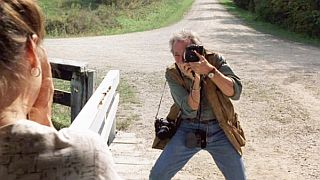
The next day on the bridge, after Francesca has invited Kincaid for a second dinner, he turns his camera on her.
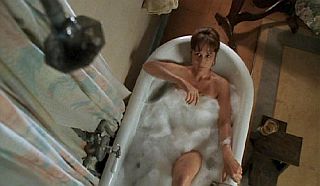
Back at the farmhouse, before dinner that evening, Francesca is thinking about Kincaid as she takes a bath.
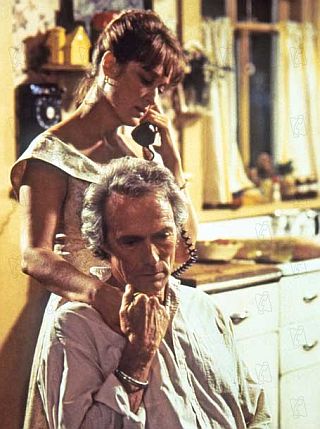
In their "first touch” scene, with Francesca in her new dress, she places her hand on Kincaid’s shoulder as she takes a phone call.
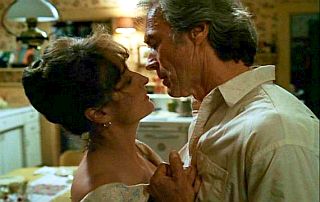
As the kitchen radio plays a sultry jazz tune, Francesca & Robert share a long, slow dance as they move to consummate their passion.
Later in the film, Robert and Francesca share a bath.
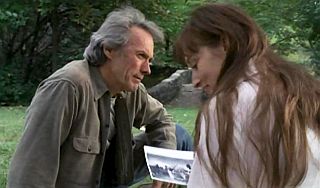
In a park away from the farming community, Robert and Francesca anguish over their future.
Hollywood Film
The film version of The Bridges of Madison County, based on the novel by Waller, became a joint project of Amblin Entertainment, Malpaso Productions (Clint Eastwood’s company), and Warner Brothers. The film — though it had some production snags and a few tries at the film script — was produced and directed by Clint Eastwood with Kathleen Kennedy as co-producer. It was filmed in Winterset, Iowa in late summer 1994, cost about $22 million to make, and was released to movie theaters in mid-June 1995. On its opening weekend, it was No. 2 at the box office. It would go on to gross some $182 million worldwide.
The film added some elements that weren’t in the book, such as bringing Francesca’s two adult children into the film more. The movie opens, in fact, with her grown children returning to the farm after she dies to deal with her estate and the discovery of her journals, as the story is told in flashback (see related photos below in Sources). The film also includes a new character, a woman in town; an outcast for having had an affair whom Francesca befriends. The movie version also shifts the story more to Francesca while toning down some of the book’s more macho Kincaid moments. Also added is the “angry breakfast scene” between Francesca and Kincaid as Francesca begins to feel the tug of her responsibilities to family while resenting Kincaid’s freedom.
In the casting for Francesca, according to Entertainment Weekly and other sources, a number of actresses were said to be in the running, among them: Isabella Rossellini, Cher, Anjelica Huston, Jessica Lange, Mary McDonnell, and others. But Eastwood had advocated Meryl Streep from the beginning. For the Kincaid role, Robert Redford had been considered before Eastwood got the role. Meryl Streep, meanwhile, would be nominated for, but did not win, an Academy Award for her role as Francesca. Streep was also a runner-up for best actress of 1995 in voting by the National Society of Film Critics.
The reviews for the film were quite favorable, often more laudatory than those for the book. Variety called the film “…A handsomely crafted, beautifully acted adult love story,” adding, “[Streep] has never been so warm, earthy and spontaneous…” The Chicago Sun-Times review of June 2, 1995 found the film “…Deeply moving.” USA Today gave it 3.5 of 4 stars. Entertainment Weekly of June 9, 1995, wrote: “…Touching in a delicate, almost lyrical way. It’s a wonderful surprise — an honest weeper for adults… Rating: A.”
In his June 1995 film review, Roger Ebert of the Chicago Sun-Times noted somewhat diplomatically of the book, though focusing on its central worth: “Its prose is not distinguished, but its story is compelling.” Indeed, in some ways, the film redeems the book, and helps make its central idea and storyline more viable and durable. This is a point other critics made in one form or another.
Janet Maslin of The New York Times praised the script writing and Eastwood’s directing, especially for moving the film away from some of the book’s excesses. “The movie has leanness and surprising decency…,” she wrote.
Chauncey Mabe of the Sun-Sentinel in south Florida, noted in his June 1995 review, that the film was more taut and realistic than the book. He also praised screenwriter Richard LaGravenese, “who has taken Waller’s original idea, filled it with intelligence and genuine romance, deflated its ‘last cowboy’ macho bombast, and lent it a brilliant structure that brings out strengths hidden in the book.” He also added that moving the central focus in the film from Kincaid to Francesca was “one of the smartest things Eastwood and LaGravenese” did with the film.
Not least, however was the acting of Streep and Eastwood. Robert Ebert said that Eastwood and Streep had made the book “into a wonderful movie love story.” Jonathan Rosenbaum, in his June 13, 1995 review for The Chicago Reader noted: “…As long as these two are on-screen one can forget the treacle that brought them there…”
Film editor, Joe Cox, in a later documentary on the film said: “I think the film was so successful because of the chemistry between Meryl and Clint. On camera there was just this, ‘Wow!’ I mean you could feel these two strangers coming together for that moment…” Amblin producer Kathleen Kennedy agreed: “It was instant. Clint and Meryl were what you always look for in a romance. They had that chemistry on film. You just instantly believe that these two people were deeply in love with one another.”
June 1995: "People" magazine cover story on Meryl Streep & "Bridges of Madison County" film.
In mid-June 1995, a film review at Newsweek offered another take on the film and some of its possible take-home messages:
…The tale that inspires either swooning or lampooning has obviously touched a neglected nerve. It taps into the yearnings of over-40 Americans–a group that now makes up 36 percent of all movie-ticket buyers. Aging boomers are wondering if life could have offered more than the everyday details of kids, a job, iced tea on a hot day. And yet maybe most appealing is the saintlike renunciation of wild passion when it does come along. …Francesca decides she cannot leave her family to ride off with Kincaid. It’s great lovemaking without consequences–no double suicide, no jealous husband blasting into the bedroom, no disruptions of the routine.
Francesca…chooses to go on with her conventional life. She experienced the love of her life. Now she has a brown-sugar meat loaf to make. In fact, the message is, it’s OK to make meat loaf–it’s even the noble choice. ‘That she can feel such passion and then opt for an empty-shell marriage is really reassuring to many people,’ says Harriet Lerner, a psychologist at the Menninger Clinic. ‘She’s a hero for choosing the conventional path.’
Film critic Robert Ebert would also offer in his review, that for him, the emotional peak of the film is “the renunciation, when Francesca does not open the door of her husband’s truck and run to Robert” (more on this later). This moment, says Ebert, and not when the characters first kiss or make love, “is the film’s passionate climax.”
People magazine at the time of the film’s release did a cover story on Meryl Streep featuring a screenshot from the film with her in the embrace of Clint Eastwood. “Meryl’s Passion,” was the headline for the magazine’s June 26th, 1995 edition, which added: “She has four kids and more than 40 years. But Meryl Streep is burning up The Bridges of Madison County – and hitting a nerve about lost love and midlife desire.”
Meanwhile, book sales in early Summer 1995 surged in response to the film, pushing the Waller book back up to No. 1 on the New York Times bestsellers list, June 25th, 1995. Bridges by then had been on that list for nearly three years. The book by late August 1995, still in hardback edition, had sold over six million copies in America and over ten million worldwide.
Also away from the farming community, Robert and Francesca visit a blues bar where jazz music played and they dance to a Johnny Hartman tune.
At their final dinner together, Kincaid tries to persuade Francesca: “I’ll only say this once. I’ve never said it before. This kind of certainty only comes but once in a lifetime.”
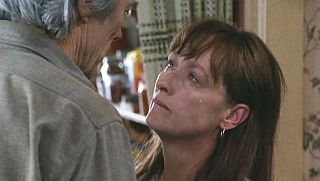
Unhappy Francesca facing the future without Robert Kincaid.
After Francesca’s family returns, and during a trip to town with her husband on a rainy afternoon, she sees Kincaid in the middle of the street, drenched by the rain.
Kincaid has remained in town solely on the chance that Francesca might reconsider.
Her hand on the truck’s door handle, she considers bolting from her husband to join Kincaid, but cannot do it... This moment, for film critic Robert Ebert, “is the film’s passionate climax.” (more screen shots continue below in Sources).
Farmhouse Jazz
Among some of Eastwood’s more interesting and subtle touches in the film are the scenes using and incorporating jazz music tracts. A jazz fan himself and pianist, Eastwood helped compose the film’s love theme, “Doe Eyes,” and he uses a number of jazz pieces throughout the film. Among these are songs by Johnny Hartman, Irene Kral, Dinah Washington, and Barbara Lewis. These music moments in the film have been noted by Janice Gomes in her essay, “Jazz in the Movies,” the source used, in part, for the summary that follows below.
In one of Eastwood’s earlier directing roles, Play Misty for Me, he built much of the film’s storyline around an Errol Garner love song of that same name. In Bridges, Eastwood’s use of the music is never dominant, but typically in the background.
The jazz tunes in Bridges are played on the kitchen radio in the Johnson farmhouse, heard on Kincaid’s pick-up truck radio, and played by a roadhouse band when Francesca and Robert visit an out-of-the-way dance bar.
Earlier, in the film, after Robert and Francesca have taken their first trip to the Roseman Bridge, and Kincaid has come inside her home for iced tea, he fiddles with the kitchen radio, finding Dinah Washington singing “Blue Gardenia,” befitting the blue wildflowers he picked for Francesca at the bridge, now on the kitchen table.
As they exchange stories in the kitchen, jazz and blues tunes continue to play on the radio. Among the songs is “When You’re in Love” by Johnny Hartman.
Francesca by this time has asked Robert to stay for dinner. As they both prepare the food for their meal, Dinah Washington is heard singing “I’ll Close My Eyes.”
After their dinner, “Easy Living” by Johnny Hartman is heard. Francesca that evening has left her note on the bridge inviting Robert to dinner the following day.
On Francesca’s drive into town the next day to buy groceries, Dinah Washington’s “Soft Winds” plays on her pickup truck radio. While in town, she decides to buy a new dress.
Later that night, at their second dinner, meeting in the kitchen, Robert is again tuning the radio, then turns to see Francesca in her new dress as the Johnny Hartman tune “I See Your Face Before Me” plays in the background.
A phone call briefly interrupts their evening, but they soon have their first moments of touching — she smoothing his collar while on the phone, leaving her hand resting on his shoulder.
As she ends the phone call, Robert takes her hand, leading to a slow dance around the kitchen as Johnny Hartman sings his tune. The love making is not far behind.
Later, as the two share a steamy bath, Irene Kral sings “This Is Always.” Also heard on the soundtrack is the Barbara Lewis hit from 1965, “Baby I’m Yours.”
Near the end of their four days together, they visit a roadhouse with jazz band and dance to Johnny Hartman’s “For All We Know,” as its lyrics, “we may never meet again,” presages their unhappy end.
Back at the farmstead on their final night together, Francesca has packed to leave with Robert. But as they share dinner, Johnny Hartman’s “It Was Almost Like A Song” plays in the background as Francesca realizes she cannot leave her family. “They would not survive the talk,” she says of the small-town censure and gossip mill.
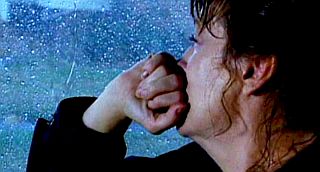
After she and Kincaid have parted from their four-day affair, and when Francesca comes to town a few days later with her husband on errands, there is the scene in the pickup truck with her husband when she sees Robert standing in the middle of the the road in the rain. As the family pickup pulls away, Francesca has her hand poised by the door handle, but she does not bolt from the truck. She returns home and is shown in a later scene leaning against the kitchen wall sobbing as Irene Kral’s “It’s A Wonderful World” plays. Francesca will never see Robert Kincaid again.
Jazz album, “Remembering Madison County”. Click for CD.
1990s DVD home video release. Click for copy.
Warner Books published thousands of copies of this coffee table book of photography as a tie-in to the film. Click for copy.
Robert Waller’s book, “A Thousand Country Roads,” billed as the conclusion to “Bridges.” Click for copy.
Cottage Industry
On June 19, 1995 The New York Times ran a business-section story headlined, “The Revenue Streams That Flow From The Bridges of Madison County,” noting that “the book and the film version have generated a not-so-small cottage industry of their own.”
The Times story included a graphic which showed the book spawning the film version, and the film, in turn, spawning two related books, a music CD from the film (there were actually two CDs), and various ancillary products linked to the Bridges story – tote bags, polo shirts, a cookbook, picture frames with the Bridges imprint, and even a perfume.
Clint Eastwood’s recording label, Malpaso Records, a division of Warner Brother’s Records, released two CDs: the original soundtrack, Music from The Bridges of Madison County, and Remembering Madison County, a companion disc of more jazz tunes. Both rose to No. 1 on the Billboard jazz chart in June 1995, each with respectable sales that year as well.
Warner Books would publish the two-tie in book volumes from the film. The first, The Bridges of Madison County: The Film, a coffee table book of film-related photos. That book was priced at $22.95 and Warner, according to the Times, had 80,000 printed.
The second film-related book, The Bridges of Madison County Memory Book, meant to be a journal, had mostly blank pages but also included some text along with photos shot by Clint Eastwood as he was acting in his role as Robert Kincaid shooting the bridges and Francesca. That volume was priced at $11.95 with Warner printing 70,000 copies.
The original book itself was not published in paperback until 1997, and then with a print run of 1.5 million copies. And there would also be other Waller books to come (see below), several published by Warner (more on this below).
The film’s main CD soundtrack, mentioned earlier, the jazz soundtrack, which the Times said was priced at $15.05, had already sold 250,000 copies. That was mid-June 1995. A DVD version of the film was also released for sale not long after the film had its first run in 1995. A “deluxe edition” DVD of the film (first photo at the top of this story) was released by Warner Home Video in June 2008, and it included a number of extra features.
In 2014 a stage musical was made of Bridges which ran on Broadway at the Gerald Schoenfeld Theater for 137 performances. The production won several awards during its run in 2014. A national tour followed, which began in the Fall of 2015.
So, yes; cottage industry indeed. In fact, when all the Bridges-related business, entertainment, and economic activity is added up (from 1991 on) – including Iowa-based tourism, which became considerable over several years – it would not be surprising to find something north of $1-to-$2 billion in total economic activity generated by the Bridges phenomenon, and perhaps more.
More Waller
As for author Robert James Waller, he went on to write several other novels. In addition to Slow Waltz at Cedar Bend (1993) already mentioned above, he also published Border Music (1995), Puerto Vallarta Squeeze (1995), A Thousand Country Roads (2002), High Plains Tango (2005), and The Long Night of Winchell Dear (2006).
Of these, A Thousand Country Roads was published as “an epilogue” to Bridges, and it follows an older Robert Kincaid on a journey to Iowa in hopes of seeing Francesca again. However, the two do not reunite. Although this book did make the New York Times bestsellers list for a time, it was not another Bridges. Yet it did allow a few reviewers to revise earlier assessments of Waller and reflect more favorably on Bridges and why so many readers loved it.
In his personal life, meanwhile, Waller had become a multi-millionaire – estimated by one source to be in excess of $15 million with earnings from movie rights, publishers’ advances, and his share of U.S. book sales. Another report from Newsweek in June 1995 estimated Waller had made $26 million from The Bridges of Madison County.
In 1994, Waller moved to Texas and bought a ranch, and later, several thousand acres of land. His first marriage ended in 1997 amid an affair he was having with a younger ranch hand. He later remarried. In 2000, Waller named his graduate school alma mater, Indiana University, to an estate gift estimated to be “well into seven figures.” In 2012, Waller also made a multi-million dollar gift to the University of Northern Iowa, where some of his papers are also housed. Waller died on March 10, 2017, at his home in Fredericksburg, Texas. He was 77 and had been battling multiple myeloma.
One Story’s Legacy
When it was all said and done, The Bridges of Madison County, in its time, had one hell of a run. To date the book has reportedly sold 60 million copies worldwide and has been printed in some 23 languages. It spent 164 weeks on the New York Times bestsellers list, clearly helped by the film in its later run. In its prime-time occupation of that list during 1992-1995, Bridges out-performed and eclipsed other best-selling authors such as John Grisham, Danielle Steel, Stephen King, Tom Clancy, Anne Rice and others. The book holds one of the highest single-year sales records, with more than 4 million copies sold in 1993. In its day, it even surpassed Gone With the Wind as the best-selling hardcover fiction book of all time. It also garnered the 1993 American Booksellers “Book of the Year” Award as well as the 1993 Literary Lion Award from the New York Public Library. Yet in subsequent years, all of Bridges’ sales and publishing records would be broken by other best sellers.
Francesca on Roseman Bridge looking down on Robert Kincaid taking his photographs of the bridge shortly after they met.
Robert Kincaid taking a few shots of his new friend.
At Roseman Bridge, Robert had picked a bouquet of wildflowers for Francesca.
Back at the farmstead, Francesca invites Robert in for iced tea.
The Bridges film, meanwhile, was nominated for 15 awards overall, including the Golden Globe and Screen Actors Guild Awards, and won six. On one list, that for the French film magazine, Cahiers du cinéma, it was rated among the top three films of the 1990s. The film is also included on the American Film Institute’s “100 Years… 100 Passions” list of the 100 greatest love stories of all time.
While the book was pilloried for its sometimes flowery prose, lampooned for its macho descriptions, and called on the carpet for its depiction of women, Bridges still held its own with millions of readers. Among reviewers, there was also some grudging praise for Waller. Chauncey Mabe of The Sun Sentinel in Florida, for example, tipped his hat to the author. “Like Love Story before it,” wrote Mabe, “The Bridges of Madison County will survive the most scathing critical condemnation. Even those who like the book least… have to admit that it is skillfully put together.”
The Bridges of Madison County, however, is a two-part phenomenon, and its legacy should be that of book and film taken together as cultural package: the book for the central idea, and the film for the imagery of the idea, this alluded to, more or less, by several reviewers. The film, in toning down some of the literary excesses of the book, had the effect of redeeming and elevating the story. Waller provided the idea, the place, and circumstance; Streep and Eastwood, the characters and their love story visually embedded in memory.
Joan Ellis, writing in 1995 after the film had come out, noted: “…Robert James Waller’s style is irrelevant; what he did, it seems, is create a blank page for the collective fantasy. Bridges is an invitation to consider what might have been, permission to think about what was missed or what was lost. As Robert Kincaid and Francesca Johnson, Clint Eastwood and Meryl Streep become the vessels for the inner lives of their audience.”
Still, Bridges the book remains controversial to this day with its fans and foes, while others question its literary value. Some regard it as romance, others accept it as literature, and still others call it an adult fairy tale. Regardless of what it’s called, the story holds a fascination for people because of the important themes it explores: love, passion, chance, consequence, loyalty, and responsibility.
Periodically, it seems, popular love stories come along unpredictably — as they have through time. They appear to be welcomed in whatever form, and continue to capture the public’s imagination and support — whether Romeo or Juliet, its musical successor West Side Story, Casablanca,An Affair To Remember, Love Story, Dr. Zhivago, and countless others. The literary rank or comparative greatness of the stories does not always appear to enter the equation. If the story succeeds in moving its audience, causing them to think and feel along with the trials, challenges, and choices of the principal characters, that appears to be quite enough. The Bridges of Madison County — in print and on the big screen —surely did that.
See also at this website: “The Love Story Saga, 1970-1977,” on the book and film of that era that also became a publishing and box office hit; “Linda & Jerry, 1971-1983,” on the respective careers of and relationship between California Governor Jerry Brown and rock star Linda Ronstadt; and “Noteworthy Ladies,” a topics page with 40 story choices featuring famous women. See also the “Film & Hollywood” or “Print & Publishing” pages for additional stories in those categories. Thanks for visiting – and if you like what you find here, please make a donation to help support the research, writing, and continued publication of this website. Thank you. – Jack Doyle
Article Citation:
Jack Doyle, “Of Bridges & Lovers, 1992-1995,” PopHistoryDig.com, June 25, 2008.
________________________________
Other Love Story Choices at Amazon.com…
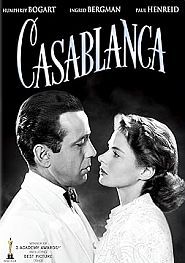
1942 classic love story in a time of war starring Humphrey Bogart & Ingrid Bergman. Click for film.
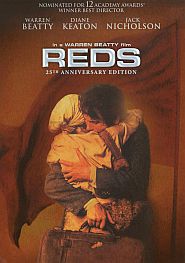
Warren Beatty, Diane Keaton star in 1981 drama about journalist & Russian Revolution. Click for film.
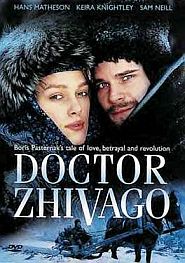
2002 British TV miniseries with Keira Knightley that aired on U.S. PBS. Click for film.
Sources, Links & Additional Information
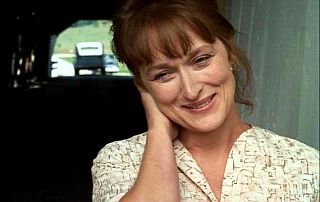
1965: Francesca Johnson in her Iowa farmhouse kitchen.
1989: Nearly 25 years later, Francesca’s adult children begin learning about their mother’s affair with Robert Kincaid.
Francesca has left behind a box of letters, photos, personal journals, and Robert Kincaid memorabilia that tells of their affair.
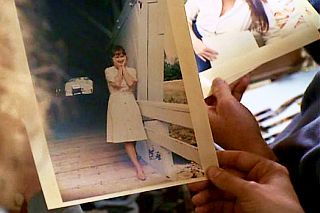
The Kincaid box inlcudes photos he took of Francesca at the Roseman Bridge in 1965.
Francesca’s two children are stunned by what they find in Francesca’s journals.
Screenshot of title frame, "The Bridges of Madison County."
Francesca Johnson shown in later years, alone at the farm, here reading a letter from Robert Kincaid.
DVD cover for 1985 film, "Out of Africa," one of many films in which Meryl Streep had a lead role, here as a farm wife who falls for a free-roaming, big-game hunter played by Robert Redford. Click for DVD.
A Clint Eastwood 20-film “legacy collection” (acting and/or directing) from Warner Bothers (2016), among them: “Dirty Harry,” “Sudden Impact,” Mystic River,” “Million Dollar Baby,” “Trouble With The Curve,” “Jersey Boys,” and “American Sniper.” Click for DVD.
Meryl Streep and Tom Hanks star in Steven Speilberg film about how the Washington Post risked everything in a freedom-of-the-press battle to publish the Pentagon Papers. Click for DVD.
Hilary Radner’s 2017 book, “The New Woman's Film: Femme-Centric Movies for Smart Chicks,” Routledge, 224pp. Includes chapter on “The Bridges of Madison County.” Click for copy.
Popular 1986 film “Heartburn,” starring Meryl Streep and Jack Nicholson and directed by Mike Nichols, based on the novel and screenplay by Norah Ephron, a semi-biographical account of her marriage to Washington Post reporter of Watergate fame, Carl Bernstein. Click for DVD.
“Casablanca,” the classic 1942 film called “the most romantic movie of all time,” here in its 70th anniversary upgraded edition. Click for DVD, Blu-Ray, or video.
Poster for 1983 film “Silkwood,” based on the true story of Karen Silkwood, a worker at an Oklahoma nuclear facility who uncovers evidence of wrongdoing, is contaminated with radioactive material for her efforts, and on her way to meet with a New York Times reporter, is killed in a mysterious auto accident that many believe was an intentional hit job. Meryl Streep plays Silkwood in this award-winning film directed by Mike Nichols, co-staring Cher and Kurt Russell. Click for DVD or Blu-ray.
Robert James Waller, The Bridges of Madison County, Warner Books, New York, NY, 1st printing, April 1992, 171 pp.
“The Bridges of Madison County (book),” Wikipedia.org.
Carey Karpick, “Waller, James Robert: The Bridges of Madison County,” 20th-Century American Bestsellers, Depart-ment of English, University of Virginia, accessed August 2020.
“Robert James Waller Interview on The Bridges of Madison County,” The Charlie Rose Show, February 12, 1993, posted on YouTube.com, August 15, 2016.
“Books by Robert James Waller and Complete Book Reviews,” Author Page, PublishersWeekly.com.
Trisha Ping, Interview, “Robert James Waller: Home on the Range,” BookPage .com, July 2005.
Gilbert Cruz, “The Backstory Behind Best-Sellers,” Entertainment Weekly, December 27, 2006.
“Meryl Streep: Making of ‘The Bridges of Madison County’,” YouTube.com (with transcript), posted by The Meryl Streep Forum, June 4, 2010.
David Comfort, An Insider’s Guide to Publishing, 2013, Penguin, 304 pp.
Associated Press, “’Bridges of Madison County’ Author Robert James Waller Dies at 77,” Hollywood Reporter.com, March 10, 2017.
William Grimes, “Robert James Waller, Author of ‘The Bridges of Madison County,’ Dies at 77,” New York Times, March 10, 2017.
Matt Schudel, “Robert James Waller, Author of Best-Selling ‘Bridges of Madison County,’ Dies at 77,” Wash-ingtonPost.com, March 10, 2017.
Patricia Bauer, “Robert James Waller, American Author,” Britannica.com, Last Updated, July 28, 2020.
Noel Murray, “The Bridges Of Madison County” (film review), TheDissolve .com, May 5, 2014.
Hilary Radner, The New Woman’s Film: Femme-Centric Movies for Smart Chicks, 2017, Routledge, 224 pp. (Chapter 3: “Anticipating the Twenty-First Century: ‘Dirty Harry Bathed in a Romantic Glow?’ and The Bridges of Madison County”).
“The Bridges of Madison County” (film), Wikipedia.org.
“The Bridges of Madison County (1995),” AFI.com, American Film Institute.
“The Bridges of Madison County,” Film Trailer, IMDB.com (International Movie Data Base).
Ken Regan and Robert James Waller, Bridges of Madison County: The Film, 1995, Warner Books/Grand Central Pub-lishing, 128pp.
“The Bridges of Madison County,” Kirkus Reviews, January 15,1992.
“The Bridges of Madison County,” Pub-lishers Weekly, April 1992.
L. S. Klepp, “The Bridges of Madison County,” Entertainment Weekly, June 12, 1992.
“Best Sellers, August 16, 1992,” New York Times Book Review/NYTimes.com.
“Booksellers’ Art of Persuasion,” News-week, September 7, 1992.
Charles Champlin, “Sleepers,” Los Ange-les Times Book Review, January 17, 1993.
William Souder, “He Wrote the Book on Love” (re: Robert James Waller), Wash-ington Post, February 9, 1993.
Elaine Jarvik, “Love, Longing & `The Bridges of Madison County’,” Deseret News (Salt Lake city, UT), February 14, 1993.
Pauli Carnes, “Waller Book: Porn for Yuppie Women?,” Los Angeles Times Book Review, April 18, 1993.
“Oprah Winfrey Show (May 21, 1993),” YouTube.com (with transcript), posted, April 29, 2020.
Harpo Productions, “The Oprah Winfrey Show (May 21, 1993),” Archive.org, The Internet Archive.
Nancy Pate, Book Critic, “Waller’s ‘Bridges’ Is Still Connecting,” Orlando Sentinel (Orlando, FL), May 30, 1993.
Dan Thomas, Wartburg College and Larry R. Baas, Valparaiso University, “Reading the Romance, Building the Bestseller: A Q-Methodological Study of Reader Response to Robert James Waller’s The Bridges of Madison County,” Prepared for the Ninth Annual Meeting of the International Society for the Scientific Study of Subjectivity, Stephenson Research Center, School of Journalism, University of Missouri, Columbia, Missouri, October 7-9, 1993.
Charles Champlin, “Bridges of Madison County, Take Two: Slow Waltz in Cedar Bend,” Los Angeles Times, October 24, 1993.
Jocelyn McClurg, Book Editor, Connec-ticut News, “Waller, As The `Last Cowboy,’ Riding High in the Saddle,” Hartford Courant/Courant.com (Hart-ford, CT), November 12, 1993.
Jon Margolis, “What’s Pop Culture? Politics, Show Biz and Total Inanity,” Chicago Tribune, June 29, 1993.
“Rush Is on For Female Lead in ‘Madison County’,” The Courier-Journal (Louis-ville, KY), July 21, 1993.
Frank Rich, End Paper/Public Stages, “One-Week Stand,” The New York Times Magazine/NYTimes.com, July 25, 1993, Section 6, p. 54.
Sarah Lyall, Book Notes, “A Big Year for ‘Bridges’,” New York Times/NYTimes .com, July 28, 1993.
Lynn Van Matre, “The Marketing of Madison County,” Chicago Tribune, August 5, 1993.
Tim Warren, “Building Bridges; Senti-mental Novel Keeps Novice Writer on Top,” The Baltimore Sun, August 6, 1993.
Associated Press, “Bridges’ Carries Readers From Cover to Cover,” Port Arthur News (Port Arthur, TX), August 6, 1993.
Malcolm Jones, Jr., “Lists You Should Check Twice,” Newsweek, August 9, 1993.
John Leo, “‘Covered Bridges’: Written Proof of People’s Private Desperation,” U.S. News and World Report, August 9, 1993.
Chauncey Mabe, “’Bridges’ Album Starts Badly, Gets Worse,” Sun-Sentinel (So. Florida), September 8, 1993.
Malcolm Jones, Jr., “A Slow Waltz to the Bank.” Newsweek, November 1, 1993.
“Best Sellers, November 7, 1993,” New York Times Book Review/NYTimes.com.
Jane Applegate, “’Bridges’ Leads to Madison County Boomlet,” The Orlando Sentinel, November 29, 1993.
“Publishers Weekly List of Bestselling Novels in the United States in the 1990s,” Wikipedia.org.
First Draft, “The Bridges of Madison County,” Screenplay Adaption by Richard LaGravenese, March 24, 1994.
“Best Sellers, May 1, 1994,” New York Times Book Review/NYTimes.com.
Anne Thompson, “The Bridges of Madison County’s Tough Road; After Changes in Director’s and Leading Stars, The Best-Selling Novel Will Go to Film,” Entertainment Weekly, May 13, 1994.
Dana Kennedy, “Robert James Waller, A Real American Cowboy,” EW.com, De-cember 16, 1994.
“The Bridges of Madison County,” Vari-ety, May 22, 1995.
Jim Bessman, “Malpaso Debuts With ‘Bridges’ Soundtrack; Eastwood War-ner Label Specializes in Jazz” Billboard, May 27, 1995.
Mick LaSalle, “The Bridges of Madison County,” San Francisco Chronicle, June 1, 1995.
Amy Longsdorf, “Crossing the Bridge: The Long Road to the Filming Of’ Madison County’,” The Morning Call (Allentown, PA), June 2, 1995.
Janet Maslin, Review, “Love Comes Driving Up the Road, and in Middle Age, Too,” New York Times/NYTimes.com, June 2, 1995.
“The Bridges of Madison County,” USA Today, June 2, 1995.
Chauncey Mabe, Book Editor, “Script, Streep’s Acting Redeem ‘Bridges’,” Sun-Sentinel.com (South Florida), June 2, 1995.
Roger Ebert, Film Critic, “The Bridges Of Madison County,” Chicago Sun-Times /RobertEbert .com, June 2, 1995.
“Steven Schiff, Movie Critic, Reviews ‘Bridges of Madison County,’ Starring Clint Eastwood and Meryl Streep,” Fresh Air / NPR.org, June 2, 1995.
Desson Howe, “’Bridge’ Work Pays Off,” Washington Post, June 2, 1995.
R. Kempley, “’Bridges’: Iowa Corn,” Wa-shington Post, June 2, 1995.
“The Bridges of Madison County,” Warner Bros. Pictures | Release Date: June 2, 1995, Metacritic.com (Meta-score 66, i.e., “generally favorable reviews based on 22 critic reviews” ).
Barbara Shulgasser, Examiner Movie Critic, “The Weeper of Madison County,” San Francisco Examiner /SFGate.com, June 2, 1995.
Richard Corliss, “When Erotic Heat Turns Into Love Light,” Time, June 5, 1995.
Bernard Weinraub, “Rebuilding ‘Bridges’ Without Leaving The Novel Behind,” New York Times/NYTimes.com, June 6, 1995.
“Is ‘Madison County’ Novel Bridge to Hell?,” Louisville Courier-Journal (Lou-isville, KY), June 7, 1995.
“The Bridges of Madison County,” Enter-tainment Weekly, June 9, 1995.
Anne Thompson, “The Making of ‘The Bridges of Madison County’,” EW.com, June 16, 1995.
Jocelyn McClurg, Book Editor, “`Bridges’ Fans Far From Burnt Out,” Hartford Courant / Courant.com (Hartford, CT), June 21, 1995.
Thomas K. Lindsay, “New-Old Lessons on Love and Family,” The Baltimore Sun, July 12, 1995.
Jonathan Rosenbaum, “The Bridges of Madison County,” ChicagoReader .com, June 13, 1995.
“The Bridges of Madison County,” Roll-ing Stone, June 15, 1995.
Newsweek Staff, “A Place In The Heart,” Newsweek, June 18, 1995.
Ty Ahmad-Taylor, “The Revenue Streams That Flow From The Bridges of Madison County,” New York Times/NYTimes.com, June 19, 1995.
“Richard LaGravenese Interview on ‘The Bridges of Madison County’,” YouTube .com, posted, August 13, 2016 (excerpted from The Charlie Rose Show, June 20, 1995).
“Best Sellers, June 25, 1995,” New York Times Book Review/NYTimes.com.
Mark Harris, “‘The Bridges of Madison County’ Tie-Ins; Three Additional Books — A Diary, Postcards, and About the Film — Can Now Be Found in Stores,” Enter-tainment Weekly, July 21, 1995.
Cheryl Lavin, “A ‘Bridges of Madison County’ Reality Check,” Chicago Tribune, August 30, 1995.
“Best Sellers, October 8, 1995,” New York Times Book Review / NYTimes.com.
Ruth Picardie, “Making Megabucks From a Mid-Life Crisis,” The Independent (London), October 14, 1993.
Christine Tatum, “Romance Novel Hits Home With Local Fans `The Bridges of Madison County’,” News & Record (Greensboro, NC ), October 18, 1993.
Frank J. Prial, “Son of Madison County,” New York Times/NYTimes.com, October 31, 1993.
Joan Ellis, “That Bad Book Has Come a Long Way; The Bridges of Madison County,” Joan Ellis.com, 1995.
Bonnie Brennan, Marquette University, “Bridging the Backlash: A Cultural Materialist Reading of The Bridges of Madison County,” Studies in Popular Culture, October 1, 1996.
“The Bridges of Madison County,” in Tom Pendergast and Sara Pendergast (eds.), The St. James Encyclopedia of Popular Culture, Gale Group, 2000.
Leslie Kaufman, “Novel’s Sequel: Bridges Are Burned; ‘Madison County’ Author Returns to His Best-Selling Characters,” New York Times/NYTimes.com, April 4, 2002.
Michael Pakenham, “Here Comes R. J. Waller Again, and Still Oblivious to Intimacy,” The Baltimore Sun, April 14, 2002.
Janis Gomes, “Jazz in the Movies,” TotalSwing.com, January 14, 2005.
“Robert J. Waller Papers, c. 1963-2002,” Special Collections & University Archives, University of Northern Iowa, UNI.edu, Cedar Falls, Iowa.
“Bridges of Madison County (Lennie Niehaus),” YouTube.com, Posted April 17, 2016.
“Bridges of Madison Magic (Lennie Niehaus – Main Theme; Irene Kral – This Is Always),” YouTube.com, posted by Madis Kaaret, January 17, 2017.
“The Bridges of Madison County – Awards,” IMDB.com.
Kyle Munson, “’Bridges of Madison County’ Made Robert James Waller Famous, But Didn’t Define Him,” Des MoinesRegister.com, March 13, 2017.
Philip Potempa, “Marriott’s ‘Bridges of Madison County’ Beautifully Brings the Page to Stage,” Post-Tribune/Marriott Theatre.com, July 3, 2017.
“An Old Fashioned Love Story: Making The Bridges of Madison County; Meryl Streep Clip,” YouTube.com, June 22, 2018.
“Streep in The 1990s: The Bridges of Madison County (1995),” SimplyStreep.com, May 2, 2020.
Aron Medeiros, “The Bridges Of Madison County – 25th Anniversary,” MauiWatch .com, June 4, 2020.
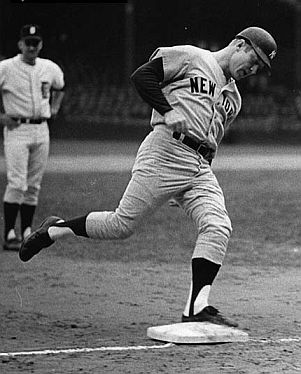
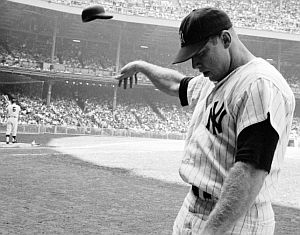
Detroit Tigers infielder Don Wert watches Mickey Mantle circle the bases after hitting his 535th career home run, Sept. 19, 1968.
America was not in the best of moods in the fall of 1968. The country was still convulsing from events near and far that would mark the year as one of the most tumultuous in the history of the 20th century.
In late January, the Tet offensive in Vietnam, striking more than 100 towns and cities in South Vietnam, stunned the U.S. and South Vietnamese armies. Two months later, in late March 1968, President Lyndon B. Johnson, mired in the Vietnam conflict, announced he would not run for re-election. In April, civil rights leader Martin Luther King was shot and killed by an assassin, and in June, Bobby Kennedy, then running for the Democratic presidential nomination, was struck down by a gunman in California.
In August, Soviet and Warsaw Pact troops crushed Czechoslovakia’s “Prague Spring.” Back in the states that month, the Democrats’ National Convention in Chicago became a spectacle of political ugliness, both inside the hall and on the streets, with clashes and confrontations over Vietnam and the nation’s future.
But then, in the midst of all this, there was still baseball, the national pastime; the one constant thing; an oasis of predictable pace and familiarity apart from the turmoil. Baseball was there in those dark days, in the background perhaps, but doing its thing; playing its games, day after day, from April thru October.
One of the game’s old lions at the time, Mickey Mantle of the New York Yankees, was nearing the end of his storied career. On September 19th, as the regular season was winding down, the Yankees were playing the Detroit Tigers in Detroit. The Tigers had already won the American League pennant that year, propelled there in part by ace pitcher Denny McLain, and were headed to the World Series. But in this game, Mantle hit his 535th home run, then putting him on the all-time homer list at No. 3, behind only Babe Ruth and Willie Mays. Mantle hit this homer off Denny McLain, who still picked up his amazing 31st win that year, as Detroit beat the Yanks, 6-2. It was Mantle’s 17th home run of the 1968 season — not the 30 or more he would normally hit each year during his prime. Mantle’s final career homer — No.536 — came the next day on September 20, 1968 off Boston’s Jim Lonborg. Mantle in those games, with his season-ending home runs, was in the last days of his career, though his official retirement announcement would not come until the following year, on March 1, 1969. These were his last games.
'Mickey Mantle: Born for The Majors,' cover story, Time, June 15, 1953.
In later years Mantle would joke half-heartedly about his hobbled, late-career performance: “Hitting the ball was easy,” he’d say. “Running around the bases was the hard part.” Those who played with Mantle, however, knew it wasn’t funny. In the above photo, you can almost see him wincing as he ran the bases.
Mantle had been a baseball sensation when he first came up in the early 1950s, a player with a rare combination of speed and switch-hitting power the game had not seen in years. Through the 1950s and early 1960s, he became one of baseball’s most feared hitters, and his speed on the base paths and in the outfield made him an all-around player, especially in his early years. Mantle played his entire 18-year career with the Yankees, winning three American League MVP titles. He was also selected to play on 16 American League All-Star teams. With the Yankees, Mantle played on 12 pennant winners and 7 World Series champions. As of 2007, he still held the records for most World Series home runs (18), RBIs (40), runs (42), walks (43), extra-base hits (26), and total bases (123).
“The Kid From Joplin” (From David Halberstam’s October 1964)
The Mantle legend, which began with his signing, grew during a special rookie camp the Yankees had…in 1950. There, some of the old-timers in the organization got a sense that they were seeing something rare; a true diamond in the rough. Mantle’s potential, his raw ability, his speed, his power from both sides of the plate, were almost eerie. If his talent were honed properly, they thought they were quite possibly looking at someone who might become the greatest player in the history of the game. There were some fast players in that camp, and one day someone decided that all the faster players should get together and have a race. Mantle, whose true speed had not yet been comprehended, simply ran away from the others. What had made some of the stories coming out of the camp so extraordinary was the messenger himself, Bill Dickey — the former Yankee catcher, a Hall of Fame player, and a tough, unsentimental old-timer who had played much of his career with Ruth, Gehrig, DiMaggio, and [Tommy] Henrich. He was not lightly given to hyperbole. Dickey started talking about Mantle to Jerry Coleman, the veteran second baseman, with superlatives that were unknown for him: “Jerry, he can hit with power righty, he can hit with power lefty, and he can outrun everyone here.”. . .
“He’s going to be the greatest player I’ve ever seen,” Dickey added. A few days later Dickey grabbed his old teammate Tommy Henrich. “Tom, you should see this kid Mantle that played at Joplin. I’ve never seen power like that. He hits the ball and it stays hit. He’s really going to be something.” Even the sound of his home runs, Dickey said, were different, mirroring something Ted Williams would say years later: the crack of the bat against the ball when Mantle connected was like an explosion. Henrich simply shook his head — it was one thing to hear about a coming star from an excited journalist, but quite another to hear it from someone like Bill Dickey.
With Two Good Legs?
Some of Mantle’s teammates and competitors, as well as sports writers and fans, have often wondered what he would have been like had he not been plagued by injuries throughout his career — especially the leg injuries. Mantle had collected some of his injuries early in life, beginning with a leg infection as a high school football player that nearly resulted in an amputation. Still, when he reached the major leagues in 1951, his running speed was among the best in baseball and his power simply awesome. In his early career, some thought him a rare kind of baseball god, possessing both power and speed.
In 1951, when Mantle was first coming up with the Yankees, his prowess was fully apparent. In an exhibition game at the University of Southern California during his rookie spring training season that year, batting left-handed, he hit a home run ball that left Bovard Field and crossed an adjacent football field, traveling an estimated 656 feet. Some cite it as the longest home run in baseball history. Mantle, in fact, hit two home runs that game — a second, right-handed shot cleared the left-field wall and landed on top of a three-story house well over 500 feet away. Throughout his career, Mantle would hit other memorable shots — including a 565-foot home run at Griffith Stadium in Washington in April 1953 (said to have coined the term “tape measure home run”); a 643-foot homer at Detroit’s Tiger Stadium in September 1960; and one that almost left Yankee Stadium, which no hitter has ever done. But those who saw Mantle hit during his rookie spring training year of 1951, remember the distinctive crack of the bat when he tore into the baseball; they knew there was something special about this “hayseed from Oklahoma,” as some called him.
Mickey Mantle, 1950s. Photo by Bob Olen.
But leg injuries plagued him from nearly the beginning of his Yankee career. As a 19 year-old rookie in his first World Series game in 1951, Mantle tore the cartilage in his right knee while running for a fly ball when his cleats caught a drainage cover in the outfield grass. His knee twisted awkwardly and witnesses reported him going down “like he had been shot,” hitting the ground instantly. He was carried from the field on a stretcher. Mantle would never play pain-free after that, but play he did — and play well. In 1952, he took over center field duties from retiring Joe DiMaggio, and completed one of his best seasons at the plate. But as the years went by, he would have knee surgery four times, and would apply thick wraps to both of his knees in something of a pre-game ritual. By the end of his career, simply swinging a bat caused him to fall to one knee in pain.
Still, even with his injuries and impaired performance, Mantle managed to compile a record that most professional players can only dream about.
During his career with the Yankees, he played more games as a Yankee than any other player (2,401), won three Most Valuable Player awards (’56, ’57 and ’62). In 1956, he won baseball’s Triple Crown with a .353 batting average, 52 homers and 130 RBIs. He led all of major league baseball that year in all three categories. When he retired in 1969, his 536 career home runs was then the third highest ever, ranking behind only Babe Ruth (714) and Willie Mays (587), and the most ever by a switch-hitter.
Mickey Mantle with U.S. Senator Robert F. Kennedy (D-NY) on Sept 18, 1965, ‘Mickey Mantle Day,’ when Mantle played his 2,000th game. Photo, Martin Blumenthal, SPORT magazine.
Indeed, with two good legs, Mickey Mantle might have been a good bet to have broken Babe Ruth’s single-season record of 60 home runs, and perhaps sooner than 1961 when Roger Maris did it. Mantle may have also compiled a career home run total closer to, if not exceeding 600. His career batting average would probably have bettered .300 as well; with more runs scored and RBIs up too, and perhaps a Gold Glove or two for fielding. All speculation, of course, and “what might have been.” Yet many of his admirers wish it could have been so; that the fair-haired kid from Oklahoma might have had a bit more luck with the health of his legs.
See also at this website: “Mantle’s Griffith Shot, April 1953,” about a monster home run by Mantle in the old Griffith Stadium park in Washington, D.C.; “Mickey Mantle Day, September 1965,” when Mantle was honored for his career at Yankee Stadium; and, “Keeps on Ticking,” featuring Mantle, among others, in Timex watch advertisements. See also “The M&M Boys,” about the 1961 home run race between Mantle and Roger Maris.
Article Citation:
Jack Doyle, “Mickey Mantle’s 535th–September 19, 1968,” PopHistoryDig.com, June 18, 2008.
_______________________________
Mickey Mantle Books at Amazon.com…
R. Roberts & J. Smith, “A Season in The Sun: The Rise of Mickey Mantle,” 2018, Basic Books, 304 pp. Click for Amazon.
Tony Castro’s 2019 book, “Mantle: The Best There Ever Was,” Rowman & Littlefield, 280 pp.Click for copy.
Jane Leavy’s best-selling, “The Last Boy: Mickey Mantle and the End of America's Childhood,” 2010, Harper, 480pp. Click for copy.
Sources, Links & Additional Information
Mickey Mantle – here in his young “Greek god” body – captured by Life magazine during a celebratory locker room scene, October 1952.
Life magazine cover story, June 25, 1956: “The Remarkable Mickey Mantle,” with story inside: “Prodigy of Power: Mickey Mantle Comes of Age As a Slugger.” Click for copy.
Young Mickey Mantle shown here with wife Merlyn and their two young boys. They would have four sons.
1965 Life magazine photo of Mantle throwing batting helmet in frustration – but check out those forearms!
Mickey Mantle on the cover of Life magazine, July 30, 1965, then at age 33 and in his 15th season with the NY Yankees. “Mantle’s Misery,” read the cover tagline, “He faces physical pain and a fading career.” Click for copy.
Mickey Mantle winces in pain during batting practice at spring training, 1967.
“The Remarkable Mickey Mantle,” cover photo, and story: “A Prodigy of Power: Mickey Mantle Comes of Age As a Slugger,”Life, June 25, 1956, pp. 99-102, 105-107.
“Mickey Mantle: My Knee Injury in the 1951 World Series,” YouTube.com.
John R. McDermott, “Last Innings of Greatness: Playing on Bum Knees and Courage, Mantle Fades After 14 Brilliant Years,” Life, July 30, 1965, pp. 46-53.
Douglas Duncan, “Mantle’s Breaks—and Yours,” Popular Science, October 1964, pp.100-103.
Roger Kahn, “Remembering Mickey” (cover story), The Sporting News, August 21,1995.
Shirley Povich, “Mantle’s Critics Swing, Miss,” Washington Post, June 19, 1995.
Note: Many of the news stories below mention Mickey Mantle injuries in their headlines, underscoring his hard times with injuries that often took him out of play.
“Mantle to Miss Finale in Boston and Yanks’ Game Here Tomorrow,” New York Times, Monday, May 26, 1952, Sports, p. 28.
“Mantle Rejected for Draft Again; Yanks’ Outfielder Ruled Unfit Because of Injury to Knee Suffered in ’51 Series,” New York Times, Tuesday, November 4, 1952, Sports, p. 34.
Joseph M. Sheehan, “Mantle Is Lost for Final Drive; Skowron Also Sidelined by Injury Suffered Friday. . .,” New York Times, Sunday, September 18, 1955, Sports, p. 2.
John Drebinger, “Ford’s 5-hitter Halts Boston, 7-1; Mantle Clouts 3-Run Homer for Yanks Before Leaving Game With Leg Injury. . .,” New York Times, Saturday, April 21, 1956, Sports, p. 12.
Deans McGowen, “Mantle Injury Held Not Serious, But He’ll Be Out 2 or 3 Days; Sprained Knee Ligaments Troubling Yank Slugger; Physician Orders New Brace; Mickey’s All-Star Role in Doubt,” New York Times, Friday, July 6, 1956, p 24.
“Mantle Hospitalized Five Days For Treatment of Shin Splint,” New York Times, Saturday, September 7, 1957, Sports, p. 27.
John Drebinger, “Braves Have Health and Hitting; Yanks Face Series, With Doubts About Mantle, Skowron,” New York Times, Monday September 30, 1957, Sports, p. 49.
Louis Effrat, “Bombers Face Prospect of Losing Mantle for Fifth Series Contest; Shoulder Injury Handicap to Star; Mantle’s Inability to Throw with Usual Strength Leads to Removal in Tenth,” New York Times, Monday, October 7, 1957, p. 31.
Louis Effrat, “Mantle to Stay out of World Series Opener Unless His Condition Improves; Yankee Slugger Weak and in Pain; Club Doctor Says He Thinks Mantle Can Play, However; Houk Also Confident,”New York Times, Tuesday, October 3, 1961, p. 47.
“Mantle’s Thigh Injury Expected to Sideline Him 2 to 4 Weeks; Star Center Fielder Resting Comfortably but Bombers Are Uncomfortable; Injured Mantle Out 2 to 4 Weeks,” New York Times, Sunday, May 20, 1962, Sports, p.1.
“Mantle on Bench With Knee Injury; Yankee Star Doesn’t Know When He Can Play Again,” New York Times, Tuesday, July 31, 1962, Sports, p. 21.
Louis Effrat, “Mantle Is Forced to Quit in Third; Injury Still Hobbles Star; Bombers Get 14 Hits off 4 Hurlers; Lopez Excels,” New York Times, Saturday, August 4, 1962, Sports, P 13.
John Drebinger, “Mantle Is Hurt in 6-to-1 Victory; Yank Ace Reinjures Muscle in Side,”New York Times, Sunday, April 14, 1963, Sports, p. 167.
Gordon S. White Jr., “Mantle Fractures Left Foot in Yank Victory at Baltimore; 4-3 Game Marred by Star’s Injury Mantle Crashes into Fence Chasing Oriole Homer and Will Be out a Month,” New York Times, Thursday, June 6, 1963, Sports, P. 56.
Leonard Koppett, “Mantle Sidelined Indefinitely with Knee Injury; Yanks Bow to Angels, 5-0; Star Could Miss Rest of Season; Loose Cartilage in Mantle’s Knee Probable Aftermath of Foot Injury on June 5; Injuries Plague Career,” New York Times, Friday, July 26, 1963, Sports, P. 17.
Leonard Koppett, “New Role for Mantle?; Full Time as Pinch-Hitter Is Urged For Ailing Slugger of the Yankees,” New York Times, Sunday, January 23, 1966, Sports, p. 182.
Leonard Koppett, “Mantle Suffers Pulled Muscle after Hitting His 475th Homer; Yankees Bow, 4-2; Mantle Injured,” New York Times, Sunday, May 15, 1966, Sports, P.1.
Joseph M. Sheehan, “Mantle Suffers Injury to Left Leg as Yankees Are Beaten by Red Sox, 5-2; Bomber Slugger Is Hurt Sliding; Injury Termed Not Serious but First Baseman Will Miss Couple of Games,” New York Times, Thursday, March 23, 1967, Sports, p. 41.
“Mantle Ends 18-Year, Injury-Ridden Baseball Career,” New York Times, Sunday, March 2, 1969, p.1.
Actor Dennis Hopper shown in one of his Ameriprise Financial television advertisements. Click for sample TV ads.
It may be surprising for baby boomers to see Dennis Hopper pitching retirement planning for Ameriprise Financial Corp. He appeared in a series of TV ads for the company during 2006-2008. Hopper, it may be remembered, played the drug-addled cowboy biker, Billy, in the 1969 film classic Easy Rider. That’s the film he directed and starred in with Peter Fond and Jack Nicholson. In fact, the storyline in that film promised its two care-free bikers a “luxury retirement” via the big Mexican drug deal the two had just made — that is, until some redneck vigilantes brought Dennis and friends to an unpleasant ending.
Others might remember Dennis as the slightly maniacal photojournalist in the Vietnam-era Apocalypse Now of 1979, or the obscenity-spewing wildman Frank Booth in David Lynch’s Blue Velvet of 1986. And then there’s the mad bomber he played in 1994’s Speed with Kenau Reeves and Sandra Bullock, or the villain “Deacon” in Kevin Kostner’s Waterworld of 1995. Or how about the war criminal Victor Drazen in TV’s 24 series of recent years. Not exactly bright and cheery characters.
Biker Billy of 'Easy Rider,' a film about financial planning of a different kind. Click for 'Easy Rider' DVD.
True, these are all fictional roles and Hopper was acting. Nevertheless, this might not be the kind of imagery and character association that a financial services company wants floating around in the heads of its would-be customers.
“Of course, when you go with a celebrity,” explained Kim Sharan, Ameriprise’s chief marketing officer, “you have to be concerned. … [B]ut we did a significant amount of testing prior to going with Dennis. He tested really well.”
Although Hopper was pitching baby boomers when he made the Ameriprise ads, he himself was not a boomer. He was born in the 1930s, and was then over 70. But according to Doug Pippin, a creative director at Saatchi & Saatchi, the ad agency then doing the Ameriprise ads, baby boomers saw Hopper as “an older brother who’s been out there.” At the time, Pippin called Hopper a “great anti-hero hero,” who stood for “unconventional thinking.”
Acting Since ’50s
Hopper, in fact, had a long and interesting career. He began acting as a teeanager in the 1950s and later signed with Warner Brothers. During the filming of Rebel Without a Cause — a 1955 film in which he had a small role — he became a friend to James Dean. He also appeared with Dean in Giant (1956), Dean’s last film before his death. By the late 1960s, Hopper teamed up with Peter Fonda and Terry Southern to co-write the 1969 film Easy Rider, which he also directed while playing the role of Billy. That film received two Academy Award nominations — one for a then-unknown Jack Nicholson for Best Supporting Actor and one for Hopper, Fonda, and Southern for Best Original Screenplay. The 1970s were a tough time for Hopper, dealing with alcohol and drug abuse.
In the 1980s, Hopper emerged in successful roles in Blue Velvet (1986) and received an Academy Award nomination for Best Supporting Actor as an alcoholic father trying to help his son’s basketball team in Hoosiers (1986). In 1988 he directed the police vs. street gangs drama Colors with Sean Penn and Robert Duvall. Since then he has directed a few more films, including The Hot Spot (1990) and Chasers (1994). In the 1990s, he became known for playing bad guy roles in films such as Speed (1994). In recent years, he has acted in several TV films and also appeared in TV series such as 24 and E-Ring. Beyond his acting and directing, Hopper is also an accomplished photographer with his work shown publicly and published in several books (see selection below “sources”). He is also a modern art collector.
Hopper has appeared in advertising throughout his career, for Nike and other sponsors. But the work he is now doing for Ameriprise may become one of those classic pieces of advertising history, despite all the criticism of a bad fit. At the very least, the style of the ads is a welcomed change from the more staid approaches of the past. Here’s some history on how it came about.
New Kind of Ad
“Our new campaign is a radical departure from standard financial services advertising,” said Ameriprise’s Kim Sharan at the launch of their ads in September 2006. “We are firmly focused on the positive aspects of retirement and our understanding that boomers aren’t going to spend this phase of life playing shuffleboard. There is no better figure to personify our message than legendary actor Dennis Hopper who embodies the spirit of the generation. With his help we are speaking with boomers not at them.”
Ameriprise — formerly a major division of American Express — became an independent company in August 2005 when it was spun off from American Express as a separate company. At the time, it was the sixth largest such roll out in corporate history. Today it is a stand-alone Fortune 500 company in its own right, ranked at #296 in May 2008, the fourth largest financial advisory firm in the U.S.
When Ameriprise became its own company, it needed to tell the world who it was and what it did, and so it began a “brand awareness” campaign. It also wanted to increase its business, add to the amount of assets under its management, and hold on to its advisor network. A marketing plan and advertising campaign were included. And that’s where Dennis Hopper comes in.
Studying Boomers
As Ameriprise began its new life as an independent, the financial services industry was in a major battle for the hearts, minds, and retirement money of the 78 million baby boomers now entering their 60s. At stake is more than $2 trillion in IRA and other assets that boomers now hold. Needless to say, companies like Fidelity, Merrill Lynch, and Ameriprise are, as one report put it, “salivating in anticipation” over this wealth. At stake is more than $2 trillion in IRA and other assets that boomers now hold. In the last few years, these and other firms have been spending some $700 million a year trying to capture boomer’s business. For Ameriprise, the question became how best to do that.
Ameriprise and its marketers began studying boomers. Using focus groups and other techniques, they met with boomers all across the country, taking their measure. They found a “work hard/play hard” cohort who were still rebels in a sense, and were not into passive retirement. Boomers are looking forward to the “next act” of their lives, but don’t want to be lectured about money and financial planning. From this, Ameriprise gleaned that “dreams” might be a good peg. Or as they put it: “We knew that we had to quell [boomers’] dread of financial planning and replace it with hope. We challenged our creative teams to take the focus off money and help boomers realize their dreams.”
Finding Their Man
In designing creative strategies, an “unexpected idea” of featuring Dennis Hopper in TV advertising arose. This came as part of the ad agency’s recommendation to use someone who was a leader or otherwise prominent in the 1960s counterculture. But the Hopper recommendation came as “a surprise” to the company. The only other celebrity used in financial services advertising at the time was Sam Waterston, who then played a righteous lawyer and prosecutor on the TV show, Law & Order. Ameriprise officials were not real comfortable with the prospect of using Hopper for their ads. Surely there must be other actors to consider, they suggested. “The Agency tried to think of some alternatives,” says one Ameriprise account of the process, “and that’s how we began to realize just how perfect and incomparable Dennis Hopper is.”Survey: “Baby Boomers saw Hopper as extremely talented, willing to chal- lenge himself, uncompro- mising, and just really cool.”
Still, Hopper was tested with audiences along with another unspecified alternative campaign. Here’s the report on what Ameriprise and their ad agency found:
“The two campaigns were taken to four markets for evaluation via one-on-one interviews. A consistent pattern of consumer response emerged. The concept featuring Dennis Hopper was clearly more appealing, in a big West Coast market as well as a smaller “Middle America” market. “Baby Boomers saw Hopper as extremely talented, willing to challenge himself, uncompromising, and just really cool. He is someone they look up to and aspire to emulate his values.”
“Meanwhile, we purchased syndicated celebrity research from E-Score (a more robust competitor to the well-known Q Score). The data reinforced what the qualitative research had demonstrated. Hopper had the combination of winning attributes that were consistent with Ameriprise’s desired brand personality: versatile, talented, experienced, intriguing, especially among our target audience.”
When they tested Dennis Hopper TV concepts, they also found a positive response. “When the Hopper spots tested above norm in quantitative testing, Ameriprise knew that Hopper was their guy.” All of the research, focus groups, and testing helped convince Ameriprise management that provocative ads featuring Dennis Hopper “could have significant positive impact on their business.” So the ads went forward, the first released in September 2006.
Hopper & ’60s Music
Hopper pitching Ameriprise.
In the ads, Dennis Hopper is aiming squarely at baby boomers and their retirement “dreams.” But he’s not exactly giving the soft sell. Rather, he is more cajoling, offering his message in a style befitting the 1960s’ way of doing things a little bit against the grain. In fact, he’s more like the “anti-retirement” messenger — at least in terms of what retirement used to be like. “No more rocking chairs or shuffleboard” — and Dennis says as much in one or more of these ads. Hopper is shown in an assortment of outdoor settings — on a sand dune, at a crossroads in the middle of nowhere, in a suburban housing tract, on a beach with blue ocean background, and others.
The ads are emotionally powered by a 1960s’ song from the Spencer Davis Group, using a signature organ riff that is a guaranteed “boomer getter”.
Each of the Ameriprise ads features Hopper dressed in black with his symbolic red chair (the “anti-rocking chair”). But most important is the music, as each of the 30-second spots is emotionally powered by the same classic piece of 1960s’ music. The song used is by Steve Winwood and the Spencer Davis Group, called “Gimme Some Lovin’ “(#7, 1967). It’s a landmark piece with a distinctive beat and signature organ riff that are immediately recognized by anyone who was even remotely paying attention in the 1960s. It also has guaranteed “kitchen-to-TV-room” drawing power for those who might have drifted away from their TV sets. The music almost has a “Pied Piper” effect on folks of that era. The tune plays prominently and at key moments in each of the ads as Dennis tells his viewers they “need a plan.” In fact, without the Spencer Davis song, these ads would be considerably less effective, as one You Tube clip without the music shows.
Curiously, at one point after the ads had run for a time, Ameriprise stopped using the Spencer Davis music with the ads and began using other music. A narrative sampling of four of the Ameriprise ads using the original Spencer Davis music, follows below. The videos with the newer music were posted earlier at the Ameriprise website.
“Wildflower”
Click to view Hopper in ad.
This ad opens with a close up of Dennis in the middle of big field of sunflowers, dressed in his black shirt, twirling a single flower in his hand as he talks directly to the viewer: “Some people say that dreams are like delicate little flowers. WRONG!” Cue Spencer Davis tune and pan out to wide view of whole field and Dennis tossing the flower into the air. “Dreams are powerful,” says Dennis, now in close-up mode talking with the viewer while using emphatic hand gestures. “Dreams are what make you say, ‘When I’m 64, I’m going to start a new business; I want to make my own movie’.” “Flower power was then, your dreams are now.” Then, with some finger pointing, he adds, “But powerful dreams need more than just a little weekend gardening.” Cut to beautiful Southwest desert scene with assorted tall cacti and attractive gray-haired lady taking in the beauty, then to scenes with husband and a financial planner sitting down going over some paperwork. Then cut to attractive adobe-like building in the desert — i.e., dream realized, home in the desert — as voiceover explains: “Start with your dreams, and your Ameriprise Financial advisor, through a unique approach called Dream, Plan, Track ( these words flash on screen, along with “Go To What’s Next” and “ameriprise.com”). We’ll work with you to help make your dreams realities.” Cut back to Dennis in the field of sunflowers, close up: “Flower power was then, your dreams are now.” Close: Ameriprise logo and lettering flash on screen with 1-800-Ameriprise phone number.
“American Dreams”
. . . in American Dreams ad.
In this ad, Dennis Hopper is shown with his red chair standing at an intersection in the middle of a suburban housing tract. “The American Dream,” he says, describing the conventional American community as the camera pans down the street, dog barking in the background. “White picket fence, 2.4 kids, and a nice puppy dog — NO!,” he then says emphatically, slightly laughing as he puts his hands to his head, waving off that idea. Cue the Spencer Davis tune, as Dennis sets us straight: “The American Dream is that each one of us gets our dreams — big dreams, small dreams, cra-a-a-zy dreams,” adding appropriate hand gestures to signify each kind of dream. “It’s not just where your dreams take you, it’s where you take your dreams.” “But here’s the thing,” he says, pausing for effect, then looking straight into the camera. “It’s not just where your dreams take you, it’s where you take your dreams.” Pan out to Hopper laughing as he walks away down the street. He disappears as the voiceover adds: “Find out why more people come to Ameriprise for financial planning than any other company.” Corporate lettering then appears on screen in the sky above the street scene — “The personal advisors of Ameriprise Financial,” along with a web page-like display of topical choices — “Financial Planning > Retirement > Investments > Insurance.” The add closes with the red chair remaining in the intersection and the voiceover continuing, “Visit us at ameriprise.com/plan.” On the final screen shot “ameriprise.com /plan” remains on screen.
“Salt Flats”
Dennis Hopper in ad.
This 30-second spot, titled “Salt Flats,” opens with Dennis, dressed in black, on a large expanse of bright sandy white salt flats with mountains in the distance. The camera work alternates from close-up and far away. “‘Your dreams are crazy!,” he bellows in the first frame, close up, pointing his finger accusingly at the viewer. Cut to Dennis at a distance, standing, making large sweeping gestures with his arms, bellowing again, “They’re impossible”[i.e., your dreams]. Back to Dennis, more close up, standing, now in a more civil tone, cue Spencer Davis music: “That’s what they said back in the day when your dreams changed everything!,” he says, now removing his sunglasses and pointing with them in hand. “See, the thing about dreams is, they don’t retire.” “That’s not gonna stop now,” he says insistently of his viewer’s expected behavior. “You’re not gonna turn your dreams over to the authorities at age 60,” he continues, incredulously. “You find someone who believes in your dreams.” Cut to sequence of shots of Japanese American client who is presumably a hobbyist photographer consulting with his wife and an Ameriprise agent, with client shown thereafter continuing his photographic quests in various settings on a road trip. “Get To What’s Next” flashes on screen during this sequence as the voiceover makes the pitch: “Start with your dreams and your Ameriprise financial advisor working with you one on one, face to face. We’ll work with you to help make your dreams realities.” Back to Dennis at close: “See, the thing about dreams is,” he says putting his sunglasses back on, “they don’t retire.” Closing shot includes Ameriprise Financial information and 1-800-Ameriprise on screen.
“Stars”
Hopper in 'Stars' ad.
This ad opens to a nighttime setting in the desert, with a big starry sky. The first scene shows Dennis at some distance, standing, back to the camera, near a red chair, looking up at the sky. An owl is heard calling in the background. Camera pans the nighttime sky.“Unless I’m completely in the dark here, you’re not a kid anymore.” Cut to Dennis close-up on his chair looking into the camera: “When you a were a kid, wishing upon a star was a cute idea. But unless I’m completely in the dark here, you’re not a kid anymore.” Cue: Spencer Davis tune. “Though you still got dreams, don’t you? You gotta plan to get them up and runnin‘?,” he asks. “Or are you just keeping your fingers crossed?” A shooting star streaks across the sky, with laughter from Dennis. “Maybe it’s time for a wake up call, ” he says, with an encouraging facial nod. Voiceover: “Find out why more people come to Ameriprise than any other financial planning company. Visit us as Ameriprise.com/plan.”
Hopper with dictionary.
In addition to the four preceding samples, there are also other ads in the Ameriprise series, including one that opens with Hopper in black shirt and sunglasses, standing on a white, sandy beach, holding a big black dictionary (see also opening photo above). “Your generation is definitely not headed for Bingo night.” That ad begins with Hopper reading from the book: “To withdraw, to go away, to disappear,” he says, quoting from the dictionary. “That’s how the dictionary defines retirement.” Then he says in louder voice, “Time to redefine,” tossing the book aside as the Spencer Davis tune comes on. “Your generation is definitely not headed for Bingo night. In fact, you could write a book about how you’re going to turn retirement upside down. . . .” Cut to the generic financial planning scenes and voiceover. Then back to Hopper: “. . .’Cause I just don’t see you playing shuffleboard, you know what I mean?”
Other Ameriprise ad.
Over the lifetime of the Dennis Hopper/Ameriprise ad series — which is still ongoing as of June 2008 — the ads have appeared on a variety of network and cable TV shows, including: NBC Sunday Night Football, LOST, Extreme Makeover: Home Edition, Desperate Housewives, CSI: Miami, Without a Trace, and others. There have also been print, radio, and online components to the campaign.
Catching Flak
Ameriprise landed a share of criticism for these ads, both in the blogosphere and from mainstream media critics, some taking shots at the use of Hopper in particular. Bob Garfield of Advertising Age — after offering a qualifying aside that “those ’60s dreams weren’t about bond yields and beach houses” — didn’t think Hopper was the right messenger. The casting of Hopper, he said “presumes that all leading-edge boomers identify with, or at least fondly recall Hopper’s transgressive roles and his generally schizoid persona. “This was a big mistake, said Garfield. “Not everyone from 1969 wanted to stick it to The Man.” Most boomers, he said, were not revolutionaries beyond bell bottoms and Rowan & Martin’s Laugh In. Bob Garfield of Advertis- ing Age noted that “those ’60s dreams weren’t about bond yields and beach houses.” The Establishment survived, he explained, and so “a fringe character like Hopper isn’t necessarily symbolic of his generation. Joni Mitchell would be a better choice.” Garfield noted that Hopper’s off-screen life “hadn’t been especially orderly, either.”
The ad also failed its sponsor, charged Garfield, for not explaining the brand, Ameriprise, which few people then knew. “This spot is a classic example of Saatchi & Saatchi, New York, falling so in love with star power that it neglects the brand itself.” Still, Garfield conceded the spot was better than most financial planning advertising fare — “not like some brain-dead, condescending pitch… to an audience of presumably doddering old fools.” Could it be, Garfield wondered, that baby-boomers might be the first retirement age group “to be treated by Madison Avenue with dignity?” Explaining how Mad Ave normally did this kind of pitch, Garfield wrote: “One day you’re a vibrant worker with responsibility, income and possibly even a sex life and — wham — the next you’re a fearful dullard, being insultingly spoken down to by the very people who want your business.” So for Garfield, although Hopper may not have been the right icon, “we’re just thrilled it wasn’t Aunt Bea.”
'Easy Riders' - from left: Hopper, Fonda & Nicholson.
“LSD-Fueled Hippie”
Diane Rohde, writing for The Onion.com in late May 2007, had some satirical fun with Hopper’s screen personas: “Retirement planning means a lot of decision making, and thank God I have the soothing presence of that amyl nitrite-huffing, obscenity-screaming, psychosexual lunatic from Blue Velvet to guide me through it.” She also added, “I’m sure that Dennis Hopper wouldn’t represent a company that was anything other than a rock of respectability. When I hear him in those commercials, it’s the familiar voice of a coke-dealing, LSD-fueled hippie cowboy biker putting me at ease….” In addition to the print send-ups, there were also a number of Dennis Hopper /Ameriprise video parodies that ran on You Tube and other sites — some quite hilarious. But others, such as blogger Lewis Green, liked the ad and thought it an effective way to reach boomers.
Hitting Their Mark
By late February 2007, the ads seemed to be hitting their mark — or at least some of them. USA Today found that the Ameriprise ads scored low overall with adults generally who were surveyed by its Ad Track weekly poll at that time. However, the target audience of boomer-age consumers generally had higher scores. About 50 percent of the boomers liked the ads “a lot” or “somewhat,” and 79 percent rated the ads “very effective” or “somewhat effective.”
“We know that these ads are striking a chord,” said Ameriprise’s Kim Sharan in February 2007. “Financial services is a pretty staid field, so we wanted to bring a tone and personality that is more emotionally driven.” Even the criticism is a good sign, according to Sharan.“We know that these ads are striking a chord,” said Ameriprise’s Kim Sharan, who added later, “… and in some ways is becoming part of our culture.” The Ameriprise website received an uptick in hits after the Onion.com piece appeared n May 2007, according to Sharan. That “shows our message is out there,” she said. “It’s resonating, and in some ways is becoming part of our culture.”
In August 2007, Ameriprise and its ad agency Saatchi & Saatchi launched a second wave of Dennis Hopper ads. This round of TV advertising was accompanied by spots on the Web, and Ameriprise also paired with National Geographic to do some videos of people fulfilling their dreams who are aided by Ameriprise advisers. The company is hoping these efforts will go beyond boomers, and appeal as well to Generation-X. Ameriprise spent $110 million on advertising in 2006, according to the Nielsen Co., and about that much again in 2007. The second round of Hopper ads began their run in late 2007 early 2008 and as of June 2008 were still appearing.
The Results
'Palm Springs Magazine,' March '07.
In one early self-assessment of their advertising and branding efforts — which is generally referred to as the “Dreams Don’t Retire” campaign — Ameriprise found as of the 3rd quarter 2007, that mostly good things had resulted for the company. Total brand awareness for Ameriprise had increased 29 percent; traffic to its website, Ameriprise.com, was up 15 percent; assets under management increased 12 percent; clients in the target audience of “mass affluent and affluent Baby Boomers” increased 11 percent; and cost per lead generated by advertising decreased by 21 percent. Ameriprise’s stock price also increased 53 percent since the September 2006 launch of the campaign.
In partial summary, the company also offered this perspective:
“The new campaign was an opportunity to position Ameriprise in a way that no brand in the category had done before. The antithesis of the stodgy and outdated financial services company, Ameriprise brought to life the independent, irreverent, and optimistic character of the Boomer generation.
We used our television executions to inspire Boomers to start dreaming. The spots featured anti-hero Dennis Hopper riffing about dreams and their indelible power. Introducing a new vocabulary to the financial services world, the spots shifted the focus of retirement away from numbers. Hopper became a trustworthy advocate for Boomer dreams in a way that only he could. . .”
Famous Andy Warhol portrait of Dennis Hopper, 1970-71. Click for Warhol book.
In April 2008, at an awards ceremony in New York, the Advertising Research Foundation awarded both its top-place Grand Ogilvy advertising award and the Gold Award for Financial Services to Ameriprise Financial for its multimedia national ‘Dreams Don’t Retire’ campaign.
As for Dennis Hopper, one can’t help but think that he had some fun making these commercials, and that he also had a few laughs in the process — including those on the way to the bank.
Hopper, who won various awards for his acting, film writing, and directing, was regarded as something of a Hollywood rebel. He was married multiple times, became a noted photographer with published works and exhibits, and was also a painter. He passed away after a bout with cancer in May 2010 at the age of 74.
See also at this website the “Madison Avenue” page for more stories related to advertising and marketing, or the “Film & Hollywood” page for stories in that category. Thanks for visiting – and if you like what you find here, please make a donation to help support the research, writing, and continued publication of this website. Thank you. – Jack Doyle
Article Citation:
Jack Doyle, “Dennis Does Ameriprise, 2006-2008,” PopHistoryDig.com, June 17, 2008.
____________________________________
Related Books at Amazon.com…
Peter Winkler’s 2011 book, “Dennis Hopper: The Wild Ride of a Hollywood Rebel,” Robson Press; 304 pp. Click for Amazon.com.
Peter Biskind’s book, “Easy Riders, Raging Bulls: How the Sex-Drugs-And Rock 'n' Roll Generation Changed Hollywood,” Click for copy.
Robert Sellers’ book, “Hollywood Hellraisers” (Brando, Hopper, Beatty & Nicholson), 2017 edition, 336 pp. Click for copy.
Sources, Links & Additional Information
2018 book, “Dennis Hopper: Photographs 1961-1967,” Taschen America, Hardcover, 482 pp. Click for copy.
Tom Folsom’s 2013 biography of Dennis Hopper (320 pp) received positive reviews. Click for Amazon.
Ameriprise Financial, Inc., Minneapolis, MN, Press Release, “New Evolution of Ameriprise Financial Advertising Emphasizes that “Dreams Don’t Retire”; Broadcast Ads Feature Actor Dennis Hopper and A 1960s-Style Red Chair,” September 7, 2006.
Bob Garfield, “Ameriprise’s Dennis Hopper Spot: Wrong Icon, Right Tone – Saatchi & Saatchi Work Hypes Star, Neglects Brand,” Advertising Age.com, November 19, 2006.
Laura Petrecca, “More Marketers Target Boomers’ Eyes, Wallets, USA Today, February 25, 2007.
“Dennis Hopper – Biography,” Biography.com, A&E Television Networks, 2007.
“Dennis Hopper,” Great Movie Actors at Movie Actors.com.
Diane Rohde, “There’s No More Reassuring Voice In Retirement Planning Than Dennis Hopper,” The Onion.com, May 30, 2007 | Issue 43•22.
Ameriprise Financial, Inc., “Online Strategy Plays a Primary Role in New Evolution of Ameriprise Financial Advertising – New television spots air tonight on ESPN Monday Night Football,” Business Wire, September 10, 2007.
Case Study, “Ameriprise Financial,” The ARF David Ogilvy Awards, 2008 Grand Ogilvy Winner, citing sources including, Ameriprise Financial 3rd Quarter 2007 Earnings Report, 5 pp.
John Morgan, “Ameriprise Dreams Don’t Retire’ Campaign Wins Grand Ogilvy Award,” Money Management Executive, April 7, 2008.
Lewis Green, “Who Are Today’s Boomer Consumers?,” Marketing Profs Daily Fix Blog, March 22, 2007, MPDailyFix.com.
Andy Warhol Polaroids and silk screens of Dennis Hopper have appeared at selected museums and variously on the web, such as: California State University, Long Beach; and, the Kemper Museum of Contemporary Art, Kansas City, Missouri.
In 1958, with the unlikely song lyric, “splish, splash, I was taking a bath,” a 22 year-old singer from New York named Bobby Darin, launched a singing career and a No.1 hit record.
That career lasted a short 15 years, ending in Darin’s premature death at the age of 37. But for a time, Bobby Darin set the entertainment world on fire, reaping fame, fortune and also a share of criticism.
He rose quickly on the pop music charts with his million-selling rock ‘n roll songs, then became a successful Las Vegas headliner and nightclub entertainer. Hollywood came next with acting, singing, film-score writing, and a movie-star wife. Yet along the way, Darin pushed hard and made brash claims, grating against many he met; but he also impressed with genuine talent.
Bobby Darin knew he would have a short life, so he grabbed what he could. He also found time for politics and social protest. Darin was swept up by the promise of Robert F. Kennedy’s presidential bid in 1968. He jumped into that campaign big, and like others, fell hard when Kennedy was assassinated.
1981 book, “Borrowed Time: The 37 Years of Bobby Darin,” by Al DiOrio, 256pp. Click for copy.
Life for Darin, too, ran out much too soon. He died on the operating table in 1973 with a failing heart. Today, his legacy is the music he left behind, but also a unique lifetime lived amid talent and peril.
Bronx Born
Bobby Darin was born Walden Robert Cassotto in May 1936. He was raised in a mixed neighborhood of mostly Italian and Irish immigrants in New York’s South Bronx along East 135th Street. As a child, he fought rheumatic fever which damaged his heart and plagued him throughout his life. Doctors told his family — which he overheard — that it would be a miracle if he lived past his teens.
As a kid growing up, he was often ill. “My earliest recollections were of being in bed, stiff, hurting,” he recalled. “I used to read or do coloring books. I couldn’t do what everybody else was doing.” Still, he made his way, graduated from the Bronx High School of Science. At 17, he enrolled at Hunter College as a theater major, landed a lead role in one play, but left Hunter after one year.
He then became a demo writer and singer at the famed music bee hive that was the Brill Building in 1950s New York. By 1957, Darin recorded a song or two, but to no great notice. He then had a one-year contract with Atco Records that was about to expire. In December of that year, he appeared on Dick Clark’s American Bandstandperforming “Don’t Call My Name.” But in 1958 he struck gold somewhat by chance.
Screen shot from "American Bandstand" TV show with Dick Clark, left, and guest Bobby Darin, possibly late 1950s. Click for Bandstand story.
One of Darin’s friends and supporters at the time was Murray Kaufman — known as “Murray ‘the K’,” a popular New York radio disc jockey. Kaufman’s mother, Jean, who had been a piano player in vaudeville, suggested a line for a song to Darin and her son one afternoon: “Splish, splash, take a bath,” she offered off the cuff.
Darin didn’t think much of it at the time, but later he started playing with it at the piano, more lyrics came and he took a finished tune (with co-author credit to Jean Kaufman) over to his record label, Atco. Although there was some division at Atco over whether the tune would work, they went with it. It was recorded in April 1958. They titled it “Splish, Splash.”
Although certainly not one of the most cerebral works of the time, its quirkiness caught on. It was released in June 1958 and soon became a No.1 pop hit. It sold a million copies. Two more singles quickly followed. “Queen of the Hop” was released in early 1959 and rose to No.9 on the charts. It sold another million copies.
Record sleeve for 1959 single, 'Dream Lover,' which became a million seller. Click for digital single.
Then in March 1959 came “Dream Lover,” a catchy tune built on a Latin calypso rhythm. It rose to No.2 on the U.S. pop charts and No 4 on the R & B chart. In May 1959, he sang “Dream Lover” on the Ed Sullivan Show. In the U.K., “Dream Lover” rose to No. 1 in June and July 1959 for four weeks.
Music Player “Dream Lover”-1959
“Dream Lover” became his third million seller. Darin was now at the apex of his “teen idol” phase. But even though he was riding high on the pop charts, Darin had something else in mind. In fact, he had already used some of the money made from his first hits to record an album of standards entitled That’s All. Released in March 1959, that album included the song “Mack the Knife,” which was also later released as a single.
Mack The Knife
Originally, “The Ballad of Mack the Knife” (composed by Kurt Weill with lyrics by Bertolt Brecht) was written for a1928 German stage drama, known in English as The Threepenny Opera, a story about a rogue and criminal named Macheath. That story opens with a singer comparing Macheath with a shark, telling tales of his dark deeds — robberies, murders, arson and rape. An English translation of the play and the song were later made in 1954, running off Broadway and elsewhere.The single “Mack the Knife” sold more than 2 million copies by 1961. Before Darin made his recording of the song, Louis Armstrong had made the first American version in 1956. Darin had gone to a theater in Greenwich Village to see a revival of The Threepenny Opera where he heard “Mack The Knife” in the show. When Darin first proposed making his own version of the song, some of his advisors and friends thought it a bad idea. Dick Clark, then popular host of the American Bandstand TV show, had become a friend of Darin’s. Clark advised Darin not to record the song because of the perception that, having come from an opera, it wouldn’t appeal to the rock and roll audience. Others agreed. Yet Darin, then 23, liked the song’s offbeat jazzy tempo. The song’s structure allowed for versatility and interpretation, and for Darin, it became a good vehicle for his talents. He recorded it in New York in December 1958. Ahmet Ertegun of Atlantic Records recalled, “We knew as we were cutting it. We were jumping up and down. After the first take, I said, ‘You’ve got it! That’s it!'” It was released as a single in August 1959. By October 5th,1959, “Mack the Knife” rose to No.1 on the national Billboard chart and remained in that position for 9 weeks.
Bobby Darin's "Mack The Knife" featured on the cover of later album collection. Click for copy.
“Mack the Knife” became one of Darin’s signature songs. It would win him a Record-of-the-Year Grammy award for 1959. More than 40 years later, Rolling Stone would rank his version of the song No.251 on its “500 Greatest Songs of All Time.” Frank Sinatra, who also recorded the song, as did others including Ella Fitzgerald, would later call Darin’s “Mack The Knife” the “definitive” version, a very high compliment.
But for Darin in 1958-59, “Mack the Knife” — along with the album That’s All — proved a very deft business move, signaling a turn in style toward more adult audiences and a broader fan base. Darin became the first young singer to bridge the singles and album gap between teenage and adult buyers, selling to both.
By March 1961, he had made six albums that sold more than 1.5 million copies. The single “Mack the Knife” by that time — which had stayed in the Top 40 for 22 weeks — had sold more than 2 million copies. Another successful single in 1960, “Beyond the Sea”, a jazzed-up version of the French hit song “La Mer” by Charles Trenet, rose to No. 6 on the music charts, and also signaled his move into new musical territory.
Las Vegas & Beyond
August 1962 - Darin has top billing at the Flamingo in Vegas. (photo - Don Fasulo)
In June 1959, Darin’s manager had secured him an opening with George Burns at the Las Vegas Sahara Club. Burns, by then a famous comedian of radio and TV fame with wife Gracie Allen, hired Darin sight unseen impressed with what he had heard of Darin’s singing. Soon, a father-son type relationship developed between Burns and Darin. The young singer, meanwhile, rose quickly on the nightclub circuit in Vegas and elsewhere through 1960 and 1961. At the young age of 23, Darin was performing at The Flamingo, The Sands, and The Hilton in Las Vegas; the Cloisters in Los Angeles and the Copacabana in New York. At the Cloisters in Hollywood, also known as the Macambo, he broke the old attendance record every night for twenty-one consecutive nights. Among his admirers in L.A. was famed columnist Walter Winchell, who followed him to Washington, D.C. for a week where he played the Casino Royal and then to New York’s Copacabana. At the “Copa” the press had been laying for Darin after he made statements that he wanted to “become a legend” by the time he was 25 and be “bigger than Sinatra.” But when he opened at the Copacabana in early June 1960, he broke all attendance records. Wrote Walter Winchell on June 7, 1960: “Darin, 24, opened a sensational engagement at the famed nightclub last Thursday night and has been playing to capacity throngs since. It was his first New York engagement after making show-business history on the West Coast.” They were lining up around the block at the Copa to buy tickets to see Bobby Darin.
Bobby Darin Top 40 Hits: 1958-1967
1958 Splish, Splash – #1
1958 Early in…Morning – #24
1958 Queen of the Hop – #9
1959 Plain Jane – #38
1959 Dream Lover – #2
1959 Mack the Knife – #1
1960 Beyond the Sea – #6
1960 Clementine – #21
1960 …Bill Bailey – #19
1960 Artificial Flowers – #20
1961 Lazy River – #14
1961 Nature Boy – #40
1961 …Beautiful Baby – #5
1961 Irresistible You – #15
1961 Multiplication – #30
1962 What’d I Say – #24
1962 Things – #3
1962 If a Man Answers – #32
1963 …Reason I’m Living – #3
1963 18 Yellow Roses – #10
1966 If I Were a Carpenter – #8
1967 Lovin You – #32
____________________ U.S. Billboard, Top 40 chart.
Film & Sandra Dee
In 1960, Darin had also begun appearing in film – a first role in Pepe, in which he also sang. He was also cast to play a role in the film comedy-romance Come September and was in Italy preparing for scenes to be shot there. It was in Italy where Darin would met his future wife, Sandra Dee, one of Hollywood’s up and coming stars, then 17-18 years old. She was cast to play opposite Darin in the film.
Dee remembers first seeing Darin standing on shore as she was arriving in a boat that was docking nearby. “Will you marry me?,” he called out to her. “Not today,” she replied. Darin continued to ask her again and again, every day. By the time the couple returned to the U.S. after their filming, they announced their engagement and were married on December 1st, 1960. Darin was then also riding high with a string of hit songs, including “Beyond the Sea,” “Clementine,” “Won’t You Come Home Bill Bailey” and “Artificial Flowers”– all in 1960.
Meanwhile, the film Come September was released in August 1961 and had good box office results. Rock Hudson and Gina Lollobrigida were its top stars along with Dee and Darin in his first movie. Other movie roles for Darin followed. In State Fair, a 1962 dramatic musical with Pat Boone, Ann-Margret, Pamela Tiffin, Tom Ewell, and veteran actress Alice Faye, Darin played an ambitious TV reporter who becomes involved with a farm girl played by Tiffin. This film, however, was not successful, although its soundtrack was a best seller. Darin, meanwhile, pushed for more film roles and had also set up his own independent film company, Sandar Productions, to elevate his career. “I want to do drama, light comedy, the whole range,” he said in 1962, adding, “And some day I want an Academy Award.”
Brash & Aggressive
Bobby Darin's version of "If I Were a Carpenter" hit No.8 in 1966. Click for CD or vinyl.
Darin’s brash and aggressive manner, according to some, was related to fears about his health. “My feeling is that he knew he wasn’t going to live long,” explained long-time friend and secretary Harriet Wasser, “[I]t was more important to him to make his statement as an artist than a diplomat.”
Known to have alienated the likes of Perry Como while the two prepared for a TV special, and not always accommodating to admiring fans, Darin assured a Saturday Evening Post reporter that he wasn’t like Pat Boone.
“I’ll write no book like Twixt Twelve and Twenty,” he explained, referring to a clean-living best-seller that Boone had then written for teenagers. “I’m here to entertain them. Their morals and their deportment are someone else’s concern. It’s not my business to tell them to go to church or not, to wear a tie or not. . .”
Darin in Film 1960-1973
Acting/Singing/Songwriting 1960 Pepe
1961 Come September
1962 Too Late Blues
1962 State Fair
1962 Hell Is for Heroes
1962 Pressure Point
1962 If a Man Answers
1963 Captain Newman, M.D.
1965 That Funny Feeling
1967 Gunfight in Abilene
1968 Cop Out
1969 The Happy Ending
1973 Run, Stranger, Run
Songs or Score only 1960 Tall Story
1964 The Lively Set
1965 That Darn Cat
Director/Producer 1970 The Vendors (never released)
In Hollywood, meanwhile, Darin appeared in four other 1962 films: his first dramatic role in John Cassavetes’ film Too Late Blues; a war drama, Hell Is for Heroes with Steve McQueen, James Coburn, and Fess Parker; Pressure Point, a drama with Sidney Poitier that earned Darin a Golden Globe Award for Most Promising Male Newcomer; and If a Man Answers, a romantic comedy with his wife Sandra Dee in which he also wrote and sang the movie’s love theme over the credits. In the 1963 film, Captain Newman, M.D., with Gregory Peck, Angie Dickinson, and Larry Storch, Darin received an Academy Award nomination for Best Supporting Actor. In 1964, he wrote the score for The Lively Set, and sang the opening theme for the 1965 Disney movie That Darn Cat. He starred again with his wife Sandra Dee in the 1965 film That Funny Feeling, also writing and singing the movie’s theme. Four other films followed in the 1967-1973 period in which he performed or wrote music. A 1970 film, The Vendors, which Darin wrote, directed and produced with actors Richard Bakalayan, Gary Wood, Dick Lord and Mariette Hartley, was never released. All in all, Darin played in 13 films, composed two full movie scores, and five title songs. He also starred in Kraft Music Hall’s television production of Give My Regards to Broadway. Through the 1960s, he also appeared on a number of television shows, among them, The Judy Garland Show (1963) and The Andy Williams Show (1964).
Darin’s musical and nightclub career also continued through his film-making years. But by the mid-1960s, he once again changed musical styles, this time moving into folk-rock. In 1966 he had success with a version of Tim Hardin’s song, “If I Were a Carpenter.” He also wrote a song for Hardin — “A Simple Song of Freedom”– which became a hit for Hardin. And Darin’s version of “Carpenter” also became a Top Ten hit in 1966.
Tough Times
By the late 1960s, however, life’s road for Bobby Darin became quite bumpy. In 1967, he divorced Sandra Dee. The following year, he discovered his supposed mother was actually his grandmother and his presumed sister really his mother — a revelation that rocked Darin and remained troubling to him for the rest of his life. Darin also became actively involved in the 1968 presidential candidacy of Robert Kennedy and believed in Kennedy’s platform. Darin participated in the 1965 civil rights march from Selma to Mont- gomery, Alabama. Darin had been attracted to social justice issues in the 1960s, and was an early supporter of Rev. Dr. Martin Luther King, Jr. Darin participated in the 1965 civil rights march from Selma to Montgomery, Alabama. As a performer, too, Darin helped black artists get on stage in the early 1960s, as he had done in the face of some management resistance at the Copacabana, insisting that Nipsey Russell be his opening act. Later, he would also have Richard Pryor and Flip Wilson as opening acts before they became well known. In Kennedy’s campaign, Darin made appearances on behalf of the candidate and also worked to help Kennedy in the primaries. Kennedy’s assassination in June 1968 had a deep effect on Darin. For a time, he dropped out, quit working, sold some of his possessions, and moved to a mobile home at Big Sur, California. In late August 1968, he sold his music publishing company, T.M. Music, to Commonwealth United Corp. for $1 million. He was also then planning to start his own record label, Direction Records, and began focusing on folk and protest music.
“Simple Song Of Freedom” (B. Darin, 1969)
Come and sing a simple song of freedom
Sing it like you’ve never sung before
Let it fill the air
Tell the people everywhere
We, the people here, don’t want a war
Hey there, mister black man can you hear me?
I don’t want your diamonds or your game
I just want to be someone known to you as me
And I will bet my life you want the same
So come and sing a simple song of freedom… [chorus]
Seven hundred million are ya list’nin’?
Most of what you read is made of lies
But speaking one to one, ain’t it everybody’s sun
To wake to in the mornin’ when we rise?
So come and sing a simple song of freedom… [chorus]
Brother Solzhenitsyn are you busy?
If not, won’t you drop this friend a line?
Tell me if the man who is plowin’ up your land
has got the war machine upon his mind
Come and sing a simple song of freedom… [chorus]
Now, no doubt some folks enjoy doin’ battle
Like presidents, and ministers and kings
So, let’s all build them shelves
Where they can fight among themselves
Leave the people be who like to sing
Come and sing a simple song of freedom… [chorus]. . .
. . .We, the people here, don’t want a war.
In late October 1968, he debuted a new protest song, “Long Line Rider,” at the Cocoanut Grove, changing his dress in mid-show from tuxedo to denim jacket. Two months later, in January 1969, he appeared at New York’s Copacabana with a four-piece rock band performing “Long Line Rider.” A few weeks later, he walked off the TV set of the Jackie Gleason Show after he was prohibited from singing “Long Line Rider.”
(A “long line rider” was a prison guard, often on horseback, who supervised inmates on prison farms and work details in the rural South. Darin’s song highlighted the terror reported at the Arkansas Cummins Prison Farm, where three skeletons of former prisoners were reportedly discovered in January 1968).
In 1969, Darin also wrote and recorded “A Simple Song of Freedom,” a soft, guitar-based anti-war protest song, which he debuted at The Troubadour in Los Angeles that May. Tim Hardin also recorded the song for a hit that year.
Music Player “Simple Song of Freedom” – 1969
Bobby Darin
Through 1969, Darin continued making club and TV appearances in his new folk style. In Las Vegas at the Sahara club in December 1969, when asked to perform “Mack the Knife,” a classic in his former nightclub routine, he refused.
By 1970, Darin was protesting the Vietnam War, and in May 1970 he took out newspaper ads denouncing the U.S. invasion of Cambodia. Around that same time, he also addressed an anti-war demonstration of mostly University of Southern California students at City Hall in Los Angeles, urging a “phone-in for peace” campaign aimed at the White House.
In early summer 1970, Darin appears to have returned to his old standards, at least partially, putting “Mack the Knife” back into his repertoire at the Landmark nightclub in Las Vegas. He still wore the denims, however, also doing renditions of songs by the rock group Blood, Sweat & Tears such as, “And When I Die” and “Spinning Wheel,” and also Fred Neil’s “Everybody’s Talkin’.” He traveled to London that June and performed there and on return to the states, co-hosted The Mike Douglas Show on TV in July 1970.
Las Vegas: 1970s
In Las Vegas during the early 1970s, Darrin had also become a friend of Jay Tell, who published The Las Vegas Free Press. According to Tell, Darin became a silent partner in the newspaper, which published a range of anti-war and anti-Nixon stories, among others. Darin also considered politics around this time, according to Tell. “I took him to Gov. Grant Sawyer and Supreme Court Justice John Mowbray, long-time Tell family friends, to explore his political viability,” said Tell. “Few knew it, but Bobby was also an authentic genius, a Mensa member, with an IQ of 137, in the top 2 percent.” – Jay Tell “They thought he could possibly be elected mayor, senator or governor.” But nothing appears to have gone beyond the meetings. Tell thought a great deal of Darin, impressed with his sharp mind and interest in world affairs: “Few knew it, but Bobby was also an authentic genius, a Mensa member, with an IQ of 137, in the top 2 percent.” Sandra Dee, although a biased party, called him the brightest person she’d ever known. Musically, Darin could do just about anything having to do with song and dance, and he also played a variety of musical instruments including piano, guitar, vibes, harmonica and drums. He had a great stage presence, a knack for comedy sketches and ad libs, and good natural timing. According to Jay Tell, Darin was also a great impressionist, and could mimic a range of celebrities and movie stars, inlcuding James Cagney, Clark Gable, Tony Bennett, Ray Charles, Jimmy Stewart, Marlon Brando and Cary Grant, among others.
Bobby Darin performing with Motown singing artists, The Supremes, on a 1967 TV show.
By early 1971, with a string of successful nightclub outings behind him, Darin was making something of a national comeback, and he recorded his Desert Inn nightclub act for a possible live album. During the latter part of this 1970-71 Vegas period, he was making a salary of about $40,000-a-week. But in 1971, his heart problem and shortness of breath worsened and he was rushed by ambulance to open-heart surgery where he received plastic heart valves. Six months following that surgery, Darin returned to performing. On September 1st, 1971, he opened at Harrah’s night club in Reno, Nevada. He also appeared in TV’s Ironsides series in early October that year, and on The Flip Wilson Show in January 1972, where he sang “Mack the Knife” and “Simple Song of Freedom.” In late February 1972, New York Times reporter Don Heckman made this observation in review of a Darin performance at the Copacabana:
. . . Elusive though his style may be — folksy-humble at some points, Vegas-flashy at others –Darin is still a first-class performer. He sang, played the guitar, drums and piano, tied things together with a virtually nonstop and often with witty patter, and managed to pull a lackadaisical first-night audience out of its lethargy.
Still, Darin belongs to another era, despite his eager efforts to keep up-to-date with songs like Tim Hardin’s “If I Were a Carpenter” and his own “Sing A Simple Song of Freedom.” He is clearly most comfortable with the Frank Sinatra-Dean Martin style that was the essence of his first musical incarnation. . . .
Throughout 1972 , Darin did more Vegas performing and television, including his own show — The Bobby Darin Amusement Company — which ran on NBC for seven-weeks that summer. He also performed a concert in New York’s Central Park in July. “It’s a one-time shot, this life, and you don’t get any second chances.” – Bobby Darin A month later, his first Motown label record album, Bobby Darin, came out, and NBC announced in November that his TV show would return in January 1973. Although The Bobby Darin Show did debut on NBC in late January 1973, by April, after the last of the show had aired, NBC cancelled it. In late June 1973, Darin married Andrea Joy Yeager in California. In July, he began performing at the Las Vegas Hilton, logging what would be his last concerts in August 1973. By then, his weak heart made performing increasingly difficult, resorting to oxygen between acts on some occasions. On December 11th, he entered the Cedars of Lebanon hospital in Los Angeles to repair the artificial heart valves he received in 1971. He died on the operating table December 20th after eight hours of surgery; doctors were unable to repair the heart valves.
20 Years Later
"Dream Lovers," the 1994 book on the lives of Bobby Darin and Sandra Dee, by their by son, Dodd Darin. Click for copy.
Renewed popular interest in Bobby Darin began to surface in the early 1990s, near the 20th anniversary of his death. In January 1990, Darin was inducted into the Rock ‘n Roll Hall of Fame at its fifth annual ceremony at the Waldorf-Astoria Hotel in New York, along with an illustrious group of performers and songwriters that included: Hank Ballard, the Four Seasons, the Four Tops, the Kinks, the Platters, Simon and Garfunkel, the Who, Louis Armstrong, Charlie Christian, Ma Rainey, Gerry Goffin, Carole King, and Motown’s “Holland-Dozier-Holland” (Lamont Dozier, Brian Holland, Eddie Holland).
During the 1990s, Darin’s music also came into a bit of revival as record companies repackaged some of his hits. In 1992, after a two-CD set, called The Best of Bobby Darin was released, Jay Cocks of Time magazine wrote that Darin’s music was worth revisiting: “Tunes like ‘Clementine’ and ‘Skylark,’ even a chestnut like ‘Bill Bailey’,” he wrote, “can still make your speakers jump.” The new CDs, said Cocks, “prove that his pop singing, had it not been eclipsed by the advent of the Beatles and the passing of Tin Pan Alley, could have become world-class.” Darin, he said, “was born a little out of time…”
Further interest in Darin continued in 1994, with the release of the book Dream Lovers, written by Dodd Darin, the son of Bobby and Sandra Dee. The book was a highly personal account by Dodd of his parents’ lives, their marriage, and his own life growing up in their household. It was not a pretty picture, probing both the insecurities of his father and the anorexia, alcoholism and childhood abuse of his mother. Dodd was described by one reviewer as “an injured bystander on the scene of a broken celebrity marriage.” He was helped on the book by writer Maxine Paetro.
Use of His Music
Over the years, Bobby Darin’s songs and song-writing have shown up in a wide range of films and television shows, and also various TV ads. “Splish Splash,” appears in the soundtrack for the 1998 movie, You’ve Got Mail and also in an episode of the TV series, Happy Days, among others. “Dream Lover” was used in the 1991 film Hot Shots! starring Charlie Sheen.
“Beyond The Sea” has been used in films such as Apollo 13, Goodfellas, Black Rain, A Life Less Ordinary, and the Austin Powers film, Goldmember. It has also been used in television series such as The X-Files and American Dreams. “Beyond the Sea” is also found in one scene of the 1998 HBO miniseries, From the Earth to the Moon. In 2005, it was used in a Carnival Cruise Lines TV ad.
Other Darin tunes have also been used in TV ads, such as those for Kodak and Oral B products. In 1989, however, Darin’s estate sued McDonald’s over a burger ad that imitated his “Mack the Knife” song, a case that was eventually settled.
In Hollywood, meanwhile, there had been long-standing interest dating to the 1980s, in putting Darin’s life on the big screen. But since that time, there had also been considerable legal squabbling among film makers and screenwriters over the making of a Darin film. While the fighting continued, PBS broadcast the well-received documentary, Bobby Darin: Beyond the Song, in December 1998.
Back in Hollywood, actor Kevin Spacey, who had keen interest in Darin’s life, surfaced as the front-runner in making a Darin biographical film. With funding from Lions Gate Films and a German production company, QI Quality International, the film Beyond the Sea was released in 2004.
Spacey — who plays Darin in the film, singing all of Darin’s songs — also produced and directed the film.
Beyond The Sea opened late December 2004 and to wider release in early 2005, but did not do well at the box office, generating about $6 million domestically and another $2 million overseas. It cost an estimated $24 million to make. The DVD version was released in June 2005. Spacey later explained on the DVD commentary that his biggest hope was that the film would reintroduce Bobby Darin’s music to a whole new generation of fans, which it appears to have done, as sales of Darin’s music shot up over 150 percent shortly after the film’s release.
Bobby Darin today has a continuing following and fan base, with several websites devoted to the details of his career. In May 2007, resulting in part from fans’ donations, Darin received a star on the Las Vegas Walk of Stars.
DVD cover for the 2004 film on Bobby Darin, "Beyond The Sea." Click for copy.
Bobby Darin Legacy
In his short life, Bobby Darin managed to leave a considerable mark on the world of music, and to a lesser extent, that of film as well. At the start of his career, he was, according to some observers, the most musically talented of all the early 1960s’ teen idols. And he was versatile; unbounded by the convention of his day, scoring hit songs in a variety of genres — pop, jazz, folk, and even country & western. He also helped advance the use of music-as-social-statement, contributing to 1960s’ protests with his folk-rock creations. A generous performer by many accounts, Bobby Darin helped others get their start, and sometimes gave them material to use in their careers. In film, he had a modestly successful acting career, appearing in 13 films while contributing songs and scores to a number of others. On the Las Vegas entertainment scene, he had an impact, in his own way, as important as other 1960s’ headliners. Regarded as one of the era’s most gifted nightclub entertainers and jazz vocalists, he was also a talented arranger and interpreter of other artists’ material. Bobby Darin made the most of his time while alive, as he himself once put it: “It’s a one-time shot, this life, and you don’t get any second chances.”
Article Citation:
Jack Doyle, “Dream Lover, 1958-1973,” PopHistoryDig.com, May 26, 2008.
_____________________________
Bobby Darin Music at Amazon.com…
“That's All,” Darin’s 1959 album to broaden his appeal; on Billboard for 52 weeks, #7 peak. Click for Amazon.
“The Bobby Darin Story,” 2014 Box Set of 3-CDs w/ more than 100 songs. Click for Amazon.
“If I Were a Carpenter: The Very Best of Bobby Darin, 1966-1969”. Click for Amazon.
Sources, Links & Additional Information
Jeff Bleiel’s 2004 book, “That's All: Bobby Darin On Record, Stage & Screen,” 341pp. Click for Amazon.
Poster for 1967 Bobby Darin performance at New York's Copacabana nightclub. Click for copy.
“Bobby Darin,” in Holly George-Warren and Patricia Romanowski (eds), The Rolling Stone Encyclopedia of Rock & Roll, Rolling Stone Press, New York, 3rd Edition, 2001, p. 238.
Will Friedwald, “Bio – Bobby Darin,” Capitol Records, July 2004.
David McGee, “Bobby Darin,” The New Rolling Stone Album Guide, Rolling Stone, New York, 2004.
Close-up of 1909 trading card showing a young Honus Wagner of the Pittsburgh Baseball Club. Click for Wagner page at Amazon.
In early September 2007, a rare sports trading card was sold at auction for $2.8 million, then a record price. The 1909 card, depicting the famous Pittsburgh baseball player, Honus Wagner, was sold to an anonymous private collector, later revealed to be Arizona Diamondbacks baseball team owner Ken Kendrick.
The Wagner card had been sold only six months earlier, in February 2007, for a record $2.35 million. But that’s only part of the story. Escalating amounts of money, along with various luminary and ordinary owners, plus a measure of controversy, have followed this card around for nearly a century. More on that in a moment. First, the player whose image is on this highly-valued piece of baseball history.
Honus Wagner was a legendary baseball player who began his professional career with the Louisville Colonels of the National League in 1897. Wagner hit .344 during his rookie year and quickly became one of the best hitters in the National League.
However, in 1899, the NL reduced its membership from twelve to eight teams, and the Colonels were eliminated. Thereafter, and through his remaining career, Wagner played with the Pittsburgh Pirates.
In Pittsburgh, Wagner compiled a stellar record through 1917. He played the infield, primarily shortstop. Wagner had grown up in the Pennsylvania coal fields and worked in the mines as a 12 year-old. His mother called him “Hans,” which over the years became “Honus.”
Babe Ruth once said there was no one who could replace Wagner at shortstop, noting his big hands, that “drew the balls to him.” Former U.S. President, Dwight D. Eisenhower, growing up in Kansas, used to daydream and tell his friend about becoming a baseball player like Honus Wagner.
An inscription on this photo reads: “I hold out for Hans Wagner as the greatest of them all. Wagner was a great ball player at 20. He was still a great ballplayer at 43. In all my career I never saw such a versatile player.” John McGraw, mgr., NY Giants, 1931.
Honus Wagner is generally considered one of the finest all-around players in the history of National League baseball, and for some, the greatest shortstop in baseball history. Others regard him as the second-greatest baseball player of his era, behind Ty Cobb. He hit for an average of .300 or better for 17 consecutive seasons, winning eight National League batting titles. He was also a good runner, dubbed “the flying Dutchman,” and excelled at base stealing. When Honus Wagner retired in 1917 he had more hits, runs, RBIs, doubles, triples and steals than any National League player. In 1936, at the opening of the Baseball Hall of Fame, he was among the first class of elite players inducted, along with Ty Cobb, Babe Ruth, Christy Mathewson and Walter Johnson — sometimes called “The Fabulous Five.”
‘Holy Grail’ of Cards
The 1909 Honus Wagner baseball card, therefore, honors a great player. But there’s a lot more to this baseball card story than Wagner’s impressive career achievements. The Wagner card — sometimes called the “Mona Lisa” or “Holy Grail” of baseball trading cards — was originally published and released by the American Tobacco Trust in 1909. Only 50 to 60 other Honus Wagner cards are believed to exist (some estimates run as high as 100, though collector quality is a limiting factor). Yet the Honus Wagner card that sold in September 2007 for $2.8 million, was especially rare and in very good, near mint condition.
Original portrait photo of Honus Wagner in his Pittsburgh uniform taken by Carl Horner in 1905, from which an artist’s version was later made, adding 'Pittsburgh' to his jersey.
The Wagner card is one of 523 baseball player trading cards that were issued by the American Tobacco between 1909 and 1911. American Tobacco was using the cards and the players to promote its various brands of cigarettes, primarily two at the time — Sweet Caporal and Piedmont. On the reverse side of the near mint-condition Wagner card is a Piedmont cigarette ad. The Wagner cards generally became a rarity, in part, because Wagner himself stopped their production, although his exact objection remains unclear. Some say Wagner did so because he wanted a bigger promotional fee from American Tobacco. Others say he didn’t want children buying and smoking cigarettes to get his picture. But Wagner did deny the tobacco company permission to use his image, responding to their recruitment efforts in one circa 1908-09 letter saying, “I don’t want my picture in any cigarettes.” To be clear, Wagner also threatened legal action to stop the company. So American Tobacco stopped production of the card.
According to his granddaughter, Leslie Wagner Blair, Honus Wagner did care about his fans, and especially young fans. Blair, who knew her grandfather as “Buck,” says in one account that “[h]e loved children. He wanted to teach kids good sportsmanship. When it came time for that card to come out, it wasn’t that he wasn’t paid. He didn’t want kids to have to buy tobacco to get his card.” Yet Wagner himself chewed tobacco, and he had also appeared in or lent his name to tobacco advertisements and products, including a cigar baseball trading card in 1899 and a newspaper ad for Murad cigarettes during the 1909 World Series. It’s possible, of course, that early in his career Wagner did endorse and use tobacco products, but later, changed his mind about endorsements.
Another Wagner card, worn and weathered, showing the backside Piedmont cigarette advertisement.
Whatever the reason for Wagner’s refusal, American Tobacco could not stop the trading cards it had already produced. So today it is believed that 50-to-60 collector-worthy Honus Wagner T206 cards are still in existence. Most of these cards are backed with a Sweet Caporal cigarette ad.
However, only three, it is believed, carry a Piedmont cigarette ad, and according to some, make those cards rarer and more valuable. Yet the $2.8 million “Gretsky card” — so named since it was owned in recent years by famous ice hockey star, Wayne Gretsky — has the Sweet Caporal cigarette ad on its reverse side.
This particular card has changed hands four times in the last 10 years (1997-2007), doubling in value on three of those occasions. See small table, later below, “Wagner Card, Escalating Value.”
“Celebrity Sell”
Star baseball players in the 1890s and early 1900s — the sports celebrities of their day — were sought after for product endorsements and testimonials. Honus Wagner, either by name or likeness, appeared in advertisements for chewing gum, gunpowder, soft drinks, Gillette razor blades, cigars, and other products.
In fact, Wagner is believed to be among the first professional athletes to receive endorsement money for allowing the use of his name on a product. He was also among the first professional players to make commercial ties with a sporting equipment company — in this case, Louisville Slugger baseball bats.
Wagner first played with the Louisville Colonels professional team in Louisville, Kentucky. There he met and befriended Bud Hillerich, who in 1894 had begun producing a trademarked baseball bat containing the engraved name, Louisville Slugger. Many ball players of that day began to use only Hillerich’s bats, who would also engrave their names on the bats so they could determine which bat was theirs. One of those players was Honus Wagner.
When Wagner left Louisville to play for Pittsburgh, he and Hillerich kept in touch and maintained their friendship. In 1905, Wagner signed a contract with Hillerich which allowed him to use Wagner’s signature on baseball bats to be sold in stores. And with that, Wagner became one of the first professional athletes to receive endorsement money by allowing the use of his name on a product for general sale.
Photograph of a 'Honus Wagner' cigar box.
++
The Card’s Trail
As early as 1933, a Honus Wagner baseball card was listed in The American Card Catalog of a collector named Jefferson Burdick at a price of $50, making it even then the world’s most expensive baseball card. But the special, mint condition card of recent $2.8 million fame, appears to have surfaced in 1985, when a Long Island, New York sports memorabilia dealer named Bill Mastro purchased it along with 50-to-75 other old cards also in the T206 series.
Mastro bought the “package deal” from a Hicksville, New York collector — Wagner card included — for $25,000. Mastro then sold his card in 1987 to Jim Copeland, a San Luis Obispo, California sporting-goods chain owner and baseball card collector, for $110,000 — a transaction credited with raising interest in baseball card collecting. Copeland, in turn, decided to sell his entire baseball card collection in 1991 — some 873 pieces, including the rare Honus Wagner card.
That sale occurred at the Sotheby’s auction house in New York, where separate action focused on Copeland’s Wagner card. Bidding rose swiftly, jumping from an opening price of $114,000 to $228,000, then $300,000, and finally, $410,000. The full price for the card, with Sotheby’s charge added, was $451,000.
The winning bidder — who had done so by phone — turned out to be National Hockey League star Wayne Gretzky, who had some financial assistance from partner Bruce McNall, the owner of the NHL’s Los Angeles Kings. Once again, publicity surrounding the Sotheby’s auction of the Wagner and other old cards, elevated interest in the baseball card collecting and the sports memorabilia business.
Wagner at left in 1912 photo with Pittsburgh teammates Mike Donlin, manager Fred Clarke & Marty O’Toole. Click for Wagner page.
Sold To Wal-Mart
Wayne Gretzky, however, was not a baseball card collector. He bought the Honus Wagner card for investment purposes. Three years after he acquired it, Gretzky bought out his partner’s share. He then sold the Honus Wagner card in 1995 to Wal-Mart for a reported $500,000. Wal-Mart and Treat Entertainment, an Atlanta, Georgia printing company, used the card as the grand prize in a nationwide contest to promote the sale of new baseball trading cards. They took the highly-prized Wagner card on road tour across the U.S.
In February 1996, on the 122nd anniversary of Honus Wagner’s birthday, a grand prize drawing was held for the Honus Wagner card. The ceremony and drawing were broadcast on CNN’s Larry King Live Show. Brooks Robinson, former Baltimore Oriole baseball star third baseman and Hall-of-Famer, came on the show to select the winning contestant. A Florida postal worker named Patricia Gibbs was the grand-prize winner.
Honus Wagner, circa 1910s.
Wal-Mart and Treat Entertainment officially awarded the card to Gibbs later at a Wal-Mart store in Florida, reportedly delivered by two armed guards. Wal-Mart and Treat Entertainment by this time were reaping handsome returns for their baseball-card publicity campaign, selling more than 30 million baseball card packs in a matter of months. Patricia Gibbs, however, could not afford to pay the taxes on the Honus Wagner card she won in the drawing, and decided to sell the card at Christie’s auction house in New York. In September 1996 the card was sold for $640,500 to an anonymous buyer (later revealed to be Chicago collector, Michael Gidwitz) whose agent said he expected it would soon fetch $1 million or more in later bidding. Sure enough, in the year 2000, Brian Seigel, the CEO of an asset management company, paid a record $1.265 million when he bought the card at auction on e-Bay.
Wagner Memorabilia
1909 World Series: Honus Wagner at center, Ty Cobb of Detroit at right, and Davy Jones of Detroit with back to camera.
By the year 2000, it was clear that Honus Wagner had real value in the sports memorabilia world. And it turned out that Wagner’s granddaughter, Leslie Wagner Blair, still living in Pittsburgh, had an attic full of her grandfather’s baseball mementos. But Blair, then moving her residence, no longer had room to keep all the treasures, nor heirs to pass them along to. So she decided to sell some of her grandfather’s keepsakes. In June 2003, a number of items from her collection were designated for auction, along with a few other Wagner items added by others. The auction was held in August 2003.
Among the Wagner items auctioned from Blair’s collection was an 11-inch Tiffany sterling chalice, or loving cup, that was presented to Wagner in December 1907 by National League president Harry Pulliam. The cup is engraved with HonusWagner’sname, given him to commemorate the five National League batting titles he had won to that point. He would proceed to win three more batting titles. Legend has it that Wagner was then in an off-season contract dispute and was called to Pulliam’s office in New York to receive the award as a way of placating him. At the auction, the Loving Cup went for more than $93,000.
Also in this auction was a baseball hit by Wagner in the final game of the 1909 World Series — a championship series in which Wagner was matched against rival Ty Cobb and his Detroit ball club. An inscription on the ball reads: “Ball hit by Honus Wagner of Pittsburgh Nationals winning game and championship from Detroit American, Oct/1909. Kindness of Umpire William Klem.”(who apparently gave the ball to Wagner). The 1909 season and that Word Series may well have been the pinnacle of Wagner’s career. He led the Pirates to 110 wins that year, and in the World Series games he outshone rival Ty Cobb and helped Pittsburgh win their first World Series.
The famed 'Wayne Gretsky' Wagner card, graded & framed.
The August 2003 auction also included a large swatch of material from the sleeve of one of Wagner’s 1908-1909 tattered baseball jerseys — a swatch which contained the Pittsburgh Baseball Club logo “PBC”. It sold for $16,000. There was also a Honus Wagner baseball card in the collection — a more worn and tattered card that ranked much lower than the Gretsky card, but which nonetheless sold for more than $92,000.
Graded Wagners
A number of other Honus Wagner cards have surfaced in recent years, some fraught with controversy over their authenticity and/or quality. The Honus Wagner card highlighted here, however, was graded in the 1990s when Wayne Gretsky owned it. The card was graded by the Professional Sports Authenticators (PSA), a firm which came into existence about that time, and has since become one of the nation’s leading third-party, sports- card grading services. The Wagner card, in fact, was the first baseball card to be PSA-graded, and it received a NM-MT 8 from PSA, which is a “near mint – mint” rating, the highest given to a T206 Wagner so far.
Honus Wagner in the infield.
The PSA grades sports cards based on a 1-to-10 scale and has instituted the PSA Sports Card Grading Standards. PSA has authenticated, graded and encapsulated 28 of the known T206 Wagner cards. Of those, only two have earned grades of 4 (VG-EX) or better, three have earned 3 (VG) status, with the remainder garnering either a 1 or 2 due to substantial wear or significant physical imperfections. Other Honus Wagner cards have been sold in the 2000-2005 period bringing prices in the $75,000 to $460,000 range. None of these cards, however, have received the 8 rating of the “Gretsky card,” with most receiving between a PSA 2 and 4. Dan Imler, managing director of SCP Auctions, one of the auction houses that has handled Wagner cards, among other memorabilia, has stated: “For many collectors, owning any example of a T206 Honus Wagner card is the crowning achievement of baseball card collecting.”
“The Card”: New Heights
By 2007, meanwhile, the “Gretsky”card, was about to reach new heights in value. Brian Seigel of Las Vegas, the CEO of Emerald Capital LLC, an asset management company, decided to sell the Gretsky card. In July 2000, he had paid a then-record $1,265,000 for the card at public auction. During his ownership of the card, Seigel had shared it with the public.
“Previous owners usually kept it locked up,” explained Seigel, “however, I displayed the card as frequently as possible at major sports collectibles shows around the country. When I lived in Orange County California I even took it to several Cal State Fullerton baseball games and to elementary schools to teach children about baseball card collecting.” The card was also displayed at the Ronald Reagan Presidential Library and Museum in Simi Valley, California in March 2003.
Seigel said he enjoyed owning the card for over six years, and added that during that time it was never for sale. “But I received an unsolicited call out of the blue late last year [2006] from a California collector who wanted to buy it. After thinking it over for a while, I decided to sell, and the two of us agreed on a price.” That price, paid in February 2007, was $2.35 million.
Six months later, in September 2007, the card was sold again, when another collector — later revealed to be Arizona Diamondbacks baseball team owner Ken Kendrick — paid $2.8 million for the card. At the time, that made the “Gretzky” Wagner card, as it has come to be called, the most valuable baseball trading card in history. However, in 2016, another T-206 Wagner, this one a PSA “5-graded” card, slightly larger than the Gretzky and also in pristine condition, having come down from former Vermont owners who passed away, was sold for $3.12 million, making it the most valuable card, at least for the time being. Another card rising in value in recent years is the Mickey Mantle 1952 Topps card, one of which sold for $2.88 million in April 2018 (See story, “Mickey Mantle Day,” for example, for more on his career). But alas, on August 16, 2021, a T206 Honus Wagner card took the high ground once again, selling for $6.606 million, breaking the record for the highest-selling sports card of all time.
Meanwhile, rare card owners like Ken Kendrick and Brian Seigel believe such cards should be available for public viewing. Kendrick, for example, had loaned his Wagner card, and others in his collection, to the Baseball Hall of Fame, which had a travelling show that moved around the country to various venues.
Portion of a full-page 1975 magazine ad featuring the 1909 Honus Wagner card in a solicitation to subscribe to ‘The Sport Hobbyist’ magazine, so readers wouldn’t miss out on deals like the Wagner card that had sold, at that time, for $1,500.
As one measure of the Honus Wagner card’s escalating value in history, consider the magazine advertisement above from a 1975 edition of Hockey World. It’s a solicitation to subscribe to The Sport Hobbyist magazine of that day, but it also explains that a Wagner card had just been sold at that time for $1,500 – up from $200 ten years earlier. David Seideman, writing in Forbes business magazine in November 2014, verified that indeed a Wagner card had been sold for that amount in 1975, and he’d wished he had bought one at that price.
2007 book by Michael O’Keefe & Teri Thompson (Wm. Morrow, pub; 296pp). Click for copy.
Card Controversy
As the value of the Honus Wagner baseball trading card has escalated over the years, so have claims about finds of other cards — some of which have generated considerable controversy and in a few cases, have become quite messy and nasty battles. Two African American card collectors from Cincinnati, Ohio named John Cobb and Ray Edwards tried to sell a Piedmont-backed Honus Wagner card in 2002 on e-Bay, but ran into a battle over authentication which included various expert reviews, police investigations, charges of fakery and racism, coverage by HBO’s Real Sports with Bryant Gumbel, and attempted sales and shut downs by e-Bay. That card, and its history to August 2006, however, is still posted on some auction sites.
Photo of 'Hans Wagner' dated October 1st, 1914.
But even the famed “Gretsky” card has generated controversy, with some charging it was cut from a sheet and did not come from an ordinary cigarette pack- age. These charges and other history are covered in a 2007 book and subsequent reporting by New York Daily News writers Michael O’Keeffe and Teri Thompson. Their book is titled, The Card: Collectors, Con Men, and the True Story of History’s Most Desired BaseballCard.
The Wagner card saga continues to generate much interest in the world of card collecting and beyond. And to keep things interesting, there is always the possibility of “old card” finds, not only in the T206 American Tobacco collection, but also in a range of other notable “old card” series and their commercial sponsors. In January 2008, a man living in the southeast U.S. discovered 550 old baseball cards in his attic — all from the legendary 1909-1911 T206 series issued by American Tobacco. Among those cards was a Honus Wagner card – a card not in the best of shape and receiving a low grade, but still expected to sell for at least $100,000.
Honus Wagner statue at entrance to Pittsburgh Pirates home stadium, PNC Park, Pittsburgh, PA.
The Genuine Article
The baseball player at the center of all this, however, Honus Wagner, is the real deal and the genuine item — a great ball player who leaves behind some still amazing achievements. Not only did he hit for an average of .300 or more for 17 consecutive seasons, but in seven of those seasons he hit for .350 or better, finishing his career with a .329 lifetime average. And although he played in an era when “small ball” was the prevailing method of play — with low-scoring games of 2-1, 3-1 and 3-2 being the norm — Wagner still had nine seasons with 100 RBIs or more, winning five RBI titles and six for slugging. He also led the National League in stolen bases on five occasions.
Some baseball historians rank Wagner as the second-best player of all time, behind only Babe Ruth. He was also a decent person by many accounts, respected by those who knew him. Says historian Bill James: “He was a gentle, kind man, a story teller, supportive of rookies, patient with the fans, cheerful in hard times, careful of the example he set for youth, a hard worker, a man who had no enemies and who never forgot his friends. He was the most beloved man in baseball before Ruth.”
U.S. stamp issued in 2003 as part of the 'Legends of Baseball' group. Click for set.
In 2003, Wagner was among those baseball greats honored with a commemorative stamp issued by the U.S. Postal Service. In July 2003, the USPS issued its “Legends of Baseball” 33-cent commemorative stamps, honoring a collection of players, including Wagner — a group named the previous year to Major League Baseball’s “All-Century Team.” Among those in addition to Wagner were: Dizzy Dean, Lefty Grove, Jackie Robinson, Ty Cobb, Roberto Clemente, Mickey Cochrane, Eddie Collins, Jimmie Foxx, Lou Gehrig, Josh Gibson, Rogers Hornsby, Walter Johnson, Christy Mathewson, Satchel Paige, Babe Ruth, George Sisler, Tris Speaker, Pie Traynor, and Cy Young.
Detailed close-up of Wagner statue at PNC Park. Photo by Jeff Hecker at pbase.com.
One story about Wagner in 1909 has it that he was ready to call it quits that season. Arthritis in his legs had begun, and he felt he was slowing down. But then-manager Fred Clarke and owner Mr. Dreyfuss convinced him that he was still essential to the team’s success. So he continued playing. But after the 1917 season, at the age of 43, he hung up his glove and spikes for good. He managed a few games for the Pirates that year, but then moved on to other things. He later returned to the Pirates in a coaching capacity, serving as a general instructor with the team from 1933 to 1951, and becoming a favorite among the players. Shortly before his death at age 81 — on December 6th, 1955 — a statue in his honor was erected in Schenley Park, not far from Forbes Field. (On the Amazon.com website, as of April 2018, a vendor named “History of the Game,” listed for sale a program from the Honus Wagner statue dedication of April 1955 at Schenley Park that was advertised as signed by Cy Young and Hack Wilson). When Forbes Field was razed and the new Three Rivers Stadium was built in 1970, the Honus Wagner statue came with it, and today, it now stands at the entrance of the new PNC Park that replaced Three Rivers in 2001.
Article Citation: Jack Doyle, “$2.8 Million Baseball Card — 1909 Honus Wagner,” PopHistoryDig.com, May 28, 2008.
_____________________________
Baseball Books & Film at Amazon.com…
“Baseball: A Film By Ken Burns,” – the definitive history; fully restored in high definition, 2021, blue-ray or DVD. Click for Amazon.
Ben Lindbergh & Travis Sawchik’s best-selling 2020 book, “The MVP Machine,” building baseball talent. Basic Books, 416 pp. Click for book.
Joe Posnanski’s 2020 best seller, “The Baseball 100,” the 100 greatest players, with foreword by George Will. Simon & Schuster. Click for copy.
Sources, Links & Additional Information
Ken Kendrick, owner of the Arizona Diamondbacks, holds Gretzky Honus Wagner card he bought for $2.8 million in 2007.
Honus Wagner jumping off the ground to field a ball, undated.
Ralph S. Davis, “Wagner A Wonder: One Player In Game Who Is Not Money Mad,” The Sporting News, October 12, 1912.
Alexandra Peers, “Baseball’s Card of Cards Is Up for Grabs,” The Wall Street Journal, September 20, 1996.
Dan Barry, “Baseball’s Card of Cards Is Auctioned for $640,500,” New York Times, September 22, 1996.
Dennis DeValeria and Jeanne Burke, Honus Wagner: A Biography, New York: Holt, 1996.
Michael O’Keeffe and Bill Madden, “Wagner’s Wild Card: Mystery Has Surrounded Honus T206 Since 1909”, Daily News (New York), March 25, 2001.
Shelly Anderson, “Honus Wagner’s ‘Honey’ to Offer Rare Memorabilia at Auction,” Pittsburgh Post-Gazette, June 13, 2003.
“Honus Wagner Original T206 Pose Carl Horner Photograph sold for $18,560,” Description written by T206museum.com, May, 2005. (Robert Edward Auctions offered a Honus Wagner Original T206 Pose Carl Horner Photograph at auction and it sold for $18,560 on April 30th, 2005).
“PSA Reports Record $2.35 Million Sale of NM-MT T-206 Honus Wagner Card,” PSAcard.com, February 27, 2007.
Bob Pool, “Honus Wagner Card Sells for $2.35 Million,” Los Angeles Times, February 28, 2007.
Associated Press, “Rare Honus Wagner 1909 Baseball Card Sold for Record $2.8 Million,” September 6, 2007.
Michael O’Keeffe and Teri Thompson The Card: Collectors, Con Men, and the True Story of History’s Most Desired Baseball Card, New York: HarperCollins, 2007.
Michael O’Keeffe, blog, “Collector Finds $300k in Baseball Cards in His Attic.” New York Daily News, January 16, 2008.
For an excellent site on Honus Wagner history, photos, and card collecting see Honus Wagner Blog.
“Wagner & Louisville Slugger,” Research Paper, University of Maryland.
Bob Diskin, “Easy-Going Honus Was a Pirates Icon,”ESPN.com
For more detail on vintage baseball card collecting, auctions, valuations, etc. see, for example: www.T206.org and www.T205.org
“The Legend of Honus,” (The Brian Seigel Collection), in Stephen Wong and Susan Einstein, Smithsonian Baseball: Inside the World’s Finest Private Collections [ a lavishly illustrated book on baseball card collections], HarperCollins, 2005, pp.59-65.
Michael Zennie, “Sports Memorabilia Dealer Admits He Trimmed Corners on Most Valuable Baseball Card Ever Sold at $2.8million… But the Value Is Likely to Increase,” Daily Mail (London), April 10, 2013.
David Seideman, “The Honus Wagner Baseball Card I Wish I Had Bought Could Have Made Me A Millionaire,” Forbes.com, November 25, 2014.
Ryan Cracknell, “World Record $3.12 Million for T206 Honus Wagner Baseball Card,” Beckett.com, October 1, 2016.
Chris Perez, “Mickey Mantle Baseball Card Sells for $2.8 Million at Auction,” New York Post, April 20, 2018.
The Pop History Dig is a website offering historical and topical stories on business, politics, and popular culture.
<-- Added by Birgit Pauli-Haack August 12, 2022 - only works when Auto-Ads are turned on. -->