The Kentucky dump site wasn’t of much notice until it caught fire in November 1966. It was located in a rural area of Northern Kentucky near the Indiana border, south of Louisville. The fire burned for more than a week, and was close enough to Louisville – about 15 miles away – that toxic smoke from the fire wafted over parts of the city, and that got some attention. On closer inspection it was discovered that the source of the fire was a huge dump on a 23-acre site filled with barrels of various substances and open pits with discarded wastes and drums. Still, the illegal site sat for another decade, without much resolution. But later, tagged with the name, “Valley of the Drums,” it became a powerful visual image that helped push through some needed federal legislation for cleaning up thousands of abandoned toxic waste sties across the U.S. – a program later known as Superfund.
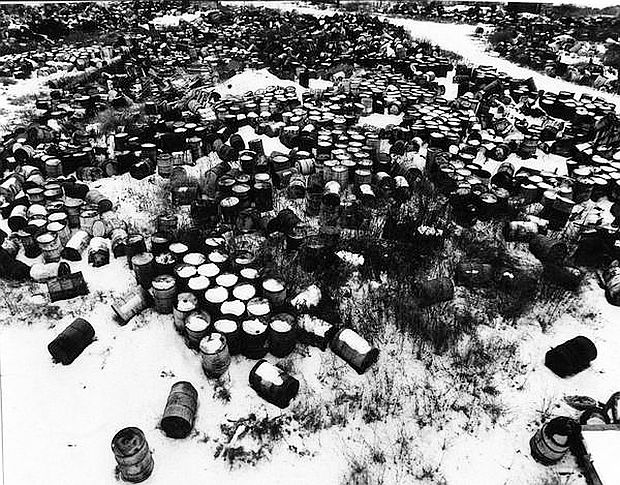
The “Valley of the Drums,” as it appeared in 1979, near Brooks, KY. Tens of thousands of barrels of toxic waste were dumped & stored at the site illegally for years, and it would be included among the nation's top toxic sites, helping to spur the Superfund law in the late 1970s & early 1980s, while an EPA and KY cleanup would later begin there. Photo, The Louisville Courier-Journal.
Before it became known as the “Valley of the Drums,” the land in northern Bullitt County was owned and used by Arthur L. Taylor, an enterprising local entrepreneur of sorts who owned a dump truck, a crane, and some 23 acres of land. Taylor had set up a “drum cleaning” and waste disposal business there. Taylor reportedly was known as a somewhat gruff and feisty fellow, who had tried his hand at horse trading, trucking and hauling, and also as a junk-yard proprietor. He wasn’t always on the best of terms with his neighbors – one recalling how discarded paint ran in a nearby water ditch on his land – a ditch the neighbor had used to water his hogs. After the neighbor found some of his animals with paint on their hides, he fenced off their access to that ditch. However, the larger community beyond Mr. Taylor’s site didn’t notice much of what was going on there.
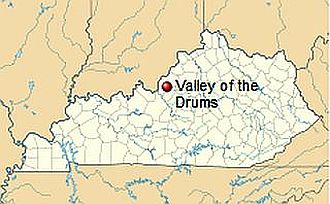 Kentucky map with location of “Valley of the Drums” site. |
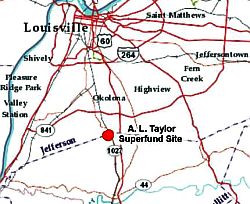 Map with site proximity to Louisville. |
After a decade of operating the site as a waste disposal and drum recycling business – from 1967 to 1977 — Taylor had accumulated and /or processed tens of thousands of drums there. Some of the drums Taylor received – many still retaining some or all of their contents – had been emptied into open pits, cleaned out, and then re-sold for various uses. Others were stored on the site more or less permanently, while still others were buried. Taylor also ran the site as part junkyard until his death in late 1977. However, Taylor never applied for the required state permits, and Kentucky environmental officials tried to bring legal actions against him, but to no avail. Complaints about the site dated to 1975. Strong odors along the Wilson Creek bed on the site were received from adjacent property owners. Others reported multicolored chemical spills and an oily sheen also on Wilson Creek – part of a larger watershed which eventually went to the Ohio River.
After the state had stopped Taylor from burning solvents at the site, some attention was focused on the pits and trenches where Taylor had buried wastes, chemical liquids, sludges, and crushed drums. At one point, soil from nearby hillsides was later used by the state to cover the pits. By 1978, Kentucky environmental officials had determined that over 100,000 drums of waste had moved through the site – some resold off site, with others stored there, and another 27,000 or so barrels buried. The waste material was spread over 13 acres of the 23-acre site.
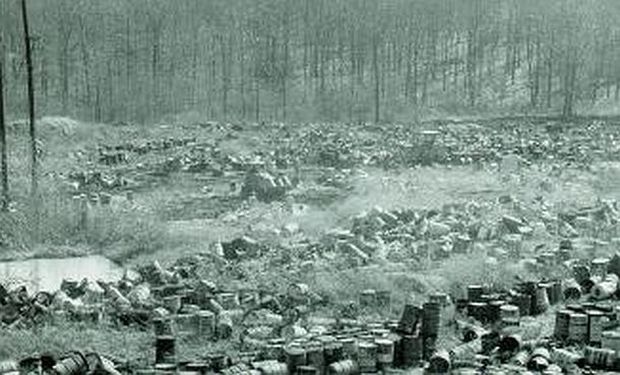
Another photo of “The Valley of the Drums” toxic waste site from the late 1970s, before it was named to the National Priority List of clean-up locations under the Superfund law, which it helped instigate, along with Love Canal, New Jersey toxic-waste fires, and numerous other toxic-waste horrors found across the U.S. during the 1970s & early 1980s.
By February 1979, the Valley of the Drums site was the focus of a Washington Post story, which appeared as a delegation of federal officials, members of Congress, and staff were then visiting the Kentucky site. As the Post then reported:
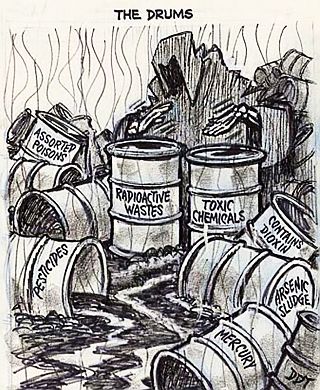
Herblock, the famous cartoonist for the Washington Post, who often held forth on environmental & public health concerns, offered this cartoon on toxic waste on March 21, 1979, as Congress and EPA began their journey on Superfund. Click for his books at Amazon.
“…Steel drums, perhaps as many as 100,000 of them, are piled helter-skelter in Taylor’s field. Many are rusted, dented, buckled, or riddled with gunshot holes. Oozing from them are a variety of unidentifiable fluids whose fumes permeate the air. The drums bear such ominous warnings [on labels] as, ‘Hazardous properties of this product have not been fully evaluated,’ and ‘For laboratory use by qualified investigators only.’
While a portion of the wastes on the Taylor site came from paint waste, scores of drums and barrels from a number of major companies were also found at Taylor’s site, among them: Union Carbide, Ford Motor Co., Cela-nese Polymer Specialties Co., Monsanto, Du Pont, Ashland Chemical Co., Chevron Oil Co., and others.
According to Washington Post reporting at the time, “spokesmen for most of the companies said they have no idea how their drums might have made their way to the dump sites.”
Many companies in those years sought only written statements from haulers certifying they would dispose of the materials legally.
EPA Acts
Meanwhile, back at the Valley of the Drums site, after large quantities of contaminants were washed into the local tributaries and creeks by the spring snow melt, EPA in 1979 responded to Kentucky requests for help, then acting under emergency provisions of the Clean Water Act, with a partial clean-up of the worst of the leaking drums.
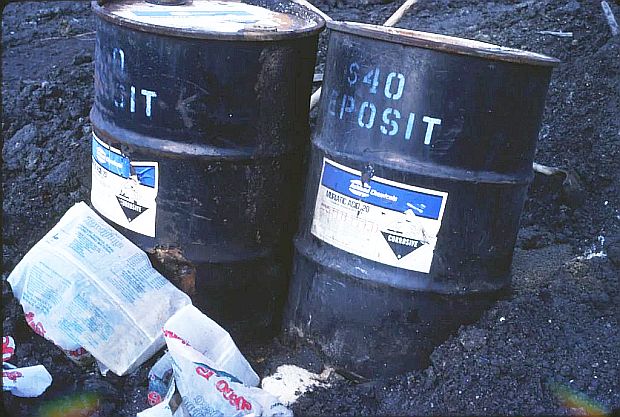
Sample of drums found at the A. L. Taylor / “Valley of the Drums” site in the 1970s – these two from Ashland Chemical Co., with labels that indicate possible contents of a corrosive material, muriatic acid. Source: KY DEP.
EPA’s analysis of samples taken at the site and Wilson Creek, found high levels of heavy metals, polychlorinated biphenyls, and some 140 other chemical substances. More than 17,000 drums of industrial waste were also inventoried, many moved away from Wilson Creek. EPA contractors also constructed interceptor trenches and a temporary water treatment system on the site. They also secured leaking drums, while segregating and organizing others drums on site.
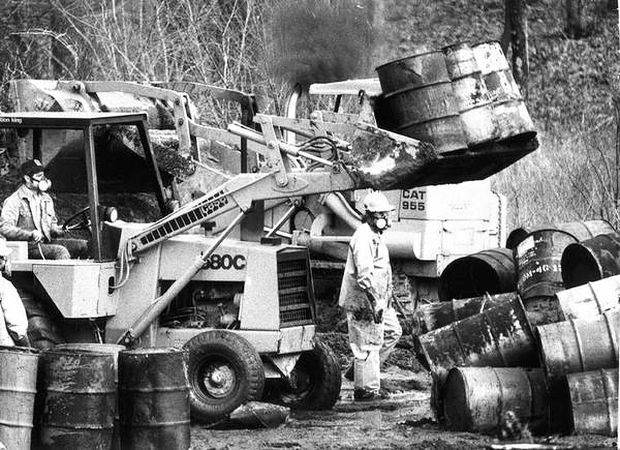
Workers at the A.L. Taylor / Valley of the Drums site with protective respirators moving chemical drums in March 1979 to protect a small stream from contamination at the toxic-waste site. Source: The Courier-Journal.
However, workers on the ground at the Taylor site quickly realized that the scope of the problem was far beyond their abilities or resources. There was still more clean-up needed at the site. Nationally, meanwhile, the toxic waste issue was making headlines across the country. The Valley of the Drums site was only one of many hundreds of other toxic waste sites and improper disposal practices

This undated aerial photo of the Valley of the Drums /A. L. Taylor site, appears to have been taken sometime after efforts had begun to organize drums at the site, appearing here to be arranged in rows, perhaps for identification purposes, degree of toxicity, workmen access, and/or later removal. (attributed to Van D. Bucher, Fine Art America).
America, it turned out, had been having a decades-long petrochemical party of sorts, inventing all kinds of synthetic and petroleum-based wonder products since the 1940s without addressing what to do with all left-over and used chemical wastes, much of it toxic and potentially threatening to public health. New chemicals had come in a seemingly non-stop torrent: as of 1978, about 70,000 were being produced at more than 100,000 plants in the U.S. Each year, 300 to 500 new chemical compounds were introduced to commerce. Thousands of older chemicals had never been studied for possible health or environmental effects. America had been having a decades-long petrochemical party, without addressing all left-over chemical wastes. New environmental laws had been enacted in the early- and mid-1970s to deal with air and water pollution, and even the review of new toxic chemicals that would come to market, as well as others for regulating municipal, solid, and hazardous wastes and landfills. But older petrochemical wastes, and abandoned waste sites had been neglected. And in the absence of controls, all kinds of actors and practices filled the void – from dump-site operators like A.L. Taylor, to midnight dumpers, mob-run operations, and in a few cases, purveyors of “dust-control” treatments for rural roads that included waste oil and dioxin concoctions. The Valley of The Drums, it turned out, was only the tip of a much bigger toxic waste iceberg. Through the 1970s, waste-site horror stories began emerging across the country — exploding dumps sites, warehouse fires, underground contamination, rivers of waste, and more. But few would prove more dramatic than that found in the middle of one New York working-class suburb.
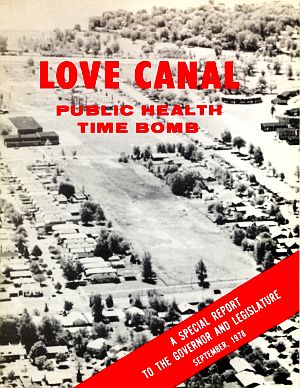
Sept 1978. Cover of NY State’s report on the Love Canal toxic waste site, with subtitle, “Public Health Time Bomb,” that says it all. Click for PDF.
In the Niagara Falls area of New York state an old, abandoned canal for a planned model city project from the late-19th century named Love Canal – after its promoter, William T. Love – had become an industrial and municipal dump site.
Later filled-in and covered over, where a school and a residential community had been built, and unbeknownst to the community, all manner of toxic chemicals, including some of the most potent, like dioxin, had been dumped there for decades by the Hooker Chemical Company and others.
Thanks to some 1970s sleuthing by local reporters at The Niagara Gazette — one of whom, Michael Brown, would rise to national notice with a later book on the subject, Laying Waste — it was soon learned that the toxic chemicals in the canal dump were on the move, rising up in the landfill and percolating into the residential basements and beyond.
These chemical exposures were later implicated in miscarriages, birth defects, serious illnesses, and death among some residents. By the spring of 1978, an enraged and determined group of citizens there — predominantly mothers and women concerned about the health of their children and families — would form a vocal and persistent protest movement to bring state and federal action to address the toxic wastes there. Lois Gibbs, a resident and mother, would lead the Love Canal Homeowners’ Association. Her son, Michael, who had attended the school atop Love Canal, developed epilepsy, suffered from asthma, and had a urinary tract infection.
By early August 1978, New York’s State Health Commissioner, Robert Whalen declared a state of emergency at Love Canal. He ordered the closing of one elementary school there, and the evacuation of pregnant women and children under the age of two from the surrounding neighborhood.
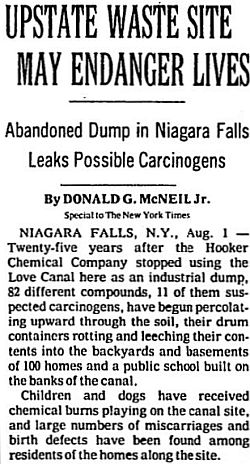
Front-page New York Times story on Love Canal of August 2, 1978.
In September 1978, New York issued it’s report, “Love Canal: Public Health Time Bomb.” The report was preceded by news reports, such as that shown at left in the New York Times of August 2, 1978, reporting: “Children and dogs have received chemical burns playing on the canal site, and large numbers of miscarriages and birth defects have been found among residents of the homes along the site.”
There would be much more to come on Love Canal, as it captured national attention for months, and it would figure prominently in the Congressional debate on toxic waste cleanups. But like the Valley of the Drums, Love Canal wasn’t alone.
1977 Jersey Fire
In the mid-1970s, the state of New Jersey was dealing with a mounting municipal and industrial waste problem. A series of toxic waste-site fires and explosions would also occur there in the late-1970s and early 1980s, a few causing injury and death, adding to an increasing perception that chemical wastes, in particular, were out of control.
On December 8th, 1977, a series of chemical reactions ignited a large chemical-waste site and treatment plant in Bridgeport, New Jersey, leaving six dead and hospitalizing 35. News reports, with front page headlines in some local newspapers, noted that the raging fire had propelled waste drums through the air and blanketed the city in a funnel of black smoke that rose hundreds of feet into the sky.
The conflagration included the explosion and rupturing of 14 storage tanks, burning their hazardous contents, including benzene, toluene, and PCBs. The chemicals, stored in the large tanks at the Rollins Environmental Services plant, were industrial waste hydrocarbons brought to the plant from oil refineries and other industries for treatment. The 250-acre Rollins plant treated the wastes by way of incineration.
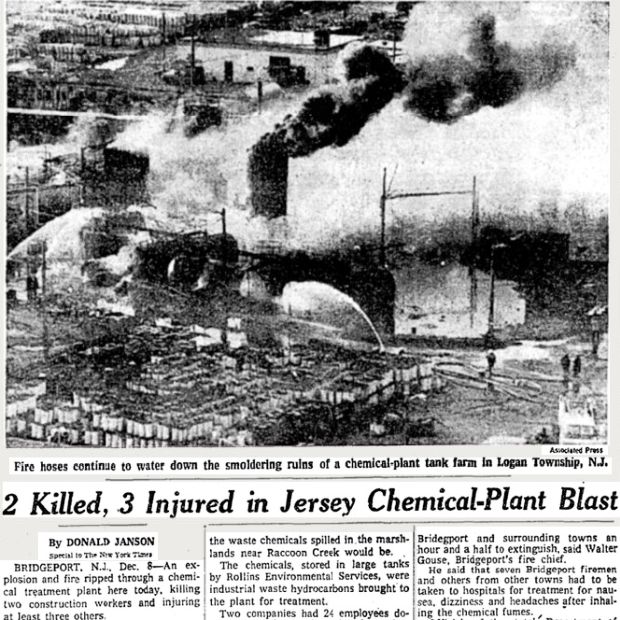
Early New York Times reporting with AP photo on the December 8, 1977 Rollins Environmental Services waste treatment plant fire and exploding tanks at Bridgeport, NJ that would kill 5 and injure others, also sending a number of firemen to hospitals.
According to some first responders at the scene, the Rollins plant that evening was quite dangerous with many unknowns. “It was just a whole lot of fire, and all that smoke. I had never seen anything like it, and I’m also a volunteer fireman,” said police Sergeant John Keller, in remarks he made to author Michael Brown in his later book, Laying Waste.

Michael Brown's book, “Laying Waste,” released May 1980, helped tell the toxic waste story at Love Canal and beyond. Click for copy.
“…A lot of firemen got sick. They didn’t even know what they were fighting. Pipelines, storage tanks – the whole place seemed like it was on fire. There were cylinders as big as a freight car flying through the air for a couple of hundred yards. Because of the toxic substances, the chemicals, we had to quarantine the four fire companies after, and impound police cars, and put all our clothes in plastic bags. Thirty or forty firemen went to the hospital. The cloud was like a mushroom, with drums popping all over the place, a very black and high funnel, hundreds of feet into the sky.”
A year earlier in Seveso, Italy, a toxic cloud with dioxins and furans from an explosion at a trichlorophenol plant had terrorized that city and nation; animals had died in its path and many people were sickened. Now, in December 1977, as New Jersey officials pondered the Rollins inferno and warning downwind communities, they did not know the full range of chemicals at the site. However, they did know that combustion of PCBs, known to be at the site, could create dioxins or furans. But after some ten hours or so, the fire died out. Still, the Rollins inferno underscored the dangers facing many communities — and well beyond New Jersey.
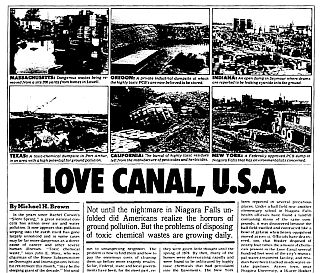
Michael Brown’s January 1979 story on toxic waste in The Sunday New York Times Magazine, was among early popularly-written pieces to frame the national dimensions of the problem.
By late January 1979, author Michael Brown, who had been a reporter focusing on Love Canal and Hooker Chemical with The Niagara Gazette, published a piece in the Sunday New York Times Magazine titled, “Love Canal, U.S.A.,” the point of which, by its title and six top-of-story photos of other waste sites, was to drive home the fact that uncontrolled toxic waste wasn’t just a Love Canal problem. And while Brown did detail the Love Canal crisis in the piece, he also profiled other chemical horrors in Iowa, Tennessee, New Jersey, Louisiana, California, and Maryland. Brown’s writing on the topic, including a later piece in The Atlantic magazine, plus his book, helped educate the public and advance political support for toxic waste action.
March 1979. Opening screen for ABC TV’s one-hour documentary on toxic waste, “The Killing Ground.”
The Killing Ground
In March 1979, ABC-TV aired a documentary film on the growing toxic waste controversy titled, “The Killing Ground.”
In those days, television was still pretty much a three-channel affair with ABC, CBS, and NBC dominating, as cable TV was just beginning. And documentaries were rare for the most part, but given the limited choices, this ABC special likely had a decent share of viewers.
ABC correspondent, Brit Hume, helped produce, narrate, and report the hour-long profile which examined various toxic waste dumps, impacts on public health, and the failures of government and the chemical industry.
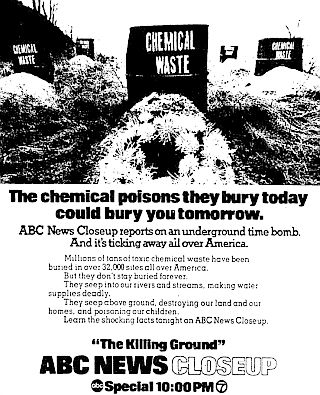
Newspaper ad for the March 1979 ABC-TV news special on chemical waste dumps that ran in the New York Times.
The ad’s accompanying art depicted a graveyard scene with “chemical waste” headstones along with the headline: “The chemical poisons they bury today could bury you tomorrow.”
The ad continued to outline the highlights of the ABC-TV special, describing the waste problem as “an underground time bomb…ticking away all over America,” adding:
“Millions of tons of toxic chemical waste have been buried in over 32,000 sites all over America. But they don’t stay buried forever.
They seep into our rivers and streams making water supplies deadly. They seep above ground, destroying our land and out homes, and poisoning our children.
Learn the shocking facts tonight on ABC News Closeup.”
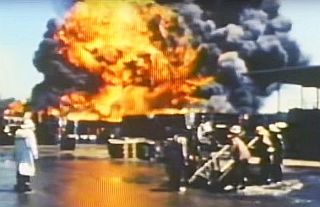
Screenshot from “The Killing Ground” – 1973 toxic waste inferno in Minnesota; hundreds of 55-gallon barrels exploded during fire.
Other dump sites are also shown – one in Lowell, MA where the operator went bankrupt, leaving 15,000 barrels of toxic waste behind, leaking and endangering drinking water. Another segment, near Louisville, KY from January 1979, showed barrels of waste floating in a stream, noting that hundreds of toxic barrels had been found there, some containing cancer-causing chemicals
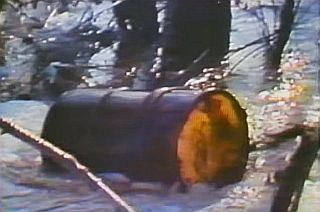
Screenshot from “The Killing Ground” showing a floating barrel of waste in a Kentucky stream where some 600 barrels of toxic waste were found in streams and rivers in January 1979.
In one segment, five year-old Mark Dunmire, who lived five blocks from the canal, appears on screen fetching some toys from a chest in the basement. Brit Hume explains in narration that Mark “was born with a heart murmur, a urinary tract obstruction, and a diseased pancreas. He can’t play in his basement anymore; it’s contaminated.”

The Love Canal chemicals, says 5-year-old Mark Dunmire, "are probably what got me sick."
Three additional Hooker Chemical dumps in the Niagara Falls area are also explored in the film, all larger and containing more wastes than Love Canal, with some holding dangerous chemicals such as chlorobenzene, mirex, lindane, C-56 residues from pesticide production, and dioxin. One Hooker memo is revealed to have cautioned against digging at one Hooker dump near its production plant for fear of chemical reactions, fires, and /or explosions. The Love Canal/Hooker segment also includes angry citizens reacting to state agency findings and inadequate evacuation rulings.

Film screenshot of 1976 aerial surveillance of a line of trucks emptying toxic liquid wastes down a hillside at Kin-Buc landfill.
The segment shows a group of large tanker trucks disgorging their toxic liquid wastes at the dump, seen as dark streams running down a hillside.
In narration, Brit Hume explains that the Kin-Buc landfill repeatedly failed state inspections, had frequent fires, and was closed down in 1976, leaving behind a “a 23 acre mountain of poison and garbage.” But subsequent reports on the site in early 1979 found that the Kin-Buc site was still leaking chemicals into the Raritan River – including PCBs, chloroform, benzene, and mercury.
Elsewhere in the film, Brit Hume and his partner, John Connor, are shown conducting a number of interviews with state officials and others about specific toxic dumps and practices. These include: an accused midnight dumper who describes the nefarious trade; a Louisiana cattle rancher whose land and cattle were contaminated by a neighboring chemical waste handler; and EPA officials who complained of being held back on finding and cleaning up toxic waste dumps. There is also an interesting interview with Louisiana Governor Edwin Edwards. That latter segment, in particular, moved New York Times reviewer Tom Buckley to write, in part:
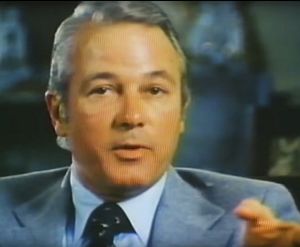
Gov. Edwin Edwards (D-LA), in “The Killing Ground,” speaks of “tradeoffs” made that brought environmental damage.
…Perhaps the most chilling section of “The Killing Ground” is an interview with Gov Edwin Edwards of Louisiana, a state whose vast petrochemical industry seems to be working full-time to despoil the state’s bayous and piney woods.
Speaking of the need for economic development, Governor Edwards acknowledges that to secure it, his and predecessor administrations have made “tradeoffs” with industry “where the environment became either totally or partially damaged, in some instances permanently.” Viewers may find it outrageous that there are giant corporations that still demand or accept such tradeoffs.
Indeed. The ABC-TV special on toxic waste did present some very troubling revelations for its day, and no doubt contributed to the mix of public and political pressures during 1979-1980 on state agencies, Congress, and EPA to take more decisive actions. But the waste issue had been a long-simmering problem, with a considerable share of regulatory neglect.
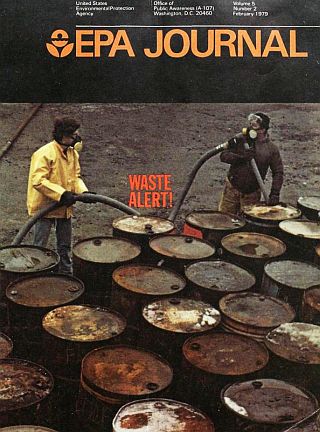
The Feb 1979 edition of “EPA Journal” featured chemical & hazardous wastes, with stories by EPA officials, Sen. Jennings Randolph, Louisiana Gov. Edwin Edwards, and others.
Waste Policy
In 1976, President Gerald Ford had signed into law the Resource Conservation and Recovery Act, or RCRA, a law prompted by the need to deal with general waste streams and landfills, which were becoming overwhelmed with materials.
The reason for this law, in part – and for at least some of the rising toxic waste volumes and waste abandonment – was ironically, the air and water pollution laws of the early 1970s. Those laws resulted in less burning and/or water disposal of wastes, putting more pressure on existing landfills, and also the “dump-it-anywhere” black arts and waste abandonment.
RCRA, meanwhile, was also supposed to help find hazardous waste sites across the nation and identify potential problems and dangers at landfills, including “imminent hazards” in waste streams and practices. But by the time of the Carter Administration in the late 1970s – EPA, for political, bureaucratic and financial reasons – had been slow to find waste sites, and by some counts, was being discouraged to look for them since they had little money to clean them up.
But Love Canal and related discoveries helped to move things along at a bit more urgent pace, but not immediately. RCRA, in any case, was more about waste going forward in time as opposed to the buried, hidden and abandoned wastes from the past.

June 1979 New York Times story reporting on toxic waste site legislation in Congress.
While some Congressional hearings on toxic waste problems and Love Canal had begun in 1978, the fight on superfund began in earnest about March 1979, when Senator Ed Muskie (D-ME) – the earlier champion of federal air and water pollution laws – had made it known that his Environment Committee would seek enactment of a hazardous waste “superfund” financed by industry.
Muskie’s bill would turn out to be the bill preferred by environmentalists. But there would be a long legislative road ahead, as multiple Senate and House committees would be involved, as well as a number of House and Senate members with bills and amendments of their own – before a final superfund bill would finally emerge.
U.S. Congressman John LaFalce (D-NY), for example, whose district included Love Canal, became involved with that fight early on, from the first 1976 local newspaper stories. In the summer of 1977, LaFalce had written to Hooker Chemical asking what was buried there and if it could be dangerous. He also drew press attention with a September 1977 visit to the site, urging state and federal officials to help. His staff later combed through federal environmental laws such as the Clean Water Act, Toxic Substances Control Act, and others seeking funding help on Love Canal.
LaFalce and staff were able to find a provision under he 1976 Resources Conservation and Recovery Act that provided some one-time funding help. But much more was needed, not only at Love Canal, but across the country. LaFalce, meanwhile, helped begin some of the first Congressional hearings on Love Canal, and by April 1979, he and Senator Pat Moynihan (D-NY) would introduce respective companion bills on toxic waste in the House and Senate. Other bills would follow.
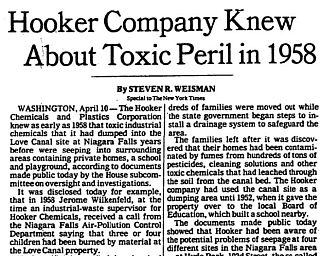
1979 NY Times story about Hooker Chemical's early knowledges of dangerous chemicals at Love Canal.
Both Bob Eckhardt (D-TX), who chaired that subcommittee, and Congressmen Al Gore (D-TN), who led some hearings, would play important roles there.
That subcommittee would conduct more than a dozen hearings on the issue between April and June 1979, and also conduct some of their own research on corporate chemical wastes, revealing new information on toxic waste volumes and their disposal sites.
In April 1979, for example, this subcommittee released information and statements from Hookier Chemical officials, that the company knew about potential public health harms occurring to some children at Love Canal in the late 1950s. And while Hooker notified one school board there, the company was reluctant to make broader public warnings. Also, at earlier hearings, a Hooker Chemical vice president told subcommittee members that it had no legal liability for the Love Canal disaster.
By mid-June 1979, the Carter Administration revealed plans for a proposed $1.63 billion superfund for hazardous waste clean-ups across the country. But that bill — which included oil and chemical spills, plus chemical waste sites — would be tied up in executive branch review for a time. EPA by then had consultant studies that estimated there were as many as 50,000 toxic chemical dump sites throughout the country, with about 34,000 of those possibly holding public health hazards.
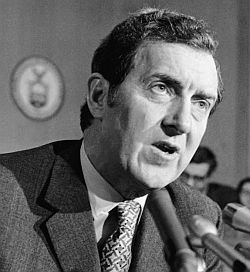
Senator Ed Muskie (D-ME) sought legislation with liability & damages provisions to help victims harmed by chemical wastes.
Not long thereafter, however, momentum on superfund legislation had largely stalled, as Congress and the White House pivoted to energy supply issues. The Iranian Revolution of 1979, and a decline in Middle East oil production, led to long gas lines across the country. New energy initiatives, such as the Energy Mobilization Board, were advanced, some with exemptions from laws like RCRA. Still, despite the energy turmoil, some committee activity on superfund type bills continued, though at a grudging pace. In the House, Florio had trouble with his bill in subcommittee where chemical and energy interests were well-represented and resistant. The Muskie-Culver bill, too, with its expansive liability and damages provisions, was also drawing determined opposition from the chemical industry.
However, the House Commerce Subcommittee on Oversight and Investigations had persisted in its efforts to raise the visibility of the toxic waste issue, receiving a share of national headlines in the process. In October 1979, this subcommittee released its formal report on the extensive toxic waste hearings it had conducted, along with a full range of recommendations. The report was quite critical of EPA and Congress, and received front-page coverage in the New York Times. The subcommittee’s report called the nation’s waste problem “an imminent hazard,” singling out industry’s laxity – “not infrequently to the point of criminal negligence.” It found that only 10 percent of the nation’s hazardous wastes generated each year were disposed of in an “environmentally sound manner.” It called out legislative and appropriations failures in Congress and EPA’s missed deadlines and enforcement failures. It recommended that Congress amend the law to give EPA and the Justice Department subpoena powers in toxic waste matters, establish strict liability for hazardous waste generators and their damages, and strengthen criminal penalties with stiff prison sentences for violators.
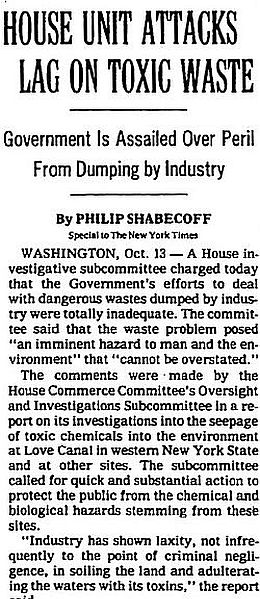 October 1979 NY Times story on report of the House Oversight & Investigations Subcommittee. |
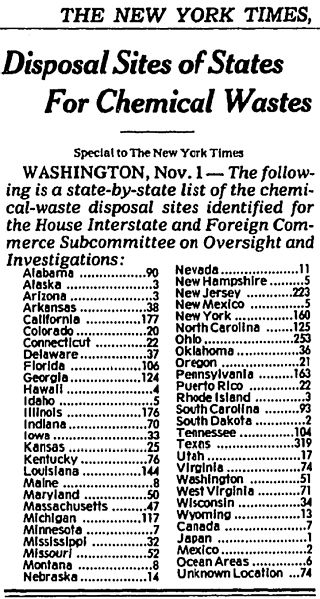 Chemical company waste sites reported in survey by House Oversight & Investigations Subcommittee, NY Times, 2 Nov1979. |
Then, on November 1st, 1979, the subcommittee followed up with another report — this one on a survey it had conducted of U.S. chemical companies, asking about their chemical wastes and disposal sites. That report also garnered headlines across the country, as it found 53 major companies had generated 762 million tons of chemical wastes disposed at 3,383 waste sites since 1950. And this list did not include the thousands of smaller companies in the chemical industry or the 16 other industries that also dumped toxic wastes. Still, the subcommittee’s listing of chemical company waste sites — as many as 2,000 then unknown to EPA — was an important finding, helping to spur the superfund debate while prodding EPA to do more on identifying sites across the country.
By 1980, Congress continued work on drafting various “superfund” bills –including one that had dealt with oil and chemical spills. The introduced bills were all aimed, in various ways, at addressing the dangers of spilled, dumped, abandoned, or uncontrolled hazardous wastes principally through a fund — i.e., superfund — to collect taxes, cost recoveries, fines and penalties to finance cleanups. Along the way there were bitter fights over just how to split the costs between taxpayers and the various industries that generate the wastes. Including oil spills and oil wastes was also a point of contention. A blow for environmentalists came in mid-April 1980 when Senator Muskie was nominated by President Carter to become Secretary of State, effectively removing the environmental champion from the superfund battle. Still, with the urging of Republican Senator Robert Stafford, the Muskie-Culver bill, after some adjustments, was later moved to full committee. But other Senate committees would also assert jurisdiction on that bill, making for delay on the Senate side
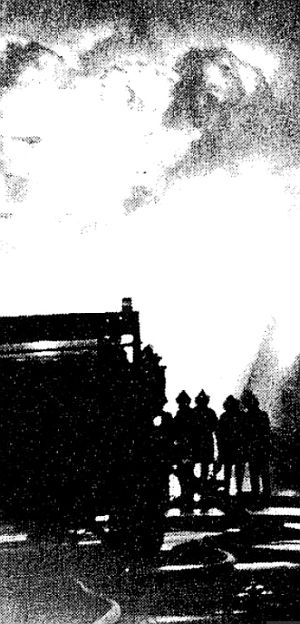
Part of an April 22, 1980 NY Times photo showing silhouetted fire fighters against a burning inferno and roiling sky at the Chemical Control Co. toxic blaze in Elizabeth, NJ.
The initial explosion – which reportedly rattled windows in Manhattan skyscrapers ten miles away – sent a thick black plume of smoke and ash over a 15-mile area as winds dispersed the toxic fumes, raising fears of widespread chemical contamination.
State officials issued an environmental advisory closing schools and urging residents to close all doors and windows and remain indoors. Later favorable winds, averted a planned evacuation of thousands of residents from Elizabeth and Staten Island. Chemicals from the site were also believed to have leached into the Elizabeth River.
But the explosion appeared to have helped spur some in Congress to keep moving on the toxic waste bills, as authors Samuel Epstein, Lester O. Brown and Carol Pope would later note in their 1982 book, Hazardous Waste in America. The Chemical Control incident, they wrote, was “a spectacular confirmation of everything that superfund advocates had said of the dangers of abandoned dump sites.” Indeed, one New York Times story of April 27, 1980 was headlined, “Elizabeth Fire Seen As ‘Prod’ On Superfund.” And about two weeks after the Chemical Control waste site fire, one of the pending superfund bills was moved out of the House Commerce Committee. Still, the chemical waste terrain in Congress was complicated, and since tax and revenue issues were involved, both the Senate Finance and House Ways & Means committees would have a say, so more wrangling was yet to come.
Nor was the Chemical Control fire of late April 1980 the only toxic waste incident in New Jersey to erupt at that time. In fact, a few months later, on July 4th, 1980, an industrial-paint-manufacturing company that stored chemical wastes had a four-alarm blaze that spread toxic fumes over Carlstadt, N.J. Three days after that, storage drums at a chemical disposal plant in Perth Amboy, N.J., erupted in a barrage of explosions and a roaring fire that wiped out seven buildings and 16 businesses in an industrial park. Nearby residences were evacuated for several hours because no one knew how toxic the spreading smoke might be.

Oct 1, 1980. Then U.S. President Jimmy Carter and Congressman John LaFalce in Niagara Falls, New York, with Lois Gibbs – mother, housewife & president of the then Love Canal Homeowners’ Association – at the President’s signing of a second emergency declaration, to help Gibbs’ family and more than 700 others, evacuate their homes around the Love Canal toxic waste dump.
Regarding Love Canal meanwhile, on May 21, 1980, President Carter, from Washington, DC, issued a second emergency declaration adding 350 more acres to the Love Canal Emergency Declaration Area, which enabled more than 700 families in the outer residential rings of the Love Canal area to leave their homes, as evidence continued to emerge that the pollution there was also causing suffering for those families. The home of Lois Gibbs – mother, housewife and president of the Love Canal Homeowners’ Association, who led the ongoing fight there – was one of those located in the outer ring area where she lived with her husband and two young children.
Gibbs and others later attended a gathering of state and federal officials in Niagara Falls, NY on October 1, 1980 where President Carter signed the second emergency declaration for Love Canal. At that gathering, also attended by Governor Carey and other Democrats, including Senator Moynihan, Rep. LaFalce and others, Carter invited Lois Gibbs to the stage (photo above) and commended her for bringing the toxic waste issue to the nation’s attention. “There must never in this country be another Love Canal,” said the President at the signing. He also urged Congress to enact pending Superfund legislation.
|
“Tumult For Democrats” As toxic waste troubles had risen on the political agenda through the late 1970s and during 1980, there were also other major political currents that dominated the scene. Jimmy Carter and the Democrats had a difficult four years leading up to the November 1980 national elections. Energy supply issues, gasoline lines, inflation, and soaring interests rates had become major domestic issues, while Americans hostages in Iran and Russia’s invasion of Afghanistan also dogged Carter through 1979-1980. In his own party, Carter was challenged in a major move by Senator Edward Kennedy, who fought Carter in 34 Democratic primaries, though Carter prevailed in 24 of those, arriving at the August 1980 Democratic Convention in New York with 60 percent of the delegates. Still, Kennedy challenged Carter at the Convention, trying to free Carter-pledged delegates, ultimately failing, as Carter was renominated with 2,129 votes to 1,146 for Kennedy. Also that summer, there had been a short-lived movement to draft Ed Muskie for President – then Secretary of State and viewed as a favorable alternative to a deadlocked convention. In fact, one poll showed that Muskie would be a more popular alternative to Carter than Kennedy. Muskie was polling even with Reagan at the time, while Carter was seven points behind. In the end, the Reagan/George H. Bush ticket defeated Carter/Mondale in a landslide, taking the poplar vote and winning the electoral vote, 489-to-49. Republicans also took the U.S. Senate for the first time since 1954. |
In Congress, there had been additional queries on the toxic waste issue. Senator Edward Kennedy (D-MA) had asked EPA for an estimate of how many people might be exposed to health risks from toxic waste sites. Environmental officials by then had studied fewer than 1,000 dump sites, but feared that there could be as many as 30,000 sites capable of causing “significant” health problems.
In answer to Kennedy’s query, EPA replied in June 1980 that more than 1,2 million Americans may be exposed to highly or moderately serious health hazards because they lived near 645 toxic waste disposal sites. That alarmed Kennedy, whose Senate Health Subcommittee convened a hearing. Given that EPA had found some 30,000 dump sites, and that many of those sites could pose health problems, Kennedy believed that “millions of Americans” — far more than anyone has estimated — are taking “involuntary health risks every day, simply because of where they live.”
At the hearing, Kennedy heard from two Love Canal residents – Phyllis Whitenight and Barbara Quimby – who testified to the cancer, miscarriage, birth defects, respiratory disease, chromosome breakage, and psychological effects their families had experienced.
Also testifying at Kennedy’s hearings was Dr. David Rall, director of the National Institute of Environmental Health Sciences, among others, who raised concerns about chemical wastes migrating into underground water aquifers, then the drinking water source for about 40 percent of the American people.
Then came a report from the U.S. Surgeon General.
On September 13, 1980, a UPI news story appearing in the New York Times and elsewhere, reported that the U.S. Surgeon General’s office had told Congress that toxic chemicals were rapidly adding to the nation’s “disease burden.” Julius Richmond, the Surgeon General, told Congress that throughout the 1980s the nation would “confront a series of environmental emergencies” posed by toxic chemicals. His report was supported by a Library of Congress study of 32 major chemical-contamination incidents across the U.S., which also noted that toxic chemicals “are so long lasting and pervasive” that human populations likely “carry some body burden of one or several of them.”
A week later, on September 22, 1980, Time magazine ran a cover story on toxic chemicals, which included a long piece running multiple pages that profiled toxic waste sites and chemically-tainted groundwater in several states, while interviewing various experts and government officials.
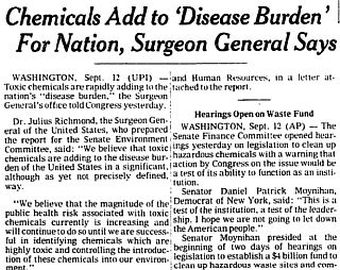 September 13, 1980, UPI wire story reporting that the U.S. Surgeon General's office had told Congress that toxic chemicals were rapidly adding to the nation's “disease burden”. |
 September 22, 1980. Time magazine's cover story appears, titled, “The Poisoning of America: Those Toxic Chemical Wastes”. |
In Congress by this time there had been some progress on two superfund bills in the House. Florio’s bill, H.R. 7020, had passed on the House floor by a 351-to-23 vote on September 27, 1980, and a week earlier, a separate bill creating a superfund for oil and chemical spills, H,.R. 85, had also passed. In the Senate, the superfund bill was bottled up in the Finance Committee. In addition, by early November 1980, following national elections, the political scene had taken a major turn to more conservative territory with the rise of Ronald Reagan. The chemical industry was now confident that it could block any Superfund bill that might emerge. In fact, at a National Press Club briefing on November 18, 1980, representatives of the Chemical Manufactures Association (CMA), looking ahead to the new Administration, were urging Congress to avoid issues like superfund (outside the Press Club, meanwhile, a group of demonstrators were chanting: “Hey, hey, CMA. How many drums did you dump today”).
Surprisingly, however, Ronald Reagan had indicated to Republican leader Senator Howard Baker that he would not object to Congress finishing work on a Superfund bill. Congress by then had convened a lame-duck session during which a stripped-down Muskie-Culver bill — a “clean-up only” bill, minus its progressive liability and victim-compensation provisions — was passed in the Senate by a voice vote. On December 3rd, the House then killed both its previously-passed oil-spill and abandoned dump bills, accepting instead the Senate compromise superfund bill. Then, under a suspension of House rules and needing a two-thirds majority, the House passed that bill by a vote of 274-to-94. President Carter then signed that bill into law at the White House on December 11th, 1980.
![December 11, 1980. President Carter signing Superfund law at the White House. Among those attending in the first row behind Carter are, L-to-R: Sen. Daniel Patrick Moynihan (D-NY), Sen. Jennings Randolph (D-WV), Sen. Robert Stafford (R-VT), Sen. George Mitchell (D-ME), Rep. James Florio (D-NJ) [Sen. Bill Bradley (D-NJ) behind Florio], Sen. John Chafee (D-RI), and others.](https://pophistorydig.com/wp-content/uploads/2024/05/1980-Carter-signing-620.jpg)
December 11, 1980. President Carter signing Superfund law at the White House. Among those attending in the first row behind Carter are, L-to-R: Sen. Daniel Patrick Moynihan (D-NY), Sen. Jennings Randolph (D-WV), Sen. Robert Stafford (R-VT), Sen. George Mitchell (D-ME), Rep. James Florio (D-NJ) [Sen. Bill Bradley (D-NJ) behind Florio], Sen. John Chafee (D-RI), and others.
Among other provisions, the law required EPA to: create a list of at least 400 “top priority” hazardous waste sites for cleanup (later known at the National Priority List or NPL); establish a $1.6 billion fund (superfund) for hazardous substance cleanup, of which 86 percent would come from taxes on chemical companies producing one or more of 45 listed substances; specified that the fund would pay for 90 percent of cleanup and maintenance costs, loss of natural resources, and health studies; authorized the President to order emergency cleanups; cover a broad spectrum of toxic releases into the environment, e.g., “any spilling, leaking, pumping, pouring, emitting, emptying, discharging, injecting, escaping, leaching, dumping, or disposing” of a toxic substance into the environment; required companies to disclose hazardous waste disposal locations and any releases to the government or face penalties; and, imposed fines on facilities that failed to immediately notify federal agencies of hazardous substance releases or that falsified or destroyed required records.
By October 1981, EPA had identified 115 toxic waste sites in the first phase of listings for the National Priority List (NPL) of sites having top priority for scheduled clean-ups, including Love Canal and the Valley of the Drums.
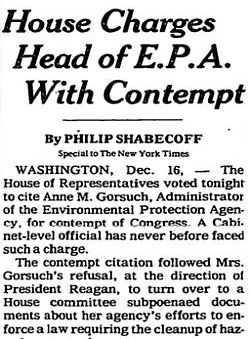
Dec 17, 1982 front-page NYTimes story on contempt charge for EPA’s Gorsuch.
The Reagan White House later abandoned the executive privilege fight, and Gorsuch resigned on March 3, 1983. Her 22 months at EPA were notable for her beliefs that the agency over-regulated business, was too large, and not cost-effective. She had cut EPA’s budget by 22 percent, reduced the number of cases filed against polluters, relaxed Clean Air Act regulations, and facilitated the spraying of restricted-use pesticides. She also cut the total number of agency employees, and hired staff from the industries the agency was supposed to regulate.
In the early 1980s, meanwhile, other toxic “hot spots” around the nation would become newsworthy – among them, notably, was Times Beach, Missouri – where dioxin-tainted oil wastes had been used for dust suppression on rural roads, leading to widespread contamination, evacuation of the town, and relocation of more than 500 residents.
Over the years, the Superfund law would be amended many times. Through the 1980s, most of the funding for Superfund came from a tax on petroleum and chemical manufacturers. However, in 1995, Congress chose not to renew this “polluter pays” tax. For the next 20 years or so, costs were shifted to taxpayers, though Congress was not always willing to increase federal funding to help close the gap. However, by November 2021, the Biden Administration’s Infrastructure Investment and Jobs Act reauthorized an excise tax on chemical manufacturers, slated to run for ten years beginning July 2022.
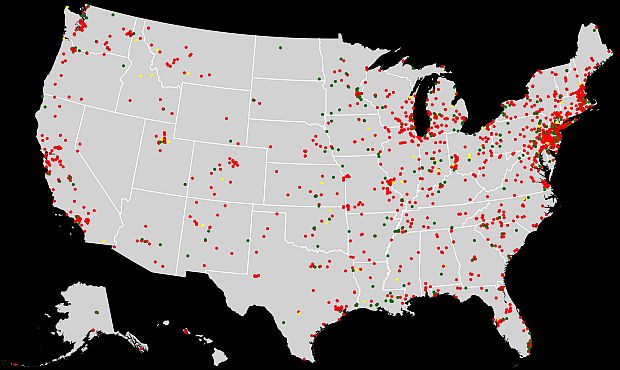
Superfund sites as of October 2013. Red indicates currently on National Priority List, yellow is proposed, green is deleted, usually meaning cleaned up. Click for larger map and list of sites at Wikipedia. See EPA for current & interactive maps.
As of October 2022, EPA has identified 40,000 Superfund sites across the country, of which more than 1,300 are on the NPL. Since 1980, about 450 sites have been cleaned up and removed from the NPL, regarded as no longer threats to public health.
Love Canal was removed from the NPL in 2004. Cleanup there had actually concluded some years earlier. The entire process at Love Canal occurred over 21 years and cost $400 million. In total, 950 families had been evacuated and about 150 acres east of the canal have been sold to commercial developers for light industrial uses.

The two-hour PBS documentary, “Poisoned Ground: The Tragedy at Love Canal,” was released in April 2024. Click for Amazon.
In 1982, a fictionalized made-for-TV film titled, Lois Gibbs and the Love Canal, starred Marsha Mason in the title role. An award-winning documentary by Lynn Corcoran titled, In Our Own Backyard: The First Love Canal, was released in the U.S. in 1983.
In literature and the popular press, there have been more than dozen books published about or referencing Love Canal in some way, ranging from Lois Gibbs’ first book in 1982, Love Canal My Story, and a later book, Dying From Dioxin, to journalist Keith O’Brien’s 2022 book, Paradise Falls: The True Story of an Environmental Catastrophe. Joyce Carol Oates included the story of Love Canal in her 2004 novel, The Falls, though set in the 1960s. Other books are listed below in Sources.
In popular song, the Punk rock group, Flipper, released “Love Canal,” a 7-inch single in 1982., and later, the 10,000 Maniacs’ song, “Poison in the Well,” appeared on their 1989 album, Blind Man’s Zoo. And most recently in 2024, PBS released a film on Love Canal in its American Experience series titled, Poisoned Ground.
The Valley of the Drums site in Kentucky that helped spur the Superfund law, was also one of the first to get EPA’s attention, with cleanup beginning there in 1983 and ending in 1990 when Kentucky took over the site’s operation and maintenance. However, an environmental audit of the site in 2003 found PCBs in the sediment surrounding the area, and further testing was ordered. In December 2008, EPA inspectors found about four dozen rusted metal drums on land just outside the capped and fenced portion of the site, including a portion of Jefferson Memorial Forest. By December 15, 2008, new cleanup work was being considered at the site. In the early 2020s, the University of Louisville Superfund Research Center has been exploring and monitoring the Valley of the Drums site and surrounding areas for ongoing issues, and documenting its toxic waste history.
For additional environmental history at this website, see the “Environmental History” topics page, which also includes additional story choices profiling oil and/or chemical company environmental and/or public safety history.
Thanks for visiting – and if you like what you find here, please make a donation to help support the research, writing, and continued publication of this website. Thank you. – Jack Doyle
|
Please Support Thank You |
____________________________________
Date Posted: 27 May 2024
Last Update: 28 May 2024
Comments to: jackdoyle47@gmail.com
Twitter: https://twitter.com/PopHistoryDig
Article Citation:
Jack Doyle, “Valley of the Drums …and Superfund,
1970s-2020s,”PopHistoryDig.com, May 27, 2024.
____________________________________
Films at Amazon.com…
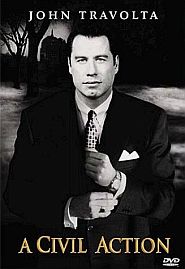 John Travolta as attorney in 1999 Hollywood film on best-selling book, “A Civil Action,” on toxic waste pollution in Woburn, MA. Click for film. |
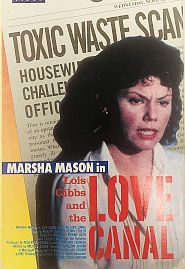 Marsha Mason stars as Lois Gibbs in 1982 made-for-TV film about the Love Canal crisis. Click for film at Amazon. |
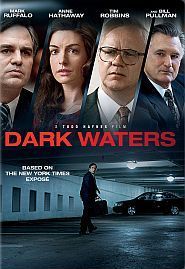 “Dark Waters,” the 2019 Hollywood film on Du Pont’s PFAS chemicals, w/ Mark Ruffalo, Anne Hathaway & others. Click for film. |
Sources, Links & Additional Information
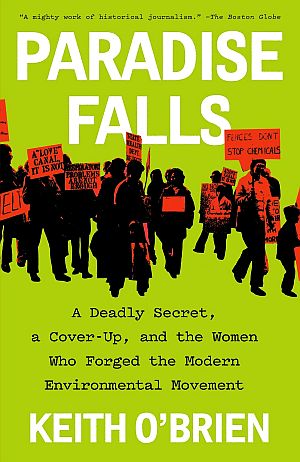 Keith O'Brien’s 2022 book on Love Canal, “Paradise Falls: A Deadly Secret, a Cover-Up, and the Women Who Forged the Modern Environmental Movement,” paperback edition, 496 pp. Cited as “a mighty work of historical journalism”(Boston Globe) and “deeply reported, masterly...” (Publisher’s Weekly). Click for Amazon. |
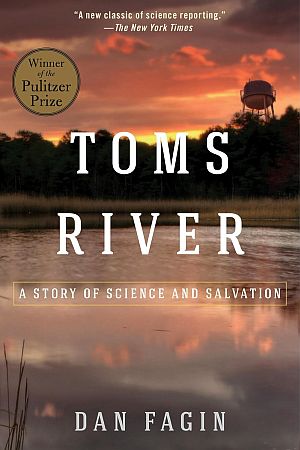 Dan Fagin’s Pulitzer-Prize winning 2013 book on Toms River, NJ, where for years, chemical companies used Toms River as their private dumping ground, burying thousands of leaky drums in open pits and discharging acid-laced wastewater into the river. The result was a notorious cluster of childhood cancers scientifically linked to local air and water pollution. This book tells the whole story. Click for Amazon. |
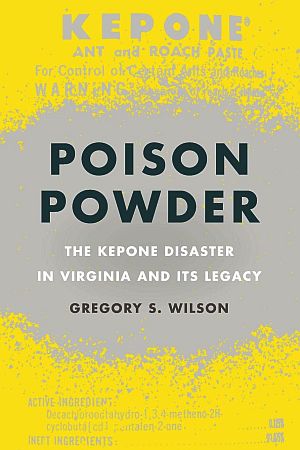 Gregory S. Wilson’s 2023 book, “Poison Powder: The Kepone Disaster in Virginia and Its Legacy,” tells the story of mid-1970s pesticide poisoning of workers, the James River & beyond by Allied Chemical Co. contractor, Life Sciences Products, and Allied itself. University of Georgia Press, 252 pp. Click for copy. |
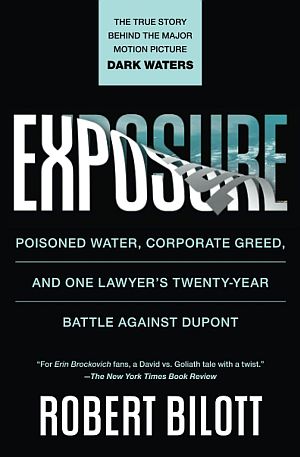 Robert Bilott’s 2019 book on Du Pont’s toxic PFAS chemicals, “Exposure: Poisoned Water, Corporate Greed, and One Lawyer's Twenty-Year Battle Against DuPont,” Simon & Schuster, 400 pp. Click for copy. |
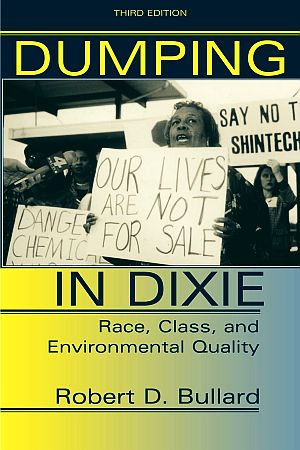 Robert D. Bullard’s book, “Dumping In Dixie: Race, Class, And Environmental Quality,” 3rd Edition, March 2000, Routledge; 260pp. Click for copy. |
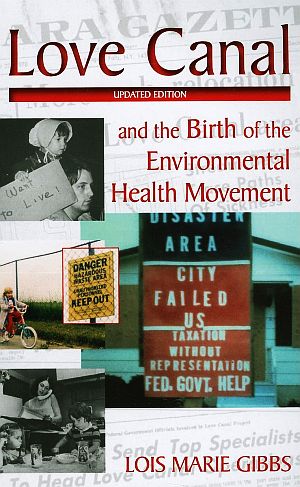 Lois Marie Gibbs’ book, “Love Canal and the Birth of the Environmental Health Movement,” 3rd edition, 2010, Island Press, 248 pp. Click for copy. |
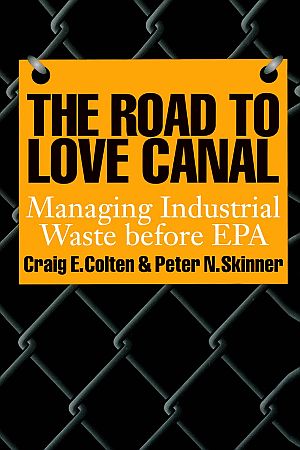 1995 book by Craig E. Colten & Peter N. Skinner, “The Road to Love Canal: Managing Industrial Waste before EPA,” University of Texas Press, 231 pp. Amazon description notes: “...The authors find that significant information about the hazards of industrial wastes existed before 1970....” Click for copy. |
 Dennis Love’s 2007 book, “My City Was Gone: One American Town's Toxic Secret. . .,” tells the story of Anniston, Alabama, with history about a Monsanto chemical plant, a federal chemical weapons depot, and a high cancer rate. Harper Perennial, 360 pp. Click for copy. |
 Ellen Griffith Spears’ 2014 book – “Baptized in PCBs: Race, Pollution, and Justice in an All-American Town “ – also tells the story of Anniston, AL. University of North Carolina Press; 464 pp. Click for copy. |
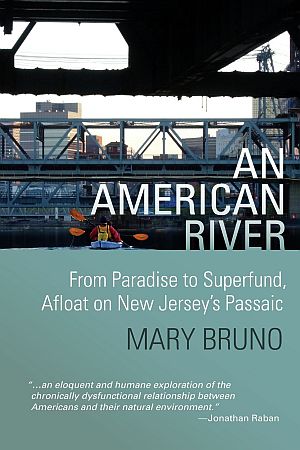 Mary Bruno’s 2012 book, “An American River: From Paradise to Superfund...,” Traveling New Jersey's Passaic River by kayak. DeWitt Press, 320 pp. Click for Amazon. |
 Thomas Church & Robert Nakamura’s 1993 book, “Cleaning Up the Mess: Implementation Strategies in Superfund,” explores the powers Congress gave Superfund, offers cases studies and best strategies. The Brookings Institution, 224 pp. Click for copy. |
 1982 book by Ralph Nader & associates – “Who's Poisoning America: Corporate Polluters and Their Victims in the Chemical Age” – includes seven case studies, among them: Kepone, PBBs, West Valley, PCBs in the Hudson, Love Canal, and more. 369 pp. Click for copy. |
U.S. Environmental Protection Agency, “A.I. Taylor (Valley of Drums) Superfund Site,
Brooks, KY, Cleanup Activities,” EPA.gov.
“Valley of the Drums,” BullittCountyHistory .org.
“Valley of the Drums,” John E. Kleber (ed), The Encyclopedia of Louisville, University of Kentucky Press, 2001.
“Valley of the Drums, Historic Photos of Louisville Kentucky and Environs,” Historic Louisville.weebly.com.
John Filiatreau and Margot Hornblower, “Kentucky Hunts Cleanup Funds for Valley of the Drums,” Washington Post, February 4, 1979.
Louisville Courier-Journal, November 25, 1979.
Donald Janson, “2 Killed, 3 Injured in Chemical-Plant Blast in Gloucester County,” New York Times, December 9, 1977, p. 51.
“Four Persons Die in Blaze, Blast at Chemical Plant,” Delaware County Daily Times (Ches-ter, PA), Friday, December 9, 1977, p. 1.
Donald Janson, “Waste Unit Closed After Explosions; Treatment Plant in Bridgeport Still Shut down as Federal and State Experts Study Hazards,” New York Times, December 14, 1977, p. 66.
Donald G. McNeil, Jr., “Upstate Waste Site May Endanger Lives,” New York Times, August 2, 1978, front page.
Editorial, “Time Bomb in Love Canal,” New York Times, August 5, 1978.
To New York Governor Hugh L. Carey and Members of the New York State Legislature, Love Canal Public Health Time Bomb, A Special Report to the Governor and Legislature, September, 1978. 32 pp.
“Love Canal,” Wikipedia.org.
“Public Apathy Toward Chemical Risks is Perilous,” Conservation Foundation Letter, September 1978, p. 1.
Joanne Omang, “A $6 Million Hassle over Spilled Poison; Who’ll Pay for Cleaning Up Yesterday’s Poisons?,” Washington Post, November 25, 1978.
“Those Deadly Dumps,” Washington Post, January 9, 1979.
Michael H. Brown, “Love Canal, U.S.A.,” New York Times Magazine, January 21, 1979.
Sen. Edmund Muskie (D-ME), “Abandoned Chemical Dump Sites Warrant Urgent Attention,” Congressional Record (Senate), January 29, 1979, p.1327.
Bob Cummings, “Dumps—And Drinking Water,” Maine Sunday Telegram, January 29, 1978.
EPA Journal, Volume 5, Number 2, February 1979.
Tom Buckley, “TV: Poisonous Wastes,” New York Times, March 29, 1979, p. C-23.
“The Killing Ground (film),” Wikipedia.org.
“ABC News Close Up: The Killing Ground (1979),” YouTube.com, uploaded by YorkVid, 2016.
Steven R. Weisman, “Hooker Company Knew About Toxic Peril in 1958,” New York Times, April 11, 1979.
Irvin Molotsky, “A Love Canal Warning No One Can Recall,” New York Times, April 14, 1979, p. 22.
Donald G. McNeil, Jr., “Study at Hooker Plant Found ’75 Emissions Dangerous to Health,” New York Times, April 17, 1979, p. 1 (front page).
Testimony of Anne Hillis, Before the Senate Standing Committee on Conservation and Recreation, Assembly Standing Committee on Environmental Conservation, Senate Sub-committee on Toxic Substances & Chemical Waste, Assembly Environmental Conservation Task force on Toxic Substances, at Niagara Falls International Convention Center, Niagara Falls, New York, May 3, 1979.
Bill Richards, “Pesticide Waste Dumping Probed Near Little Rock; U.S. Probing Deadly Wastes Near Little Rock,” Washington Post, May 18, 1979.
Ward Sinclair, “Industry Lobby Loosens Waste Controls,” Washington Post, May 19, 1979.
Edward Walsh, “Carter Asks $1.6 Billion to Clean Up Chemical, Oil Hazards,” Washington Post, June 13, 1979.
“Hazardous Waste Disposal,” Report, Together with Additional and Separate Views, by the Subcommittee on Oversight and Investigations of the Committee on Interstate and Foreign Commerce, U.S. House of Representatives, 96th Congress, 1st Session, September 1979, 93 pp.
Aaron Epstein, Knight News Service, (Wash., D.C.), “The Growing Mountains of Chemical Waste,” San Francisco Examiner, October 1979, p. 12
“Waste Disposal Site Survey,” House Committee Report, Subcommittee on Oversight and Investigations of the Committee on Interstate and Foreign Commerce, U.S. House of Representatives, October 1979.
Larry Kramer, “Waste Hazards Rise Laid to EPA Laxity,” Washington Post, October 13, 1979.
Philip Shabecoff, “House Unit Attacks Lag on Toxic Waste,” New York Times, October 14, 1979, p. 1.
Bill Richards, “House Investigation Pinpoints 3, 383 Chemical Dumps,” Washington Post, November 1, 1979.
Irvin Molotsky, “House Panel Releases a List of Sites Used in States to Dump Chemicals; Importance Stressed,” New York Times, November 2, 1979.
Michael H. Brown, “Love Canal and the Poisoning of America,” The Atlantic, December 1979.
Michael Brown, Laying Waste: The Poisoning of America By Toxic Chemicals, New York: Pantheon Books, 1979-1980, 351 pp.
“Portraits in Oversight: Congress and the Love Canal Disaster,” Levin Center / LevinCenter .org.
Sheila Rule, “Fire Breaks Out Amid Chemicals At Site in Jersey,” New York Times, April 22, 1980, p. 27.
“Chemical Control Superfund Site,” Wikipedia.org.
Greg Easterbrook, “Dump Now, Die Later: Disposal of Toxic Wastes” (Review of Laying Waste: the Poisoning of America by Toxic Chemicals, By Michael Brown, Pantheon, 351 pp.) Washington Post, May 18, 1980.
AP, “Drums To Be Moved,” Daily News (Bowling Green, KY), May 30, 1980, p. 3-A.
Victor Cohn, “EPA: 1.2 Million May Be Exposed To Toxic Waste,” Washington Post, June 5, 1980.
Victor Cohn, “Waste Sites May Invade Water Supply, Subcommittee Told,” Washington Post, June 6, 1980.
Les Ledbetter, “Chemical Dump In Elizabeth Hit By Another Fire; 3 Firefighters Treated,” New York Times, June 6, 1980, p. 30.
Editorial, “The Chemicals Question,” Wash-ington Post, June 29, 1980.
Ann Fisher, “The Toxic Waste Dump Problem and a Suggested Insurance Program,” Envi-ronmental Affairs, Vol. 8, 1980.
Richard F. Shepard, “TV: ‘The Killing Ground’ Is Updated,” New York Times, August 21, 1980, p. 74
Marchant Wentworth, “Can Industry Kill Superfund?,” Environmental Action, Vol. 12, No. 3, September 1980, p. 20.
Lois Ember, “Chances Only 50-50 for “Super-fund” Legislation,” Chemical and Engineering News, v58 n39 p29 September 1980.
UPI, “Chemicals Add to ‘Disease Burden’ For Nation, Surgeon General Says; Hearings Open on Waste Fund,” New York Times, September 13, 1980, p. 7.
Reports By U.S. Office of the Assistant Secretary for Health; Senators Edmund S. Muskie, John C. Culver, Robert T. Stafford, “Health Effects of Toxic Pollution: A Report from the Surgeon General; And, A Brief Review of Selected Environmental Contam-ination Incidents With a Potential for Health Effects,” GAO/Library of Congress, 1980, 312 pp. (possibly also published as a committee print by the U.S. Senate Environment Committee).
Ed Magnuson (with Peter Stoler/ New York & J. Madeleine Nash /Chicago), “The Poisoning of America,” Time magazine / Time.com (cover story), September. 22, 1980.
Philip Shabecoff, “Congress Set to Debate ‘Superfund’ to Clean Up Hazardous Wastes; Complaints of Exaggeration; Original House Version Favored,” New York Times, September 18, 1980, p. A-24.
Philip Shabecoff, “Waste Cleanup Bill Approved by House; $1.2 Billion ‘Superfund’ Is Voted; Stronger Version in Senate is Stalled in Committee; Compensation for Victims Bipartisan Support in House Spurred by Love Canal Issue,” New York Times, Septem-ber 24, 1980, p. A-16.
“Carter Signs Cleanup Bill On Upstate Toxic Wastes,” New York Times, October 2, 1980, p. M-12.
Editorial, “Save the Superfund,” New York Times, November 22, 1980, p. 22.
Philip Shabecoff, “Compromise on ‘Superfund’; Efforts to Revive Toxic Waste Bill Seen as Omen Of How New Leaders Will Operate in the Capital; News Analysis How the New Order Will Operate Parliamentary Delaying Tactics,” New York Times, November 24, 1980, p. B-9.
Edward C. Burks, “How the Hazardous; Waste Superfund Will Work,” New York Times, December 21, 1980, Section N, Page 14-16
Barnaby J. Feder, “The E.P.A. Gets Tough On Waste,” New York Times, December 22, 1980, pp. 65, 67.
https://timesmachine.nytimes.com/timesmachine/1980/12/22/111328802.html?pageNumber=65
“Congress Clears ‘Superfund’ Legislation,” CQ Almanac 1980, 36th ed., pp. 584-93, Washington, DC: Congressional Quarterly, 1981.
Senator Robert T. Stafford, “Why Superfund Was Needed,” EPA Journal, June 1981.
“Industrial Accidents in Elizabeth Area,” New York Times, August 1, 1981, Section 2, p. 28.
Press Release, “EPA Schedules Emergency Cleanup at Valley of the Drums” (Superfund Information on the Valley of the Drums), EPA.gov, September 18, 1981.
U.S. General Accounting Office, “Hazardous Waste Sites Pose Investigation, Evaluation, Scientific, And Legal Problems,” GAO.cov, April 24, 1981, 80 pp.
Robin Herman, “Next Door to Danger, a City Copes,” New York Times, August 1, 1981, Section 2, p. 1.
Associated Press, “114 Toxic Waste Sites Listed as Nation’s Most Dangerous,” New York Times, October 24, 1981, front page.
Philip Shabecoff, “45 Toxic Waste Sites Listed as Health Risks,” New York Times, July 24, 1982.
Frank P. Grad, “A Legislative History of the Comprehensive Environmental Response, Compensation and Liability (“Superfund”) Act of 1980,” Columbia Journal of Environmental Law, 1982.
J.P. Sean Maloney, “A Legislative History of Liability Under CERCLA,” Seton Hall Legislative Journal, Vol. 16, 1982, pp. 517-550.
Philip Shabecoff, “House Charges Head of E.P.A. with Contempt,” New York Times, December 17, 1982, p. 1.
James J. Florio, “Toxic Waste and the Future of ‘Superfund’; a Call for More Dollars and Discipline,” New York Times, June 24, 1984, Section 3, p. 2.
Philip Shabecoff, “Lawmakers Agree on Tax Measures for Toxic Wastes,” New York Times, October 3, 1986 (front page).
Louisville Courier-Journal, April 23, 1987.
Mark J. Raabe, “Al Gore, Environmentalist,” Letters to the Editor, Washington Post, December 25, 1999, p. A-40 (Rabe was chief counsel and staff director of the House subcommittee on oversight and investigations from 1979 to 1980).
U.S. Environmental Protection Agency, “Superfund History / Timeline,” EPA.gov.
Keith Schneider, “E.P.A. Superfund at 13: A White Knight Tarnished,” New York Times, September 6, 1993, p. 7.
Rich Newman, “Making Environmental Politics: Women and Love Canal Activism,” Women’s Studies Quarterly (Feminist Press at the City University of New York), Vol. 29, No. 1/2, (Spring – Summer, 2001), pp. 65-84.
Carol M. Browner, Op-Ed, “Polluters Should Have to Pay”(Superfund), New York Times, March 1, 2002.
“Love Canal Declared Clean, Ending Toxic Horror,” New York Times, March 18, 2004.
“After 25 Years of Superfund, America’s Safety Net in Crisis; American Taxpayers Shoulder the Burden As Polluter Pays Fees Eliminated,” Center for Health, Environment & Justice / CHEJ.org, Falls Church, VA, 2005. 91pp.
“Returning to the Valley of the Drums” (photo gallery), Louisville Courier-Journal, Decem-ber 13, 2008.
James Bruggers, “Toxic Legacy Revisited: Valley of the Drums, 30 Years Later; EPA Review Renews Concerns about Superfund’s Poster Child,” Louisville Courier-Journal, December 14, 2008.
Center for Health, Environment & Justice, “Love Canal Chronology,” CHEJ.org, Fact Pack, August 2009, 76 pp.
Congressional Research Service, “Compre-hensive Environmental Response, Compensa-tion, and Liability Act: A Summary of Superfund Cleanup Authorities and Related Provisions of the Act,” CRS Reports.Cong-ress.gov, Updated, June 14, 2012.
U.S. Government Accountability Office(GAO), “Superfund: Trends in Federal Funding and Cleanup of EPA’s Nonfederal National Priorities List Sites,” September 2015.
Bryan Anderson, “Taxpayers Pay Billions for Industrial Contamination Cleanup.” News21/ News21.com, August 14, 2017.
“Toxic America – Cancer, Chemicals and the Fight for Clean Air in Louisiana” (cover story), The Guardian Weekly, May 10, 2019.
EPA Alumni Association, “Superfund: A Half Century of Progress,” EPAalumni.org, April 2020.
Kentucky Energy and Environment, “Looking Back: Valley of the Drums,” YouTube.com, posted August 3, 2021.
Keith O’Brien, “How a Determined Congres-sional Aide Helped Break Open the Biggest Environmental Scandal in U.S. History; Thousands of Niagara Falls Residents Lived in a Toxic Wasteland for Years until a Whistleblower Made a Call,” Politico.com, April 17, 2022 (from Paradise Falls: The True Story of an Environmental Catastrophe, by Keith O’Brien, Pantheon Books).
University of Louisville Superfund Research Center Community Engagement Core, “A.L. Taylor Valley of the Drums Superfund Site: Documenting the History and Status of the Valley of the Drums and Surrounding Areas,” October 11, 2022.
Cameron Kinvig, “Federal Environmental Regulations Affecting Oil and Gas Operations,” LexisNexis.com, August 24, 2023 (exempt & non-exempt oil & gas wastes ).
U.S. EPA, Region 4, Atlanta, Georgia, “Seventh Five-Year Review Report for A.l. Taylor (Valley of the Drums) Superfund Site, Brooks, Bullitt County, Kentucky,” EPA.gov, September 2023, 53pp.
“Love Canal: Timeline and Photos” (Niagara Gazette, Love Canal Timeline), University Libraries, University at Buffalo, Buffalo.edu, January 8, 2024.
James Bruggers (Inside Climate News), “EPA Cleaned Up Valley of The Drums 45 Years Ago, But Left Behind Gully of the Drums,” KentuckyLantern.com, April 3, 2024.
____________________________________
Environmental History at Amazon.com…
 Elizabeth Kolbert’s “The Sixth Extinction: An Unnatural History,” 2015 paperback edition. Click for copy. |
 PBS 2016 documentary film, “Rachel Carson,” American Experience series, 2 hrs. Click for DVD or Prime Video. |
 Jack Doyle’s 2004 book, “Trespass Against Us: Dow Chemical & The Toxic Century,” 300pp. Click for copy. |