During the flood of folk and rock music that came in the 1960s, there were also some notable love affairs among the music makers. One of the pairings at the time, cheered by many, was that between Joan Baez and Bob Dylan. Both were key troubadours of their day, probing the woes of racial discrimination, social injustice, and the Vietnam War with their songs. Their sound, together and separately, marked the era.

August 1963. Iconic photo of Joan Baez and Bob Dylan singing together taken by photographer Rowland Scherman (rowlandscherman.com) at the 1963 March on Washington, where Dr. Martin Luther King gave his famous “I Have A Dream Speech.” Baez also sang “We Shall Overcome” separately that day.
For a time, they were the iconic pair of 1960s protest music. Their relationship, however – at least the romantic, happily-ever-after kind – was not to be, although they would have a revived musical performance relationship that would run from the mid-1970s to the mid-1980s. Aside from their 1960s romance, temporary though it was, each gained some musical inspiration and creativity from the other – and in Dylan’s case, early career-launching exposure by way of Baez stage-sharing and covering and promoting his songs. Baez, for her part, became more political with Dylan’s songwriting. Some of their story follows here.
Joan Before Bob
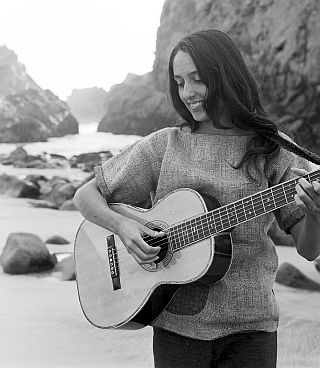
1962. Joan Baez on the rocky coast at Carmel, CA, near her home at the time. Ralph Crane / LIFE Collection.
Joan’s father, Albert Baez, was born in Mexico, grew up in Brooklyn, and turned to the study of mathematics and physics, receiving a PhD at Stanford University in 1950. He would later become a co-inventor of the x-ray microscope. Joan’s mother — Joan Chandos Bridge – was born in Scotland. Both parents came from strong religious backgrounds. The Baez family converted to the Quaker faith, and their three daughters – Pauline, Joan, and Mimi – were raised in a strong moral climate. All three would become political activists and musicians. Her father’s work, meanwhile, as physicist, teacher, and consultant, took the family to various locations around the world – from Paris to Bagdad – and across the U.S..
When Baez was 13, her aunt took her to a concert by folk musician Pete Seeger, and found herself strongly moved by his music, soon practicing his songs. In 1957, Baez bought her first Gibson acoustic guitar and was soon listening to the music of the Kingston Trio and their 1958 hit song, “Tom Dooley.”

1959 album of Harvard Square folk music featuring Joan Baez, Bill Wood & Ted Alevizos. Click for Amazon.
Folk music was having something of a revival at the time. Groups such as The Kingston Trio, The Limeliters, The Chad Mitchell Trio, Peter, Paul and Mary, and others were creating a new phase of popular music, especially on college campuses and at urban coffeehouses.
In 1958, Joan took up a chance to play at open-mic nights at Club 47 in Cambridge, and soon became a local attraction there.
One early collection of folk singers there — “Round Harvard Square,” on the Veritas label, shown at left — said of Baez in its liner notes that within a few months of her arrival in the Boston University area, she had become the most popular performer, adding: “Her unusually expressive voice and intuitive musicianship have immediate impact. This is an undeniable talent….”
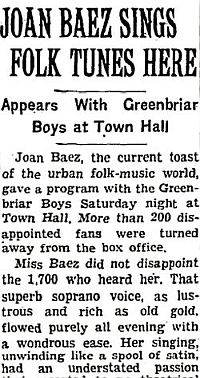
Portion of Nov 1961 New York Times review of Joan Baez performance by Robert Shelton.
In the summer of 1959, another folk singer, Bob Gibson, brought Baez on stage at the first Newport Folk Festival in Rhode Island, where the 18 year-old with her stunning soprano became an instant star.
A number of recording labels tried to sign her after her Newport debut, including Columbia – whose head man at the time was Mitch Miller and album producer John Hammond. Baez, however, was not impressed and feared Columbia was a bit too commercial for her tastes at the time, chose to sign with a small independent label, Vanguard. She recorded her first album for Vanguard in the summer of 1960, when she was 19.
On November 11, 1961, Baez had played her first major New York concert at a sold-out performance at Town Hall. Robert Shelton, music writer for the New York Times reviewing her performance there, noted:: “That superb soprano voice, as lustrous and rich as old gold, flowed purely all evening with a wondrous ease. Her singing unwinding like a spool of satin, had an understated passion…”.
She recorded her first solo LP for Vanguard Records in the summer of 1960, the beginning of a 12-year association and more than a dozen albums with that label. In fact, her first three Vanguard albums – Joan Baez (October 1960), Joan Baez, Vol. 2 ( September1961), and Joan Baez in Concert 1 (September1962) – would all achieve gold record status.
 1960: “Joan Baez,” debut album, Vanguard. Click for Amazon. |
 Sept 1961: “John Baez Vol 2.” Vanguard. Click for Amazon. |
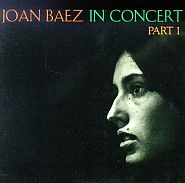 Sept 1962: “Joan Baez in Concert, Part 1,” Vanguard. Click for copy. |
By late 1962, Time magazine, the popular news weekly read by millions, featured “Folk Singer Joan Baez” on its cover in an artist’s rendition, showing her barefoot and seated with guitar. Time magazine cover treatments for musicians were then a rare honor.
Time’s editors titled their feature piece, “Folk Singing: Sibyl with Guitar,” with Baez as the “sibyl,” a woman in ancient times supposed to utter the oracles and prophecies of a god, or a woman able to foretell the future.
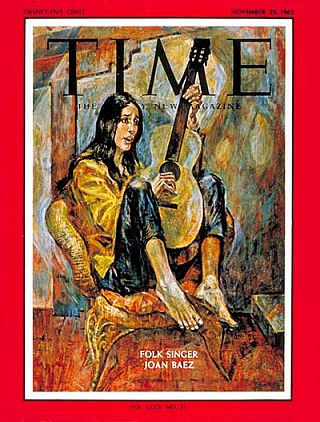
On November 23, 1962, an artist’s rendition of Joan Baez appeared on the cover of Time Magazine – a rare honor then for a young musician.
…Her voice is as clear as air in the autumn, a vibrant, strong, untrained and thrilling soprano. She wears no makeup and her long black hair hangs like a drapery, parted around her long almond face…. The purity of her voice suggests purity of approach. She is only 21 and palpably nubile. But there is little sex in that clear flow of sound. It is haunted and plaintive, a mother’s voice, and it has in it distant reminders of black women wailing in the night, of detached madrigal singers performing calmly at court, and of saddened gypsies trying to charm death into leaving their Spanish caves.
Impresarios everywhere are trying to book her. She has rarely appeared in nightclubs and says she doubts that she will ever sing in one again; she wants to be something more than background noise Her LP albums sell so well that she could hugely enrich herself by recording many more, but she has set a limit of one a year. Most of her concerts are given on college campuses.
The Time piece also covered the folk music scene in some detail — its players, its history, and its politics. The story noted, for example, that Pete Seeger, who Baez saw as a 13 year-old, had appeared before the U.S. House Un-American Activities Committee and was cited for contempt, convicted in 1961, but had that charge overturned in May 1962 by the U.S. Court of Appeals. But while his case was under review, Baez dedicated a song to Seeger in every concert she gave. It was a clear example of where the music of Joan Baez would head for the next 60 years – closely allied with social protest and liberal politics.

In his early 1960s performances, Bob Dylan often appeared with cap, harmonica, and guitar.
“…He is 21 and comes from Duluth. He dresses in sheepskin and a black corduroy Huck Finn cap, which covers only a small part of his long, tumbling hair. He makes visits to Woody Guthrie’s hospital bed, and he delivers his songs in a studied nasal that has just the right clothespin-on-the-nose honesty to appeal to those who most deeply care. His most celebrated song is Talkin’ New York — about his first visit to the city, during the cold winter of 1961, when he discovered ‘Green Witch Village’.”
Bob Before Joan
Bob Dylan, born Robert Zimmerman in Hibbing, Minnesota, began his involvement with music in high school where he performed songs by Little Richard, Elvis Presley, Danny & the Juniors, and others.
In September 1959, Dylan moved to Minneapolis and enrolled at the University of Minnesota.
It was about this time that his focus on music shifted from rock and roll to American folk music, which he found more serious material and captured more of the human condition.
Dylan began to perform in the folk medium at a coffeehouse near the university and also in what was known locally as the Dinkytown folk music circuit. At this point, he began to introduce himself as “Bob Dylan,” though not formally adopting that name until a few years later.

April 1961 Gerdes Folk City poster noting Bob Dylan on the bill.
By February 1961, Dylan played at clubs around Greenwich Village, befriending and picking up material from other folk singers there – among them, Woody Guthrie protégé, Ramblin’ Jack Elliott, who knew and performed Guthrie’s repertoire, and other performers, such as Dave Van Ronk.
After Dylan did well in a show for the New York University folk club on April 5, 1961, he was signed up for a two-week slot to open for the legendary Mississippi bluesman, John Lee Hooker beginning April 11th at Gerdes Folk City. There, Dylan used a series of Guthrie-styled ballads with his own lyrics.
But a few months later, there came a woman in Bob Dylan’s life.
One hot July day in 1961, Bob Dylan met Suze Rotolo at a concert at Riverside Church in New York. At the time of their meeting, Dylan was just another singer at an all-day folk concert at Riverside Church in Manhattan. She was a 17-year-old in a dress with thigh-high slits. Dylan was 20 at the time. “Right from the start I couldn’t take my eyes off her,” Dylan would write in his 2004 memoir, Chronicles: “She was the most erotic thing I’d ever seen.” Rotolo, for her part, considered Dylan “oddly old-time looking, charming in a scraggly way.” But according to one source, they were both vibrant and curious, and became inseparable.
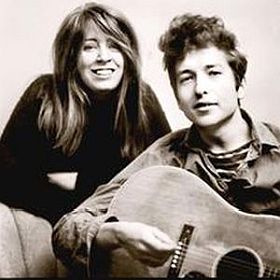 Suze Rotolo and Bob Dylan, early 1960s. |
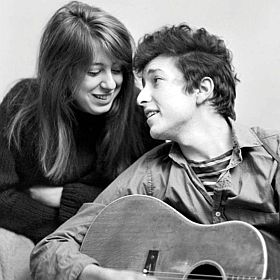 Suze Rotolo and Bob Dylan, early 1960s. |
But Suze Roloto would have no small impact on Dylan’s output, and would be, by some accounts, quite a substantial influence on Dylan. She worked for the Congress for Racial Equality, and her commitment to civil rights was believed an influence on some of Dylan’s songs. Rotolo told Dylan about the brutal 1955 murder of Emmett Till, inspiring Dylan to write his protest song, “The Death of Emmett Till.” Rotolo is also believed to have influenced other songs including “Masters of War” and “Blowin’ in the Wind.” Her interests in theater and art also exposed Dylan to ideas and artists beyond the world of music. The New York Times later quoted Dylan acknowledging Rotolo’s influence: “She’ll tell you how many nights I stayed up and wrote songs and showed them to her and asked her: ‘Is this right’?” And that Rotolo, because of her parents involvement with unions, “was into this equality-freedom thing long before I was.”
“…He had an incredible ability to see and sponge—there was a genius in that. The ability to create out of everything that’s flying around. To synthesize it. To put it in words and music.”But although she had an influence on Dylan — often cited as the muse for some of his early classics — she clearly saw and acknowledged the genius in his creative abilities, as noted in Robbie Woliver’s book, Hoot! A 25-Year History of the Greenwich Village Music Scene:
“People say I was an influence on him, but we influenced each other. His interests were filtered through me and my interests, like the books I had, were filtered through him … It was always sincere on his part. The guy saw things. He had an incredible ability to see and sponge — there was a genius in that. The ability to create out of everything that’s flying around. To synthesize it. To put it in words and music.”
Among those Dylan had met in the Village music scene was fellow folk performer David Van Ronk, who, with his his wife, Terri Thal, helped Dylan and Suze Rotolo make their way around the Village. Terri Thal, who managed Van Ronk and other folksingers, also lined up some shows for Dylan. When Dylan and Rotolo were living together they often socialized with the Van Ronks at their apartment on 180 Waverly Place.

Bob Dylan's first album of March 1962. Click for copy.
In his review, Shelton wrote, in part: “…His clothes may need a bit of tailoring, but when he works his guitar, harmonica or piano and composes new songs faster than than he can remember them, there is no doubt that he is bursting at the seams with talent.”
At that time, Dylan had also come to the attention album producer John Hammond, who would sign Dylan to Columbia Records. Dylan’s first album with Columbia, Bob Dylan, was released March 19, 1962. It consisted of familiar folk, blues and gospel songs, plus two original Dylan compositions. The album sold 5,000 copies in its first year, just enough to break even.
Dylan and Suze Rotolo meanwhile, began living together in January 1962 at an apartment on West 4th street, though her family did not approve. Rotolo, however, went to Italy in 1962 to study art, leaving Dylan lovesick and writing her “stylish, lovelorn letters,” according to one source. He would later say he was then also writing songs about her, like “Bob Dylan’s Blues” and “Down the Highway.” By some accounts, the Rotolo separation is also credited as inspiration for other Dylan love songs, including “Don’t Think Twice, It’s Alright”, “Tomorrow Is a Long Time”, “One Too Many Mornings”, and “Boots of Spanish Leather”.
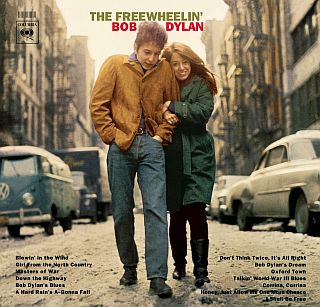
“The Freewheelin' Bob Dylan” features the famous photo of Dylan and Suze Rotolo taken by CBS photographer, Don Hunstein, in February 1963, a few weeks after Rotolo returned from Italy. The album was released on May 27, 1963. Click for copy.
For Dylan’s second album, The Free-wheelin’ Bob Dylan, a famous photograph of Dylan with Suze Rotolo would serve as the album cover. It was taken by CBS staff photographer Don Hunstein in February 1963, a few weeks after Rotolo had returned from Italy, with she and Dylan walking arm-in-arm in New York’s West Village close to the apartment where they lived together at the time.
With the release of Freewheelin` in late May 1963, Dylan had begun to make his name as a singer-songwriter.
As Dylan’s fame rose, however, Rotolo found the relationship increasingly stressful. She also had become pregnant by Dylan in 1963 and had an abortion. In August 1963, she moved out of their apartment in the Village as Dylan began spending more time on the road.
Dylan by this time had begun performing with Joan Baez. By late 1963, Rotolo could no longer ignore the rumors that the Baez-Dylan relationship had become more than professional, and they split up for good, though remained friends for a short time thereafter.
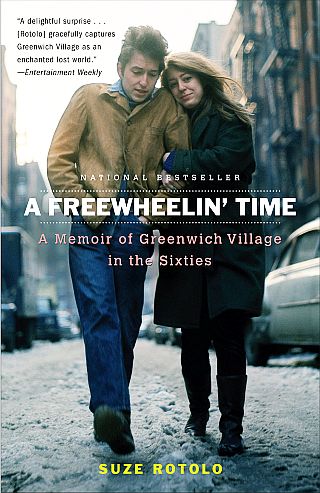
Suze Rotolo’s best-selling book of 2009, “A Freewheelin Time: A Memoir of Greenwich Village in the Sixties.” Click for copy.
It included, for example, some reference to a heated argument between Dylan and Suze’s sister, Carla, who Dylan disliked – “For her parasite sister / I had no respect.”
And on the argument: “Beneath a bare lightbulb the plaster did pound / Her sister and I in a screaming battleground / And she [Suze] in between, the victim of sound / Soon shattered as a child to the shadows.”
Suze, for her part, later offered a very Dylanesque perspective on the song: “People have asked how I felt about those songs that were bitter, like ‘Ballad in Plain D’, since I inspired some of those… yet I never felt hurt by them. I understood what he was doing. It was the end of something and we both were hurt and bitter. His art was his outlet, his exorcism. It was healthy. That was the way he wrote out his life; the loving songs, the cynical songs, the political songs, they are all part of the way he saw his world and lived his life, period.”
In 1967, Rotolo married a film editor she’d met in Italy and they had a son. She also taught at the Parsons School of Design in New York. For years she would not talk about her time with Dylan. However in 2009 she wrote a best-selling book titled, A Freewheelin` Time: A Memoir of Greenwich Village in the Sixties, covering her time with Dylan and the Greenwich Village scene. But during the years they were together, Bob Dylan was transformed from an obscure folk singer into an uneasy spokesperson for a generation. Suze Rotolo passed away on February 25, 2011, at the age of 67.
Bob & Joan
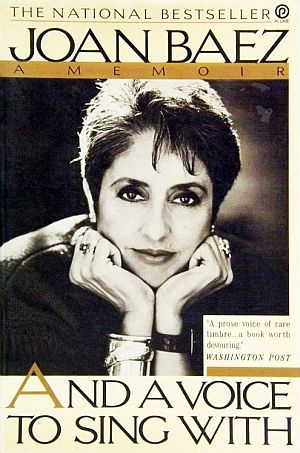
A later Penguin paperback edition of Joan Baez’s 1987 memoir, "And A Voice To Sing With." Click for copy.
Word had it at the time, that the “new kid” at Gerde’s was worth coming out to see, and that he had terrific stuff. However, back in Boston Joan had struck up a relationship with 23 year-old Michael New, of Trinidad-English decent. “I was sure it would only last two weeks as usual,” she said of that relationship at the time. “But then after three weeks there we were, still together. We were passionately, insanely, irrationally in love for the first few months.” Disagreements ensued, however, and her relationship with Michael New would end sometime later.
But on the night of her meeting Dylan at Gerde’s in 1961, Michael was then with her and she felt restrained. “…I wanted the freedom to gush over Bobby and couldn’t under Michael’s suspicious and critical eye. There was no question that this boy was exceptional and that he touched people, but had only just begun to touch me.” In a later interview, she would also tell Rolling Stone of the meeting, “I just thought he was brilliant and superb and so on. And I think shortly after that, he wrote ‘Blowin’ in the Wind’.”
Dylan had actually seen Baez on TV earlier, when he was still in Minnesota – on a 1960 CBS show, Folk Sound USA, where she performed with other artists. “I couldn’t stop looking at her,” he would later write in his book, Chronicles. “She was wicked looking — shiny black hair that hung down over the curve of slender hips, drooping lashes… The sight of her made me high. All that and then there was her voice. A voice that drove out bad spirits. It was like she’d come down from another planet.” She sang “in a voice straight to God,” Dylan wrote, and “was an exceptionally good instrumentalist.”
“However illogical it might have seemed,” Dylan wrote, “something told me that she was my counterpart – that she was the one that my voice could find perfect harmony with. At the time there was nothing but distance and worlds and big divides between her and me. I was still stuck in the boondocks. Yet some strange feeling told me that we would inevitably meet up…”

April-May 1963. Local billing for Bob Dylan’s performances at the Café Yana in Cambridge, MA.
The meeting occurred at a Cambridge apartment on April 21st, 1963, following a Sunday night hootenanny at Club 47 in Cambridge, Massachusetts. The club that night was packed, especially since word got out that rising star, Joan Baez would be there.
As was custom at hootenannies, performers took turns on stage, each offering a song or two, Dylan among them. Dylan had been in town playing at the Yana club.
But later that night, following the Club 47 performances, Sally Schoenfeld, a Cambridge singer, along with her roommates, threw an impromptu gathering at their apartment above a dry goods store on Harvard Square. And this is where Dylan and Baez would have one of their first early, longer encounters.
At the Schoenfeld party that night, as he had done once before with Baez at an earlier meeting in Greenwich Village, Dylan asked about Joan’s younger sister, Mimi, which had irked Joan. But he also asked Joan if she wanted to hear a new song he had written. And as he began playing his guitar and singing, “With God On Our Side,” the room then fell silent
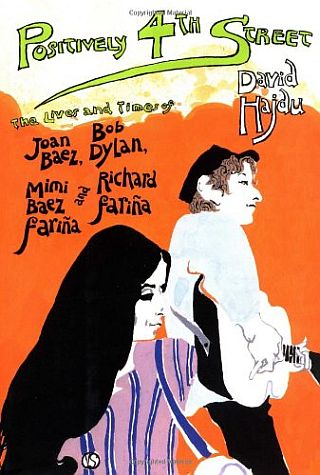
David Hajdu’s 2001 book, “Positively 4th Street: The Lives and Times of Joan Baez, Bob Dylan, Mimi Baez Farina and Richard Farina.” Click for Amazon.
“When I heard him sing ‘With God on Our Side,’ I took him seriously,” said Joan. “I was bowled over. I never thought anything so powerful could come out of that little toad. It was devastating. ‘With God on Our Side’ is a very mature song. It’s a beautiful song. When I hear that, it changed the way I thought of Bob. I realize that he was more mature than I thought. He even looked a little better.”
Dylan also played a few other songs that evening, including “The Death of Emmett Till,” “A Hard Rain’s a-Gonna Fall,” and “Masters of War.” Those songs astounded some of those listening, and according to Hajdu, the songs “seemed to overwhelm Baez.” Hajdu also noted parenthetically:
…In one interview, Baez recalled ‘The Death of Emmett Till,’ not ‘With God on Our Side,’ as the Dylan song that changed her view of him and prompted her to take up protest music; “I was basically a traditional folksinger,” she said. “I was not ‘political’ at that time. When I heard ‘Emmett Till’ I was knocked out. It was my first political song. That song turned me into a political folksinger.” Although the songs varied in separate recollections, the same point remained: one of Dylan’s early protest songs inspired Baez to rethink her career.
And those who knew her would acknowledge that Baez was not easily impressed. Still, she was moved by what Dylan was doing. “It’s fair to say [that] I fell under that spell of his,” said Baez. “Nobody was writing like that. He was writing exactly what I wanted to hear. It was [as if] he was giving voice to the ideas I wanted to express but didn’t know how.”
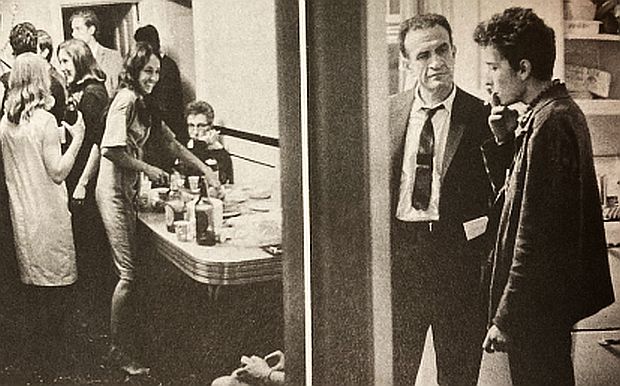
Photos of April 1963 Club 47 after-party at Sally Schoenfeld’s Cambridge, MA apartment – at left, showing Joan Baez, and at right, Bob Dylan. Photos by Rick Stafford from book “Baby, Let Me Follow You Down”. Click for updated edition.
It was after 2 a.m. when Dylan’s little impromptu concert at the Schoenfeld apartment had ended. Joan had to fly back to California. But again, according to Hajdu:
“…she wanted to hear more of the songs Bob was writing; perhaps he could teach some of them to her at another time. They should get together again, she told him. He was going to be in New York for a while, recording songs for his next album; then he was going to California, supposed to play and Monterey Folk Festival in a few weeks, he said. She should come and hear him. She could sing something with him, if she wanted to. Joan thanked him and said she liked that idea, She lived near Monterrey. In fact, she said, he was welcome to come to her house and visit, while he was in the area. Bob said sure, that sounded cool…

Part of NYTimes story on CBS barring Dylan’s John Birch Society song for the Ed Sullivan TV show.
Meanwhile, when he did get to California six days later to join Joan Baez at the Monterey Folk Festival on May 18th, 1963, it would be his first-ever West Coast performance. At the festival, he performed his John Birch Society song along with “A Hard Rain’s A-Gonna Fall” and “Masters of War,” concluding with Baez joining him on, “With God on Our Side.” Also appearing at the festival were Peter, Paul & Mary, The Weavers, The Dillards, The Rooftop Singers, Peter, Paul, and Mary, and others.
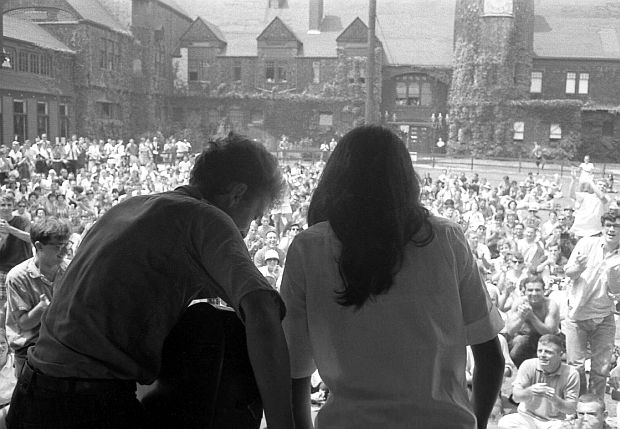
July 27, 1963. Bob Dylan and Joan Baez finishing their set at the Newport Folk Festival, famously photographed by Rowland Scherman (rowlandscherman.com). Special Collections, University of Massachusetts Amherst Libraries.
Nine days later, by the end of May 1963, Dylan’s second album, The Freewheelin’ Bob Dylan – the one with he and Suze Rotolo on the cover – was released. It would prove to be his breakout album.
Following the murder of Mississippi civil rights worker, Medgar Evers, on June 12th, 1963, Dylan wrote a song about the incident, titled “Only a Pawn in Their Game,” which sought to raise the systemic social and political elements of racism that bred the assassin. And in early July 1963, he performed that song and others at a civil rights gathering on Silas Magee’s farm in Greenwood, Mississippi along with Pete Seeger and others.
But later that month, an important break for Dylan came in July when Baez invited him to join her on stage at the Newport Folk Festival in Newport, Rhode Island (photo above) before a crowd of about 10,000. Dylan performed two duets with Baez there, and would later join her on her August 1963 tour.
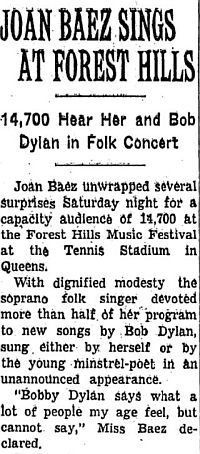
Aug 19, 1963. Part of NYTimes story reporting on Baez-Dylan concert.
In early August, for example, he performed with her at the Joan Baez Concert at the Camden, New Jersey Music Fair, where he did a short solo set then duets with Baez.
On August 10th Dylan was again her guest at a Joan Baez concert in Asbury Park, New Jersey.
Then, in mid-month — on August 13th, 14th, and 16th — Dylan joined Baez again as a guest performer at her concerts in Connecticut and Massachusetts
Also that month, on August 17th, 1963, he appeared as an unannounced guest at a Joan Baez concert at the Forest Hills Music Festival at the Tennis Stadium in Queens, New York, where nearly 15,000 heard Baez and Dylan perform new folk songs.
Reporting on that concert, Robert Shelton of the New York Times noted of Baez:
“With dignified modesty the soprano folk singer devoted more than half of her program to new songs by Bob Dylan, sung either by herself or by the young minstrel-poet in an unannounced appearance.”
During the concert, Baez told her audience: “Bobby Dylan says what a lot of people my age feel, but cannot say.”
By then, she and Dylan had appeared together at least half a dozen times since the Newport Folk Festival.
Robert Sheldon of the Times concluding his report on the Forest Hills concert, noted: “Miss Baez’s ability to hold and move an audience by herself is widely known. To have her so closely align herself with Mr. Dylan’s charismatic poetry resulted in an unforgettable evening.”

August 1963: NYTimes front-page photos and reporting on the “March on Washington” for civil rights.
March on Washington
But there were more memorable Baez-Dylan moments to come that summer, not least, when they both appeared in Washington, D.C. at the famous August 28th, 1963 March on Washington.
At that historic event, a crowd of 200,000 or more converged on the Washington Mall and Lincoln Memorial for a day-long protest and petitioning the federal government for civil rights.
The day’s events included a number of speeches, the most famous of which was the Dr. Martin Luther King “I-Have-A Dream” speech. Protest and folk music was also part of the day’s messaging.
Joan Baez led the crowds in several verses of “We Shall Overcome” and “Oh Freedom,” while Dylan performed “Only a Pawn in Their Game” and “When the Ship Comes In,” the latter on which he was joined by Baez.
Other artists also performed that day. Peter, Paul and Mary sang “If I Had a Hammer” and the Dylan song, “Blowin’ in the Wind.” Odetta sang “I’m On My Way.”
____________________________________________________
“Dylan’s Ship Comes In”
August 1963
|
“When The Ship Comes In” Oh, the time will come up And the sea will split Oh, the fishes will laugh And the words that are used A song will lift Then the sands will roll Oh, the foes will rise Then they’ll raise their hands |
It was August 1963 when Bob Dylan wrote the song, “When the Ship Comes In.” The song came about in something of an odd way, but reveals the brilliance of his sometimes fevered writing skill.
At the time, he and Joan Baez were traveling together, and Baez has stated (in the documentary film, No Direction Home) that the song was inspired by a hotel clerk who angered Dylan when they tried to get a room there. The clerk refused them a room because of Dylan’s “unwashed” appearance.
In those days, Dylan was not the most well kempt person of his generation, often acknowledged by Baez, who tried her best to clean him up. With the clerk, however, Baez vouched for Dylan’s good character, and the clerk relented.
Still, Dylan was enraged by the clerk’s charge, but channeled his anger into his pen, as Baez watched in amazement as he poured out the verse, then writing an epic song:
“,,,[H]e wrote a song that was just devastating – ‘The Hour That They Ship Come In.” And I could see him hanging them all. He’d never fess up to that sort of thing, but that’s what it seemed like to me. Working out whatever feelings he had about not being given a room, and a brilliant song – in one night!”
Music Player
“When the Ship Comes In”
Bob Dylan-1963
In the end, the song grew into a sprawling epic allegory about vanquishing the oppressive “powers that be.”
The song’s theme is essentially about people rising up against oppressive forces that are mistreating them. For Dylan, as one source observes, it was “a song of revolution that came out of a personal slight.”
Another believed inspiration, in part, according to Dylan biographer Clinton Heylin, was “Jenny’s Song” (or “Pirate Jenny”) from Brecht and Weill’s Threepenny Opera.
Dylan’s former girlfriend, Suze Rotolo recalls that her interest in Brecht was an influence on Dylan:
“I was working for the Circle-in-the-Square Theater and he came to listen all the time. He was very affected by the song that Lotte Lenya’s known for, ‘Pirate Jenny’.”
“As Pirate Jenny dreams of the destruction of all her enemies by a mysterious ship,” explains biographer Heylin, “so Dylan envisages the neophobes being swept aside in ‘the hour when the ship comes in’.”
Shortly after Dylan wrote the song, he and Baez performed it together at the March on Washington, August 28th, 1963.
Dylan also performed the song later that year at Carnegie Hall on October 26, 1963, and this version would be used in the soundtrack for Martin Scorsese’s 2005 PBS TV documentary on Dylan, No Direction Home.
____________________________________________________
Following the August 1963 March on Washington, one account has it that Dylan, on the trip back to New York, read a news story about the murder of a 51 year-old black bar maid in Maryland who had been beaten by a drunken white restaurant customer. He resolved to write a song about the incident that would later be recorded as, “The Lonesome Death of Hattie Carroll.”

November 1963 album “Joan Baez in Concert, Part 2,” peaked at No. 7 on Billboard chart. Click for Amazon.
In November 1963, Baez released her second album of live concert material, Joan Baez in Concert, Part 2, from her concerts of early 1963. It was also the first Baez album to feature Bob Dylan covers – “Don’t Think Twice It’s Alright” and “With God on Our Side.”
Liner notes with this album included an untitled poem by Bob Dylan, which also appeared elsewhere as “Poem for Joanie.” The Baez album, meanwhile, would peak at No. 7 on the Billboard chart.
Through the remainder of 1963, mid-October through late December 1963, Dylan would have a half dozen or more solo concerts at various locations around the U.S., including the University of Michigan’s Hill Auditorium, Philadelphia’s Town Hall, Carnegie Hall, Boston’s Jordan Hall, Syracuse University’s Regent Theater, Princeton University, St. Lawrence College, Newark’s Mosque Theater, George Washington University’s Lisner Auditorium, and Chicago’s Orchestra Hall.
1964
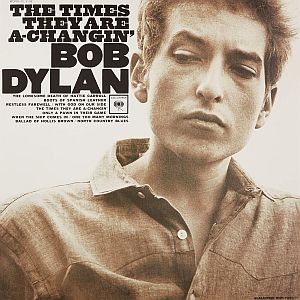
February 1964. Cover of Bob Dylan’s 3rd studio album, “The Times, They Are A Changin`.” Click for copy.
Also in February 1964, Dylan embarked on a 20-day road trip across the U.S. in a station wagon with a few friends (folk musician Paul Clayton and the journalist Peter Karman), the purpose of which was to find inspiration for new songs. He worked from the back of the station wagon on a portable typewriter, and among songs composed were “Chimes of Freedom” and “Mr. Tambourine Man,” airing the former at a Denver concert at the Municipal Auditorium Theater on February 15th It was also on this road trip when Dylan exclaimed about hearing certain Beatles tunes on the car radio while traveling through Colorado, the Beatles then dominating the pop charts, and Dylan much impressed by their “outrageous chords.” He would meet the Beatles later that year.
On February 25th, 1964, Dylan would appear on TV performing “The Lonesome Death of Hattie Carroll” on The Steve Allen Show, then a popular weekly variety show. Throughout 1964, meanwhile, Dylan and Baez would occasionally appear together, sometimes as guests of each other’s concerts, as Joan did on February 22nd, 1964 at Dylan’s concert at Berkeley Community Theater, Berkeley, CA, or as Dylan did, as a “guest of Joan Baez,” at the Westchester County Center, White Plains, NY on April 19th, 1964. And through that year, each had their own separate concert schedules, with dozens of performances across the U.S., and in Dylan’s case, a few in England.

July 1964. Baez & Dylan at Newport Folk Festival.
At Dylan’s encore on July 26th, he invited Baez to join him for “With God On Our Side.”
While in Newport, at the Viking Motor Inn on July 24th, there was an after-show party with Dylan, Baez, Johnny Cash, June Carter, Jack Elliott, and others.
Reportedly at one point, Dylan and Cash sat on the floor trading songs, with their impromptu performances taped by Baez.
Separately, one series of photos from that same location of Dylan and others, including his manager, Albert Grossman, has Dylan sitting on Joan’s lap while he plays his guitar for a small group of fans. Two of those photos are shown below.
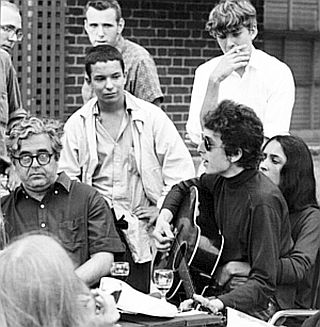 July ‘64. At Viking Motor Inn during Newport Festival, w/Albert Grossman (lower left, glasses), Bob, Joan, others. |
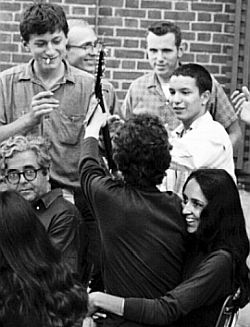 ...More of the same with Dylan turning toward fans, on Joan’s lap. Photos by David Gahr. |
A couple of weeks later, on August 8th, 1964, the album, Another Side of Bob Dylan, was released. That was the same day Dylan joined Baez at her concert at the Forest Hills Tennis Stadium, Queens, New York.
Sometime that summer, Dylan had invited Joan, Mimi Baez Farina, and Dick Farina to house sit at manager Albert Grossman’s place in Woodstock, New York. Baez was then between tours, and spent some weeks there. A letter from Joan to her mother at the time noted, “…[Y]ou would be pleased to see what fun we have together,” she wrote. “I really love him.”
The Kramer Photos
The first time photographer Daniel Kramer saw Bob Dylan it was on TV when he performed “The Lonesome Death of Hattie Carroll” on The Steve Allen Show in February 1964. Kramer at that point had no idea who Dylan was, and didn’t know his name. “…[B]ut I was riveted by the power of the song’s message of social outrage, and to see Dylan reporting like a journalist through his music and lyrics,” Kramer later told Time magazine. “As a photographer,” he said, “that’s someone you want to photograph.”
Kramer then tried to arrange a photo shoot with Dylan, and for six months, got nowhere with his cold calls. But then, on one of his calls, Dylan’s manager, Albert Grossman, answered the phone and agreed to give Kramer an hour at his house in Woodstock, New York in late August 1964. Kramer then spent the day with Dylan, and later that fall, Dylan invited him to travel by station wagon with him to a Philadelphia concert that October, when the two got to know each other a little better. That led to a year of Kramer following Dylan around the country, and later, a famous book of Dylan photos, A Year and Day. One of the Kramer photos from October 1964 appears below.

October 1964. Dylan and Baez in a famous Daniel Kramer photo taken at the Newark Airport in front of a poster saying, fittingly – for the times and Dylan-Baez songs – “Protest Against The Rising Tide of Conformity.” But the poster is actually an ad promoting Booth’s Gin with the fine print at bottom reading: “Serve Booth’s House of Lords, the non-conformist gin from England.” Behind Joan’s leg, a bottle of the stuff is also shown.
There is another Daniel Kramer photo of the Dylan and Baez at Philharmonic Hall, Lincoln Center in New York on October 31 1964, taken at a concert after-party. In that photo, partly blurred because of the action, Kramer describes Baez, “in her exuberance, hugging and then lifting Dylan off his feet.” That same moment would also appear in the 2005 documentary film by Martin Scorsese, No Direction Home, with Baez explaining in a voice-over, “I was crazy about him. We were an item and we were having wonderful fun.”

October 31, 1964: During his Halloween concert at New York’s Lincoln Center in Philharmonic Hall (now David Geffen Hall), Dylan brought Joan Baez on stage for three duets. Here they are shown in a sequence of Daniel Kramer photos that night during one performance.
It was also during that fall of 1964 that Baez would recall some of her happier times with Dylan::
…Once he bought me a beautiful coat, a blue green corduroy thing. I wore it with a silk scarf. And I bought him a black jacket and some weird lavender cuff links, and a white shirt. I remember it was winter then, and we were staying at the Earle in the Village. We were leaning out the window one morning and watching the kids. I felt as if I’d been with Bobby for a hundred years and all those kids wandering around out there were our own children, you know…

Portion of news story in the Buffalo Courier-Express on Baez-Dylan concert there of November 1st, 1964.
But in 1964, a time when Dylan and Baez were still in a relationship and touring together, Dylan had become romantically involved with Sara Lownds, then married to magazine photographer Hans Lownds. Sara, previously known as Shirley Noznisky, an American actress and model, had changed her name to Sara after her marriage to Hans, with whom she had a child. But the marriage, his third, began to fail and Sara began going out on her own. She drove around town in an MG sports car Hans had given her, and was drawn to the Greenwich Village scene, where sometime in early 1964, she met Dylan. Later that year, Dylan and Sara moved into separate rooms in New York’s Hotel Chelsea to be near one another, along with Sara’s child.

Portion of news story from The Oregonian newspaper on April 23rd, 1964 Baez-Dylan concert in Portland, OR.
In 1965, through late April, Joan Baez was still appearing with Dylan at a number of concerts in the U.S. – Philadelphia, PA; New Haven CT; Pittsburgh, PA; Raleigh, NC; Portland, OR, and Seattle WA. But their love affair was ending by then.
Daniel Kramer had also photographed Dylan and Sara Lownds at Albert Grossman’s cabin in Woodstock, NY in mid-March 1965. Another Kramer photo of Dylan with Grossman’s wife, Sally, appearing in the background, was used for the album cover of Dylan’s Bringing It All Back Home, released on March 22, 1965.
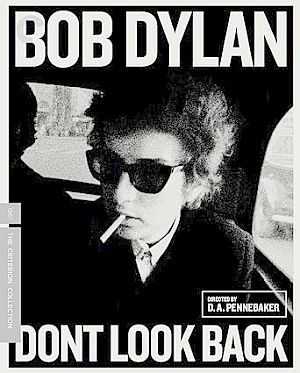
1967 film, “Don’t Look Back,” which covers Dylan’s 1965 tour of England. Click for film.
This tour, and various backroom and rehearsal moments, was famously documented by film maker D. A. Pennebaker in his 1967 documentary, Don’t Look Back.
According to one review, that film, in part, also “painfully shows the end” of the Dylan-Baez union in one unhappy scene where Dylan allows friends to taunt Baez. And during his concert tour, Dylan did not invite Baez to join him on the stage at any of his tour stops.
Baez was quite hurt and disappointed by that and more, and would later tell Rolling Stone in a 1983 interview:
“I just sort of trotted around [on that tour], wondering why Bob wouldn’t invite me on stage, feeling very sorry for myself, getting very neurotic and not having the brains to leave and go home…It was sort of just wasted time.”
Still, at the time, Dylan and Baez were enough of an item together — as well as being the reigning king and queen of folk music — that the press was quite interested. The two were the focus of a press photo session on April 27th, 1965 behind the Savoy Hotel in the Embankment Gardens. A number of photos of Dylan and Baez resulted, shown together, in various shots on and near park benches there.
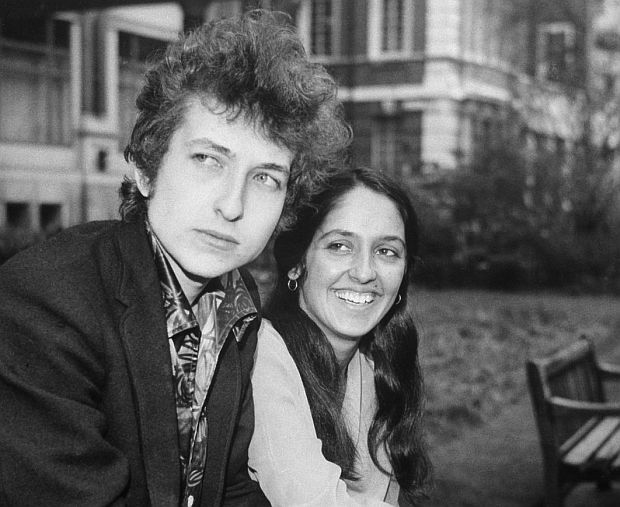
April 1965: Although their relationship was then ending, Bob Dylan and Joan Baez appeared together in a number of photos taken at a press photo shoot behind London’s Savoy Hotel in the Embankment Gardens area during Dylan’s tour of England.
Dylan, meanwhile, was soon to spend time with Sara Lownds. Following the last of his British concerts on May 10th in London, he and Sara would vacation in Portugal for a couple of weeks before returning home on June 2, 1965.
Back in the U.S. that summer, Dylan made his famous, career-pivoting “electric” rock ‘n roll performance at the July 22-25,1965 Newport Folk Festival – called his “declaration of independence” by some – to the consternation and boos of folk music fans that year. He left the stage after three songs.
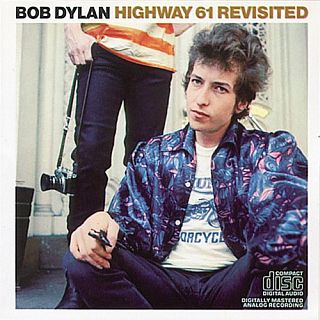
Aug 30, 1965. Dylan’s 6th studio album, “Highway 61 Revisited,” a Top-10 performer, was released. Click for copy.
Music Player
“Like A Rolling Stone” – 1965
Dylan’s music then was actually heralding the rise of what would become “folk-rock,” as groups like the Byrds had demonstrated in April 1965, taking Dylan’s earlier acoustic-version “Mr. Tambourine Man” to the top of the charts with their electric cover version.
A second 1965 Dylan album, Highway 61 Revisited, his 6th studio album, was released on August 30th and became a Top Ten performer in the U.S. and UK, with mostly rock-‘n-roll type songs, among them, “Like A Rolling Stone,” “Tombstone Blues,” and “Highway 61 Revisited.”
On the concert scene, Dylan continued touring through the remainder of 1965 with dozens of shows, and depending on the location and audience, he would still receive mixed reviews here and there about his move to rock ‘n roll. He and Baez, meanwhile, went their separate ways.
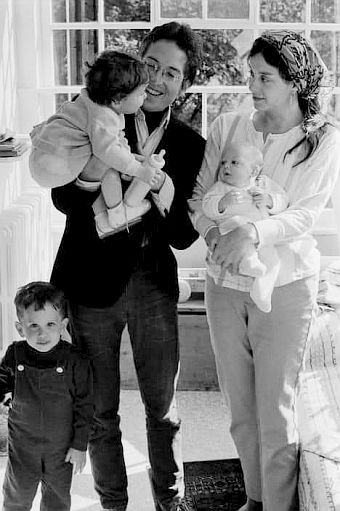
Late 1960s-early 1970s, Woodstock, NY. Bob Dylan and wife Sara with three of their children.
Bob & Sara
Dylan married Sara Lownds on November 22, 1965. Their first child, Jesse Byron Dylan, was born on January 6, 1966.
By 1970, he and Sara would have three more children together: Anna Lea, (July 1967); Samuel Isaac Abram (July 1968); and Jakob Luke (December 1969). Dylan also adopted Sara’s daughter from a prior marriage, Maria Lownds.
Dylan, however, had been involved in a motorcycle accident near Woodstock, New York in July 1966, about month after he released his 7th studio album, Blonde On Blonde. He then went into seclusion for a time thereafter, not appearing in concert for some years. But his songwriting and music making didn’t stop.
In 1967, Dylan recorded over 100 songs at his Woodstock home and in the basement of another nearby house known as “Big Pink” – the place where he and his companion musicians, first known at the Hawks, and later, The Band, did their recording.
More Dylan albums would come as well– in fact, a succession of Top 10 and Top 20 albums were released though the late 1960s and early 1970s – John Wesley Harding (Dec 1967, No. 2), Nashville Skyline (Apr 1969. No. 3), Self Portrait (June 1970, No. 4), New Morning (Oct 1970, No. 7), Pat Garrett & Bill The Kid (July 1973, No. 16), Dylan ( Nov 1973, No. 17), and Planet Waves (Jan. 1974, No.1). In January 1974, Dylan, backed by the Band, embarked on a North American tour of 40 concerts—his first tour in seven years.

October 1965. Joan Baez featured on the cover of her 6th studio album, “Farewell, Angelina,” which takes its name from a Bob Dylan song. Click for copy.
This album charted at No. 10. It was followed by two more studio albums: a Christmas album, Noel, released in October 1966, and later, Joan, an August 1967 album that rose to No. 38 on the Billboard chart.
Activist Joan
Baez, already a committed activist on several fronts, also continued what would be a very crowded lifetime of protest appearances, marches, and benefit concerts on behalf of various causes. You name it, she was there – civil rights, the Vietnam War, prison and death penalty reform, environmental causes, farm worker rights, and more.
In 1964, she had withheld 60 percent of her 1963 income tax from the IRS to protest military spending. She also participated in the birth of the Free Speech movement at UC Berkeley in 1964. A year later she co-founded the Institute For The Study of Nonviolence near her home in Carmel Valley, CA. In 1966, she stood with Cesar Chavez and migrant farm workers striking for fair wages. In September 1966, she joined Martin Luther King, Jr. to lead a group of children to a newly integrated school in Grenada, Mississippi. That December she opposed capital punishment during a Christmas vigil at San Quentin. In mid-August 1967, some 30,000 came out to a free concert she gave near the Washington Monument in D.C. to protest the Vietnam War.

1965, Civil Rights march.. James Baldwin, Joan Baez, James Foreman in Montgomery, Alabama during the Selma-to-Montgomery civil rights march.
In October 1967, Baez, her mother, and nearly 70 other women were arrested for blocking, Armed Forces Induction Center at Oakland, California, trying to prevent the processing of military inductees during the Vietnam War. During her incarceration, she met Vietnam War draft resistor, David Harris. She and Harris later teamed up and announced a nationwide Vietnam War protest tour in early March 1968. Thereafter the couple became involved.
Joan & David
Joan Baez and David Harris were married in New York on March 26th, 1968, beginning their marriage at Struggle Mountain in California’s Santa Cruz Mountains. In May 1968, Harris was tried in federal court in San Francisco for draft evasion, convicted of a felony and sentenced to three years in prison, then appealing his sentence for a year, though unsuccessfully.
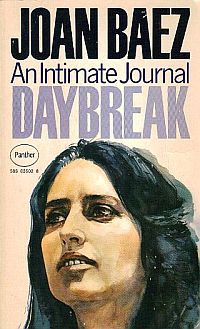
Baez book, "Daybreak." Click for copy.
Later in 1968, Baez published her first memoir, Daybreak. She also released an album in June 1969, titled David’s Album, named for her then husband, who favored country music, which this album featured.
On July 15, 1969 federal marshals came to the Harris/Baez home in the Santa Cruz to take Harris to jail to begin serving his sentence for resisting the draft.
Baez would later perform at the famous August 1969, Woodstock rock festival in upstate New York. Then some months pregnant, she did a 14-song set before an early a.m. crowd in the rain.
When the Woodstock documentary film was later released, Baez’s performance electrified audiences as much as any of the featured bands, and it also helped raise her musical and political profile.
A few months following her Woodstock appearance, Joan and David’s son, Gabriel, was born on December 2, 1969.

May 1970 cover story at Look magazine features David Harris, Joan Baez, and their infant son in a story titled “A Family Kept Apart by Conscience.”
On March 15, 1971, Baez with her infant son, Gabriel, flew to La Tuna Federal Prison near El Paso, Texas, to welcome David’s release and to signal to the press their continued mutual commitment to the peace movement.
Harris was released from prison after spending 20 months in Federal detention for draft evasion. However, he and Joan separated three months after his release and the couple divorced amicably in 1973. Harris went on to a long career as a distinguished journalist and author, reporting national and international stories.
Baez, meanwhile, had released two more albums in 1970 – One Day At A Time in March and Blessed Are in August, the latter reaching No. 11 on Billboard.
She also had a 1971 singles hit with “The Night They Drove Old Dixie Down,” a song from The Band that went to No.1 for her on the Adult Contemporary chart, and No. 3 on Billboard Hot 100.
“Forever Young,” a song by Bob Dylan recorded in November 1973, which he released in January 1974, was also covered by Joan Baez that year and released as a single, rising to No. 13 for her on the Adult Contemporary chart. Later that year, in April 1974, Baez was featured on the cover of People magazine with the story tagline: “Joan Baez: New Life, New Songs, New Causes.”
Then came the phone call in 1974.
Dylan’s Call
It was Bob Dylan calling from a phone booth somewhere in the Midwest. Baez at the time happened to be at work trying to compose a new song of her own, as Dylan’s call arrived out of the blue.
The call, at least in part, would turn out to be the inspiration for one of her most popular songs, “Diamonds and Rust.” She wrote it in November 1974.
|
“Diamonds and Rust” Well I’ll be damned As I remember your eyes Well you burst on the scene Now I see you standing Now you’re telling me |
In later interview with music writer Mike Ragogna, Baez admitted that the character in the song is Dylan:
MR: ‘Diamonds and Rust’ was another magic moment. You’ve said when you began writing the song, it started as something else until Dylan phoned you. Then it became about him. That must have been one helluva call.
JB: He read me the entire lyrics to ‘Lily, Rosemary and the Jack of Hearts’[a Dylan song] that he’d just finished from a phone booth in the Midwest.
MR: What was the song [you were then writing] about originally?
JB: I don’t remember what I’d been writing about, but it had nothing to do with what it ended up as.
The resulting song that Baez crafted, captures the moment when former lover, Dylan, after about a decade absent, begins to come back into her life again, hearing a troubled voice on the line, even as she flashes to the past in remembrance.
But Baez, as songwriter and aroused narrator, is wary, though she travels down memory lane quite willingly and wistfully. The allure is still there, and the song becomes both a look back in time, and seemingly “not-going-there-again” answer to what appears to have been a Dylan query – or at least a reaching out of a personal kind.
Music Player
“Diamonds & Rust” – 1975
As she builds the song, Baez remembers all the details of their time together – from his Robin-egg blue eyes to cufflinks she bought him a decade ago. She also describes his early days and rise to prominence – and her meeting the “unwashed phenomenon” and “original vagabond” – the guy who told her that her poetry was lousy, but needfully, became her lover. He found safe harbor there; a “Madonna” to comfort him and more – “the girl on the half-shell,” as she put it.
The imagery she uses of their time together is visceral and moving – their winter breathes forming white clouds in the cold air of Washington Square, mingling and joining there: “Speaking strictly for me we both could have died then and there.” Pretty powerful, that!
But alas, as a decade before, she sees this clever wordsmith and lover of old being as vague as ever, and despite her knowledge of his elusive, wordy charms, she is tempted once again, knowing full well it could again lead to a fall. Still, at the end, the ball seems to be in his court?
When Dylan placed the surprise call to Baez in 1974, it came at a time when his marriage to Sara was reportedly on the rocks, and that he was possibly looking to rekindle his relationship with Baez.
Sara, however, is believed to have been the inspiration for a number of Dylan songs created during the 1960s and ’70s, among them: “Sad Eyed Lady of the Lowlands,” from the 1966 album, Blonde on Blonde; “Love Minus Zero/No Limit,” from early 1965; “She Belongs to Me,” from 1965’s Bringing It All Back Home, and “Sara,” from the 1976 album, Desire. But Dylan’s 1975 album, Blood on the Tracks, has been cited by some, at least in part, as describing the dissolving marriage between Bob and Sara Dylan. They divorced in 1977.
In 1973, Bob and Sara Dylan had sold their Woodstock home, then buying property in Malibu, California on Point Dume peninsula where they began building a large home, with continuing re-modelling as they lived there bringing some marital tensions. In April 1974, Dylan was then taking art classes in New York, as he and Sara also retained a house in Manhattan. But Dylan’s art lessons reportedly caused problems in the marriage.
Musically, meanwhile, Dylan was planning a new tour – a tour which Joan Baez would later join.

One of the early poster ad formats for the Rolling Thunder Revue.
Rolling Thunder
In the summer of 1975, Dylan had been thinking about a concert tour that would play smaller venues, and smaller towns and cities, where he could be closer to his audience, or as he put it, to “play for the people.”
Thus was born the Rolling Thunder Revue, a tour that would have 57 concerts in two legs—first in the American northeast and Canada in the fall of 1975, and a second leg in the American South and southwest in the spring of 1976.
Joan Baez appears to have joined the tour early on, becoming a key member and receiving top billing on some concert posters and advertising. One Wikipedia.org account, summarizing part of one of the early Rolling Thunder shows, noted:
…Dylan and Baez often opened the second half of the show duetting in the dark on ‘Blowin’ in the Wind.’ Then Baez would take center stage with a dynamic six-song set, followed by a solo set from Dylan. He was joined by the band for a few numbers, until the finale song, Woody Guthrie’s ‘This Land Is Your Land,’ featuring everyone on stage…
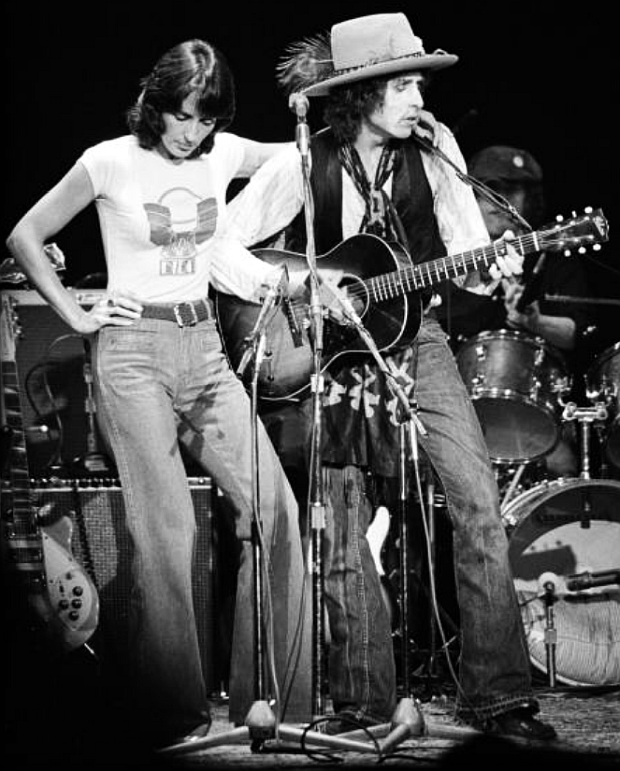
1975. Joan Baez and Bob Dylan (in white face makeup) during Rolling Thunder Revue concert at Harvard Square Theater, Cambridge, MA, November 19, 1975. Photo, Peter Simon.
In the end, the Rolling Thunder Revue would include numerous well-known performers and backing musicians, among them: Roger McGuinn, Joni Mitchell, Ronee Blakely and Ramblin’ Jack Elliott, violinist Scarlet Rivera, bassist Rob Stoner, and drummer Howie Wyeth, plus Mick Ronson on guitar, and others. Beat poet Allen Ginsberg was also there, as was Dylan’s wife, Sara, for a portion of the tour, having a staring role in the film Dylan was making of the tour, Renaldo and Clara. Sara appeared in many scenes, playing Clara to Dylan’s Renaldo, along with Baez who played The Woman in White. Some have reported that the Dylan movie was, in part, an attempted tribute to Sara.

Mid-1970s. An interesting moment of some apparent humor between Joan Baez and Bob Dylan during Rolling Thunder Revue tour of 1975. Photo, Ken Regan.
In addition to the Dylan film, a later documentary was also made – released as a 2019 Netflix film, Rolling Thunder Revue: A Bob Dylan Story by Martin Scorsese. The film, called a “pseudo-documentary,” is composed of both fictional and non-fictional material covering the 1975 portion of the tour.
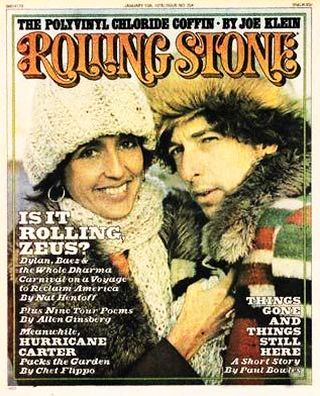
January 15, 1976 edition of Rolling Stone magazine did a cover feature on the Rolling Thunder tour with a cover photo of Baez and Dylan.
Among the the high points of the tour itself, however, was a Madison Square Garden benefit concert on December 8, 1975 in New York for wrongly-convicted boxer, Rubin Hurricane Carter (Dylan’s November 1975 song, “Hurricane,” had become a Top 40 hit). At that date, in addition to the tour’s traveling entourage of performers, special quests included: Muhammad Ali, Coretta Scott King, Roberta Flack, Robbie Robertson, Bill Franklin and John J. Hooker, plus a “vocal appearance” by Rubin Hurricane Carter.
The January 15, 1976 edition of Rolling Stone magazine did a cover feature on the Rolling Thunder tour with a cover photo of Baez and Dylan together in winter coats and hats, with story taglines: “Rolling Zeus? Dylan, Baez & The Whole Dharma Carnival on a Voyage to Reclaim America,” by Nat Hentoff, “Plus Nine Poems by Alan Ginsberg,” and a related “Hurricane Carter” story.
In 1982, Dylan and Baez performed together at the Peace Sunday anti-nuke concert at the Rose Bowl Stadium in Pasadena California on June 6, 1982. Some 85,000 people attended the all-day concert calling for nuclear disarmament. Among the stars performing during the 10-hour concert were: Stevie Wonder, Jackson Browne, Linda Ronstadt, Dan Fogelberg, Graham Nash, David Crosby, Stephen Stills, Gary U.S. Bonds, Gil Scott-Heron, Donovan, and Tierra. Baez, herself a surprise guest at the concert, paused midway during her 20-minute set at dusk to introduce her surprise guest, Bob Dylan, as the two then performed together.
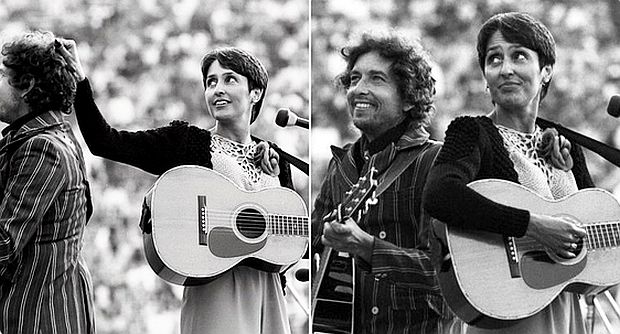
June 1982. Two photos of Dylan and Baez performing at the “Peace Sunday” nuclear disarmament concert in Pasadena, CA, where Baez in the first photo is shown playfully grabbing a handful of Dylan’s hair. The concert, with multiple acts, was attended by 85,000 that day.
Baez and Dylan would again tour together briefly in Europe in the late spring of 1984, a twenty-seven date European tour with Santana. But Baez withdrew from that tour after not getting the singing time she believed was promised her, culminating in a somewhat awkward goodbye scene in Dylan’s dressing room. In that scene, recounted in her 1997 book and a Rolling Stone story, Dylan is reported to have run his hand under her skirt and up her thigh as they spoke, complimenting her “great legs,” prompting Joan to remove his hand, then kissing his head and taking her leave. At that point in their respective careers, they each had 30 more years ahead of them, which they each pursued separately in their own unique ways.
Yet some years later, in the 2023 documentary, Joan Baez: I Am a Noise, she explains being swept up by Dylan and the social fervor of the early 1960s, though hurtfully wounded in the end: “I was just stoned on that talent… I was just there riding the wave with him. I think Dylan broke my heart because it was so shattering. That, I admit.”

Portrait painting of Bob Dylan by Joan Baez in 2018, titled, “Baby Blue.” Click for her portrait paintings.
…I was doing his portrait one day in my art studio. And it was a portrait of him when he was very young. And I put on his music, and all of that resentment, all of that bullshit, just drained away, it drained away. And I wrote him a letter and told him so. And that was it. I didn’t put a return address or an email or anything that was in any way trying to get something out of him. I just wanted him to know how much he meant to me. How much his music had meant to me. And I may never see him again, and that’s okay too.
Legacies
The Baez and Dylan legacies, in any case, remain large and lasting. Each of them continued recording and performing through the 2010s. And over their 50-plus years of making music – and/or “good trouble” – they would each collect a long and impressive list of both music awards and other honors. Among these, for example, is the Presidential Medal of Freedom, awarded to Dylan by President Obama in 2012, and the Noble Prize for literature in 2016. Also that year, a vast archive of Dylan material and artifacts were purchased for an estimated $20 million by the George Kaiser Family Foundation of Tulsa, Oklahoma, where a Bob Dylan Center and the Institute for Bob Dylan Studies now operate, the latter at the University of Tulsa.

2021. Joan Baez in her art studio.
Both Baez and Dylan, of course, have also sold millions of recordings worldwide, won various Grammy awards, music Hall of Fame honors, and Lifetime Achievement awards, with some of their works selected by the Library of Congress for preservation in the National Recording Registry. Both of their careers have also been celebrated at Kennedy Center honors.
In addition, there is a considerable list of books and documentaries about each of their respective lives and careers, some of which are listed or shown below in “Sources.”
See also at this website these other Dylan-related stories: “Only A Pawn in Their Game,” “Dylan’s Hard Rain,” and “Music Rights Deals, 2020s.” Additional story choices on Music or Politics can be found at those respective topics pages.
Thanks for visiting – and if you like what you find her, please make a donation to help support the research, writing. and continued publication of this website. Thank you. – Jack Doyle
|
Please Support Thank You |
________________________________________
Date Posted: 19 December 2023
Last Update: 10 March 2024
Comments to: jackdoyle47@gmail.com
Twitter: https://twitter.com/PopHistoryDig
Article Citation:
Jack Doyle, “Diamonds & Rust: Joan & Bob, 1960s-1980s,”
PopHistoryDig.com, December 19, 2023.
________________________________________
 Daniel Kramer photos, “Bob Dylan: A Year and A Day,” Taschen. Click for Amazon. |
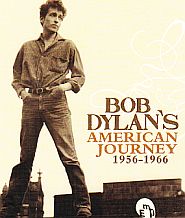 “Bob Dylan’s American Journey, 1956-1966.” Promo CD, SonyBMG w/10 songs. Click for CD. |
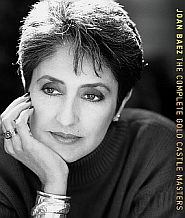 3-disc set, “Joan Baez: The Complete Gold Castle Masters.” Click for Amazon. |
Sources, Links & Additional Information
 Joan Baez's 1975 album, "Diamonds & Rust," includes the hit single of that name and others. Click for Amazon. |
 2019 film, “Rolling Thunder Revue: A Bob Dylan Story by Martin Scorsese.” Click for Criterion edition. |
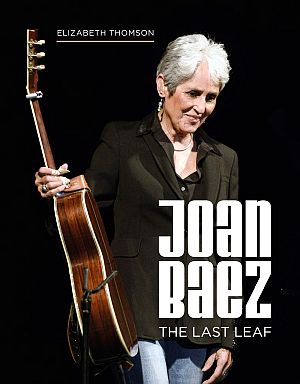 Elizabeth Thomson/s 2020 biography, “Joan Baez: The Last Leaf,” Palazzo Editions, 224 pp. Click for Amazon. |
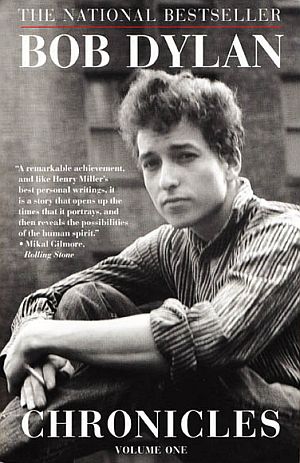 2005: Paperback edition of Bob Dylan’s memoir, “Chronicles,” Vol. 1, published by Simon & Schuster. Click for Amazon. |
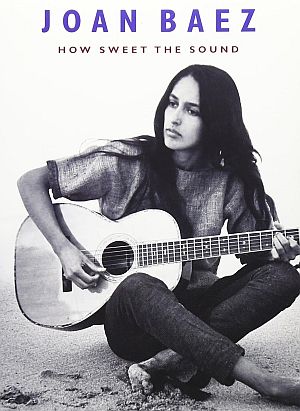 2009 PBS documentary, “Joan Baez - How Sweet The Sound.” Click for this & other Baez docs & videos at Amazon. |
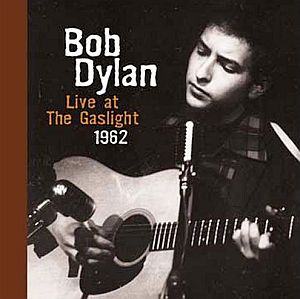 “Live at The Gaslight 1962" is a CD with 10 songs from Bob Dylan performances at the Gaslight cafe in New York's Greenwich Village; Columbia Records, 2005. Click for CD. |
 “Joan Baez - Greatest Hits,” digitally remastered. Twenty songs. Click for Amazon. |
 The Original Mono Recordings box set of Dylan's first 8 studio albums in mono on 9 CDs, released in October 2010 on Legacy Recordings with 56-page booklet. Click for CD. |
 “Baez Sings Dylan” – CD or digital – twenty songs. Click for Amazon. |
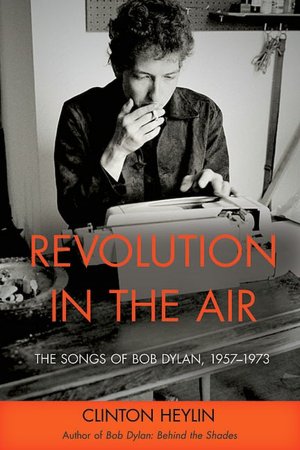 Clinton Heylin’s “Revolution in the Air: The Songs of Bob Dylan, 1957-1973,” Chicago Review Press, 2009. Click for book. |
 Markus Jaeger’s 2021 book, “Popular Is Not Enough: The Political Voice Of Joan Baez: A Case Study In The Biographical Method,” ibidem Press, 242 pp. Click for Amazon. |
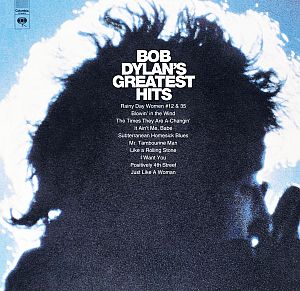 “Bob Dylan’s Greatest Hits” from 1999. Reissued & remastered in 2006. Click for copy. |
 Popular, deluxe two CD edition of “Joan Baez 75th Birthday Celebration” from 2016 performance. Click for CD or digital. |
 Howard Sounes biography, “Down the Highway: The Life of Bob Dylan,” updated edition, 2021. Penguin edition shown. Click for Amazon. |
Joan Baez Official Bio & Chronology / Joan Baez.com.
Robert Shelton, “Joan Baez Sings in Folk Program; Soprano and Guitarist Gives Second Major Concert,” New York Times, May 19, 1962, p. 18.
“Joan Baez,” Wikipedia.org.
“Folk Singing: Sibyl With Guitar”(cover story), Time, November 23, 1962.
Patrick Murfin, “Joan Baez — Our Lady of Perpetual Prophesy With Murfin Reminis-cence,” PatrickMurfin.blogspot.com, Janu-ary 9, 2020.
“Bob Dylan,” Wikipedia.org.
Bob Egan, “Bob Dylan: A Life in Over 100 PopSpots,” PopSpotsNYC.com.
“Bob Dylan’s New York, 1961,” Gotham Center.org, Excerpted from Stephen Petrus book, Folk City: New York and the American Folk Music Revival, Oxford University Press.
Michael Pollak, “Bob Dylan’s Quiet Debut in New York City,” NYTimes.com, July 3, 2015.
Robert Shelton, “Bob Dylan: A Distinctive Folk-Song Stylist,” New York Times, Sep-tember 29,1961.
“Suze Rotolo,” Wikipedia.org.
William Grimes, “Suze Rotolo, a Face, With Bob Dylan, of ’60s Music, Is Dead at 67,” New York Times, March 1, 2011.
Margot Adler, “Suze Rotolo, Dylan’s Cover Girl, Has Died,” All Things Considered / NPR.org, March 1, 20114.
“Remembering Suze Rotolo, Dylan’s ‘Free-wheeling’ Muse,” Fresh Air/NPR.org, March 1, 2011.
Robert Shelton, “Bob Dylan Sings His Compositions; Folk Musician, 21, Displays Originality at Town Hall,” New York Times, April 13,1963, p. 11.
Val Adams, “Satire on Birch Society Barred From Ed Sullivan’s TV Show,” New York Times, May 14, 1963, p. 79.
Robert Shelton, “Joan Baez Sings at Forest Hills; 14,700 Hear Her and Bob Dylan in Folk Concert New Songs in Repertory,” New York Times, August 19, 1963, p. 21..
“The Freewheelin’ Bob Dylan,” Wikipedia .org.
Rowland Scherman, “Bob Dylan and Joan Baez on Porch #1 After Finishing Their Set, Newport Folk Festival….” Newport, RI, July 27, 1963, Special Collections, University of Massachusetts, Amherst Libraries, and RowlandScherman.com.
“Bob Dylan and Joan Baez 1963 March on Washington,” YouTube.com, anblog21, Nov 29, 2011.
Olof Björner, “Before The Hurricane Begins; Bob Dylan 1963. A Summary of Recording & Concert Activities, Releases, Tapes & Books,” BJorner.com.
“Another Side of Bob Dylan” (album), Wikipedia.org.
Olof Björner, “Still on the Road / 1964 Con-certs, Interviews and Recording Sessions,” BJorner.com.
“When the Ship Comes In,” Wikipedia.org.
Frank Reagan, “2 Folksingers Entertain At White Plains,” The Daily News (Tarrytown, NY), April 20, 1964.
“Baez Joins Dylan and Rafters Ring,” Buffalo Courier-Express (Buffalo, NY), November 2, 1964, p. 8.
“Folk Singer Bob Dylan To Perform in San Jose,” Santa Cruz Sentinel (Santa Cruz, CA), November 4, 1964.
Joe Harrand, “Bob Dylan Songs Don’t Entertain,” The Capital Times (Madison, WI), November 20, 1964.
“List of Bob Dylan Concert Tours,” Wiki-pedia.org.
“Bob Dylan Concerts 1960s,” Fandom.com.
“Words Fill My Head; Album Liner Notes,” BJorner.com.
“The Farina Files, Timeline,” Nebula5.org.
Bob Dylan Concerts, 1964,” SetList.fm.
Berserk Research, “Bob Dylan’s 1965 Appear-ances: A Documentation” (PDF file), Bob Dylan-ComeWritersAndCritics.com, 2022.
“Sara Dylan,” Wikipedia.org.
Jack Berry, “Baez, Dylan Inspire 3,500 Portland Fans,” The Oregonian, April 24, 1965 (April 23rd concert, Public Auditorium, Portland, Oregon).
Nora Ephron, “Hush! Bob Dylan Is Wed,” New York Post, February 1966.
Phillis Funke, “Folk Rock Review: Join The Dylan Rebellion – It’s Pallid,” Louisville Courier-Journal, February 6, 1966.
Jules Siegel, “Bob Dylan: ‘Well, What Have We Here?’,” The Saturday Evening Post, July 30, 1966.
“David Harris & Joan Baez, 1967-2014,” The Bob Fitch Photography Archive: Movements for Change, Stanford Libraries / Stanford .edu.
B. Drummond Ayres, Jr. “30,000 in Capital at Free Concert by Joan Baez; Folk Singer Chides D.A.R., Which Protested U.S. Site,” New York Times, August 15, 1967, p. 33.
Alfred G. Aronowitz, “Enter the King, Bob Dylan” Saturday Evening Post, November 2,1968.
Richard Goldstein, “Is the Image Real?,” Review of Daybreak by Joan Baez (Dial Press, New York. 159 pp), The New York Times Book Review, September 8, 1968, p. 64.
William Hedgepeth, Jim Marshall (photog-rapher), “Joan Baez & David Harris: A Family Kept Apart by Conscience“(cover), Look (magazine), May 5, 1970.
Anthony Scaduto, Bob Dylan. An Intimate Biography, New American Library, 1973.
Joan Baez & Bob Dylan (cover), Rolling Stone, January 15, 1976.
Joyce Maynard, “Old Baez Image Is Slow to Fade,” New York Times, September 8, 1976, p. 40.
“The Berman Collection: High-Quality Scans of Papers Chronicling Bob Dylan’s Early Years” (1963-1979), WordPress.com.
Kurt Loder, “Joan Baez: The Rolling Stone Interview; Old Folk at Home,” Rolling Stone.com, April 14, 1983.
Robert Shelton, No Direction Home. The Life and Music of Bob Dylan, New American Library, 1986.
Barbara Goldsmith, “Life on Struggle Mountain,” (Book Review, Joan Baez book, A Voice To Sign With: A Memoir, 378 pp. New York: Summit Books), The New York Times Book Review, June 21, 1987, p. 30
Colman McCarthy, “The Clear Voice of Joan Baez,” WashingtonPost.com, June 7, 1987.
James Gavin, Pop Music. “Joan Baez, the First Lady of Folk,” New York Times, Sunday, November 29, 1992, Arts & Leisure Section, p. 25.
Clinton Heylin, A Life In Stolen Moments. Bob Dylan Day By Day 1941-1995, Schirmer Books 1996, 404 pp. Click for Amazon.
Janet Maslin, Books of the Times, “Protest and Soap Opera for 4 Singers of the 60’s.” Review of David Hajdu’s 2001 Book, Positively Fourth Street The Lives and Times of Joan Baez, Bob Dylan, Mimi Baez Fariña and Richard Fariña, New York Times, May 17, 2001.
Howard Sounes, Down the Highway. The Life of Bob Dylan, updated, 2001. Double-day, 608 pp. Click for Amazon.
Peter Howell, “Joan Baez Gets Her Apology,” TheStar.com / Toronto Star, September 21, 2009.
Arthur Levy, “Fifty Years of Joan Baez,” September 24, 2009,” PBS.org /American Masters.
Stephen Pate, “Joan Baez Beautiful Obses-sion Haunts Diamonds and Rust; The Folk Music Queen Joan Baez Tells Her Bob Dylan Story in a Song and PBS Special,” NJNnetwork.com, September 25, 2009.
Bob Dylan & Joan Baez – 2009 Documen-tary,” YouTube.com.
Mike Ragogna, Contributor, “How Sweet The Sound: An Interview With Joan Baez,” HuffPost.com, Mar 18, 2010.
Andy Greene, “Suze Rotolo, Bob Dylan’s Girlfriend and the Muse Behind Many of His Greatest Songs, Dead at 67,” Rolling Stone.com, February 27, 2011.
Phil Bicker, “A Year and a Day with Bob Dylan,” Time.com, March 19, 2012.
Sam Tanenhaus, “A Dylan Insider’s Back Pages,” New York Times, August 7, 2014.
Rick Sebak, “Joan Baez’s Night of Music and Peace,” PittsburghMagazine.com, August 20, 2014.
“Joan Baez – In Pictures; For More than Half a Century, Joan Baez Has Been Music’s Most Outspoken Activist. Ahead of Her European Tour We Look Back on a Life of Performance and Protest,” TheGuardian .com, August 30, 2014.
Lily Rothman, “Library of Congress Selects Joan Baez Album for Preservation,” Time.com, March 25, 2015.
Mark Bulik, “1961: Bob Dylan Takes the Stage,” New York Times, September 2, 2015.
Ben Sisario, “Bob Dylan’s Secret Archive,” NYTimes.com, March 2, 2016.
Stephen Raskauskas, “Joan Baez Talks Trump, Taxes, and Dylan,” WFMT.com, October 27, 2016.
Barney Hoskyns, Small Town Talk: Bob Dylan, The Band, Van Morrison, Janis Joplin, Jimi Hendrix & Friends in the Wild Years of Woodstock. Da Capo Press. 2016. Click for Amazon.
David Browne, “Joan Baez’s Fighting Side: The Life and Times of a Secret Badass. The Sixties Icon Helped Invent the Idea of the Protest Singer – More than Five Decades Later, She’s Still at It,” RollingStone.com, April 5, 2017.
Kyle Almond, “A Year – And a Day – With Bob Dylan,” Photographs by Daniel Kramer, CNN.com, January 2019.
Andy Greene, “Flashback: Bob Dylan and Joan Baez Duet for the Last Time; Watch the Sixties Duo Perform ‘Blowin’ in the Wind’ on Their Ill-Fated 1984 Tour,” RollingStone .com, May 2, 2019.
Patrick Ryan, “Netflix Documentary ‘Rolling Thunder Revue’ Gives Intimate Look at Bob Dylan and Joan Baez’s Relationship,” USAToday.com, June 10, 2019.
“Fifty Years of Joan Baez,” PBS.org/WNET/ American Masters.
“Diamonds & Rust (song),” Wikipedia.org
Jeff Tamarkin, “Joan Baez’s ‘Diamonds & Rust’ — Reflections on an Old Friend Named Bob,” BestClassicBands.com, October 29, 2020.
Andy Greene, “Flashback: Joan Baez and Marianne Faithfull Sing ‘As Tears Go By’ in Bob Dylan’s Hotel Room…,” RollingStone .com, January 27, 2021.
Clinton Heylin, The Double Life of Bob Dylan A Restless, Hungry Feeling, 1941-1966, Little, Brown, 2021, 704 pp.
“Rolling Thunder Revue,” Wikipedia.org.
Mimi Haddon, “Matrices of ‘Love and Theft’: Joan Baez Imitates Bob Dylan,” Twentieth-Century Music, Volume 18, Issue 2, June 2021, pp. 249-279, Cambridge University Press
Karen Heller, “Listening to Her Older Records, Joan Baez Hears Perfection in an ‘Unsurpassable’ Voice; The Kennedy Center Honoree Redefined Folk Music and Showed up Wherever Her Songs and Courage Were Needed,” WashingtonPost.com, May 12, 2021.
“The 80 Greatest Dylan Covers of All Time; From Hendrix, Baez, and The Byrds to Cher, Adele, and the Roots…,” RollingStone.com. May 28, 2021.
Colman McCarthy, “Joan Baez, Singer and Peacemaker, Finally Honored by Kennedy Center,” NCRonline.org (National Catholic Register), June 5, 2021.
Annie Gowen, “At 80, Bob Dylan Finally Gets a Museum,” WashingtonPost.com, May 6, 2022.
Skyler Caruso, “Bob Dylan’s Life in Photos. Recognized as a Legacy Writer, a Folk Protest Hero and a Voice of a Generation, Singer-Songwriter Bob Dylan Has Solidified His Status as a Cultural and Musical Icon since the 1960s….,” People.com, updated, December 8, 2022.
Nick Vivarelli, “Joan Baez on Visual Memoir Doc ‘I Am a Noise’ in Which She Reveals Abuse From Her Father and Talks Heartbreak by Bob Dylan,” Variety.com, February 17, 2023.
Martin Kielty, “How Joan Baez Got Over Her Resentment for Bob Dylan,” UltimateClassic Rock.com February 18, 2023.
Scott Roxborough, “Berlin: Joan Baez on Bob Dylan, Childhood Abuse and Hanging Up Her Guitar,” HollywoodReporter.com, February 24, 2023.
Ryan H. Walsh, “60 Years Ago, Bob Dylan’s Boston Debut Was a Freewheelin’ Good Time Weeks Before the Release of His Seismic ‘The Freewheelin’ Bob Dylan,’ The Singer Performed Stunning New Originals at a Tiny Kenmore Square Cafe,” Boston Globe, April 19, 2023.
Ryan Walsh, “Bob Dylan in Boston 1963”(parts 1 & 2), RyanHamiltonWalsh .Tumblr.com.
Ilana Kaplan, “Joan Baez Reveals How She Found ‘Total Forgiveness’ for Bob Dylan Years After Breakup,” People.com, October 4, 2023.
Elizabeth Sandifer, “…The Case for Joan Baez,” EruditorumPress.com, October 16, 2023.
“Latest News,” JoanBaez.com.
Sarah M. Seltzer, “Joan Baez Looks Back, I Am a Noise, A Career-Spanning Documentary, Makes it Clear That the Folk Singer Was One of the Most Important Political Musicians of Her Generation,” TheNation.com, December 14, 2023.
______________________________________________
 Martin Scorsese’s 2005 documentary, “No Direction Home.” Click for Amazon. |
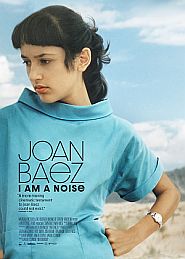 2023 PBS documentary on Joan Baez, “I Am a Noise.” Click for Amazon. |
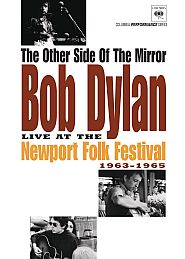 Film - Bob Dylan at Newport, 1963-1965. Click for copy. |