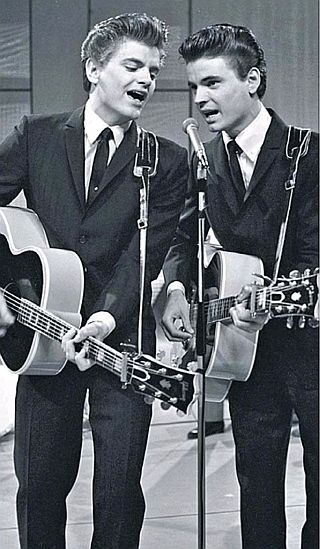
The Everly Brothers – Phil and Don – performing in the 1950s.
With Kentucky Appalachian roots, they grew up in the Midwest doing early morning country radio as young boys with their family. But soon thereafter, the Everly Brothers would storm the pop and country charts with their special sound.
Music Player
“Wake Up Little Suzie”-1957
Everly Brothers
By the late-1950s they had a string of hits, beginning with “the big three” as they came to be called – “Bye Bye Love” and “Wake Up Little Susie” in 1957, and “All I Have To Do is Dream” in 1958.
All three of these songs, plus “Bird Dog” — all in 1957-58 — became No. 1 hits, either on the country and/or pop music charts, with “Susie” being their first No. 1 pop hit. (more on this song later).
During their recording career, and especially in their early years, their guitar-driven ballads and extraordinary harmonies swept the nation off its feet. On most recordings, Don sang the baritone part and Phil the tenor harmony. Don usually sang most of the solo lines.
For a period of six years, from 1957 to 1962, The Everly Brothers’ songs were regularly at the top of the contemporary music charts. In that six-year span, the Everly’s had an amazing run on the charts, landing 15 Top Ten singles with three at No. 1. All told, the Brothers would have 35 charting Billboard singles in their career, 26 in the top 40. In the UK, they would have similar success, with 30 chart singles, 29 in the Top 40, 13 Top Ten, and four at No. 1. Throughout their career, they would release 75 singles, 21 studio albums, two live albums, and 29 compilation albums. They would also have a significant influence on rock groups that followed, among them, the Beatles, the Beach Boys, the Byrds, the Bee Gees, and Simon & Garfunkel.
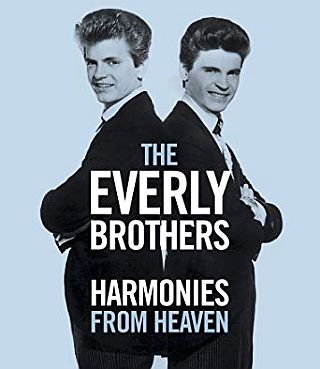
2016 BBC documentary on the lives and career of the Everly Brothers, “Harmonies From Heaven.” Click for DVD.
And while the Simon and Garfunkel sound of the 1960s did became notable in its own right, Garfunkel, for one, would admit that the Everlys – being brothers – had a DNA advantage in the harmony department over he and Paul. Indeed, “brotherly harmony,” as it was called, is pretty powerful stuff.
Paul Simon, in his later career, would also work with the brothers on his Graceland album, and would say of them shortly after Phil’s death in January 2014: “Phil and Don were the most beautiful sounding duo I ever heard. Both voices pristine and soulful. The Everlys were there at the crossroads of country and R&B. They witnessed and were part of the birth of rock and roll.”
The Everly Brothers would be inducted into the inaugural class of the Rock and Roll Hall of Fame in 1986, and they were also selected for the Country Music Hall of Fame in 2001. In 2015, Rolling Stone magazine ranked the Everly Brothers No. 1 on its list of the 20 Greatest Duos of All Time, and their entry in The Rolling Stone Encyclopedia of Rock and Roll states flatly they are “the most important vocal duo in rock.”
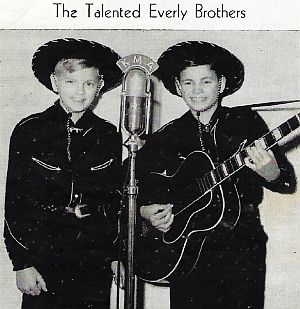
Starting out at the ages of 8 and 6, the boys joined their parents on “The Everly Radio Show,” broadcast from Shenandoah, Iowa during the 1940s & early 1950s.
Don Everly was born in 1937, and Phil two years later. They were raised in a musical family with Kentucky roots, and in 1940s appeared on an early morning country radio show in Shenandoah, Iowa, before school started, singing with their father, Ike Everly and mother, Margaret Everly, as “The Everly Family.”
In their high school years, after the family had moved to Tennessee, the brothers would meet their father’s friend, Nashville musician Chet Atkins, who would help groom the boys and send them to music publisher Acuff-Rose.
Atkins introduced the boys to Wesley Rose, of Acuff-Rose, who told them he would secure a recording deal for them if they signed on with Acuff-Rose as songwriters. They signed in late 1956, and in 1957 Rose helped arrange an introduction to Archie Bleyer, who was looking for artists for his Cadence Records. The Everlys signed on with Cadence in February 1957 and would soon make their first recording there.
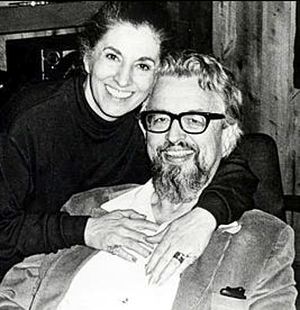
Felice & Boudleaux Bryant, the husband and wife team who wrote early Everly Brothers hits. Click for their book.
The Bryants initially were a struggling song-writing team starting out in the 1940s before having a country hit in 1948, and from that point on, they also became associated with Acuff-Rose in Nashville, where they would write many other country and pop hits – of which “Bye Bye Love” for the Everly Brothers would become one of their early and most successful songs – but not at first.
Initially, in fact, “Bye Bye Love” had been rejected by 30 other acts, but with the Everly Brothers it became a 1957 smash hit. In fact, it was a musical breakthrough, as described by Kit Rachels in the Rolling Stone Illustrated History of Rock & Roll: “…Simultaneously precise, cohesive and effervescent, Bye Bye Love” had fused country music’s obsession for order with the boundless energy of rock & roll.” It reached No. 2 on the pop charts, behind Elvis Presley’s “Teddy Bear,” but it also hit No. 1 on the country chart and No. 5 on the R&B chart. The song became the Everly Brothers’ first million-seller.
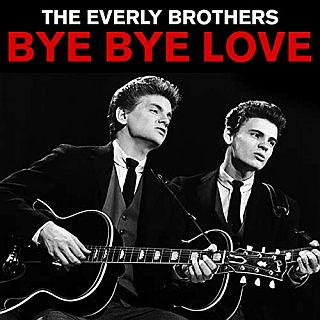
“Bye Bye Love,” No. 1 country hit, 1957. Click for digital.
Music Player
“Bye, Bye Love”-1957
Everly Brothers
But the key innovation on this song came in the recording studio, courtesy of Don’s intervention, as he and his brother had become enamored of the guitar styles of Bo Diddley and other R&B musicians.
At the session, Don suggested they add a more aggressive guitar intro at the front of “Bye Bye Love.” As later explained at EverlyBrothers.com, the front-loaded guitar riff “utilized an open G tuning and an unusual rhythm. Everyone at the [recording] session knew immediately that this was like nothing they had heard on the front of a song before.” The term “rock and roll” at the time was still taking form, and popular musicians then saw the use of a separate guitar riff up front, and not used elsewhere in the song, as something new. So the Everlys, in that March 1, 1957 session and others, were country guitar players pioneering new rock-and-roll techniques, helping invent and advance the new genre.
“Bye Bye Love” would be the first song a young teenager named Paul McCartney performed on stage with his brother Mike at a holiday camp in North Yorkshire, England. And some years later, in 1974, another Beatle, George Harrison, reinterpreted “Bye Bye Love” for his album, Dark Horse, changing some of its lyrics to reference his wife, Pattie Boyd, who would leave him for his friend Eric Clapton.

“Wake Up Little Susie,” No. 1 hit, on Cadense Records.
Their second hit of 1957, “Wake Up, Little Susie” – sampled at the top of this story – came next for the Everlys. The song’s lyrics were also penned by the Bryants.
Released in September 1957, this Everly Brothers song quickly scaled the charts, rising to No. 1 on the Billboard pop chart and the Cash Box chart. The song also had a seven-week run at the top of the Billboard country chart and hit No. 2 on the UK Singles chart.
The Everly Brothers performed “Wake Up Little Susie” on The Ed Sullivan Show, October 6, 1957. The brothers also appeared at least twice on Dick Clark’s American Bandstand TV show in 1957 – September 13th & December 23rd, singing “Wake Up Little Susie” and other songs. As of 2011, Roiling Stone magazine listed “Wake Up, Little Susie” at No. 318 on its list of the “500 Greatest Songs of All Time.”

Warner Brothers record jacket for Everly Brother’s hits, “Wake Up, Little Susie” (No. 1) and “Bird Dog” (No. 2 Pop, No. 1 Country). Click for digital.
… What are we gonna tell your Mama / What are we gonna` tell your Pa. / What are we going to tell our friends when they say ‘O lah lah’…
That last phrase carrying a little suggestive sexual innuendo, and perhaps the reason the song was banned in Boston (after all, this was the 1950s). Yet when songwriter Boudleaux Bryant heard about the Boston ban, he was overjoyed, knowing that controversy would only boost sales.
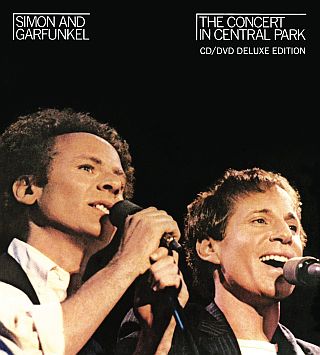
Simon & Garfunkel, lifelong Everly Brothers fans, included “Wake Up Little Susie” in their famous 1981 New York City Central Park Concert. Click for CD.
Years later, lifelong fans of the Everly Brothers, Simon & Garfunkel, included their own live version of “Wake Up, Little Susie” at their famous concert in New York city’s Central Park on September 19, 1981.
In fact, a recorded version of that Central Park performance hit No. 27 on the Billboard Hot 100 in 1982, becoming Simon & Garfunkel’s last Top 40 hit.
Beyond that, during Simon & Garfunkel’s “Old Friends” tour in 2003–2004, they performed “Wake Up Little Susie” and others in a segment with the Everly Brothers joining them, as the brothers had agreed to perform with Simon & Garfunkel on their tour.
In 2017, sixty years after the Everly Brothers 1957 recording of “Wake Up, Little Susie,” this song was inducted into the Grammy Hall of Fame.
Big Hit Ballad
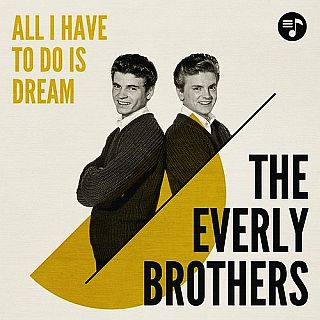
Record jacket for 1958 Everly Brothers hit song, “All I Have To Do is Dream.” Click for their digital music.
Music Player
“All I Have To Do Is Dream”
Everly Brothers – 1958
In fact, by June 2, 1958, it was the only single ever to reach No. 1 on all of the Billboard singles charts simultaneously – having reached each of those four charts: the “Most Played by Jockeys” chart; the “Top 100″ chart; the R&B chart; and the Country chart. In August 1958 – when Billboard created the new Hot 100 chart – “All I Have to Do Is Dream” ended the year at No. 2. Three years later, in 1961, the Everly Brothers briefly returned to the Hot 100 in 1961 with this song. It was also ranked at No. 141 on the Rolling Stone magazine’s list of “The 500 Greatest Songs of All Time.”
Outside the U.S., meanwhile, “All I Have to Do…” saw massive success, most notably the in the UK, where it topped the Singles Chart in June 1958 and remained there for seven weeks. In total, “All I Have To Do” spent 21 weeks on the UK charts. The song has also been featured on several notable lists of the best songs or singles of all time, including the “1,001 best songs ever” list offered by the British music magazine, Q, in 2003. The Rock ‘n Roll Hall of Fame named “All I Have to Do…” one of the “500 Songs that Shaped Rock and Roll” and in 2004 it received the Grammy Hall of Fame Award (the B-side on this recoding. “Claudette,” was the first major song-writing success for Roy Orbison).
The late 1950s became a whirlwind time for the Everly’s – with road tours, TV appearances, recoding sessions. Singer Frankie Avalon recalled their touring the country in a school bus with disc jockey Alan Freed’s road show in 1958, a show that included “maybe 15 to 18 different acts.” As Avalon recounted their itinerary, he noted, “we did 91 nights; different city every night.” At one of the Freed shows at New York’s Paramount Theater the Everlys were headliners with Buddy Holly and the Crickets.
Earlier, in July 1957, the Everlys appeared along with The Billy Williams Quartet, Connie Francis on the premiere of Alan Freed’s ABC-TV, show, “The Big Beat.” They also appeared at least twice in 1957 on Dick Clark’s American Bandstand TV show – September 13th & December 23rd, singing “Wake Up Little Susie” and other songs. Other TV appearances included those on The Perry Como Show and Tennessee Ernie Ford’s show, on the latter, performing “Bird Dog” with Ford, an Everlys’ song which had hit No. 1 on the country charts.
 Everly Brothers 1958 country album, “Songs Our Daddy Taught Us.” Click for Amazon. |
 2013 remake of Everly Bros. country album by Billie Joe Armstrong & Norah Jones. Click for Amazon. |
In 1958, in something of a surprise, the Everly Brothers, then at the top of their rock ‘n roll fame, also released a pioneering album of country music, Songs Our Daddy Taught Us (shown above, left). The album is filled with classic folk songs the brothers grew up singing — songs their father, Ike Everly, taught them. The album was not considered mainstream at the time, but both brothers were proud of it. Said Don at one point: “It was a good idea; it was a natural. We put our hearts into it and it was as good a thing as we’d ever done. It was true and it was from the heart and that’s exactly where we were in those days… I still love that whole thing, that whole album.” One of the songs on this album, and a fan favorite, “Kentucky,” is partly in homage to their family roots, also showcasing their amazing harmonies. ( clip below from later performance).
Some decades later, in 2013 Green Day frontman, Billie Joe Armstrong, and jazz singer, Norah Jones, recorded a remake of the album, titled Foreverly. It was released on November 25, 2013. And that version charted on the Billboard 200. In one interview, Armstrong noted on the 1958 Everly Brothers album, in part: “…I got into the Everly Brothers’ record a couple years ago and I thought it was just beautiful. I was listening to it every morning for a while off and on. I thought it would be cool to remake the record because I thought it was sort of an obscure thing and more people should know about it…”

Record jacket cover for “Let It Be Me”. Click for digital.
Music Player
“Let It Be Me” – 1959
Everly Brothers
This song was the first Everly Brothers single to be recorded in New York, and not in Nashville, and their version hit No. 7 on the Billboard chart. On the B side of the Cadense single, the brothers used “Since You Broke My Heart.” But “Let It Be Me” featured a harmony arrangement that was used by a long list of others who would also cover the song in later years. In 1964, for example, Betty Everett and Jerry Butler released their version of the song that became a No. 5 hit on Billboard and No. 1 on the Cashbox R&B chart. And the Everly Brothers themselves, nearly 25 years later in 1983 at their famous reunion concert at London’s Albert Hall, performed a quite moving version of “Let It Be Me” with somewhat older voices, but still on the mark (see video, later below).
New Label
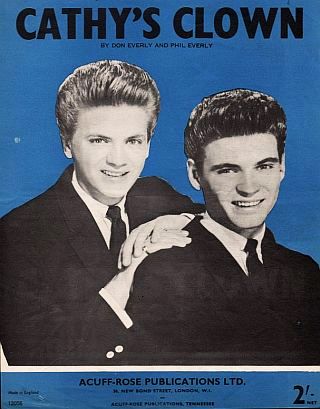
Sheet music cover for “Cathy’s Clown.” Click for digital.
Music Player
“Cathy’s Clown” – 1960
Everly Brothers
“Cathy’s Clown” rose to No. 1 on the Billboard charts, holding that position for five weeks in 1960, It sold eight million copies and became the duo’s biggest-selling record. And so far, it is the only Everly Brothers’ song to be cited by the U.S. Library of Congress – in 2013 — as being culturally significant and worthy of inclusion in the National Recording Registry.
|
National Recording Registry “Cathy’s Clown” Daniel Levitin, American-Canadian psychologist, writer, musician, and record producer, is the author of four New York Times best-selling books, including, This Is Your Brain on Music: The Science of a Human Obsession, a million seller in 2006. Levitin wrote an essay on the Everly Brothers “Cathy’s Clown” song for the Library of Congress upon its selection in 2013 to the National Recording Registry. An abridged and excerpted version of Levitin’s essay follows below, which offers, in part, a somewhat technical analysis of that song’s singular musical attributes: …”Cathy’s Clown” did not represent a major departure for the duo. Their tight, seamless, fraternal harmonies are still the song’s most distinguishing feature. The song is catchy and an important part of early rock music’s heritage. It begins as a three-cord tune in D Major but an E minor chord is added for the third line of the verse. “Cathy’s Clown” begins on the verse, followed by a bridge (there is no chorus).It is the sound of “Cathy’s Clown” that is so gripping. Like “I Walk the Line” and “Heartbreak Hotel,” it features voices that are instantly recognizable, and an overall sonic profile that puts the record in a class by itself. But far more distinctive than the song itself is this recording of it because “Cathy’s Clown” sounds like no other record before or since. Along with only a handful of other recordings—Johnny Cash’s “I Walk the Line” (1956) and Elvis Presley’s “Heartbreak Hotel” (1956), for instance—“Cathy’s Clown” established a line of demarcation for the increasingly important role that timbre (tonal color) would play in 20th and 21st century popular music. In the selection of a particular vocalist or instrumentalist, composers, musical arrangers, and conductors understood the importance of an individual’s own sound, a notion that traces back to Mozart and before that to the ancient Greeks. But the idea that timbre could overshadow melody and rhythm and become the dominant, identifying attribute of a piece of music was probably first shown by Ravel in “Boléro” (1928).What the Everlys, and their producer Wesley Rose, did with this idea for “Cathy’s Clown,” influenced music for the next several decades. 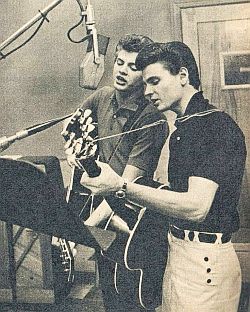 The Everly Brothers at work. It is the sound of “Cathy’s Clown” that is so gripping. Like “I Walk the Line” and “Heart-break Hotel,” it features voices that are instantly recognizable, and an overall sonic profile that puts the record in a class by itself. The plate reverberator was a new sound in 1960 and the entire track is drenched in it, thick as the hot, humid Kentucky summer. The song opens with bass, drums, electric guitar and piano. The kick drum, bass and piano come in on the downbeat, playing a I–V root motion that sounds vaguely Celtic; the bass (Floyd Chance) slides into the I at the top of the second measure contributing the drone-like qualities of a bagpipe. The snare drum (Buddy Harman) plays a standard rock backbeat on the second beat of the measure, and then rolls into the backbeat in a kind of march cadence for the fourth beat, propelling the song inevitably forward. The guitars play crisp, punctuated I and V chords on beats two and four, emphasizing the backbeat while drenched in thick, liquid reverb. At six seconds, the band stops completely after the downbeat of measure 4. Then, on the second beat of the fourth measure, Phil and Don enter, singing in unison “Don’t want your love.” The word “love” starts on the downbeat of measure 5 and then something miraculous happens. They stretch the word “love” out for six beats, and beginning on the third of those beats, Don diverges from the unison, putting a harmony underneath brother Phil’s high, single held note. This splitting and spreading of the melody into two parts gives the vocals on this song its distinctive sound. It’s not just a musically pleasing maneuver, it’s textually brilliant.This splitting and spreading of the melody into two parts gives the vocals on this song its distinctive sound. It’s not just a musically pleasing maneuver, it’s textually brilliant. As the unity of the relationship starts to fall apart and the couple separates, the word “love” splits and descends harmonically into two distinct parts, settling on their famous open thirds harmony for the lyrics “any more.” They repeat this for the second line of the verse, “Don’t want your kisses, that’s for sure.” On the next line, “I die each time,” they introduce a four note guitar arpeggio call, followed by a four note guitar arpeggio response on “I hear this sound.” The final line’s hook, “Here he co-o-o-o-o-omes, that’s Cathy’s clown,” follows that beautifully separating-and- descending vocal line, with each of the brothers adding a vocal scoop as they elongate the word “comes,” underlining the narrator’s long walk of embarrassment and shame. In the verse, the drummer switches to the ride cymbal and pianist Floyd Cramer .appears, playing a part slightly reminiscent of the one he played on “(Til) I Kissed You” a year earlier–slightly behind the beat, giving it a relaxed, laid-back feel… In his essay, Levitin also singled out engineer Bill Porter who used a then innovative approach in the song of a taped drum loop to give the song a sound like that of two drummers. |
“Cathy’s Clown” wasn’t the only hit the Everly Brothers had in 1960. “When Will I Be Loved,” written by Phil Everly, released in May 1960, became a Top 10 hit that summer, rising to No. 8 on the Billboard Hot 100. Fifteen years later, Linda Ronstadt covered the song in 1975 – transposing and altering the lyrics a bit, but her version was an even bigger hit, peaking at No. 2 on the pop charts and No 1 on the Billboard country chart. Ronstadt released her version in March 1975 as the second single from her chart-topping album, Heart Like A Wheel (more on Linda & her career at “Linda & Jerry: 1971-1983”). Vince Gill also covered “When Will I Be Loved” in 1994, which appeared on the film soundtrack for 8 Seconds, about bronc- and bull-riding rodeo cowboys.
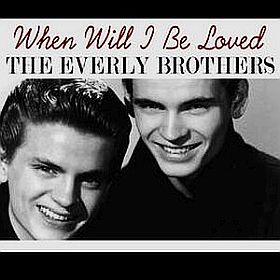 The Everly’s “When Will I Be Loved,” became a Summer 1960 hit at No. 8. Click for Amazon digital. |
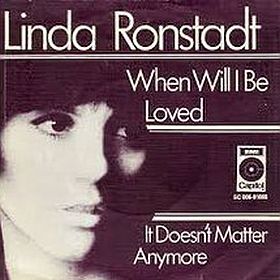 Linda Ronstadt hit paydirt with her 1975 cover of “When Will I Be Loved,” a No. 2 hit. Click for Amazon. |
By August 1960, the Everly Brothers had released, “So Sad (To Watch Good Love Go Bad).” That song, written by Don Everly, spent 12 weeks on the Billboard chart, peaking at No. 7. It was also a Top 10 hit in multiple countries – including No. 4 in the UK, and No. 7 in New Zealand. In the 1970s and 80s, the song also became a later country hit for multiple artists. Another 1960 Everly Brothers song, “Like Strangers,” written by Boudleaux Bryant, was released that fall and spent 10 weeks on the Billboard chart, peaking at No. 22 and also reaching No. 11 in the UK.
In the following year the Everlys released more songs – “Walk Right Back” and “Ebony Eyes,” songs that became No. 7 and No. 8 hits, while “Temptation” and “Don’t’ Blame Me” were somewhat lesser Top 40 hits, at respectively, No. 27 and No. 20. But it was during 1961 and 1962 that their careers began to change.
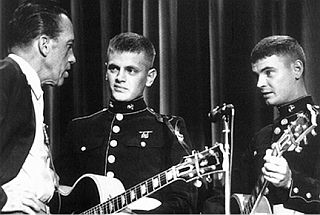
Feb 1962. Everly Brothers on Ed Sullivan Show in their Marine uniforms.
Don and Phil were discharged from their active duty with the Marines on May 24, 1962. A Warner Brothers-issued single only weeks earlier – “That’s Old Fashion (That’s the Way Love Should Be)” – would become their second 1962 Top Ten single in a row, peaking at No. 9 in late June 1962. But changes had been afoot in the Everly Brothers career, as troubles began surfacing in 1961 and 1962.
Troubled Times
|
The Everly Hits “Bye Bye Love” |
By 1962, recordings by the Everlys had reportedly generated $35 million in sales (worth about $360 million in today’s money). But the brothers had become unhappy with their publisher, Acuff-Rose, and Wesley Rose in particular, as well as their share of the revenue. And by then they were located in California recording at Warner Brothers in Los Angeles, not Nashville.
But a full-blown falling out with Wesley Rose had ensued in 1961 over the recording of their song, “Temp-tation,” for which Rose was not the publisher and would not receive publishing royalties. Rose then made efforts to block their recording and slow their careers as they were also shut off from Acuff-Rose songwriters, including hit-makers, Felice and Boudleaux Bryant. The Everlys themselves were also still contracted to Acuff-Rose as songwriters. From 1961 through early 1964, the Everlys recorded songs by other composers to avoid paying any royalties to Acuff-Rose and had also tried using a pseudonyms briefly until Rose took legal action. Had it not been for this disruption with Acuff-Rose, and especially the loss of the Bryant’s songwriting talents, the Everly’s might have had a few years worth of additional hit songs. But there was still more trouble to come.
The Everlys’ dispute with Acuff-Rose lasted until 1964, when they resumed writing and composing as well as working with the Bryants. By then, however, the popular music landscape was changing and both of the brothers had become addicted to amphetamines — with Don collapsing at one point in England during a mid-October 1962 tour. By 1963-64 the Beatles had arrived on the music scene, and the “British invasion” of pop music in America had begun. Suddenly, the rising country rock that had propelled the Everly’s to rising fame – was no longer in vogue. Still, they continued recording and touring, with success in the UK and Canada in particular. But through the 1960s, their hit making in the U.S. had fallen off sharply. Of their 27 singles on Warner Bros. from 1963 through 1970, only three made the Billboard Hot 100, and none peaked higher than No. 31. Album sales were also down. Outside of their first two albums for Warners (in 1960 and 1961) which peaked at No. 9, of a dozen more Warner Brothers albums, only one made it to No.141 on the top 200, Beat & Soul (1965).
A 1968 album, Roots, received some notice as a promising early country-rock album. But by the end of the 1960s, the Everly Brothers were no longer contemporary hit-makers. And in 1970, their ten-year contract with Warner Bros had expired.
Split & Reunion
In 1973, the Everlys announced their final performance would occur on July 14, 1973, at Knott’s Berry Farm in Buena Park, California. However, tensions between the brothers had been mounting and surfaced during the show, as Phil slammed his guitar down on the floor and walked off the stage. Don performed solo the following night, commenting to the audience that “the Everly Brothers died ten years ago.”
Indeed, the two brothers had been in a decade-long pressure cooker, turning out hits and performing practically non -stop since 1957 and even earlier. In the music business at that time, singles were the more popular and preferred recording strategy, and the Everlys were constantly under the gun to do more of them. And nine-month long touring stints to promote those songs were also part of the grind. Don Everly, later noting the long-standing strain they experienced that contributed to their break up. “We had been singing together, and hadn’t really been apart, since we were around 6 years old. It kept us immature, in a way, kept us from developing any individuality….”
Following their 1973 split, the Everly Brothers would not perform together for the next ten years. In the interim they would do a mix of things as solo artists, TV hosts, guest performers, background singers, and other projects.
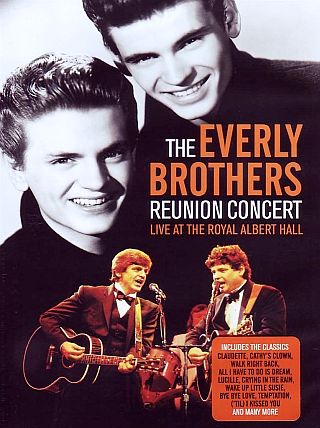
The Everly Brothers' 1983 Reunion Concert at London's Albert Hall. Click for Amazon.
The concert proved to be a big deal for a lot of Everly fans, including popular musicians of that day who had grown up with, and were influenced by, the Everly sound. Tom Petty, for one, flew in from L.A. to be there, and others in the UK from groups such as The Who and others were also in attendance.
Among the performances that evening was their closing song, “Let It Be Me,” slowed down a bit from their 1950s version, but coming across quite movingly and to the great approval of their audience that evening (see video clip below).
The reviews of the the Everlys’ reunion concert at Albert Hall were quite positive, and brought renewed interest in their music.
Following the concert, they began receiving media exposure they hadn’t seen in years. A video of the concert was scheduled to be shown on HBO in January 1984, and a documentary film on their career was also scheduled for PBS in March. They also had a new recording contract and their first U.S. concert tour in 11 years covering some 35 U.S. cities. And they returned to the studio as a duo for the first time in over a decade, recording the album EB ’84, produced by Dave Edmunds, with the lead single, “On the Wings of a Nightingale”(August 1984), written by Paul McCartney and becoming their most popular song since 1970, reaching No. 50 on the Billboard Hot 100.
Stephen Holden of the New York Times reporting on the Everly’s July 1984 appearance at Pier 84 in New York City noted, “The years haven’t diminished the distinctive appeal of the Everlys’s bluegrassy style in which Phil Everly’s penetrating tenor sails lyrically over his brother Don’s somewhat darker, more resonant voice. While they offered a smattering of new material, the focus of the concert, especially its second half, was on the Everlys’s greatest hits.”
[Above video clip from Everly Brothers Sept 1983 reunion concert in London].
In March 1986, Time magazine’s music writer, Jay Cocks, found that the Everlys had come to terms with their split, acknowledging they had needed the time apart. But Cocks also found promise in their recent music, citing their 1986 album, Born Yesterday and its title track. “The Everlys are back,” he wrote, “They are back to stay. Back, and as good as ever. And rock ‘n’ roll just doesn’t get any better than that.”

Everly Brothers 1984 album, “EB-84” (#34 Billboard; #24 Country). Click for Amazon.
Through the 1990s and 2000s the Everly Brothers continued to perform periodically while pursuing other interests and spending time with family. They appeared at the 10th annual Everly Brothers Homecoming concert in Central City, Kentucky in 1997. In 1998, they recorded “Cold” for Andrew Lloyd Webber’s and Jim Steinman’s musical Whistle Down the Wind. In 2003 and 2004 there was the touring with Simon & Garfunkel mentioned earlier. In the UK, they played their last headlining tour in 2005. Country star Vince Gill recorded a duet with Phil Everly in 2006 for his These Days album set.
Kudos & Critics
Over the years, the Everly Brothers have received many notable honors and awards, among them: the Grammy Lifetime Achievement Award. (1997); a star on the Hollywood Walk of Fame for their work in the music industry (1986); inductees to the Country and Vocal Group halls of fame (2001, 2004); and a ranking at No. 33 on Rolling Stone’s list of “The Immortals: The Fifty Greatest Artists of All Time” (2004). Their life stories have been covered in a number of books and documentary films (see “Sources” below), and they also inspired several musicals, including, Bye Bye Love: The Everly Brothers Musical (1998), which ran in Nashville, and Dream, Dream, Dream (2000’s), which played Atlantic City.

Popular Everly Brothers “Greatest Hit” album – a 3-CD set with 75 songs. 2013 release. Click for Amazon.
In some press accounts, and a 2024 book, Crying in the Rain: The Perfect Harmony and Imperfect Lives of the Everly Brothers, by Mark Ribowsky, the Everlys’ problems and discontents during their careers are covered, sometimes in not-so-flattering ways. Both brothers suffered from drug abuse, but Don’s dependence on Ritalin for drug therapy, led him into deeper trouble than Phil. There were also reports of girlfriends, mistresses and infidelity. Both brothers experienced multiple divorces; Don, three, and Phil, two. Internal family difficulties were also reported, as well as later inter-family litigation over some copyrights and other issues. As for their troubled behaviors, no doubt personal and business pressures were involved – especially after rising to peak success so quickly in their 20s. Demands on their professional performances and personal lives, set both by themselves as well as publishers, agents, management, and record companies, were surely challenging.Graham Nash has said the Everly Brothers produced a “ghost harmonic” with their blended voices.
But in the end, it is their indelible harmonic sound that will abide through the ages. In January 2014, Terence McArdle, in the Washington Post, wrote about their harmonies: “…When brothers harmonize, their genetically close voices often produce a distinctive, ethereal sound, and the Everlys exemplified that. In their case, though, the sound was rendered almost spooky by the fact that Don, the baritone, and Phil, the tenor, hardly ever sang more than a diatonic third apart.” And on some of their songs, “…the two melodies, rendered by two nearly identical voices, formed what was called a ‘ghost harmonic’ by Graham Nash of the Hollies and Crosby, Stills and Nash” – a kind of a “two-plus-two-equals-five” effect. Indeed, as Don Everly once said: “I swear that there are times that what comes out is not either of us, but the voice of a third person.”
“…They were just so tight..,” offered John Pareles of the New York Times, describing the Everlys’ harmonies in a video that ran with Phil Everly’s obituary in January 2014. “It sounds easy when you listen to them sing; sounds just as natural as can be. But it wasn’t easy. …Everybody learned from them: the Beatles learned from them, the Hollies learned from them, the Byrds learned from them. They really taught rockers the way voices could blend. The Beatles admitted that they took “Please Please Me” from a trick they learned from the Everly Brothers: one voice would be holding a single note while the other voice descended and sang a melody…”
And then there’s the innocence – both in the Everly sound and the times in which they produced that sound.
The 1950s…
Everly Innocence

Songwriter Felice Bryant on camera, re: Everly Brothers' innocent sound.
Kit Rachels, then with L.A. Weekly and writing an Everlys profile for The Rolling Stone Illustrated History of Rock & Roll, would also pick up on this theme.
“The Everly Brothers were innocents,” he wrote. “From their first hit, “Bye Bye Love” in 1957, to their last, “That’s Old Fashioned” five years later, the Everly Brothers sang about love, always love, and always with ingenuous passion and conviction. They never hungered after sex and never sought revenge. Instead, they were dreamers, seeking not the ideal woman, but the ideal – or perhaps more accurately, the idealized – relationship…”
And indeed, the innocence projected, or then found, in the harmonic “Everly ether,” was also, in a way, characteristic of those times – the late-1950s-early-1960s period – a time between Eisenhower and the assassination of JFK; before things became a little meaner. America then, when those first-round Everly hits were in the air, was a kinder place (and yes, to be sure, there was the Cold War, racism, Communist witch-hunts, FBI surveillance, etc,). Still, for many, at least on the surface, this was the Saturday Evening Post era, or the “Happy Days,” as they would later be portrayed.The Everly sound seemed to offer a kind of purity; a longing for that perfect love; a kind of hopeful innocence… There was innocent newness and innocent technology (before the knowing of side effects). The automobile and interstate highways could take you anywhere. TV projected innocence, too. Leave it To Beaver was celebrating perfect families and the suburbs. Ricky Nelson was there, too, a teen idol boosted by The Ozzie and Harriet Show. And yes, in addition to the Everlys, there was lots of rock ‘n roll talent on the rise: Chuck Berry, Fats Domino, Bill Haley, Buddy Holly, and of course, Elvis Presley. But the Everlys stood out and stood apart – in their own little corner of the market with that special harmony sound that seemed to offer a kind of purity; a longing for that perfect love; a kind of hopeful innocence. And so that sound remains, now digitally archived and encased in its innocence; now perhaps, an aspirational sound for the ages, but never again to be felt quite like it was in the 1950s.
See also at this website, “Pop Music, 1950s: Artists, Songs, Bios” – a topics page with more than 20 story choices from that era. Thanks for visiting — and if you like what you find here, please make a donation to help support the research, writing, and continued publication of this website. Thank you. – Jack Doyle
|
Please Support Thank You |
____________________________________
Date Posted: 22 July 2024
Last Update: 22 July 2024
Comments to: jackdoyle47@gmail.com
Twitter: https://twitter.com/PopHistoryDig
Article Citation:
Jack Doyle, “The Everly Sound: 1950s-2000s,”
PopHistoryDig.com, July 22, 2024.
____________________________________
Everly Brothers Music at Amazon.com…
 “Very Best of Everly Brothers,” WB, 2006 – as CD, streaming, MP3, cassette / vinyl. Click for Amazon. |
 “Everly Brothers ... Country Rock Ses-sions, 1966-1968,” 3-CDs, hits & country mix. Click for Amazon. |
 “Everly Brothers Platinum Collec-tion,” 3-CD set w/60 tracks. Click for Amazon. |
Sources, Links & Additional Information
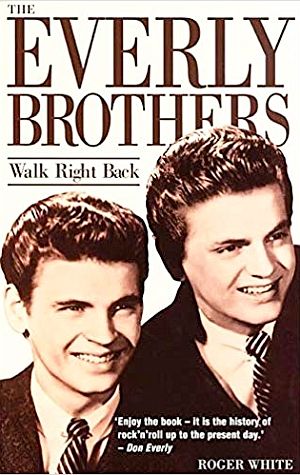 Roger White’s 1998 book, “The Everly Brothers: Walk Right Back,” 1998, Plexus Publishing, 192 pp. Click for Amazon. |
 Mark Ribowsky’s 2024 book, “Crying in the Rain: The Perfect Harmony and Imperfect Lives of the Everly Brothers,” Backbeat Press, 256 pp. Click for Amazon. |
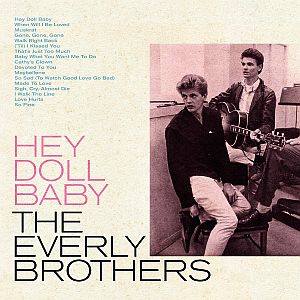 “Hey Doll Baby” is a 2022 remastered 17-track compilation of lesser-known Everly songs, which Everly family and Don Everly (before he passed), had input and offer commentary. Click for Amazon. |
 “The Best of Simon & Garfunkel” album, reissued & remastered, 2006. Click for Amazon. |
 Ricky Nelson, another popular 1950s rock star. Click for his “Greatest Hits” album at Amazon. |
“Everly Brothers,” in Holly George-Warren and Patricia Romanowski (eds), The Rolling Stone Encyclopedia of Rock & Roll, Rolling Stone Press, New York, 3rd Edition, 2001, pp. 315-316.
“Everly Brothers,” CountryMusicHallofFame .org, 2001.
“The Everly Brothers,” Wikipedia.org.
“History,” EverlyBrothers.com.
“Bye Bye Love (The Everly Brothers song),” Wikipedia.org.
Early Photograph of Everly Brothers on Iowa Radio Program, Iowa Museums, PastPerfect Online.com.
“Wake Up Little Susie,” Wikipedia.org.
“The Everly Brothers Discography,” Wikipedia .org.
Richmond Times Dispatch, July 7, 1957 (story about the premiere of Alan Freed’s “Big Beat Show” on ABC-TV, which included an Everly Brothers appearance).
“The Everly Brothers: They Deal in Millions,” Gibson Gazette, Summer, 1963.
Alan Cackett, “The Everly Brothers: Back To Their Roots,” Country Music People, August 1973.
Kit Rachlis, “The Everly Brothers,” in Anthony DeCurtis and James Henke (eds), with Holly Geroge Warren; Original Editor: Jim Miller, The Rolling Stone Illustrated History of Rock & Roll, 1978, 1980, 1993, New York: Random House / Straight Arrow Publishers, pp. 80-84.
Alan Cackett, “Don Everly: ‘I’ve Always Been A Solo Singer’,” AlanCackett.com, April 1978, pp. 16-17.
Alan Cackett, “Riding Success – Bryant Style: Boudleaux & Felice Bryant, Part Two,” Country Music People / AlanCackett.com, March 1981.
Richard Williams, “Harmonic Delight: Everly Brothers, Albert Hall,” The Times (London), September 24, 1983.
Robert Palmer, “The Pop Life; New Record by Everlys,” New York Times, February. 29, 1984.
John J. Archibald, “Everlys: Comeback Kids,” St. Louis Post-Dispatch, March 4, 1984, p. 169.
Mark Schwed, UPI Archives, “Everly Brothers Back on Music Trail,” UPI.com, July 5, 1984.
Stephen Holden, “Rock Group: Everly Bros. At Pier 84,” New York Times, July 26, 1984, p. 66.
BBC / Arena, “The Everly Brothers: Songs of Innocence and Experience” (1984 film about the Everly Brothers), YouTube.com.
Steve Morse, “The Everly Brother’s Shindig” (Everly Brothers – In Concert with Pat Alger at the South Shore Music Circus on Saturday), The Boston Globe, August 5, 1985, p. 7.
Jay Cocks, “Music: The Everly Brothers in Arms,” Time, March 17, 1986.
“The Everly Brothers,” Encyclopedia.com.
“The Life & Times of The Everly Brothers,” 1996 film, YouTube.com.
Jim Patterson, Associated Press (Nashville, TN), “Nashville Show Spotlights Everly Brothers,” The Times-Tribune (Scranton, PA), Sunday, May 10, 1998, p. 95.
“Everly Brothers International Archive: A&E Biography,” (1999) film
“Cathy’s Clown – The Everly Brothers (1960) Named to the National Registry,” Library of Congress /LOC.gov, 2013, Guest Essay by Daniel J. Levitin.
“Boudleaux Bryant Dies at 67; Writer of Country Music Hits,” New York Times, June 28, 1987.
“Old Friends Unite on Stage,” The Miami Herald (Miami, FL), Monday, October 20, 2003, p. 128.
“The Immortals: The Fifty Greatest Artists of All Time,” RollingStone.com, April 15, 2004.
Paul Simon, “The Everly Brothers” (No.33), RollingStone.com, April 15, 2004.
Jon Pareles, “Phil Everly, Half of a Pioneer Rock Duo That Inspired Generations, Dies at 74,” New York Times, January 4, 2014 (w/short video by Jon Pareles).
Terence McArdle, “Appreciation: Phil Everly, Half of a Duo with Ethereal Sound,” Washington Post.com, January 4, 2014.
“How Music Row & Acuff-Rose Killed The Everly Brothers,” SavingCountryMusic.com, January 4, 2014.
“Foreverly,” Wikipedia.org.
Bill Friskics-Warren, “Don Everly, 84, Brother In Groundbreaking Duo That Changed Rock, Dies,” New York Times, August 23, 2021, p. B-7.
Mariah Timms, “Nashville Judge Has Last Word in Everly Brothers’ Famous Argument: Who Wrote ‘Cathy’s Clown?’, Nashville Tennessean, May 6, 2021.
Matt Friedlander, “The Everly Brothers’ Don Everly Dies at Age 84; Don’s Brother, Phil, Died in 2014,” ABCnews.go.com /GMA, August 23, 2021 (with video).
John Blackstone “‘Hey Doll Baby’: Revisiting the Everly Brothers’ Enduring Harmonies,” CBS News / Sunday Morning, March 26, 2023.
_____________________________________________
1950s-Related Reading at Amazon.com…
 J.C. De Ladurantey’s 2016 book, “Rock & Roll and Doo-Wop...” 1950s & Early 1960s. 256 pp. Click for Amazon. |
 Richard Aquila’s 2016 book, “Let's Rock!: How 1950s America Created Elvis and the Rock and Roll Craze,” 368 pp. Click for Amazon. |
 David Halberstam’s best seller, “The Fifties,” w/fascinating profiles of Madison Avenue, Ricky Nelson, Elvis Presley, etc. Click for Amazon. |